

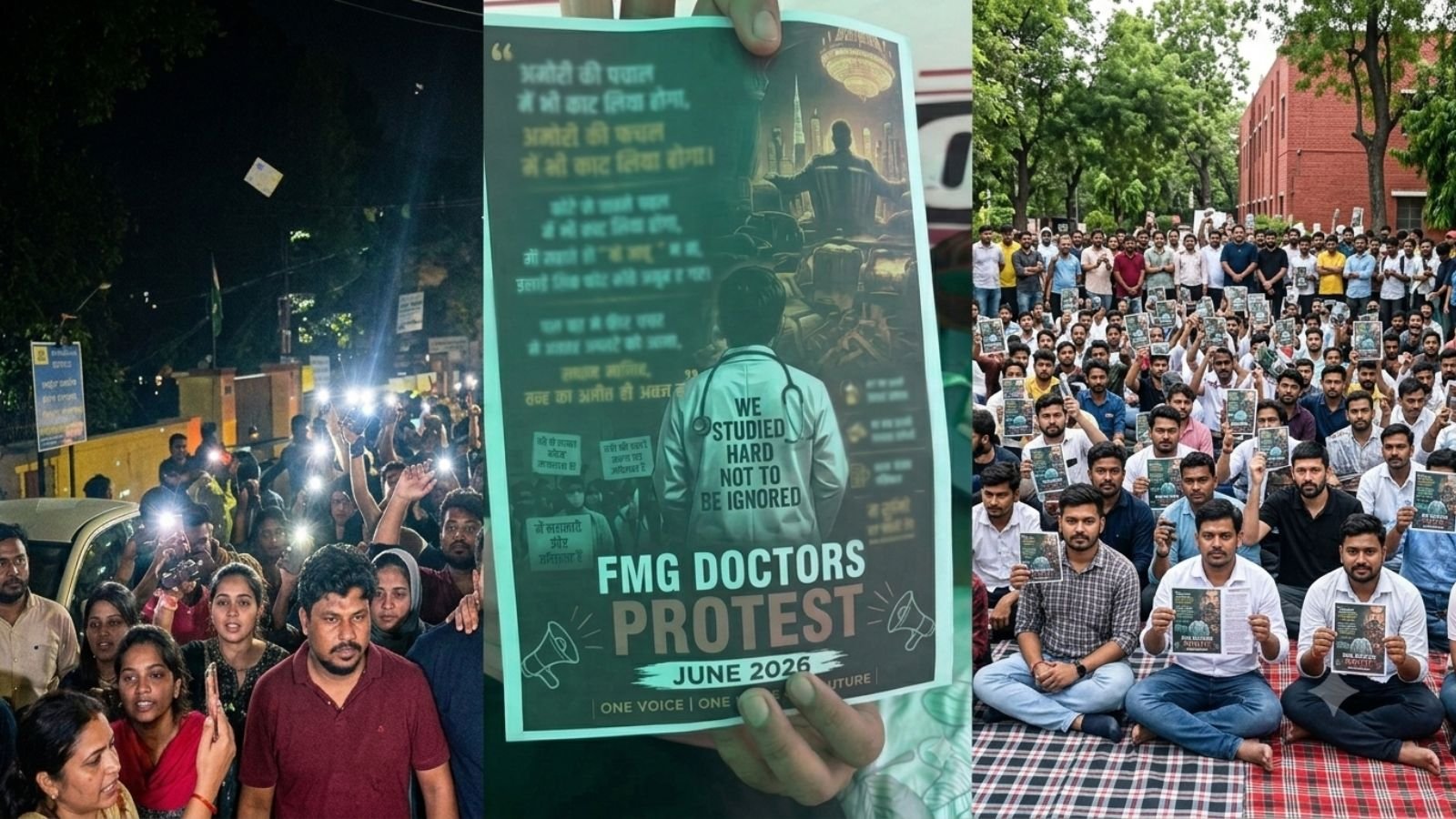
Indian foreign medical graduates (FMGs) are back on Delhi streets, with some on hunger strike, weeks after the National Board of Examinations in Medical Sciences (NBEMS) agreed to examine several of their concerns over the June 2026 FMG examination. The latest protest comes weeks after the candidates and the Board held rounds of talks. Candidates and medical students now say that while several of their demands were considered, their key demand for compensation for this year’s June examination remained unattended.
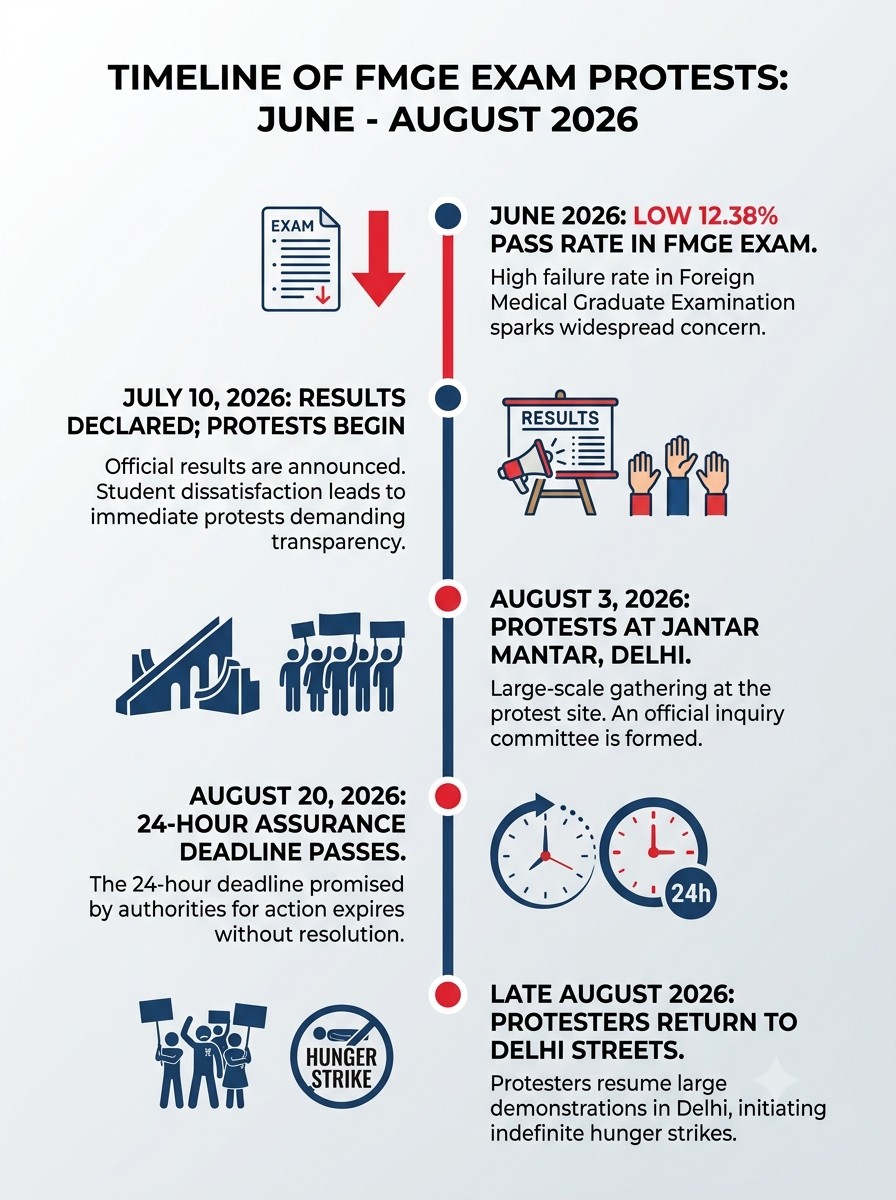
The June Foreign Medical Graduate Examination (FMGE) had seen only 12.38% of the 37,448 candidates who appeared for the examination qualify. The low pass rate triggered protests, with candidates alleging that the paper was unusually difficult, that video-based questions were introduced without adequate advance notice and that there were problems with examination-centre conditions and transparency.

Indian foreign medical graduates (FMGs) are back on Delhi streets, with some on hunger strike, weeks after the National Board of Examinations in Medical Sciences (NBEMS) agreed to examine several of their concerns over the June 2026 FMG examination. The latest protest comes weeks after the candidates and the Board held rounds of talks. Candidates and medical students now say that while several of their demands were considered, their key demand for compensation for this year’s June examination remained unresolved.
The June Foreign Medical Graduate Examination (FMGE) had seen only 12.38% of the 37,448 candidates who appeared for the examination qualify. The low pass rate triggered protests, with candidates alleging that the paper was unusually difficult, that video-based questions were introduced without adequate advance notice and that there were problems with examination-centre conditions and transparency.
The FMGE is the screening examination conducted by NBEMS for foreign-trained medical graduates seeking to practise medicine in India. The Health Ministry had earlier proposed a National Exit Test (NExT); once implemented, it is also expected to provide a common licensing framework for domestic and foreign medical graduates. The FMG protesters have themselves suggested that NExT could eventually provide a level playing field for both groups.
What happened after the first protest at Jantar Mantar?
The candidates say their agitation did not begin with the current hunger strike. They had been protesting from the time the June FMGE result was declared on July 10, after which the low pass percentage became the central issue.
The protest continued through July and culminated in a demonstration at Delhi’s Jantar Mantar on August 3. Representatives of the All India Medical Students’ Association – Foreign Medical Students’ Wing (AIMSA-FMSW) and the All FMGs Association (AFA) were subsequently called for discussions with NBEMS officials.
Story continues below this ad
Following the August 3 protest, NBEMS constituted an independent three-member committee to examine the issues raised by the candidates. It was tasked with reviewing the conduct and outcome of the June FMGE.
The protesters then suspended their agitation while discussions continued.
Candidates who spoke to Indianexpress.com said the meetings initially gave them hope that their concerns would be addressed. According to Dr Jaswant Singh Yadav, the main leader of the protesting candidates and one of those currently on hunger strike, representatives were told that the concerns would be investigated and that the Board would look into issues including the answer key, examination difficulty, video-based questions, fees and other complaints.
However, the candidates allege the discussions eventually stalled over what they consider the most important issue: relief for those who appeared in the June examination.
Why did the candidates return?
According to the protesters, the immediate dispute is over compensation for the June batch.
Story continues below this ad
Candidates claim NBEMS representatives indicated that several demands could be addressed, including conducting FMGE three times a year, reducing the examination fee and introducing greater transparency in future examinations. The expert committee has since recommended several such changes, including a proposed increase in lower-difficulty questions, advance information about multimedia questions and a possible three-minute additional window for biometric formalities. It has also recommended that video-based questions be deferred for at least a year.
However, the committee did not recommend compensatory or grace marks for the June 2026 candidates. It said the available evidence did not establish a material impact of the issues examined on the examination outcome. It also noted the legal framework governing the FMGE qualifying standard while rejecting the request for compensation.
That decision has brought the protesters back to the streets.
Dr Ashish Kumar, a core committee member, told Indianexpress.com that the candidates’ position is that if the Board has accepted that changes are needed for future examinations, the June batch should also receive some form of relief.
Story continues below this ad
“We are not asking them to pass us from above,” he said, arguing that candidates affected by what they allege were shortcomings in the examination should receive a one-time relaxation or compensation.
24-hour ‘assurance’ not honoured, allege protestors
The protesters also pointed to a later meeting in which, according to their account, NBEMS representatives sought 24 hours to obtain permission to show the questions to a small group of student representatives.
Rafiq said the candidates agreed and were prepared to have five representatives examine the questions, including the video-based questions, so that the number and nature of the disputed questions could be established.
According to his account, the 24-hour period passed without a response. He said the candidates waited further and, after what he described as around 56 hours, went to the NBEMS office on August 20 to seek an update.
Story continues below this ad
The candidates say the failure to resolve the issue after this round of discussions was what led to the hunger strike.
Why are video-based questions still a flashpoint?
The protesters’ main complaint about the June examination remains the introduction of video-based questions.
FMGE has traditionally been a computer-based examination with 300 questions conducted in shifts. Candidates are given roughly one minute per question. The protesters allege that video-based clinical questions were introduced without adequate prior notice and that watching the clips, reading the question, and analysing the options consumed time that could otherwise have been used on other questions.
Rafiq claimed that candidates encountered around 20 to 22 such questions, although the number has been disputed. In its review, the expert committee referred to video or multimedia-based questions and recommended that candidates should be informed sufficiently in advance if such questions are used. It also recommended deferring their reintroduction in FMGE for at least one year.
Story continues below this ad
The candidates say this recommendation itself strengthens their argument that the June batch should have received some form of relief.
NBEMS and NMC, however, have maintained a different position. Senior NMC officials had earlier told Indianexpress.com that video-based questions test clinical signs and findings that cannot always be assessed through static images. They also maintained that such questions are consistent with medical training and that the FMGE’s purpose is to ensure that doctors entering India’s healthcare system must meet a minimum competency standard.
The officials had also argued that the low pass rates among FMGs are linked in part to differences in clinical exposure and training in foreign medical institutions. Many foreign medical courses, they said, can have a largely theoretical initial phase, while clinical exposure may differ from the patient profile, disease patterns and healthcare environment candidates eventually encounter in India.
Low competency argument not valid, say protestors
The protesters dispute the suggestion that the low pass rate can primarily be explained by deficiencies in foreign medical training.
Story continues below this ad
Rafiq argued that if the authorities believe foreign and Indian medical graduates should be held to the same competency standard, the most transparent solution would be to have both groups appear for a single common exam, such as the NExT, for both domestic and foreign medical graduates.