

Close Menu

    Subscribe to Updates

    Get the latest news information from worldwide businesses.

    What's Hot

    Trump and Iran trade new threats after strikes exchanged

    June 10, 2026

    FSSAI Confirms No New Regulation on Zero Added Sugar in Baby Foods Amid Controversy | India News

    June 10, 2026

    Carnival Horizon murder case hinges on cellphone Wi-Fi data tracking: Docs

    June 10, 2026
    Facebook Instagram YouTube LinkedIn X (Twitter)
    Trending
    • Trump and Iran trade new threats after strikes exchanged
    • FSSAI Confirms No New Regulation on Zero Added Sugar in Baby Foods Amid Controversy | India News
    • Carnival Horizon murder case hinges on cellphone Wi-Fi data tracking: Docs
    • IIT Kanpur alumnus commits $1.15 million for new Chemical Engineering facility | Education News
    • Swirling spiral galaxy will hypnotize you photo of the day for June 10, 2026
    • A tragic 1702 mystery changes everything
    • BYD threatens to sue Trump administration over Pentagon military list
    • Expert Says Sunil Chhetri’s Superpower Might Signal Sleep Debt
    Newspublicly
    • About Us
    • Advertise & Partner with us
    • Pitch Your Story
    • Contact Us
    Facebook Instagram LinkedIn X (Twitter)
    Subscribe
    • Home
    • World News
      • Asia
      • India
      • USA
      • UK & Europe
      • Middle East
    • Economy & Business
      • Global Economy
      • Corporate & Industry
      • Finance & Markets
      • Policy & Trade
    • Technology
      • Gadgets & Devices
      • Software & Apps
      • AI & Machine Learning
      • Robotics & Automation
    • Health & Medicine
      • Fitness & Nutrition
      • Research & Innovation
      • Disease & Treatment
      • Doctors, Clinics & Patient Care
    • Travel & Tourism
    • Automobile
      • Electric & Hybrid Vehicles
      • Auto Industry Insights
    • Sports
    • More
      • Education
      • Real Estate
      • Environment & Climate
      • Space & Astronomy
      • War & Conflicts
    Newspublicly
    Home»More»Space & Astronomy»NASA is building a new space telescope to search for life on nearby planets. What would it have seen on ancient Earth?
    Space & Astronomy

    NASA is building a new space telescope to search for life on nearby planets. What would it have seen on ancient Earth?

    AdminBy AdminJune 10, 2026No Comments4 Mins Read0 Views
    Share
    Facebook Twitter LinkedIn Copy Link WhatsApp


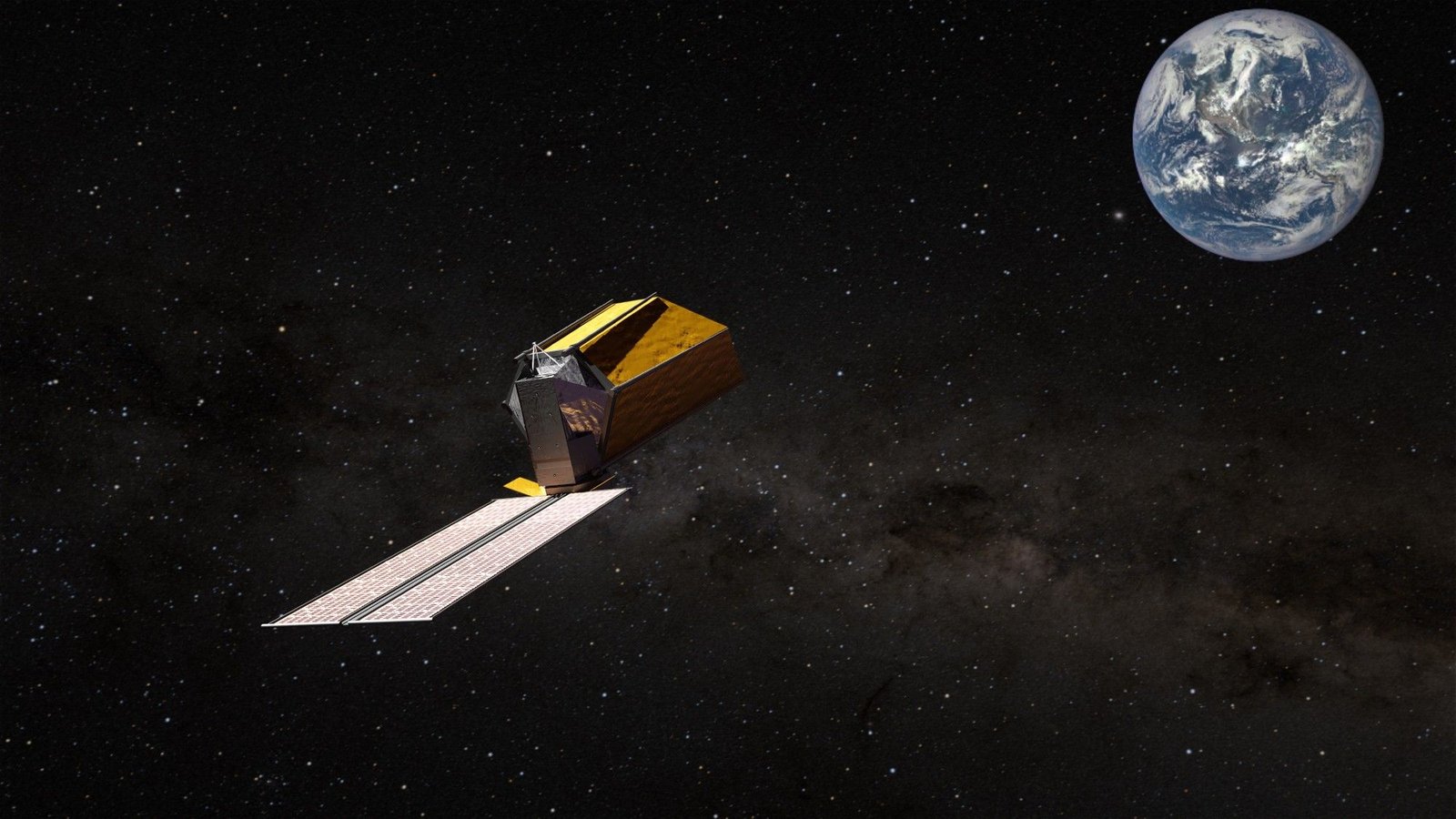
    NASA’s Habitable Worlds Observatory is the agency’s next flagship space telescope, designed to do something no previous instrument has managed: directly image Earth-like planets around nearby stars and analyze the light reflecting off their atmospheres for signs of life.

    The mission is still years from launch. But the design choices being made right now will determine what it can actually detect. A new paper posted to the arXiv preprint server tackles one of the most consequential of those choices: spectral resolution.

    The authors of the study ran a careful analysis of how finely the Habitable Worlds Observatory (HWO) would need to slice up the light from a distant Earth to confidently spot biosignatures in its atmosphere. The question matters more than you might think.

    Spectral resolution is how well a telescope can distinguish between adjacent colors of light. Higher resolution means a more detailed atmospheric fingerprint, but it also means longer exposure times, more detector noise, and trickier engineering. Push too high and you blow the mission’s observing schedule. Push too low and you can’t tell the difference between an inhabited planet and a barren one.

    To estimate what type of spectral resolution would be needed to detect biological signatures on our planet in its infancy, the team modeled what HWO would see when staring at versions of Earth through geological time.


    You may like

    Earth’s atmosphere has changed dramatically over its history. The Archean Earth, before plants and cyanobacteria got going, had almost no oxygen. The Proterozoic Earth had some, but not much. The Phanerozoic Earth, the one we know, hit roughly 20 percent oxygen once complex life took hold. Each leaves a different spectral signature, and HWO will need to recognize all three.

    The headline numbers are surprisingly modest. To detect molecular oxygen, the gold-standard biosignature on a planet like our own, HWO needs a visible-light resolving power of about 140. Ozone shows up at a much lower resolving power of around 7 in the ultraviolet. Those numbers are well within what current optical designs can deliver.

    Space

    The infrared is harder. Carbon dioxide and carbon monoxide have spectral features that overlap, and if HWO can’t tell them apart, it could mistake a volcanically active dead planet for a living one. The team found that a near-infrared resolving power of at least 40 is the minimum needed to break that degeneracy. To characterize an atmosphere through Earth’s entire geological history, they recommend a nominal infrared resolving power of about 70.

    a blue and green planet dotted with white clouds

    An illustration of ancient Earth. (Image credit: Mark Garlick/Science Photo Library/Getty Images)

    How did they arrive at those numbers? They generated synthetic HWO observations across resolving powers from 20 to 5,000, then ran each simulated spectrum through retrieval algorithms to see what could actually be inferred about the underlying atmosphere. They factored in detector noise, exposure time, and anti-biosignatures (atmospheric features that would argue against the presence of life).

    There are real engineering limits in play. The dark current of HWO’s detectors, the tiny background hum of electrons that any detector generates even with no light hitting it, sets a hard floor on what fine resolution can buy you. Pushing oxygen detection significantly further than the baseline would require reducing that dark current by roughly a factor of ten. And pushing to higher resolution for oxygen would roughly double the exposure time needed for water vapor.


    What to read next

    The authors are careful about the limits of their analysis. Their absolute exposure times could be off by around 20 percent. And the more philosophical caveat is the one that has always shadowed this work: even a confident detection of oxygen, ozone, methane, and water in an exoplanet atmosphere is not the same as a confident detection of life.

    The universe has non-biological ways to make any one of those gases. HWO’s job isn’t to declare victory on its own: it’s to find the candidates worth following up on.

    What this paper provides is a clear, quantitative target for the engineers building the instrument. A resolving power of 140 in the visible, 7 in the ultraviolet, and 70 in the near-infrared, with low enough dark current to make oxygen detection routine. That is the spec sheet for a telescope that could, in principle, find signs of life on another world.

    Now we just have to build it.


    Source link

    Author

    • Admin

      NewsPublicly.com is News & Articles Platform that creating SEO-focused articles on travel, lifestyle, and digital trends.

    Admin
    • Website

    NewsPublicly.com is News & Articles Platform that creating SEO-focused articles on travel, lifestyle, and digital trends.

    Related Posts

    Swirling spiral galaxy will hypnotize you photo of the day for June 10, 2026

    June 10, 2026

    Annular solar eclipse 2027 —everything you need to know about the ‘ring of fire’ on Feb. 6

    June 10, 2026

    Strange ‘spacetime crystals’ could give birth to tiny black holes

    June 10, 2026
    Leave A Reply Cancel Reply

    Demo
    Top Posts

    The Blue Moon rises on May 30— Where and when to see the second full moon of the month

    May 30, 202640 Views

    New SOCOM rifle allows barrel swapping and cartridge changes

    June 1, 202632 Views

    “Inside Gemini Robotics 1.5: How Robots Learn to Reason & Act

    November 22, 202525 Views

    525 pounds of cocaine seized after Nebraska K9 alerts troopers on I-80

    May 28, 202624 Views
    Don't Miss

    Trump and Iran trade new threats after strikes exchanged

    June 10, 20261 Min Read0 Views

    Also on Wednesday, Iran’s foreign ministry spokesman Esmaeil Baqai accused the US of “damaging this…

    FSSAI Confirms No New Regulation on Zero Added Sugar in Baby Foods Amid Controversy | India News

    June 10, 2026

    Carnival Horizon murder case hinges on cellphone Wi-Fi data tracking: Docs

    June 10, 2026

    IIT Kanpur alumnus commits $1.15 million for new Chemical Engineering facility | Education News

    June 10, 2026
    Stay In Touch
    • Facebook
    • Twitter
    • Instagram
    • YouTube
    • LinkedIn
    • WhatsApp

    Subscribe to Updates

    Get the latest creative news from SmartMag about art & design.

    Demo
    NEWSPUBLICLY
    Facebook X (Twitter) Instagram LinkedIn

    Home

    • About Us
    • Leadership
    • Advertise & Partner With Us
    • Pitch Your Story
    • Media Kit & Pricing
    • Career
    • FAQs

    Guidelines

    • Editorial & Submission
    • Partnership
    • Advertising & Sponsor
    • Intellectual Property Policy
    • Community & Comment
    • Security & Data Protection
    • Send Your Opinion

    Quick Links

    • Cookie Policy
    • Payment & Billing Terms
    • Refund & Cancellation
    • Copyright Policy
    • Complaint & Support
    • Sitemap
    • Contact Us

    Subscribe Us

    Get the latest news and updates!

    Copyright © 2026 Newspublicly (DIGITALIX COMMUNICATION). All Rights Reserved.
    • Privacy Policy
    • Terms of Use
    • Disclaimer