

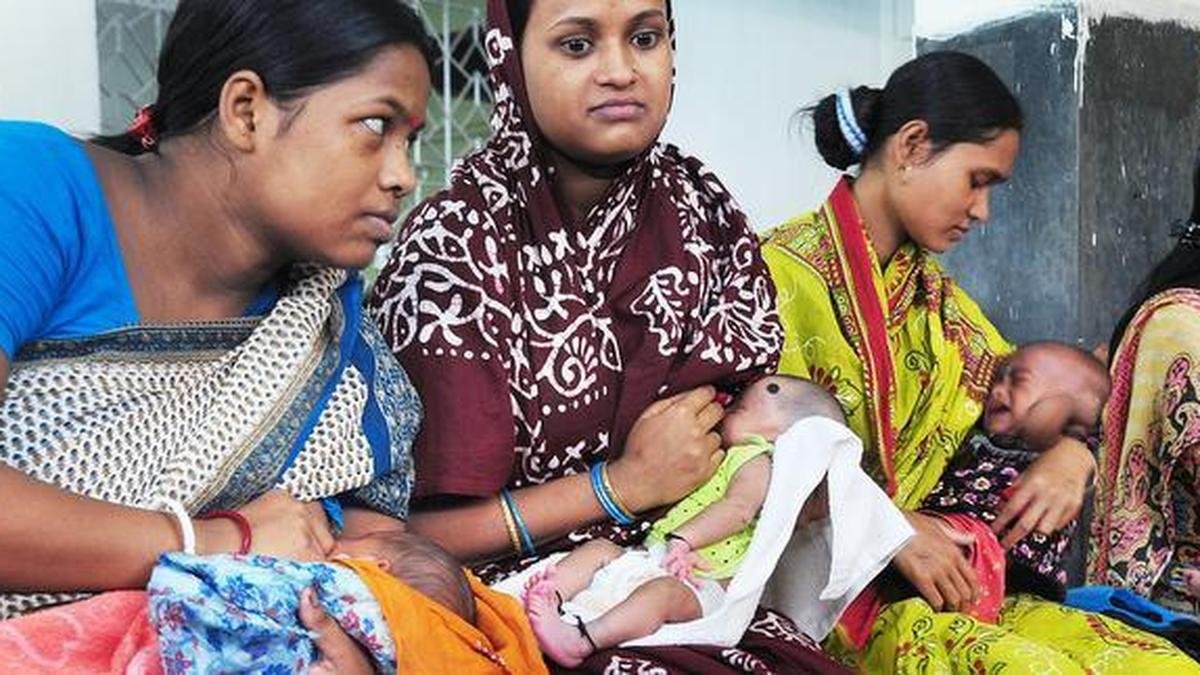
Maternal healthcare indicators in India have shown consistent improvement over the past few years. Not only did the percentage of women delivering in hospitals increase, but the number of women receiving postnatal check-ups within two days of birth has also increased. However, C-section rates have also risen. These trends continued in the most recent National Family Health Survey (NFHS-6, 2023–24), with institutional deliveries reaching 90.6% and postnatal care coverage at 82.8%
However, exclusive breastfeeding rates did not follow this route. The percentage of infants exclusively breastfed for the first six months increased from 54.9% in NFHS-4 to 63.7% in NFHS-5 but again declined to 55.8% in NFHS-6. This development effectively brings us back to where we started nearly a decade ago, in just three years.
State-level NFHS data were analysed to examine the apparent divergence between improvements in institutional delivery and declines in exclusive breastfeeding.

National trends in maternal healthcare, exclusive breastfeeding and selected child nutrition indicators, NFHS-4 to NFHS-6. EBF refers to exclusive breastfeeding among infants younger than six months; stunting and wasting refer to children under five
Ruling out a survey artefact
The first suspect was the survey itself. NFHS-5’s fieldwork was split awkwardly by the pandemic: 22 ‘Phase-I’ States finished their surveys before COVID-19 struck, while 14 ‘Phase-II’ states had data collection interrupted by the March 2020 lockdown and resumed only that December. If breastfeeding looked artificially inflated in NFHS-5 because of how the survey was conducted, that alone could explain part of the later ‘decline.’

Average percentage-point change in selected maternal healthcare and breastfeeding indicators between NFHS-4 and NFHS-5, comparing Phase-I states (fieldwork completed pre-pandemic) with Phase-II states (fieldwork interrupted by the March 2020 lockdown)
The data, however, doesn’t support this theory. Between NFHS-4 and NFHS-5, breastfeeding actually improved more in the pandemic-disrupted Phase-II States (up 10.5 percentage points on average) than in Phase-I States (up 1.6 points), the opposite of what a fieldwork-contamination explanation would predict. Whatever went wrong, it happened after NFHS-5, not because of it.
What’s happening in the States
The data show that there isn’t a uniform decline across the country; it varies by State.

State-level change in exclusive breastfeeding between NFHS-5 (2019–21) and NFHS-6 (2022–24). Positive bars indicate an increase; negative bars indicate a decline.
Biggest movers, NFHS-5 → NFHS-6 (percentage points)
| Improved most | Change | Declined most | Change |
| Sikkim | +21.3 | Haryana | −28.3 |
| Kerala | +17.2 | Uttar Pradesh | −25.1 |
| Andaman & Nicobar Is. | +12.3 | Ladakh | −18.8 |
| Puducherry | +8.3 | Madhya Pradesh | −17.6 |
| Gujarat | +6.4 | Rajasthan | −16.1 |
| Delhi | −16.0 |
That the biggest declines fell in Uttar Pradesh, Madhya Pradesh, Rajasthan and Haryana matters beyond those States’ borders: together they account for a large share of all births in India, so their reversal was enough to drag the national number down almost on its own.
Next, the data shows a non-random pattern. States with the largest increases in exclusive breastfeeding between NFHS-4 and NFHS-5 experienced the most significant declines between NFHS-5 and NFHS-6. . This pattern shows that the gains achieved were thin and susceptible to reversal, rather than the result of a uniform national shock.

Relationship between pre-pandemic (NFHS-4→NFHS-5) and post-pandemic change (NFHS-5→NFHS-6) in exclusive breastfeeding, across states. Each point is a state or union territory; the dashed line shows the OLS fit. Pearson r = −0.54 (p = 0.002); Spearman ρ = −0.40 (p = 0.027)
Haryana, Uttar Pradesh, Madhya Pradesh, Rajasthan, and Delhi clearly show this pattern, with earlier gains largely offset by the steepest declines. The negative correlation between gains and falls is statistically significant across all 31 states and UTs with available data, although some exceptions do exist. For instance, Kerala, Puducherry, and Gujarat improved in both periods, whereas, Andhra Pradesh and Jammu & Kashmir declined initially and recovered later. Sikkim shifted from a decline to the largest gainer nationally. The current data do not explain these exceptions.

State-level trajectories in exclusive breastfeeding across successive NFHS rounds. Left panel: change between NFHS-4 (2015–16) and NFHS-5 (2019–21). Right panel: change between NFHS-5 (2019–21) and NFHS-6 (2022–24)
The path ahead
With the given data, causality cannot be established, but it does point to some causes that can be looked into in order to improve breastfeeding rates in the country.
Support services may not have kept pace with the restoration of service access after the lockdowns were lifted. Anecdotal evidence from newspaper reports shows that hospitals reopened, and delivery numbers returned to pre-pandemic levels; however, lactation counselling, early skin-to-skin contact, and postnatal breastfeeding support may have remained limited. This is consistent with earlier reports of mother-newborn separation and reduced staffing for breastfeeding support in Indian health facilities during the pandemic.
The reopening of the economy could be another reason. Women in the informal sector, as well as those lacking maternity benefits, could return to paid work early, thereby reducing the duration of exclusive breastfeeding.
The massive increase in C-section deliveries: from 17.2% to 27.2% nationally between NFHS-5 and NFHS-6, may also be a factor. Past research has linked C-sections with delayed breastfeeding initiation, unless paired with strong post-discharge support..
What the numbers can’t tell us
Because the analysis relies on published, aggregated State indicators rather than individual-level data, it cannot say which of these explanations, if any, is doing the work, or why some States bucked the trend entirely. That will require the unit-level NFHS-6 data, expected to become available for research in the coming months.
What the numbers do make clear is that India’s breastfeeding story cannot be read off the national average. A country can get better at getting mothers to hospitals and worse at supporting them once they’re home with a newborn, and, for a large share of India’s mothers, that appears to be exactly what happened.
(Sonali Mishra is a PhD Student at IIT Bombay. 23d0695@iitb.ac.in; Karan Babbar is an assistant professor of economics at XLRI Jamshedpur. phd17karanb@iima.ac.in)
Published – August 02, 2026 07:00 pm IST