

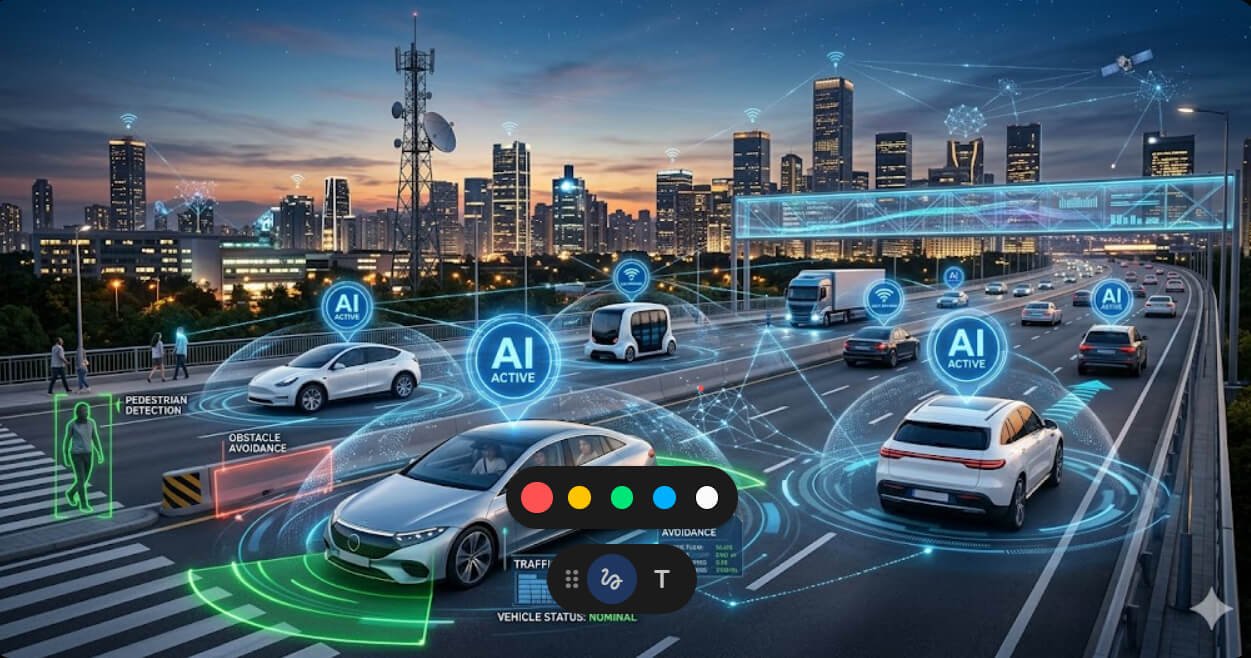
The idea of cars driving themselves once belonged purely to science fiction. Today, autonomous vehicles—commonly known as self-driving cars—are becoming a reality. With major advancements in Artificial Intelligence (AI), sensors, and machine learning, the automotive industry is rapidly moving toward a future where human drivers may no longer be necessary.
But one question continues to dominate public discussion: Are self-driving cars truly safe yet?
In this blog, we’ll explore how autonomous vehicles work, their safety benefits, current challenges, and whether they are ready for widespread adoption.
What Are Autonomous Vehicles?
Autonomous vehicles are cars that can operate without human intervention by using a combination of technologies such as AI, sensors, cameras, radar, and LiDAR. These systems allow the car to perceive its environment, make decisions, and navigate roads.
Levels of Automation
Self-driving technology is classified into six levels (Level 0 to Level 5):
- Level 0: No automation (fully human-controlled)
- Level 1: Driver assistance (e.g., cruise control)
- Level 2: Partial automation (steering + acceleration, but driver required)
- Level 3: Conditional automation (car handles most tasks, driver on standby)
- Level 4: High automation (minimal human input in specific conditions)
- Level 5: Full automation (no human driver needed)
Most vehicles available today operate at Level 2, while Level 4 and Level 5 are still under development and testing.
How Do Self-Driving Cars Work?
Autonomous vehicles rely on a combination of hardware and software systems:
- Sensors & Cameras: Detect objects, road signs, pedestrians, and other vehicles
- Radar & LiDAR: Measure distance and create a 3D map of surroundings
- AI Algorithms: Analyze data and make driving decisions
- GPS & Mapping Systems: Provide navigation and route planning
These systems work together in real-time, allowing the vehicle to respond quickly to changing road conditions.
Safety Benefits of Autonomous Vehicles
1. Reduction in Human Error
Human error is responsible for the majority of road accidents. Self-driving cars eliminate risks such as:
- Distracted driving
- Drunk driving
- Fatigue
AI systems remain alert at all times, making consistent and calculated decisions.
2. Faster Reaction Times
Machines can process data and react much faster than humans. This can help avoid collisions in critical situations.
3. Improved Traffic Flow
Autonomous vehicles can communicate with each other and optimize speed and distance, reducing traffic congestion and accidents.
4. Accessibility
Self-driving cars can provide mobility solutions for people who cannot drive, such as the elderly or disabled.
Current Safety Challenges
Despite the benefits, autonomous vehicles are not yet perfect. Several challenges still need to be addressed:
1. Complex Driving Environments
Urban roads with unpredictable pedestrians, cyclists, and traffic patterns are difficult for AI systems to navigate safely.
2. Weather Conditions
Heavy rain, fog, or snow can affect sensors and reduce the accuracy of data.
3. System Failures
Like any technology, self-driving systems can experience glitches or malfunctions, which can be dangerous if not properly managed.
4. Ethical Decision-Making
In unavoidable accident scenarios, how should a car decide between two harmful outcomes? This raises ethical concerns.
Real-World Testing and Progress
Many companies are actively testing autonomous vehicles on public roads. These tests have shown significant improvements in safety and performance over time. However, there have also been incidents and accidents, highlighting the need for further development and stricter regulations.
Governments and regulatory bodies are working to create safety standards and guidelines to ensure these vehicles can operate safely on roads.
Are Self-Driving Cars Safer Than Human Drivers?
This is a complex question. In controlled environments, autonomous vehicles often perform better than human drivers due to their precision and ability to process data quickly.
However, in real-world conditions, human drivers still outperform AI in handling unpredictable situations. The technology is improving rapidly, but it has not yet reached a level where it can completely replace human judgment in all scenarios.
The Role of AI in Improving Safety
AI continues to evolve and improve the safety of autonomous vehicles through:
- Machine Learning: Learning from millions of driving scenarios
- Simulation Testing: Testing rare and dangerous situations virtually
- Continuous Updates: Improving software through over-the-air updates
As AI systems gain more data and experience, their ability to handle complex situations will continue to improve.
The Future of Autonomous Vehicles
The future of self-driving cars looks promising. Experts believe that fully autonomous vehicles will become mainstream in the next decade, but gradual adoption is more likely.
Key Trends to Watch:
- Increased use of AI and deep learning
- Integration with smart city infrastructure
- Growth of autonomous ride-sharing services
- Improved safety regulations and standards
While full autonomy (Level 5) may still be years away, partial and high automation will continue to expand.
So, Are Self-Driving Cars Safe Yet?
The honest answer is: Not completely—but they are getting there.
Self-driving cars are already safer in some aspects, especially when it comes to reducing human error. However, they are not yet reliable enough to handle all driving conditions independently.
For now, the best approach is a hybrid model—where AI assists human drivers rather than fully replacing them. This combination offers improved safety while maintaining human control when needed.
Conclusion
Autonomous vehicles represent one of the most exciting advancements in modern technology. They have the potential to revolutionize transportation, reduce accidents, and make mobility more accessible.
However, safety remains a critical concern. While significant progress has been made, there is still work to be done before self-driving cars can be considered completely safe.
As technology continues to evolve, one thing is certain: the road ahead is intelligent, automated, and full of possibilities.
FAQs
1. What is an autonomous vehicle?
An autonomous vehicle is a car that can drive itself using AI, sensors, and advanced software without human input.
2. Are self-driving cars available today?
Yes, but most are only partially autonomous and still require human supervision.
3. What is the biggest safety concern with self-driving cars?
Handling complex and unpredictable real-world situations remains the biggest challenge.
4. Can self-driving cars work in bad weather?
They can, but performance may be affected due to reduced sensor visibility.
5. Will autonomous vehicles replace human drivers?
Eventually, but widespread adoption will take time and depend on technological and regulatory advancements.
6. Are autonomous cars legal?
They are legal in some regions for testing and limited use, but laws vary by country.