

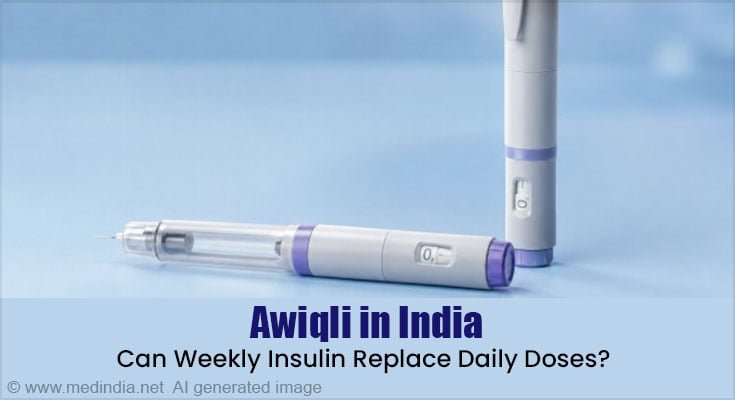
Novo Nordisk has launched Awiqli in India, a once-weekly basal insulin for eligible adults with type 2 diabetes requiring basal insulin.

- India launches the world’s first once-weekly basal insulin, Awiqli, for adults with type 2 diabetes
- Weekly dosing reduces basal insulin injections from about 365 to 52 a year
- ONWARDS clinical trials showed effective HbA1c reduction with a safety profile comparable to daily basal insulin
Novo Nordisk has now introduced Awiqli (insulin icodec) in India, making the country one of the first to offer the world’s first once-weekly basal insulin for adults with type 2 diabetes.
According to Novo Nordisk, the long-acting insulin is designed to provide continuous background insulin support throughout the week with a single injection.
The launch comes at a time when diabetes continues to place a growing burden on India’s healthcare system.
According to recent research published in Frontiers in Endocrinology, India had an estimated 101 million people living with diabetes in 2021, and the disease burden is expected to continue increasing over the next decade (1✔ ✔Trusted Source
The rising burden of diabetes and state-wise variations in India: insights from the Global Burden of Disease Study 1990-2021 and projections to 2031
The study also highlights significant differences in diabetes prevalence across Indian states, underlining the need for better access to effective treatment and long-term disease management.
Many people delay insulin therapy because of concerns about frequent injections, pain, and treatment burden. By reducing injection frequency, the company believes Awiqli could help lower both psychological and practical barriers to starting insulin treatment.
Advertisement
Why Is Once-Weekly Insulin Being Seen as a Major Advance?
Basal insulin is often prescribed when lifestyle changes and oral diabetes medicines no longer keep blood sugar under control. Traditional basal insulin is injected once every day to provide steady insulin levels between meals and overnight.
Awiqli works differently. It contains insulin icodec, an ultra-long-acting insulin analog specifically engineered to remain active for an entire week after a single injection (2✔ ✔Trusted Source
FDA approves Novo Nordisk’s Awiqli®, the first and only once-weekly basal insulin treatment for adults with type 2 diabetes
The medicine is administered using the Awiqli FlexTouch pen, with patients injecting it on the same day every week.
According to Novo Nordisk, Awiqli is approved as an adjunct to diet and exercise to improve blood sugar control in adults with type 2 diabetes.
The medicine should only be injected under the skin and must not be mixed with other insulin preparations or administered through an insulin pump.
Researchers say reducing injection frequency could improve treatment acceptance.
Daily insulin therapy is often delayed because many patients fear injections, worry about treatment complexity, or struggle to maintain a daily routine.
According to The Lancet Diabetes & Endocrinology, once-weekly basal insulin was developed to reduce this treatment burden while maintaining effective glucose control (3✔ ✔Trusted Source
Switching to once-weekly insulin icodec versus once-daily insulin degludec in individuals with basal insulin-treated type 2 diabetes (ONWARDS 2): a phase 3a, randomised, open label, multicentre, treat-to-target trial
The American Diabetes Association (ADA) Standards of Care 2026 also recommend that diabetes treatment should be individualized through shared decision-making, taking into account patients’ preferences, lifestyle, and ability to follow therapy over time (4✔ ✔Trusted Source
Facilitating Positive Health Behaviors and Well-being to Improve Health Outcomes: Standards of Care in Diabetes-2026
Advertisement
Can One Weekly Injection Control Blood Sugar as Well as Daily Insulin?
The approval of Awiqli is backed by the global ONWARDS 2 clinical trial program, which evaluated insulin icodec in more than 4,000 adults with type 1 and type 2 diabetes.
Key findings from ONWARDS 2:
- HbA1c decreased from 8.17% to 7.20% with insulin icodec and from 8.10% to 7.42% with insulin degludec after 26 weeks.
- Insulin icodec showed superior HbA1c reduction over insulin degludec (estimated treatment difference: −0.22 percentage points).
- Overall rates of level 2 or level 3 hypoglycemia were 0.73 vs 0.27 events per patient-year of exposure, although the difference was not statistically significant.
- No new safety concerns were identified.
Additional evidence came from the ONWARDS 3 trial, published in JAMA, involving adults with type 2 diabetes starting basal insulin therapy.
Key findings from ONWARDS 3 (5✔ ✔Trusted Source
Once-Weekly Insulin Icodec vs Once-Daily Insulin Degludec in Adults With Insulin-Naive Type 2 Diabetes
):
- HbA1c decreased from 8.6% to 7.0% with insulin icodec and from 8.5% to 7.2% with insulin degludec after 26 weeks.
- Insulin icodec achieved superior HbA1c reduction (estimated treatment difference: −0.2 percentage points).
- 56.8% of participants receiving insulin icodec achieved an HbA1c level below 7%, compared with 41.6% receiving insulin degludec.
- Combined level 2 or level 3 hypoglycemia was higher with insulin icodec (0.35 vs 0.12 events per patient-year during the 26-week treatment period).
Advertisement
How Does Once-Weekly Awiqli Compare with Daily Basal Insulin?
Weekly insulin is not intended to replace all basal insulin therapies. However, for eligible adults with type 2 diabetes, Awiqli offers a simpler dosing schedule while maintaining blood sugar control comparable to daily basal insulin in clinical studies.
| Feature | Daily Basal Insulin | Awiqli (Insulin Icodec) |
|---|---|---|
| How often is it taken? | Once every day | Once every week |
| Approximate injections each year | About 365 | About 52 |
| Who is it for? | Adults who need basal insulin for diabetes management | Adults with type 2 diabetes who need basal insulin, as prescribed by a healthcare professional |
| Starting insulin therapy | Standard option for insulin initiation | Shown to be effective even in adults starting basal insulin for the first time |
| Blood sugar control (HbA1c) | Effective and well established | Comparable or slightly greater HbA1c reduction in major ONWARDS clinical trials |
| Time in target glucose range | Effective with regular dose titration | Longer time within the recommended glucose range in some studies |
| Treatment convenience | Requires remembering a daily injection | Weekly dosing may reduce injection burden and improve treatment acceptance |
| Dose adjustment | Dose can be adjusted daily if needed | Requires careful weekly titration, especially during the first few weeks |
| Risk of hypoglycemia | Established safety profile | Overall low risk, but some studies reported more mild or clinically significant hypoglycemia than daily insulin |
| How it is given | Subcutaneous injection using an insulin pen | Subcutaneous injection using the FlexTouch prefilled pen |
Who Can Use Awiqli and What Precautions Should Patients Know?
According to Novo Nordisk’s prescribing information, Awiqli is approved for adults with type 2 diabetes to improve blood sugar control alongside a healthy diet and regular physical activity.
The medicine is injected once every week on the same chosen day. If a dose is missed, it should be taken as soon as possible within three days. If more than three days have passed, patients should skip the missed dose and resume their usual weekly schedule.
Like all insulin medicines, Awiqli should only be used under medical supervision. The dose is individualized based on blood sugar levels and previous diabetes treatment.
According to the prescribing information, the most common side effect is hypoglycemia (low blood sugar). Other possible side effects include injection-site reactions, allergic reactions, swelling caused by fluid retention, weight gain, itching, and skin changes at repeated injection sites.
The medicine should not be used:
- During episodes of hypoglycemia
- By people with a known allergy to insulin icodec or any ingredient in the formulation
- In insulin pumps
- Mixed with other insulin preparations
- Through intravenous or intramuscular injection
Patients are also advised to rotate injection sites regularly to reduce the risk of skin thickening or fat tissue changes that may interfere with insulin absorption.
Frequently Asked Questions
Q: What is Awiqli?
A: Awiqli is a once-weekly basal insulin containing insulin icodec for adults with type 2 diabetes.
Q: Who can use Awiqli?
A: It is approved for adults with type 2 diabetes who need basal insulin and should be used only under a doctor’s prescription.
Q: How often is Awiqli injected?
A: It is injected once every week, on the same day each week.
Q: Does Awiqli replace all insulin treatments?
A: No. It is not suitable for everyone and does not replace all insulin regimens.
Q: Is Awiqli as effective as daily basal insulin?
A: Clinical trials found it provided comparable or slightly better HbA1c reduction than daily basal insulin in eligible adults.
Q: Does Awiqli lower the number of injections?
A: Yes. Weekly dosing reduces basal insulin injections from about 365 to around 52 per year.
Q: Are there any safety concerns with Awiqli?
A: Like all insulins, it can cause hypoglycaemia. Careful dose adjustment and regular blood glucose monitoring are especially important when starting treatment.
References:
- The rising burden of diabetes and state-wise variations in India: insights from the Global Burden of Disease Study 1990–2021 and projections to 2031 – (http://frontiersin.org/journals/endocrinology/articles/10.3389/fendo.2025.1505143/full)
- FDA approves Novo Nordisk’s Awiqli®, the first and only once-weekly basal insulin treatment for adults with type 2 diabetes – (https://www.novonordisk-us.com/media/news-archive/news-details.html?id=916522)
- Switching to once-weekly insulin icodec versus once-daily insulin degludec in individuals with basal insulin-treated type 2 diabetes (ONWARDS 2): a phase 3a, randomised, open label, multicentre, treat-to-target trial – (https://www.thelancet.com/journals/landia/article/PIIS2213-8587(23)00093-1/abstract)
- Facilitating Positive Health Behaviors and Well-being to Improve Health Outcomes: Standards of Care in Diabetes-2026 – (https://diabetesjournals.org/care/article/49/Supplement_1/S89/163932/5-Facilitating-Positive-Health-Behaviors-and-Well)
- Once-Weekly Insulin Icodec vs Once-Daily Insulin Degludec in Adults With Insulin-Naive Type 2 Diabetes – (https://jamanetwork.com/journals/jama/fullarticle/2806635)
Source-Medindia