

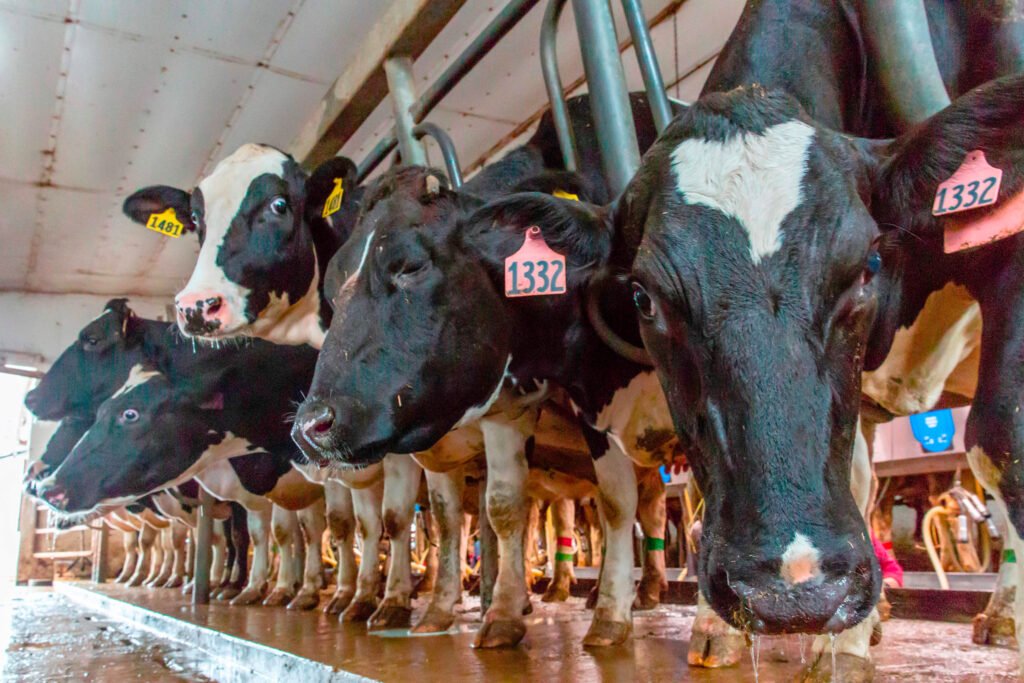
As Riverview LLP aggressively expands its mega-dairies across the Upper Midwest, advocacy groups and worried residents are mounting legal challenges and orchestrating local efforts to push back.
The Minnesota-based dairy giant, the second-largest producer of milk and milk products in the United States, has been on the march in recent years, building and enlarging its facilities around the country, especially in its home and neighboring states.
“Riverview is just proposing expansions at a crazy clip,” said Dani Replogle, an attorney with the advocacy group Food & Water Watch. “Their rate of expansion is just so beyond any other dairy producer that we’re seeing in the region and they’re already such a huge force in the region that it’s ringing a lot of alarm bells.”
Residents and environmental groups say the company’s massive facilties—some that will milk 25,000 dairy cows—have started to overwhelm small rural communities, threatening them with air and water pollution, largely from the enormous amount of uniquely potent manure produced by dairy cows. They also argue that regulators are undercounting and under-regulating greenhouse gas emissions from Riverview’s operations.
“Minnesota is an agriculture-heavy state. It’s a critical part of our economy. It’s part of our lifeblood,” said Jay Eidsness, an attorney with the Minnesota Center for Environmental Advocacy. “We have also set ambitious climate targets to reduce our greenhouse gas emissions across all sectors of our economy. We’re making great progress in a lot of places, but agriculture is a sector where we’re not.”
Agriculture is the second-largest emitting industry in Minnesota, after transportation, responsible for 96 percent of nitrous oxide emissions and 44 percent of methane emissions. Both are especially potent greenhouse gases.
The center recently filed a lawsuit challenging the Minnesota Pollution Control Agency decision to issue Riverview a feedlot permit for its site near Morris, about 140 miles northwest of Minneapolis. The lawsuit notes that facilities of Riverview’s size are required under a state rule to submit a plan identifying strategies to lower emissions, including from manure management. Riverview did not do that, the lawsuit says.
“The rule requires an assessment of the emissions from the facility, and those emissions include greenhouse gases,” Eidsness said. “We want, and are demanding, that the state take another look and require an air emissions plan that satisfies the rule so we can start taking steps to reduce greenhouse gas emissions from our agriculture sector.”
Riverview did not respond to questions from Inside Climate News, but replied with an emailed statement. “We take our responsibility to be a good neighbor and steward of the environment very seriously,” wrote Brady Janzen, one of Riverview’s partners. “These projects were subject to extensive environmental and regulatory review, including detailed technical analysis and evaluation by the appropriate agencies. The permits reflect the conclusion of that review that the projects satisfy the standards required by law.”
Under the current Minnesota rules, larger-emitting facilities have to go through an environmental review process in which they provide an estimate of their potential greenhouse gas emissions. But, Eidsness explained, these estimates are informational.
“This is not a binding document,” Eidsness said. “The only thing that binds the feedlot moving forward after this process is what’s found in the permit, so the goal of our lawsuit is to transpose some of these emissions reporting requirements and mitigation measures and put them in a permit, so it’s actually an enforceable document.”
Greenhouse gas emissions from livestock in the United States have climbed over the past 40 years, and now beef and dairy cows account for about 6 percent of the country’s total greenhouse gas emissions. Most of them are methane, which comes from cow burps and manure management systems. These systems become increasingly greenhouse-gas intensive with higher numbers of cows.
As of now, California is the only state that has gotten close to establishing an enforceable statewide regulatory program to lower methane emissions.
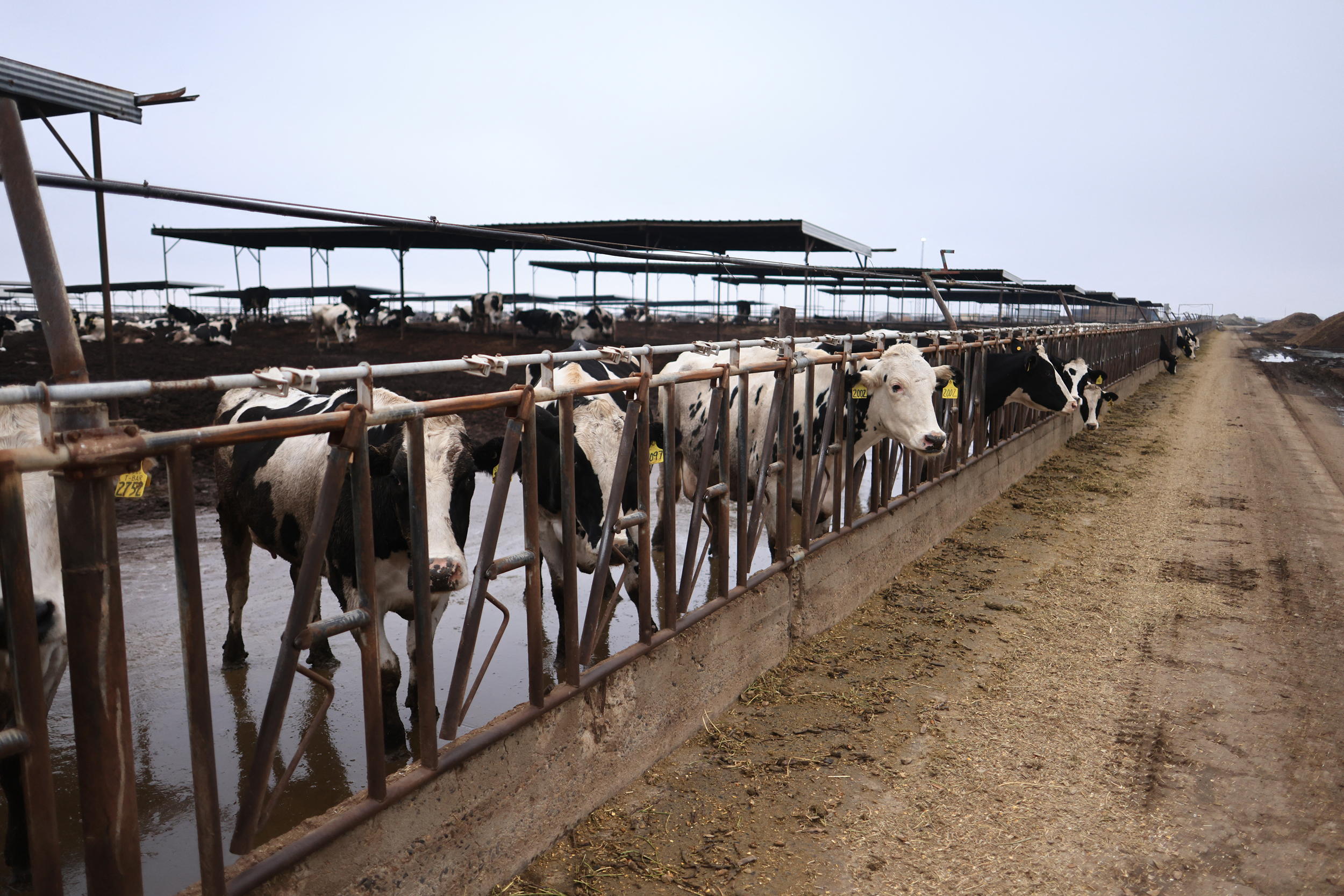
Eidsness said he is not aware of any other state-level lawsuit in the U.S. aiming to make greenhouse gas reporting and reduction a condition of a state-approved feedlot permit for a large-scale livestock operation.
Last week, Food & Water Watch and the Minnesota-based Land Stewardship Project added to the legal challenges involving Riverview when they sued the state Pollution Control Agency after it decided in June that the expansion of the Morris facility did not merit a detailed environmental impact statement, or EIS. This, the groups say in their suit, is despite the “potential effects on the climate, water quantity, water quality, and rural communities” that “are not just possible, but likely.”
In Minnesota, more than 90 percent of the dairy farms have 500 cows or fewer. The Riverview expansion would accommodate a total of nearly 19,000 cows, almost doubling its current size and making it the largest ever allowed by the state.
“We are not just talking about big—we’re talking about hundreds of times bigger than the average,” said Sean Carroll, policy director at the Land Stewardship Project. “It cannot be underestimated, the contrast between this and the normal dairy farm in Minnesota.”
Those cows are projected to produce at least 200 million gallons of effluent and manure, which would be spread on nearby fields, potentially adding to the state’s growing drinking-water problems. Dairy cow manure is especially high in nitrogen, phosphorus and salt, which, when applied to soil, can leach dangerous levels of nitrate into waterways. Nitrate is a potentially cancer-causing compound that can trigger a fatal condition in infants known as “blue baby syndrome.”
“We are not just talking about big—we’re talking about hundreds of times bigger than the average.”
— Sean Carroll, Land Stewardship Project
The facility would also produce at least 66,000 tons of additional greenhouse gas emissions, according to the advocacy groups.
The state Pollution Control Agency concluded in June that “there are no potential significant environmental effects reasonably expected to occur from the proposed West River Dairy Feedlot Expansion Project.”
The agency said it would not comment on pending litigation and referred Inside Climate News to a web page containing a “finding of fact” document. The document says the agency found Riverview’s projected emissions do not meet the threshold that would trigger additional review and an EIS.
Nearly 1,400 comments, many critical of the project, were submitted to the state. Opponents packed into public hearings, including one the Stevens County Planning Commission held Monday.
“The impact is on water usage, water pollution. It’s the climate impact,” Carroll said. “But it is also the systems-change that that creates. … It’s driving out small and mid-sized farms and sustainable farming systems that then has multiplier effects for rural economies.”
Last year, Minnesota sharpened its system for tracking how manure is spread off-site—a loosely regulated practice that large facilities often use to dispose of massive amounts of manure and waste. That, advocacy groups say, has driven Riverview increasingly toward the Dakotas, where rules covering manure management are not as stringent.
This story is funded by readers like you.
Our nonprofit newsroom provides award-winning climate coverage free of charge and advertising. We rely on donations from readers like you to keep going. Please donate now to support our work.
In South Dakota, Riverview is planning a new 25,000-head facility in Edmunds County that would add to the five dairies it already runs there. As in Minnesota, this dairy would dwarf the majority of existing dairies in the state, which house fewer than 2,500 head of cattle.
Advocacy groups are calling attention to the company’s permit application, which they say underestimates the amount of manure the facility will generate and the amount of land where that manure can be legally dumped or piped.
Dakota Rural Action, a small-farm advocacy group that helped two communities organize against Riverview, forcing it to abandon projects, now has its sights set on the Edmunds County facility, known as the Belle Dairy. County commissioners approved the facility one year ago, despite heavy community pushback.
Since then, the state Department of Agriculture and Natural Resources has received updated application documents from Riverview that Dakota Rural Action says miscalculates the amount of manure the site will produce. According to the group, these documents were not made easily accessible to the public and the commission has not yet held a hearing where the public could learn about or comment on the updated information.
“It’s very important that the county commissioners feel empowered to demand a public hearing to review these updated documents because they are vastly different than what they approved,” said Megan EisenVos, a community organizer with the group. “South Dakota in general has very lax regulation around our water, and there are a lot of operators from California or Michigan or out of Minnesota and other states that are coming into South Dakota because we are so business-friendly here, and so Riverview is just one player.”
The South Dakota Department of Agriculture and Natural Resources did not respond to questions from Inside Climate News.
Over the border in North Dakota, Riverview has submitted at least two new applications for dairies—the 12,500-head Abercrombie Dairy and the 25,000-head Herberg Dairy. The state’s Department of Environmental Quality issued permits to both last year. State regulators also approved Riverview’s purchase of roughly 183 million gallons of water for the Abercrombie Dairy from the Wahpeton Buried Valley Aquifer.
According to Food & Water Watch, both dairies plan to apply waste from the dairy onto fields that drain into the Red River. The group said that will threaten both the river and Lake Winnipeg, often referred to as “Canada’s sickest lake,” largely because of pollution from farms and livestock.
Last October, the organization, along with the Wild & Scenic Law Center, a legal advocacy group based in Portland, Oregon, sued the North Dakota Department of Environmental Quality on behalf of the Dakota Resource Council, accusing the agency of failing to require Riverview to get a discharge permit for its Herberg facility under the federal Clean Water Act.
“State law says that before North Dakota can issue a feedlot permit, they have to make a determination that operations under that permit are not going to cause pollution,” said Replogle. “Our argument is just about their arbitrary conclusions that all of the practices they authorized under that permit are not going to cause pollution in the Red River and its tributaries.”
Sarah Waldron Feld, a program manager in the Department of Environmental Quality’s division of water, said the department determined that both facilities were determined to be “non-discharging” and therefore a permit under the Clean Water Act was not required. Waldron Feld referred to the Environmental Protection Agency’s 2012 permitting manual, which says that federal permits are only needed if facilities discharge to waterways. A “permit is not required here because the production area does not discharge to surface water. The facility’s manure is instead processed through land application under a nutrient management plan and is exempt from the Clean Water Act,” Waldron Feld wrote.
The EPA requires large livestock facilities to obtain permits under the Clean Water Act only if they discharge into waterways, but leaves it up to the facility to determine whether it actually does discharge into waterways—and, therefore, whether they require a permit.
Replogle said much of the legal focus is on Riverview because of its rapid spread through the tri-state area. But it has also expanded into the Southwest, including New Mexico and Arizona, where it was a major contributor to the decline of groundwater levels in one desert community. Earlier this year, Riverview agreed to compensate residents and fallow fields where it had been growing water-hungry grain to feed its cows.
“When it affects people’s drinking water and the livelihoods of their communities, people tend to react,” Eidsness said. “I think these lawsuits and the growing chorus of opposition is just a natural outcrop of the aggressive expansion that we’re seeing and the consolidation in the agriculture sector.”
About This Story
Perhaps you noticed: This story, like all the news we publish, is free to read. That’s because Inside Climate News is a 501c3 nonprofit organization. We do not charge a subscription fee, lock our news behind a paywall, or clutter our website with ads. We make our news on climate and the environment freely available to you and anyone who wants it.
That’s not all. We also share our news for free with scores of other media organizations around the country. Many of them can’t afford to do environmental journalism of their own. We’ve built bureaus from coast to coast to report local stories, collaborate with local newsrooms and co-publish articles so that this vital work is shared as widely as possible.
Two of us launched ICN in 2007. Six years later we earned a Pulitzer Prize for National Reporting, and now we run the oldest and largest dedicated climate newsroom in the nation. We tell the story in all its complexity. We hold polluters accountable. We expose environmental injustice. We debunk misinformation. We scrutinize solutions and inspire action.
Donations from readers like you fund every aspect of what we do. If you don’t already, will you support our ongoing work, our reporting on the biggest crisis facing our planet, and help us reach even more readers in more places?
Please take a moment to make a tax-deductible donation. Every one of them makes a difference.
Thank you,
