

Close Menu

    Subscribe to Updates

    Get the latest news information from worldwide businesses.

    What's Hot

    Alien life likely can’t survive on exoplanets smaller than Mars, scientists say

    July 21, 2026

    Polissya Zhytomyr vs FC Copenhagen Prediction and Betting Tips

    July 21, 2026

    BYD Wants To Take the World’s Fastest Car Record… From Itself

    July 21, 2026
    Facebook Instagram YouTube LinkedIn X (Twitter)
    Trending
    • Alien life likely can’t survive on exoplanets smaller than Mars, scientists say
    • Polissya Zhytomyr vs FC Copenhagen Prediction and Betting Tips
    • BYD Wants To Take the World’s Fastest Car Record… From Itself
    • GM just added ChargePoint to its EV apps
    • Can You Bring Alcohol on a Plane? Yes, If You Do So Properly
    • Alabama Warns of Cyclospora and Summer Bite Risks
    • OpenAI says it accidentally hacked Hugging Face with a new AI system
    • These are the countries moving to ban social media for children
    Newspublicly
    • About Us
    • Advertise & Partner with us
    • Pitch Your Story
    • Contact Us
    Facebook Instagram LinkedIn X (Twitter)
    Subscribe
    • Home
    • World News
      • Asia
      • India
      • USA
      • UK & Europe
      • Middle East
    • Economy & Business
      • Global Economy
      • Corporate & Industry
      • Finance & Markets
      • Policy & Trade
    • Technology
      • Gadgets & Devices
      • Software & Apps
      • AI & Machine Learning
      • Robotics & Automation
    • Health & Medicine
      • Fitness & Nutrition
      • Research & Innovation
      • Disease & Treatment
      • Doctors, Clinics & Patient Care
    • Travel & Tourism
    • Automobile
      • Electric & Hybrid Vehicles
      • Auto Industry Insights
    • Sports
    • More
      • Education
      • Real Estate
      • Environment & Climate
      • Space & Astronomy
      • War & Conflicts
    Newspublicly
    Home»More»Space & Astronomy»Using the James Webb Space Telescope, astronomers have discovered the secrets of early galaxies that pumped the infant cosmos full of dust, but by studying a much closer and more recent galaxy.
    Space & Astronomy

    Using the James Webb Space Telescope, astronomers have discovered the secrets of early galaxies that pumped the infant cosmos full of dust, but by studying a much closer and more recent galaxy.

    AdminBy AdminJuly 21, 2026No Comments5 Mins Read0 Views
    Share
    Facebook Twitter LinkedIn Copy Link WhatsApp


    Using the James Webb Space Telescope (JWST), astronomers have discovered the secrets of early galaxies that pumped the infant cosmos full of dust, which would become vital for the birth of new stars and the growth of galaxies.

    However, while the JWST is powerful enough to see many of these early galaxies, it is still limited when it comes to delving into them in great detail. So, the team at the heart of this research worked around this by studying a much closer and more modern galaxy with many characteristics that resemble the universe’s first galaxies.

    In lieu of being able to study the processes that occurred in the early universe that allowed galaxies to be seeded with “metals, (the term astronomers use to describe elements heavier than hydrogen and helium), the researchers turned their attention to a dwarf galaxy just 4.6 million light-years away.

    “Directly studying the galaxies that populated the early universe is still very difficult, which is why observing a nearby galaxy like Sextans A, which presents similar chemical conditions, offers us a precious opportunity to understand how the first generations of stars evolved and what role they played in transforming the interstellar medium,” team leader Claudio Gavetti of the National Institute for Astrophysics (INAF) said in a statement.

    How does Sextans A impersonate ancient galaxies?

    The early universe was a pretty dull place in terms of chemistry. That is because it was dominated by the lightest element, hydrogen, with some helium and a tiny smattering of heavy elements, or metals. That means that the first generation of stars, so-called POP III stars, were correspondingly metal-poor.


    You may like

    During their lives, however, POP III stars fused hydrogen and helium in their cores to forge heavier elements. When these original stars reached the ends of their lives, they exploded in supernova explosions that dispersed these metals into the interstellar medium, the vast clouds of dust and gas between stars.

    Eventually, dense and cool patches in these vast clouds collapsed under their own gravity, birthing the next generation of stars, POP II stars, which, thanks to the supernova deaths of their predecessors, were richer in metals.

    Space

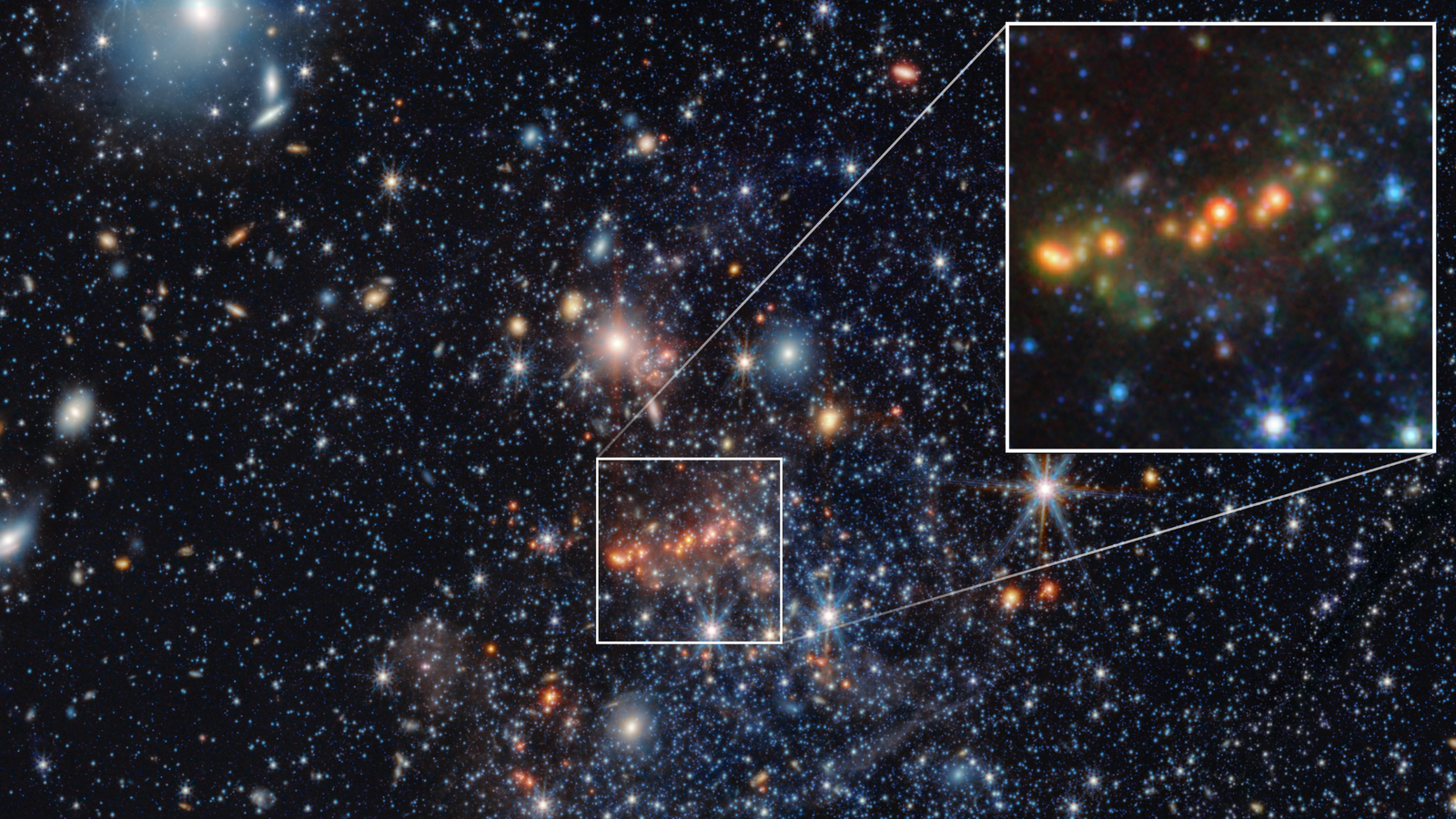
    The dwarf galaxy Sextans A observed by the James Webb Space Telescope.

    The dwarf galaxy Sextans A observed by the James Webb Space Telescope. (Image credit: NASA, ESA, CSA, STScI, Janice Lee (NOIRLab). Image processing: Alyssa Pagan (STScI).)

    Our own star, the sun, is classed as a POP I star, meaning it is even richer in metals than these second-generation stars. However, not all modern galaxies are so metal-rich; this is especially true for dwarf galaxies like Sextans A, even though it lies at the outer edge of our cosmic backyard, known as the “local group.”

    Sextans A is so metal-poor that it is estimated to contain only between 1% and 7% of the heavy elements found in the sun. That makes it a great proxy for the study of metal-poor early galaxies.

    Using the JWST’s NIRCam (Near-InfraRed Camera) and MIRI (Mid-Infrared Instrument) instruments, Gavetti and colleagues obtained high-resolution observations of Sextans A that allowed them to map the dwarf galaxy’s entire population of stars during an evolutionary phase known as the “asymptotic red giant branch.”


    What to read next

    This phase occurs when stars larger than the sun exhaust helium in their cores, creating an inert carbon heart, but nuclear fusion continues in outer alternating helium- and hydrogen-burning layers. These stars “puff out” as a result of this and can undergo thousandfold increases in brightness.

    An image of the galaxy Sextans A where Red indicates the infrared emission of dust, blue the emission of atomic hydrogen gas, and green the far-ultraviolet emission created by newly formed stars.

    An image of the galaxy Sextans A where Red indicates the infrared emission of dust, blue the emission of atomic hydrogen gas, and green the far-ultraviolet emission created by newly formed stars. (Image credit: Yong Shi)

    The team’s findings revealed that around 90% of the asymptotic red giant branch stars they studied were not surrounded by envelopes of dust. However, around 20 or so of these stars were embedded in thick dust shells. They also found that these “dust factories” formed between 2 billion and 3 billion years ago from stars with an initial mass about 1.5 times the mass of the sun.

    This research is a leap forward in understanding which stars in the early universe were most likely to create the metal dust that would have enriched the next generations of stars. That means it helps paint a complete picture of how the universe as we see it today took shape.

    The scientists behind this study say that this type of research would have been impossible before the launch of Webb.

    “The JWST allows us to observe in unprecedented detail environments that until a few years ago were beyond our reach,” team member Flavia Dell’Agli of the INAF. “The value of these data lies not only in the images, but in the ability to compare them with theoretical models and verify how correctly they describe the evolution of stars.”

    The team’s research was published on Monday (July 20) in The Astrophysical Journal.


    Source link

    Author

    • Admin

      NewsPublicly.com is News & Articles Platform that creating SEO-focused articles on travel, lifestyle, and digital trends.

    Admin
    • Website

    NewsPublicly.com is News & Articles Platform that creating SEO-focused articles on travel, lifestyle, and digital trends.

    Related Posts

    Alien life likely can’t survive on exoplanets smaller than Mars, scientists say

    July 21, 2026

    SpaceX Falcon 9 rocket sends Starlink satellites to orbit a day after rare launch abort

    July 21, 2026

    Space Force orders 36 more Golden Dome missile-tracking satellites, for $1.75 billion

    July 21, 2026
    Leave A Reply Cancel Reply

    Demo
    Top Posts

    The Blue Moon rises on May 30— Where and when to see the second full moon of the month

    May 30, 202640 Views

    New SOCOM rifle allows barrel swapping and cartridge changes

    June 1, 202633 Views

    “Inside Gemini Robotics 1.5: How Robots Learn to Reason & Act

    November 22, 202527 Views

    525 pounds of cocaine seized after Nebraska K9 alerts troopers on I-80

    May 28, 202624 Views
    Don't Miss

    Alien life likely can’t survive on exoplanets smaller than Mars, scientists say

    July 21, 20267 Mins Read0 Views

    A rocky planet orbiting in the habitable zone of a sun-like star may look like…

    Polissya Zhytomyr vs FC Copenhagen Prediction and Betting Tips

    July 21, 2026

    BYD Wants To Take the World’s Fastest Car Record… From Itself

    July 21, 2026

    GM just added ChargePoint to its EV apps

    July 21, 2026
    Stay In Touch
    • Facebook
    • Twitter
    • Instagram
    • YouTube
    • LinkedIn
    • WhatsApp

    Subscribe to Updates

    Get the latest creative news from SmartMag about art & design.

    Demo
    NEWSPUBLICLY
    Facebook X (Twitter) Instagram LinkedIn

    Home

    • About Us
    • Leadership
    • Advertise & Partner With Us
    • Pitch Your Story
    • Media Kit & Pricing
    • Career
    • FAQs

    Guidelines

    • Editorial & Submission
    • Partnership
    • Advertising & Sponsor
    • Intellectual Property Policy
    • Community & Comment
    • Security & Data Protection
    • Send Your Opinion

    Quick Links

    • Cookie Policy
    • Payment & Billing Terms
    • Refund & Cancellation
    • Copyright Policy
    • Complaint & Support
    • Sitemap
    • Contact Us

    Subscribe Us

    Get the latest news and updates!

    Copyright © 2026 Newspublicly (DIGITALIX COMMUNICATION). All Rights Reserved.
    • Privacy Policy
    • Terms of Use
    • Disclaimer