

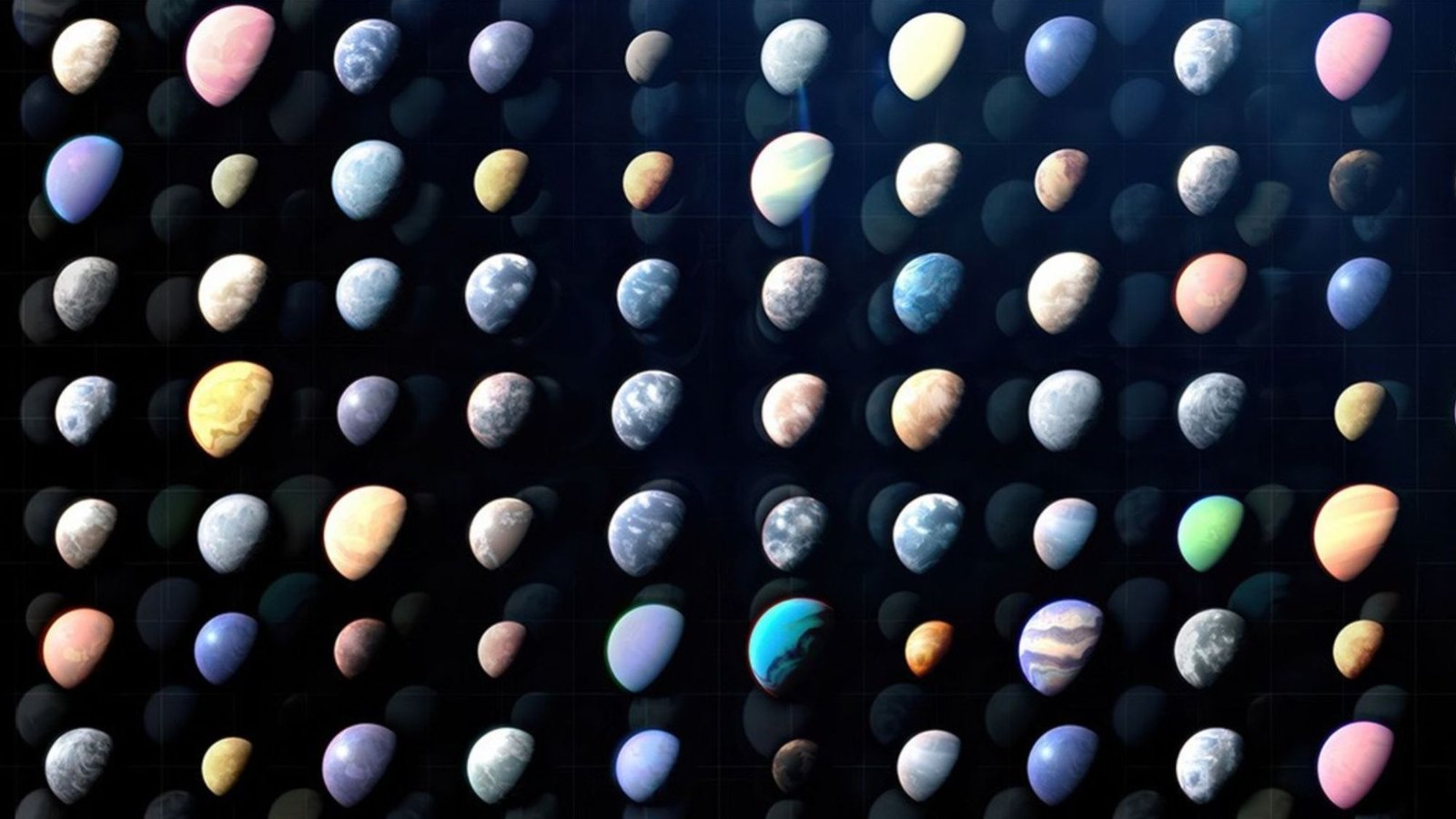
A rocky planet orbiting in the habitable zone of a sun-like star may look like a perfect place for life to thrive — but not if it’s too small to hold onto its atmosphere.
So, we may wonder: How much smaller Earth could be and still have its delightfully breathable atmosphere? How small could an exoplanet be to sustain life as we know it?
With these questions in mind, University of California Riverside planetary scientist Michelle Hill and her colleagues recently simulated what happens to the atmospheres of different sizes of rocky worlds. The worlds tested were similar to Earth and orbited in the habitable zones around sun-like stars. It turns out for a world to maintain an atmosphere long enough for life to gain a foothold (a few billion years at minimum), it needs to be at least as big as Mars.
Narrowing down the search for life
The habitable zone — the area around a star where temperatures are right for liquid water to exist on a planet’s surface — is prime real estate in the hunt for alien life. It’s also a tough neighborhood for exoplanet atmospheres, because the closer a planet is to a star, the more ways in which radiation and stellar wind will try to strip away an atmosphere.
This is why Hill and her colleagues recently simulated how long it would take rocky, Earth-like planets of various sizes, in the habitable zone of a star like our sun, to lose their atmospheres. In other words, how much smaller could Earth, or a similar planet, be and still keep an atmosphere?
The answer turns out to be that an atmosphere-sustaining planet needs to be about 80% as wide as Earth, but could technically be as small as 60%. This offers astrobiologists a clue about which planets to focus on in the search for habitable worlds and signs of alien life.
“The plethora of exoplanets creates an interesting challenge in the search for potentially habitable planets,” wrote Hill and her colleagues. “Of the many targets in the habitable zones of their star, which are the best candidates for follow-up observations with the aim of detecting biosignatures?” In other words, astrobiologists now have almost too many planets to choose from and not enough telescope time to search them all. So, it’s time to narrow the search.
One way to do that is to figure out which planets are most likely to be habitable — and for life as we know it, that habitability means having an atmosphere.

Modeling atmospheres — and volcanoes
Hill and her colleagues’ “Smaller Than Earth Habitability Model” simulates the fate of atmospheres around digital versions of Earth. Some of the simulated worlds are exactly like ours but smaller, with the same chemical makeup and the same proportions of core, mantle and crust. Others have slightly different amounts of carbon, larger or smaller cores, or different starting temperatures. The model traces what happens to these worlds over a few billion years, based on two things: how quickly stellar wind and radiation strip away gas from the planet’s atmosphere and how quickly volcanoes pump out gas (mostly carbon dioxide) to replace it.
The model is how the team realized a scaled-down version of Earth needs to be at least 80% as wide as true Earth (0.8 Earth radii) to maintain an atmosphere in the long run. Smaller planets tend to lose gas faster than volcanic eruptions can replace it.
That’s because smaller planets have less gravity and weaker magnetic fields with which to hold onto their thin envelopes of gas. They also don’t usually release enough gas from within to make up for the loss. Their mantles — the churning layer of magma beneath the crust — tend to release less volcanic gas over time, and their upper layers cool and harden much faster. The latter process cuts off volcanic eruptions much earlier in a planet’s lifespan.
Smaller planets clinging onto atmospheres
By changing some of Earth’s parameters, the team managed to get planets as small as 0.6 Earth radii to maintain a stable atmosphere. Carbon was the key: planets with more carbon in their mantles tend to release more carbon dioxide gas in eruptions, and that turns out to be the biggest factor (other than size) in whether a planet keeps its atmosphere.
“Carbon dioxide is a heavy molecule,” Hill and her colleagues wrote, “which can make it a difficult molecule to lose. We focus on a pure carbon dioxide atmosphere as a best-case scenario for atmospheric retention.” Of course, that’s only a best-case scenario for some relatively simple forms of life, so your astrobiological mileage may vary.
It took tons more carbon than Earth contains to make a significant difference to the fate of a planet’s atmosphere — but because it’s theoretically possible for a planet to form with that much carbon in its makeup, that’s useful knowledge. Planets with relatively smaller cores, and therefore relatively thicker mantles, also had better luck on the atmospheric retention front. Starting with a larger supply of radioactive elements, which decay and release heat into the surrounding rock, helped keep the mantle molten and the volcanic gases churning skyward.

Starting with a cooler mantle also helps — which sounds surprising. You’d think a hotter mantle would be more likely to spew volcanic gases into the atmosphere. Yet, a cooler mantle takes longer to start erupting in earnest, which means the planet gets to hold onto its reservoir of gases until its star is older and more settled.
Newborn stars are prone to violent bursts of radiation and plasma, which would sweep away the volcanic gas as fast as it erupted. With a cooler mantle and later eruptions, the planet gets to keep more of the erupted gas.
A second chance for airless worlds
There’s still hope of life for smaller worlds.
Even planets that lose their initial atmospheres entirely — instead of gradually replacing them with things like carbon dioxide and methane — might have a second chance to build a new atmosphere.
Hill and her colleagues suggest that one way for a planet to regain its lost atmosphere could be comet and asteroid impacts, which might deliver volatile elements like hydrogen, oxygen and carbon. These elements can combine to form all sorts of atmospheric gases.
Such impacts could be especially helpful if they happen later in the star system’s life, like after the star is past its youthful phase of intense flares.
“While smaller planets face greater challenges in retaining atmospheres, our model suggests that they can develop atmospheres under the right conditions,” wrote Hill and her colleagues, so, “even those that initially lose their atmospheres should not be immediately discounted as potentially habitable worlds.”
What’s next?
Future simulations using the Smaller Than Earth Habitability Model could study worlds around smaller, cooler stars called red dwarfs — stars like TRAPPIST-1, which is home to at least seven rocky planets, with three of them in the habitable zone. These stars make up about 75% of the stars in our galaxy, and their relatively dim light makes it easier for telescopes like the James Webb Space Telescope (JWST) to capture images of starlight filtering through the atmospheres of planets that pass between Earth and their host stars.
Hill and her colleagues also hope to explore what happens to atmospheres around tidally-locked planets, or planets where tidal forces keep the interior hot and seismically active, similar to Jupiter’s moon Io.
The researchers published their work in June in The Planetary Science Journal.