

In high-income countries like the U.S. and the U.K., it is well-established that people who live in poorer and marginalised localities are more exposed to pollution than those in wealthier neighbourhoods. According to a recent report, that pattern seems to be reversed in low and middle income countries (LMIC) like India.
The report, titled ‘Schools in the Shadow of Toxic Sites: Pollution Proximity in Low- and Middle-Income Countries’, looked at how close 2,840 schools were to toxic sites in 17 countries. It concluded that 10% of schools in LMICs lie within 5 km of a documented toxic site, especially in urban areas.
And of all the world’s capital cities, New Delhi topped the list, with more than 90% of its private schools located near a site contaminated with lead, mercury, cadmium, arsenic, and/or pesticides.
When exposed to such contaminants, children in particular develop higher risk of heart and kidney diseases as well as of irreversible learning and cognitive disabilities. According to the World Bank, lead exposure during childhood alone costs LMICs $1 trillion a year.

‘Equally exposed to contamination’
While lead exists naturally in the deep layers of the earth, no amount of lead exposure is safe for humans. Once it enters the body, it can stay silently stuck to the bones, mimicking calcium. When mixed with blood, it can lead to severe kidney and heart problems. In individuals showing no acute symptoms, it can spike blood pressure and lead to sudden heart attacks.
Among children, lead can be a powerful neurotoxin that degrades myelin, the protective outer layer of the brain, and hampers brain cell connections.
In the last few decades, more and more studies from both developed and developing countries have linked lead exposure to shortened attention spans, heightened aggression, behavioural disorders, and a permanent drop in IQ.
“But we did not know where exactly the problem was,” Lee Crawfurd, the report’s author and a researcher at the Center for Global Development (CGD), London.

Lead-acid batteries alone contribute to 86% of global lead consumption.
| Photo Credit:
Getty Images
For the analysis, Mr. Crawfurd mapped 2.6 million schools to 11,301 documented toxic sites across Mexico, India, Ghana, Kenya, Armenia, and 12 other countries. While the contamination was severe within a few metres of a site, pollutants do not remain there forever. People living as far as 5 km from a toxic site have shown to have elevated blood lead levels as well.
“If you look at household lead exposure, the poorest are slightly more likely to be exposed than the richest, but since lead exposure can be impactful within 5 km of radius, everyone who lives and breathes in the same air is equally exposed to the contamination,” Mr. Crawfurd said.
The study found 9.7% of schools in the sample were within 5 km of a contaminated site.
As a result, “Nearly a billion children have some lead exposure globally. And we know that a big share of that comes from polluted sites, many of them lead-battery recycling,” Mr. Crawfurd said.
As opposed to developed countries, where polluting sites lie where public opposition is weakest, the study found that in LMICs, urban schools are 4- to 28-times more likely than rural schools to be near a toxic site.
“The results are a bit surprising,” Mr. Crawfurd said. “But it makes sense with the urban clustering. If you don’t have good regulation of where recycling can happen, then it happens in the most convenient places, which is where people are.”

Paradox of development, recycling
Lead-acid batteries are used to start most petrol and diesel motor engines; lead is also present in smaller quantities in the electrical components of photovoltaic cells, wind turbines, and as part of back-up power supply systems. These batteries alone contribute to 86% of global lead consumption.
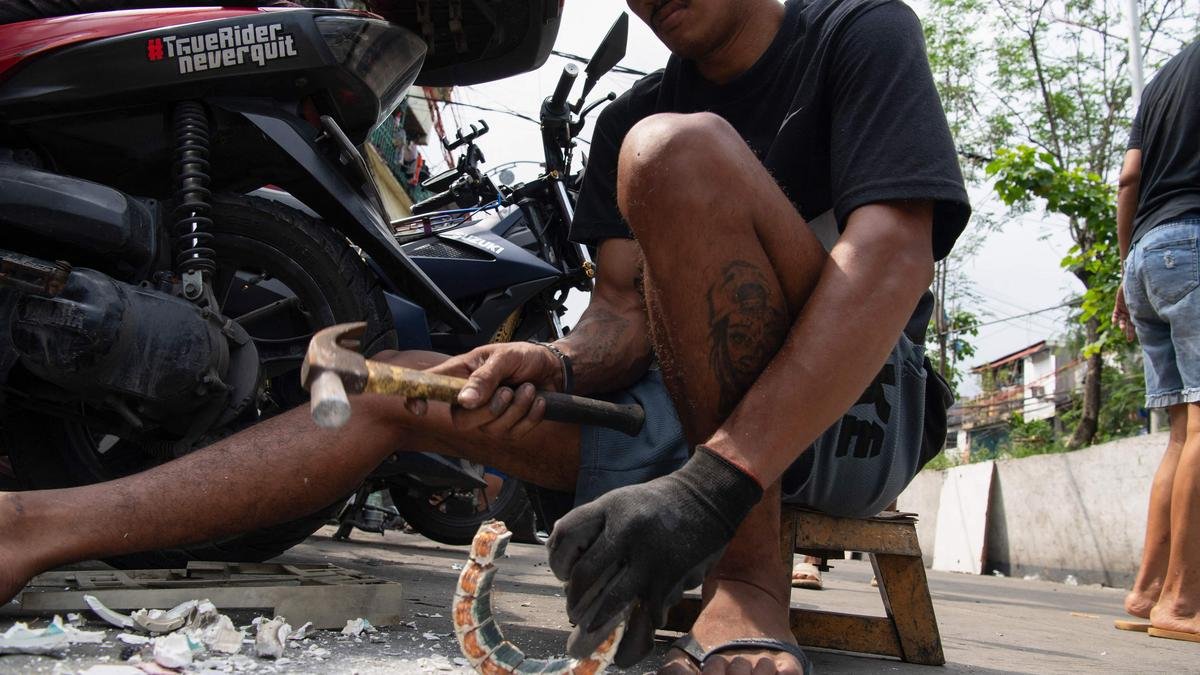
Lead acid batteries are also popular because they are cheap, rechargeable, and easy to recycle. The metal melts at 327° C, a temperature that can be achieved using a blowtorch in a backyard. Thus, numerous informal enterprises have erupted in India that simply break open old batteries, isolate the lead-containing parts, and toss them in a furnace. The liquid lead is then filtered out and recast into ingots for new batteries.
But without a safe, closed-loop management system, the lead leaches into the soil and can enter human bodies through food, water, and the air.
In developed countries, lead is generally recycled under strict guidelines and with restrictions, and costs tens of millions of dollars. But in LMICs, where enforcement is weak and labour is cheap, a large proportion of recycling happens in backyards.
Thus, in India, even though there are more than 350 well-equipped recycling units, some 90% of the waste ends up in the informal network, where profits are also higher.
Per the report, this network is now estimated to be responsible for around 33% of the world’s lead poisoning burden. In LMICs, this burden is equivalent to 80 lakh disability-adjusted life years or 8 lakh annual deaths.

‘An invisible problem’
Mr. Crawfurd said variables like a school being private, secondary or single-sex all correlated to some degree with higher pollution exposure simply because they were clustered in cities.
New Delhi had 91.2% of schools within 5 km of a toxic site; it was followed by Manila (86%), Nairobi (71%), Accra (67%), and Jakarta (51%).
This clustering is not inevitable, however: Mr. Crawfurd’s analysis also found that Mexico City, despite its large size and high population density, had almost no toxic-site contamination because its industrial manufacturing zones were successfully regulated and separated from the urban core.
“Lead is an invisible problem that’s easy to ignore,” Mr. Crawfurd said. “But badly polluted sites can be regulated, closed down or moved out of city/populated areas. It’s something that the Indian government has done and they can do it, with more public pressure.”
Monika Mondal is a freelance science and environment journalist.