

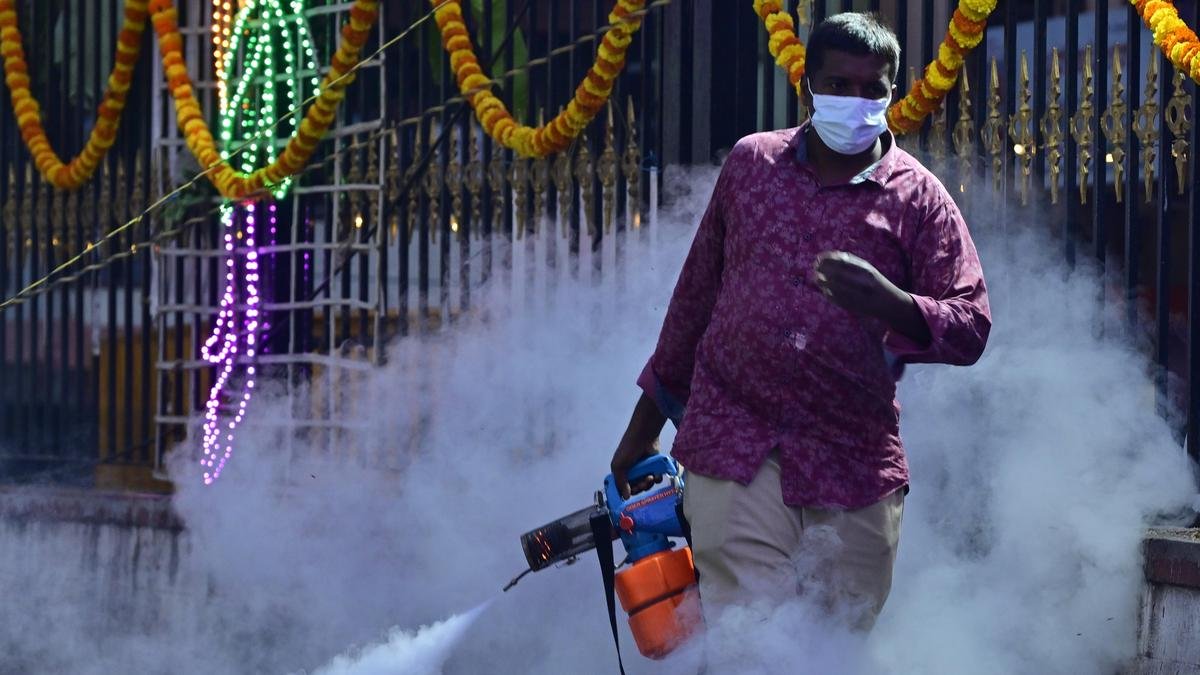
The story so far: India’s dengue epidemic is entering a more complex phase, with multiple virus strains now circulating simultaneously across much of the country, notes a two-year nationwide surveillance study by the Indian Council of Medical Research’s (ICMR) Virus Research and Diagnostic Laboratory (VRDL). Experts warn that this pattern, known as hyperendemic transmission, can increase the risk of severe illness, make outbreaks more difficult to predict and complicate future vaccination strategies.
Also Read | Understanding the ABCs of dengue for control and better management
The findings offer a clear picture of how dengue is evolving in India and why these matters for outbreaks, severe disease, and future vaccination policy.
What does the study say?
The study titled: “Pan-India Molecular Surveillance of Dengue Serotypes, 2023–2025”— notes that India is entering a new epidemiological phase with multiple existing virus strains now circulating together across much of the country.
The two-year study, which analysed 6,889 laboratory-confirmed dengue samples from 45 laboratories across 25 States and Union Territories between 2023 and 2025, found widespread co-circulation of dengue virus serotypes. Eight States and Union Territories had all four serotypes in circulation simultaneously, while 15 had three circulating together. DENV-2 remained the dominant strain nationally, accounting for more than half of infections.

Around 7% of patients were simultaneously infected with more than one dengue serotype.
What is dengue?
According to the World Health Organization (WHO), dengue is a mosquito-borne viral disease caused by the dengue virus (DENV), which is transmitted primarily through the bite of infected female Aedes aegypti mosquitoes and, to a lesser extent, Aedes albopictus.

Dengue is common in tropical and subtropical regions and has become a major global public health problem. The illness usually begins 4–10 days after a mosquito bite and commonly presents with high fever, severe headache, pain behind the eyes, muscle and joint pain, nausea, vomiting, skin rash, and extreme weakness. While many people recover within one to two weeks, some develop severe complications that require immediate medical care.
There are four serotypes (types) of the dengue virus: DENV-1, DENV-2, DENV-3, and DENV-4. Infection with one serotype provides lifelong immunity only against that particular serotype, while immunity to the other three is temporary and incomplete. Therefore, a person can be infected with dengue more than once, and a second infection with a different serotype may increase the risk of severe dengue.
WHO classifies dengue into three clinical categories: dengue without warning signs, dengue with warning signs, and severe dengue.
Warning signs include severe abdominal pain, persistent vomiting, bleeding from the gums or nose, lethargy, and fluid accumulation. Severe dengue may lead to shock, severe bleeding, respiratory distress, or organ failure and can be fatal if not treated promptly. There is no specific antiviral treatment for dengue, so management mainly involves adequate fluid intake, rest, fever control with appropriate medicines, and careful monitoring.
According to WHO, the best way to prevent dengue is to control mosquito breeding, eliminate stagnant water, use insect repellents, wear protective clothing, and maintain community awareness to reduce mosquito bites and prevent disease transmission.
What is hyper-endemic dengue?
Researchers describe India’s current situation as one of hyper-endemic transmission.
In epidemiological terms, hyper-endemicity refers to the sustained circulation of multiple serotypes within the same population over long periods. Instead of one strain replacing another every few years, several strains circulate simultaneously, increasing the chances that people will experience repeated infections with different serotypes over their lifetime.
Also Read | Explained: Why is a viable dengue vaccine not yet available
This has two consequences.
First, it increases the probability of secondary infections, which are already known to carry a higher risk of severe disease.
Second, it creates opportunities for simultaneous infections involving more than one serotype, something that until recently was considered relatively uncommon.
The new surveillance data suggest these concurrent infections may no longer be rare in India.
About one in 14 patients in the study carried more than one dengue serotype at the same time. Researchers found these patients were more likely to develop thrombocytopenia (dangerously low platelet counts), haemorrhagic manifestations and severe joint pain compared with patients infected by a single serotype. While the study cannot establish that multiple infections directly cause severe disease—and the authors note that longer-term clinical studies are needed—the association is important enough to warrant closer monitoring.
Clinicians have noted that disease severity depends on several factors, including age, immunity, underlying illness and previous dengue exposure. The study adds another layer to that understanding by suggesting that concurrent infections may contribute to worse clinical outcomes.
Also, DENV-2, the dominant serotype identified nationally, has also been associated with several severe dengue outbreaks in India and elsewhere, although disease severity cannot be explained by serotype alone.
Why surveillance has become crucial?
The study is also significant because, unlike routine case reporting, molecular surveillance identifies exactly which dengue serotypes are circulating and how their distribution changes over time.
This information can provide an early warning before outbreaks become clinically apparent.
If one serotype suddenly begins replacing another in a particular region, health authorities can anticipate shifts in disease patterns, strengthen hospital preparedness and intensify vector-control measures.
The researchers argue that surveillance should become a continuous national activity rather than an occasional research exercise.
Public health experts say that India needs regular nationwide studies capable of identifying emerging hotspots, tracking changes in circulating serotypes and providing early warning signals before outbreaks intensify.
Such surveillance would also improve outbreak prediction models by providing real-time information about how dengue viruses are evolving geographically.
Also India currently does not include a dengue vaccine in its Universal Immunisation Programme.
The challenge is that dengue vaccines are inherently more complex than vaccines against viruses with a single circulating strain.
An effective dengue vaccine must generate balanced immunity against all four serotypes simultaneously. If protection is substantially weaker against one serotype, vaccinated individuals could remain vulnerable to infection with that strain.
The new study therefore highlights why continuous monitoring of circulating serotypes will become increasingly important once vaccination programmes begin. Changes in the dominant serotype could influence both vaccine performance and outbreak intensity over time.
Rather than adopting a “one-and-done” strategy, India may need a surveillance system that continually informs vaccination policy, much like influenza surveillance guides seasonal flu vaccines in many countries, note experts.
The findings also reflect how dengue itself has changed in India over the past decade.
What was once considered an urban, monsoon-driven disease has steadily expanded into peri-urban and rural areas. Cases are now reported for longer periods of the year, aided by rapid urbanisation, changing rainfall patterns, population movement and expanding mosquito habitats.
The widespread circulation of multiple serotypes suggests the virus has established itself more firmly across diverse ecological settings.
In other words, India’s dengue problem is no longer defined simply by mosquito abundance. It is increasingly shaped by viral evolution, human immunity, and changing transmission dynamics.