

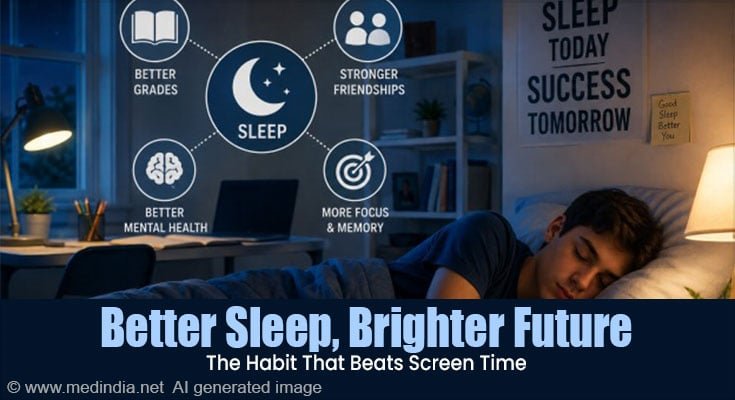
A good night’s sleep may have a bigger impact on school performance and friendships than cutting screen time, especially for adolescents facing mental health challenges.

- Sleep had the strongest link with better grades and fewer social problems
- Its benefits were greatest in adolescents with anxiety and depression
- Screen time mattered, but sleep had a much bigger influence on daily functioning
A good night’s sleep may be more important than limiting screen time when it comes to helping adolescents succeed in school and build healthy friendships.
A new study published in Psychological Medicine by researchers at UC Davis Health found that among four key lifestyle habits—sleep, screen time, physical activity, and diet—sleep quality was the strongest factor associated with better academic performance and fewer social problems in children aged 10 to 13 (1✔ ✔Trusted Source
A good night’s sleep may help adolescents thrive in school and with friends
)(2✔ ✔Trusted Source
Mediating effects of healthy lifestyle factors on associations between mental health and functional outcomes in early adolescence
).
The findings were particularly evident among adolescents experiencing anxiety,
Advertisement
Could Better Sleep Matter More Than Screen Time for Teen Success?
For years, reducing screen time has been one of the most common recommendations for improving children’s well-being. However, the new study suggests that sleep may play an even bigger role in helping adolescents succeed both academically and socially.
Using data from the Adolescent Brain Cognitive Development (ABCD) Study, researchers evaluated children aged 10 to 13 years and found that sleep consistently outperformed every other lifestyle factor.
Among the four lifestyle habits studied:
- Sleep quality showed the strongest association with better school performance and healthier friendships.
- Screen time ranked second, while
physical activity and diet had smaller effects. - Better sleep was linked with higher grades and fewer social difficulties, particularly in adolescents experiencing anxiety, depression, or psychotic-like symptoms.
The researchers also quantified how strongly sleep explained the relationship between mental health symptoms and school performance.
Sleep accounted for:
- 36.3% of the association between anxiety and lower academic performance.
- 18.5% of the association with depression.
- 8.3% of the association with psychotic-like experiences.
By comparison, screen time explained only 5% to 6.3% of these relationships, highlighting that while limiting excessive screen use remains important, adequate sleep may have an even greater impact on helping adolescents function well in everyday life.
The findings were unexpected because researchers anticipated sleep would be important but did not expect it to stand out so clearly above screen time, exercise, and diet.
Advertisement
Why Is Sleep So Important for Learning and Friendships?
The study findings are supported by a growing body of neuroscience research showing that sleep is essential for the developing adolescent brain.
According to Nature’s npj Science of Learning, adequate sleep helps the brain (3✔ ✔Trusted Source
Sleep duration and subject-specific academic performance among adolescents in China
- Consolidate new memories.
- Maintain attention and concentration.
- Improve executive functioning and decision-making.
- Regulate emotions.
- Support problem-solving and learning.
The study, which analyzed data from more than 54,000 adolescents, found that students who slept around eight hours per night generally achieved the best academic performance, particularly in mathematics and science.
Researchers also observed that insufficient sleep was linked to poorer learning outcomes, while the greatest benefits were seen among students with lower academic performance.
Sleep also appears to influence social development, not just classroom learning.
According to the study, better sleep was associated with fewer social problems and healthier peer relationships.
Researchers believe adequate sleep improves emotional regulation, reduces irritability, and helps adolescents respond more effectively in social situations.
Poor sleep, on the other hand, may increase fatigue, reduce attention, and make it more difficult for young people to manage emotions or maintain healthy friendships.
Together, these findings suggest that sleep supports many of the brain functions adolescents rely on every day—whether they are learning in the classroom, preparing for exams, or interacting with friends.
Advertisement
Is Screen Time Really the Problem, or Is It What It Replaces?
Although excessive screen use is often blamed for poor mental health and declining academic performance, researchers suggest the issue may be less about screens themselves and more about what they replace.
The study found that screen time was the second strongest lifestyle factor affecting academic and social functioning, but its influence was consistently smaller than that of sleep.
Similarly, according to the American Academy of Pediatrics (AAP), the focus should not be on eliminating digital devices altogether. Instead, families should ensure that screen use does not replace activities that are essential for healthy development, including (4✔ ✔Trusted Source
Updated AAP recommendations for screen time: What parents need to know
- Adequate sleep
- Physical activity
- Homework and learning
- Family interaction
- Free play and recreation
The AAP also recommends simple habits that can help protect sleep while allowing healthy technology use:
- Keep bedrooms and mealtimes device-free.
- Avoid screens for at least one hour before bedtime.
- Create a Family Media Plan with clear expectations for device use.
- Encourage conversations about online content instead of relying only on strict screen-time limits.
Does Research Link Better Sleep to Better Academic Performance?
The UC Davis study adds to a growing body of evidence showing that good sleep is consistently linked with better learning and academic achievement. Rather than relying on a single study, researchers worldwide have been investigating this relationship for years.
According to a recent systematic review and meta-analysis ,researchers analyzed 59 studies involving 163,357 children and adolescents and found a consistent positive relationship between sleep quality and academic performance (5✔ ✔Trusted Source
The Effect of Sleep Quality on Academic Performance: A Systematic Review and Meta-Analysis Study
The review concluded that students who sleep better generally perform better in school, regardless of how sleep was measured.
The review also identified several factors that influenced academic performance:
- Good sleep quality was consistently associated with better grades.
- Adequate sleep duration showed a positive relationship with learning.
- Social jetlag—having very different sleep schedules on weekdays and weekends—was linked with poorer academic performance.
- Difficulty falling asleep and daytime sleepiness were also associated with worse learning outcomes.
Interestingly, the association between sleep and school performance was strongest among school-aged children (7-12 years), although it remained significant during adolescence as well.
Researchers also observed that the relationship was stronger in Eastern countries than in Western populations, suggesting that educational demands and lifestyle factors may influence how sleep affects learning.
Why Does Poor Sleep Make Learning More Difficult?
Scientists believe that sleep supports learning long before students enter the classroom. Sleep helps the brain process and store new information while preparing it for learning the next day.
During healthy sleep, the brain supports several functions that are essential for academic success, including:
- Memory consolidation, which helps retain newly learned information.
- Attention and concentration during classroom activities.
- Executive functions such as planning, decision-making, and problem-solving.
- Emotional regulation, helping children stay focused and manage stress.
When sleep is disrupted, these brain functions become less efficient, making it harder for students to pay attention, process information, and perform well in school.
Poor sleep has been linked with headaches, fatigue, emotional difficulties, and reduced cognitive performance, all of which can interfere with classroom learning.
In adolescents, chronic sleep deprivation has also been associated with anxiety, depression, impaired emotional regulation, and poorer executive functioning.
These biological mechanisms help explain why the researchers found that sleep had a much greater influence on school performance than screen time, exercise, or diet.
Frequently Asked Questions
Q: Why is Sleep Important for Teenagers?
A: Sleep supports learning, memory, emotional regulation, and healthy brain development.
Q: Is sleep more important than limiting screen time?
A: In this study, sleep showed a stronger association with better academic performance and social functioning than screen time.
Q: How many hours of sleep do adolescents need?
A: Most adolescents should aim for 8-10 hours of sleep each night.
Q: How does poor sleep affect school performance?
A: It can reduce attention, memory, problem-solving ability, and emotional control.
Q: Can screen time affect sleep?
A: Yes. Using screens before bedtime may delay sleep and reduce sleep quality.
Q: How can parents help improve sleep habits?
A: Keep bedrooms device-free, avoid screens before bed, and maintain a consistent sleep schedule.
References:
- A good night’s sleep may help adolescents thrive in school and with friends – (https://health.ucdavis.edu/news/headlines/a-good-nights-sleep-may-help-adolescents-thrive-in-school-and-with-friends-/2026/08)
- Mediating effects of healthy lifestyle factors on associations between mental health and functional outcomes in early adolescence – (https://www.cambridge.org/core/journals/psychological-medicine/article/mediating-effects-of-healthy-lifestyle-factors-on-associations-between-mental-health-and-functional-outcomes-in-early-adolescence/2316A2F2269538FEE1F7E8970198E82D)
- Sleep duration and subject-specific academic performance among adolescents in China – (https://www.nature.com/articles/s41539-025-00361-y)
- Updated AAP recommendations for screen time: What parents need to know – (https://health.choc.org/updated-aap-recommendations-for-screen-time/)
- The Effect of Sleep Quality on Academic Performance: A Systematic Review and Meta-Analysis Study – (https://www.mdpi.com/2076-328X/16/5/634)
Source-Medindia