

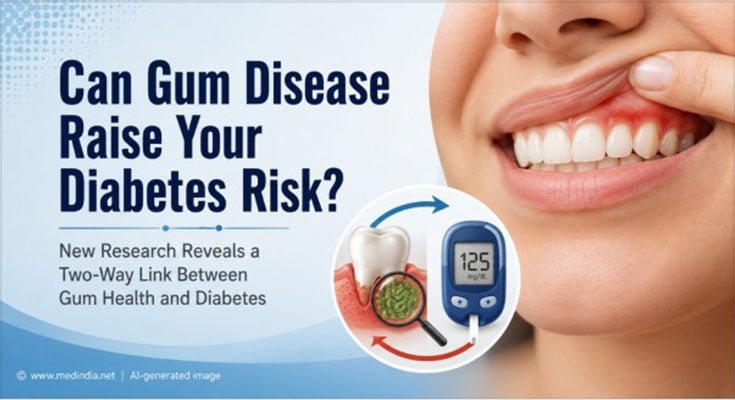
Gum disease may be linked to a higher risk of type 2 diabetes, while diabetes may also increase the risk of gum disease, according to a major review.

- People with periodontitis had an 18% to 25% higher occurrence of newly diagnosed type 2 diabetes during follow-up
- Complete tooth loss was linked to a 30% higher occurrence of newly diagnosed diabetes
- The researchers found evidence of a two-way relationship between diabetes and gum disease
Could the health of your gums provide clues about your future diabetes risk? A major review involving more than 300,000 people suggests that gum disease and diabetes may be connected in both directions (1✔ ✔Trusted Source
Oral health and diabetes: a systematic review and meta-analysis
).
A systematic review and meta-analysis published in The Lancet Public Health found that people with periodontitis, a severe form of gum disease, were more likely to develop type 2 diabetes during follow-up than those without periodontitis.
The researchers also found evidence pointing in the opposite direction: people with diabetes were more likely to subsequently develop periodontitis and experience tooth loss.
The findings do not mean that gum disease causes diabetes or that bleeding gums are a diagnosis of diabetes. Instead, they highlight a potentially important connection between oral and metabolic health.
Advertisement
What Did the New Study Find?
Researchers conducted a systematic review of 28 longitudinal studies from 16 countries, involving more than 300,000 participants. Unlike studies that examine people’s health at only one point in time, longitudinal studies can help researchers determine which condition appeared first.
The review looked at several major oral health conditions, including:
- Periodontitis
- Dental caries
- Tooth loss
- Complete tooth loss, also called edentulism
- Oral cancer
Periodontitis was the most commonly studied condition, appearing as an outcome in 21 of the 28 studies.
Advertisement
Does Gum Disease Increase Diabetes Risk?
The strongest evidence concerned periodontitis and newly diagnosed type 2 diabetes.
Across six studies involving 29,265 participants, with follow-up periods ranging from 5 to 20 years, people who had periodontitis at the beginning of the studies had an 18% to 25% higher occurrence of newly diagnosed type 2 diabetes compared with people without periodontitis.
The researchers also found a similar direction of association when they examined risk ratios from other studies.
However, this does not prove that periodontitis causes diabetes. The studies were observational, meaning other factors may contribute to the relationship.
Advertisement
Can Tooth Loss Also Be a Warning Sign?
The study found another notable association involving tooth loss. Across analyses involving more than 226,000 participants, greater tooth loss was associated with a 12% to 20% higher hazard of developing diabetes, depending on the threshold of tooth loss used.
People who had lost all their teeth at the beginning of the studies also had a 30% higher occurrence of newly diagnosed diabetes than people who still had their natural teeth.
The pooled risk ratio was 1.30, with a 95% confidence interval of 1.02 to 1.64.
This does not mean that tooth loss itself causes diabetes. Tooth loss can result from several factors, including periodontal disease, oral hygiene, smoking, diet and access to dental care.
Could Diabetes Also Damage Gum Health?
The relationship appeared to work in the opposite direction as well.
Among people who already had diabetes, the researchers found an increased likelihood of subsequently developing periodontitis.
The pooled analysis showed a 28% higher relative risk of periodontitis among people with diabetes, although the evidence was less consistent than the association between periodontitis and later diabetes.
The researchers’ pooled analyses found a risk ratio of 1.28 (95% CI 1.00–1.64) for diabetes and subsequent periodontitis.
Diabetes was also associated with a higher risk of tooth loss over time.
Why Might Gum Disease and Diabetes Be Connected?
The exact biological mechanisms were not the main focus of this review, but the researchers pointed to several possible explanations.
Periodontitis involves long-lasting inflammation in the tissues around the teeth. This inflammatory activity may contribute to changes elsewhere in the body and could potentially interfere with normal glucose regulation.
The researchers suggest that chronic low-grade inflammation, altered immune responses and shared risk factors may help explain the two-way relationship between periodontal inflammation and abnormal glucose metabolism.
The relationship may also work in the opposite direction. Poorly controlled diabetes can affect the body’s ability to fight infection and heal normally, potentially making the gums more vulnerable to periodontal disease.
However, these mechanisms remain explanations for the observed associations rather than proof of cause and effect.
What About Cavities?
The review also examined dental caries, but the evidence was much more limited.
Only three longitudinal studies were available, and their methods and findings were too different to combine statistically. Some studies suggested that poorer blood sugar control was associated with greater progression of dental caries.
The researchers therefore said that the evidence on dental caries should be interpreted cautiously and that more longitudinal research is needed.
What About Oral Cancer?
The researchers found no longitudinal studies suitable for evaluating the relationship between diabetes and oral cancer. Therefore, this review cannot determine whether diabetes is associated with a future risk of oral cancer.
What Makes This Study Important?
One of the major strengths of the review is its focus on longitudinal evidence, which allows researchers to examine how the two conditions may influence each other over time. The team searched multiple databases and initially identified 45,477 records. After removing duplicates and screening the studies, 28 longitudinal studies from 16 countries were included in the final analysis.
Importantly, the researchers examined the relationship in both directions, whether periodontitis was linked to a higher risk of developing diabetes in the future, and whether diabetes was associated with an increased risk of developing periodontitis later. This approach provides a clearer understanding of the potential relationship between the two conditions than studies that assess diabetes and gum disease at only a single point in time.
Does Bleeding Gums Mean You Have Diabetes?
No. Bleeding gums are common with gum inflammation and periodontal disease, but this study did not establish that bleeding gums are an early diagnostic sign of diabetes.
The research investigated periodontitis, not bleeding gums alone.
Therefore, someone with bleeding gums should not assume they have diabetes. However, persistent gum swelling, redness, bleeding, gum recession or loose teeth should be evaluated by a dental professional.
People with gum disease who also have risk factors for diabetes may benefit from discussing whether diabetes screening is appropriate.
What Should You Do About Your Oral Health?
The findings support treating oral health as part of overall health rather than viewing dental care as completely separate from medical care.
Regular dental examinations can help detect gum disease early. People who already have diabetes should also pay particular attention to their oral health and maintain good blood sugar control as part of their overall care.
The researchers suggest closer collaboration between dentists, primary-care professionals and diabetes-care teams to identify and manage these interconnected health problems.
See a dentist if you notice:
- Gums that bleed frequently
- Red or swollen gums
- Persistent bad breath
- Receding gums
- Loose teeth
- Increasing gaps between teeth
- Pain or tenderness while chewing
These symptoms do not automatically indicate diabetes, but they should not be ignored.
What Are the Study’s Limitations?
Although the review included a large number of participants and focused on longitudinal studies, the researchers noted several limitations.
The studies differed in how they diagnosed and measured periodontitis, diabetes and tooth loss. Some relied on self-reported information, while others used clinical examinations, blood glucose measurements or medical records.
The researchers also noted that residual confounding cannot be completely excluded. Factors such as smoking, obesity, diet, socioeconomic conditions and other health behaviours may influence both oral health and diabetes risk.
In addition, evidence for some oral conditions, particularly dental caries, was limited and too heterogeneous for meaningful meta-analysis.
The authors therefore emphasized that the findings demonstrate associations rather than proof of causation.
The Bottom Line
Gum disease may be more closely connected to metabolic health than previously appreciated.
This large review found that people with periodontitis had an 18% to 25% higher occurrence of newly diagnosed type 2 diabetes during follow-up, while people with diabetes also had a higher likelihood of developing periodontitis. Complete tooth loss was associated with a 30% higher occurrence of newly diagnosed diabetes.
The findings do not mean that gum disease causes diabetes or that bleeding gums can diagnose the condition. Instead, they strengthen the case for treating oral health and metabolic health as interconnected parts of overall healthcare.
A healthy mouth may not predict your future with certainty, but taking care of your gums could be an important part of taking care of your overall health.
Frequently Asked Questions
Q: Can Gum Disease increase the risk of Type 2 Diabetes?
A: A major review found that people with periodontitis had an 18% to 25% higher occurrence of newly diagnosed type 2 diabetes during follow-up. However, the findings show an association and do not prove that gum disease causes diabetes.
Q: Can Diabetes increase the risk of Gum Disease?
A: Yes. The review found that people with diabetes had a 28% higher relative risk of subsequently developing periodontitis, although the evidence was less consistent.
Q: Do Bleeding Gums mean I have Diabetes?
A: No. Bleeding gums can occur because of gum inflammation or periodontal disease, but this study did not establish bleeding gums as a diagnostic sign of diabetes.
Q: Does losing teeth increase Diabetes risk?
A: The review found that greater tooth loss was associated with a higher likelihood of developing diabetes. Complete tooth loss was associated with a 30% higher occurrence of newly diagnosed diabetes.
Q: How can I protect my Gums and Overall Health?
A: Regular dental examinations, good oral hygiene, and timely treatment of gum disease can help maintain oral health. People with diabetes should also pay particular attention to their oral health and blood sugar control.
Reference:
- Oral health and diabetes: a systematic review and meta-analysis
– (https://www.thelancet.com/journals/lanpub/article/PIIS2468-2667(26)00149-0/fulltext)
Source-Medindia