

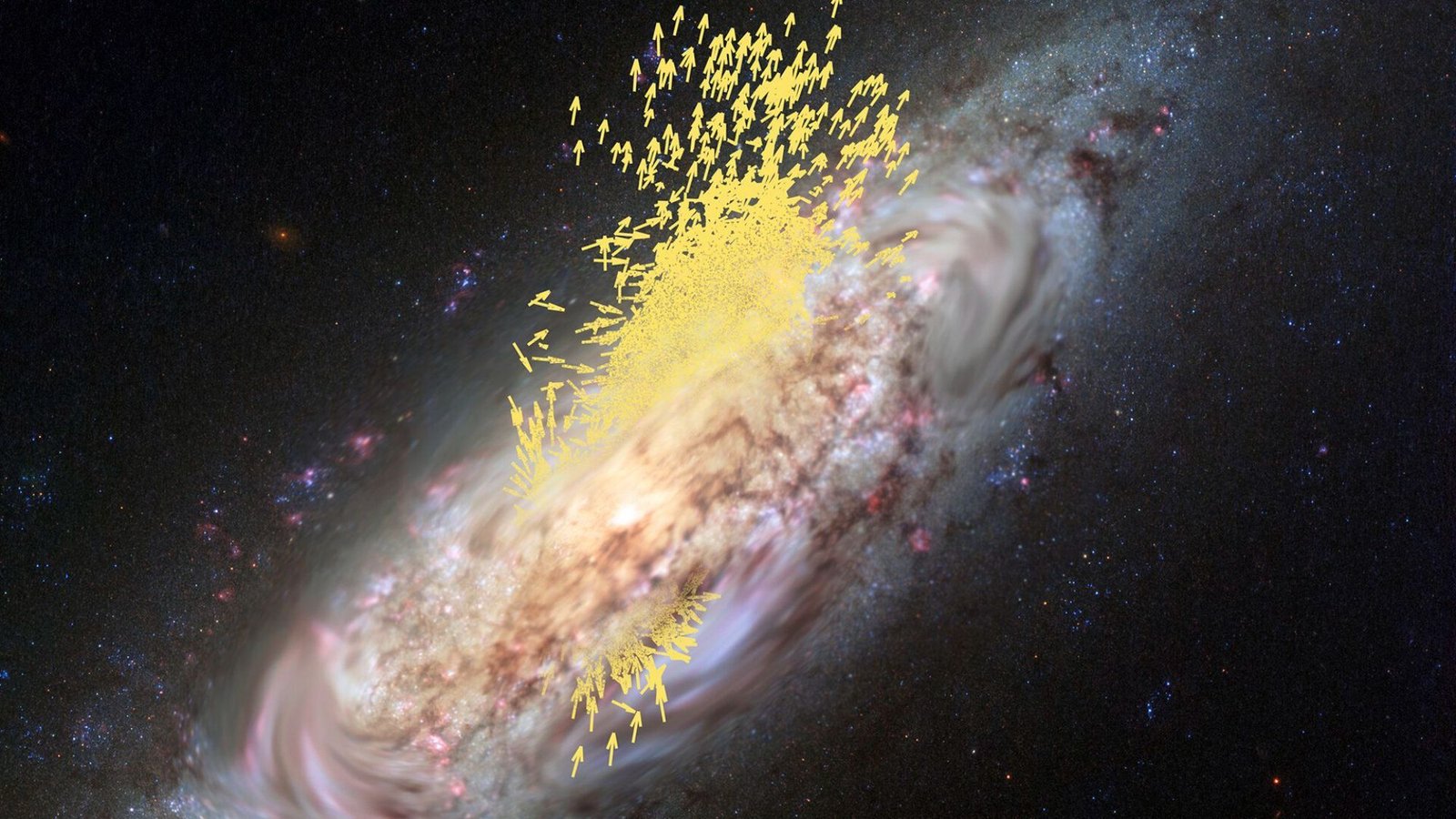
The Milky Way’s spiral disk may have flipped over by 90 degrees, in turn altering the solar system’s orbit around the center of the galaxy.
Spiral galaxies such as the Milky Way have two main, visible, structural components: a disk that encapsulates most of its stars, gas and the central black hole, and a more diffuse halo of older stars that encapsulates the disk.
However, the Milky Way’s stellar halo has always been a bit of an oddity. The European Space Agency’s Gaia mission measured the motion of the halo’s stars to find they rotate slowly compared to other material within the spiral disk. Now, supercomputer models led by Kirill Batrakov of the University of Durham have found what triggers this: galactic mergers and spiral disks becoming flipped over.
In their simulations, Batrakov and colleagues tracked the evolution of 25 Milky-Way-like galaxies across billions of years. They found that those which had slowly spinning haloes also experienced head-on mergers with other galaxies and had their disk flipped at some point.
“We already know that the Milky Way had a massive head-on collision in the past with a galaxy known as Gaia-Sausage-Enceladus,” Batrakov said in a statement. “So, we think that the Milky Way disk likely flipped in the past.”
Gaia-Sausage-Enceladus was a dwarf galaxy with more than 10 billion times the mass of our sun that slammed into the Milky Way between 8 billion and 11 billion years ago. The evidence for this collision was also found in Gaia’s measurements of the motions of stars. The colliding galaxy’s strange name comes in part because as it was ripped to pieces by the Milky Way’s gravity, its stars were channeled onto highly elongated, sausage-shaped streams that our galaxy incorporated into its halo.
This collision was the last major impact that our Milky Way galaxy experienced, but maybe not the last major event that it experienced. At some point, the Milky Way’s disk seems to have also flipped, but what caused this is uncertain. Also of note: The simulations showed that galaxies whose disks flipped hadn’t always experienced a merger.
“We think that there might possibly be different mechanisms driving the disk flips,” Batrakov told Space.com. “At this point, we are not sure which scenario applies to the Milky Way specifically and a further investigation is needed on the precise mechanics of disk flips.”
These two mechanisms — the merger and the flip — would both contribute to the slower spinning halo. The head-on merger sees lots of stars from the Gaia-Sausage-Enceladus galaxy get thrown into the halo but on trajectories strongly misaligned with the disk. So, relative to the disk, they collectively rotate more slowly.

The disk flip leads to a similar situation. In the simulations, the flip is measured with respect to the space around the galaxy, but as the orientation of the disk changes relative to the halo, the halo doesn’t immediately reorient with it and takes its time to synchronize its rotation with the disk. Hence, this misalignment results in the halo having less coherent rotation relative to the new orientation of the disk.
If the disk flip occurred during the solar system’s lifetime, then it could have impacted our own orbit around the galactic center.
“A disk flip means that most of the Milky Way’s stars once moved on very different trajectories than they do today, possibly even our sun, meaning our ‘stable’ spot in the galaxy might not have been so stable for the solar system‘s whole lifetime,” said Batrakov.
Much of what we understand about other galaxies comes from our knowledge of the Milky Way and its story.
“Finding that its disk flipped adds a new chapter to that story, one we must account for when placing the Milky Way in a broader context of other galaxies,” said Batrakov, who recognizes just how incredible it is that we can infer this story through careful observations billions of years after the fact.
“What excites me most is that this complex history can be reconstructed just from present-day observations,” he said.
Batrakov presented his work at the Royal Astronomical Society’s National Astronomy Meeting, being held at the University of Birmingham between July 20 and July 24.