

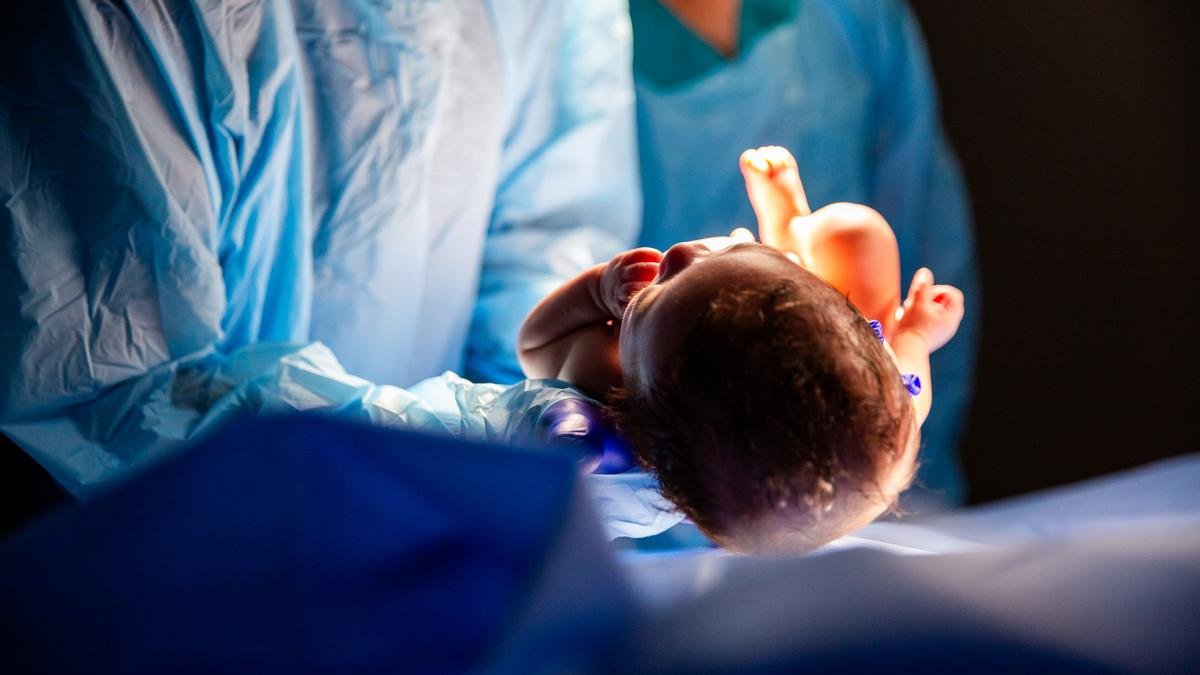
In Jammu and Kashmir’s private hospitals, nine out of every ten babies born arrived by Caesarean section — the highest private-sector C-section rate anywhere in India, according to newly analysed data from the National Family Health Survey-6 (NFHS-6). West Bengal follows at 87.7%, and Telangana at 83.9% — all three States running far above the national private-sector average of 54.1%.
In India, medical experts attribute the increase in C-sections to a combination of more institutional deliveries, improved detection of high-risk pregnancies, increasing maternal age and medical complications, greater use of assisted reproductive technologies, previous C-sections, and the rapid growth of private-sector obstetric care, where scheduled deliveries, convenience, financial incentives and maternal preference in some cases also contribute to higher C-section rates.

“The objective is not to achieve a specific C-section rate but to ensure that every woman who needs a Caesarean receives one, while avoiding unnecessary surgical intervention. There is no single research study that conclusively explains why C-sections are more common in Jammu and Kashmir,” said Dr. Sami Jan, Faculty, Gynaecology and Obstetrics department at the SKIMS Medical College and Hospital Bemina in Srinagar, Jammu and Kashmir.
“But some plausible reasons could be that the tertiary referral system receives a large proportion of high-risk pregnancies from district and peripheral hospitals. This naturally increases the number of women requiring a Caesarean section. Delayed referrals, better technology that can detect distress, geographic and weather challenges, increased maternal age, and infertility treatments are all contributing factors,” Dr. Jan added.

According to the National Family Health Survey-6 (NFHS-6, 2023–24), 27.2% of all births in India are now delivered by caesarean section (C-section), a sharp rise from 21.5% in NFHS-5 (2019–21), indicating a continued increase in surgical childbirth across the country. The rise is driven largely by the private healthcare sector, where 54.1% of births are by C-section, up from 47.4% in NFHS-5.
In contrast, the public sector C-section rate increased more modestly from 14.3% in NFHS-5 to 16.9% in NFHS-6. Overall, the data show that while institutional deliveries have increased from 88.6% to 90.6%, the growth in C-sections has outpaced this rise, with the gap between private and public facilities widening further, raising concerns about the potential overuse of medically unnecessary C-sections, particularly in private hospitals.
The World Health Organisation (WHO) says Caesarean sections should be performed only when medically necessary; at the population level, C-section rates above around 10% are not associated with further reductions in maternal or newborn mortality, and WHO no longer recommends a specific national target rate.

“Fear of labour pain, anxiety about the baby’s safety, past experiences, misinformation, and cultural beliefs can influence Caesarean decisions for women and their families. Some emerging biomedical evidence suggests that C-sections may influence early gut microbial colonisation in infancy; a meta-analysis of observational studies has reported a modest association with neurodevelopmental conditions such as autism, although causality remains unproven,” said Nikhil Gupta, Integrative Psychiatrist and Mind Health Physician at Wellness Clinic Jammu.
“Informed consent requires balanced counselling about both vaginal and surgical delivery, and integrating psychological support throughout pregnancy can promote informed decision-making and help ensure that C-sections are performed only when medically necessary,’’ Dr. Gupta added.
So, what explains India’s private-sector numbers running five to nine times higher than that benchmark?
Also read | How nature intended: pregnancy and C-sections
“India’s rising Caesarean rate reflects both overuse in some settings and underuse in others, highlighting the need for interventions tailored to local health-system realities rather than a uniform approach,” said Preety Aggarwal, medical director of Obstetrics and Gynaecology at Motherhood Hospital, Gurugram.
Dr. Aggarwal points to fear of litigation pushing some obstetricians toward surgery to minimise perceived medico-legal risk, alongside a shift in maternal age and health: “Today women are increasingly having babies at a later age, which is associated with higher rates of pregnancy complications requiring surgical delivery. Also, a rise in lifestyle diseases, including obesity, diabetes, hypertension, infertility treatments, and multiple pregnancies further complicate the situation,” she added.
Additionally, maternal preference for C-sections shaped by fear of labour pain, convenience, prior birth experience, or choosing an auspicious birth date — has also pushed up demand in some urban settings.

Meanwhile, the picture reverses in rural India. According to NFHS-6 (2023–24), 40.5% of births in urban India were delivered by caesarean section compared with 22.8% in rural India,
“Obstetric haemorrhage remains the single largest killer of women during childbirth [in rural India]; it accounts for nearly 47% of maternal deaths in India, with the burden falling disproportionately on poorer states,” said Astha Dayal, director of Obstetrics & Gynaecology at CK Birla Hospital, Gurugram, adding that C-section is not a matter of convenience or commerce — rather, it is, in countless cases, the only intervention standing between a mother’s survival and a preventable death. When labour is obstructed, when the placenta ruptures, or when bleeding after delivery spirals beyond control, timely surgical intervention saves both mother and newborn.”
Vaginal delivery remains the preferred mode of birth for most uncomplicated pregnancies because it is associated with lower maternal morbidity, reduced blood loss and infection, shorter hospital stay, faster recovery, earlier breastfeeding, fewer complications in future pregnancies, and improved neonatal respiratory adaptation.

Mamatha K.V., obstetrician-gynaecologist and principal of SDM College of Ayurveda and Hospital, Udupi, points to the physiological case for vaginal delivery: “Normal vaginal delivery offers significant benefits for both mother and baby. Passage through the birth canal exposes the newborn to beneficial maternal microbes that help establish a healthy gut microbiome, supporting immunity and reducing the risk of allergies and metabolic disorders. Labour also triggers hormonal and physiological changes that aid lung maturation, breastfeeding, and mother-infant bonding, while mothers experience faster recovery and fewer surgical complications.” She adds that Ayurveda’s traditional framework — Garbhasamskara and Garbhini Paricharya — emphasises preconception care, a month-wise antenatal diet and lifestyle, and labour support aimed at an uncomplicated vaginal delivery.
India currently has no standard national tariff for a C-section in India. Costs vary widely by city, hospital, room category, and case complexity — from roughly ₹50,000 to ₹5 lakh or more. The bill typically includes the obstetrician’s and anaesthetist’s fees, operating theatre charges, room rent, nursing care, medicines, surgical consumables, lab investigations, paediatric assessment of the newborn, and other hospital services. Costs can climb sharply if the mother needs intensive monitoring or additional procedures, or if the newborn requires NICU admission.