

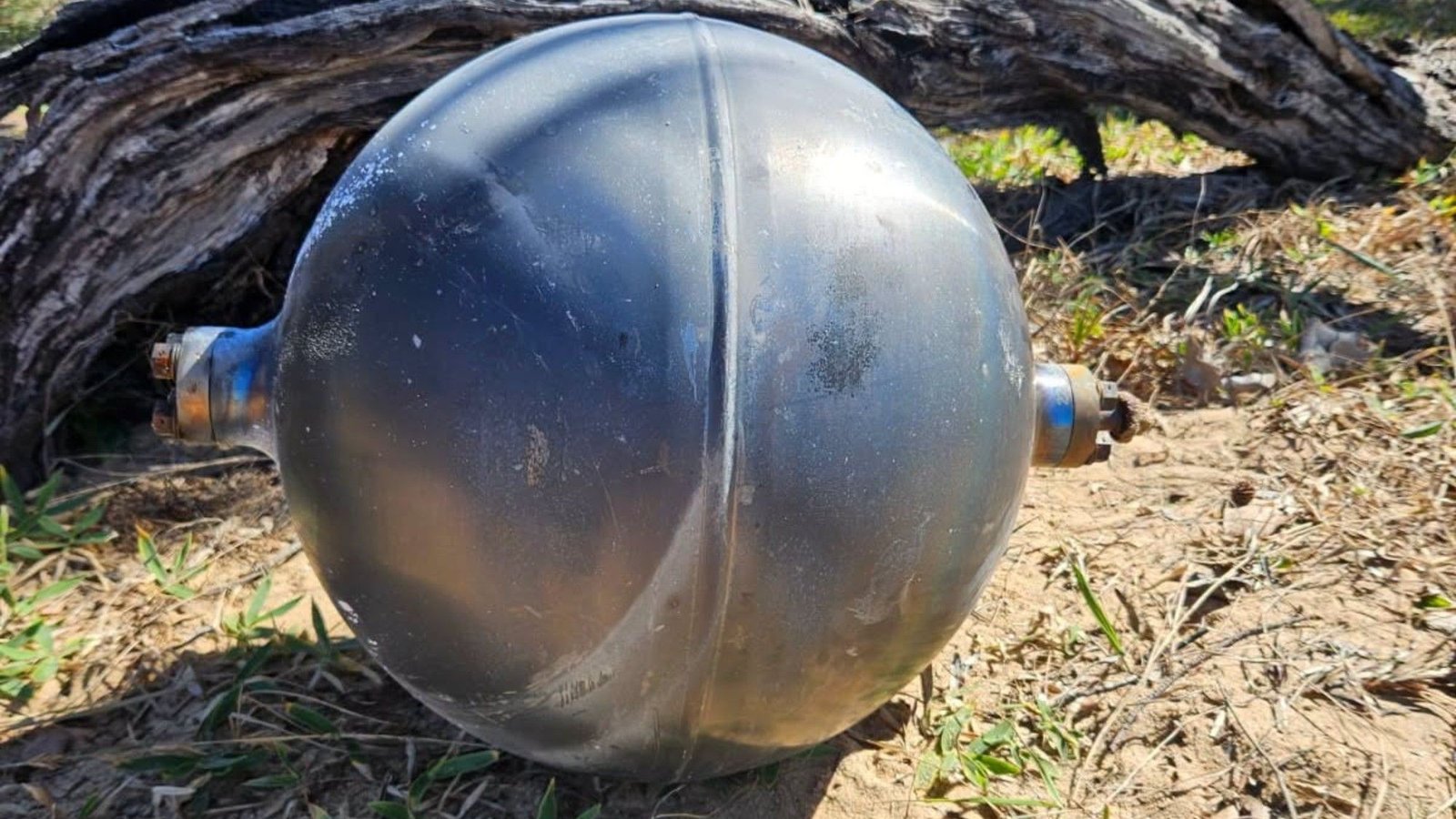
Once again, the “Land Down Under” is on the apparent uptick for falling space debris.
In early July, the Australian Space Agency reported that objects recovered, dubbed “space balls,” are likely pressure vessels from a space launch vehicle. Six spherical pieces of space junk were found in the small seaside community of Forrest Beach, near Ingham. Australian Queensland Fire Department crews swung into action to assist partner agencies following the discovery of the potentially hazardous objects. Scientific teams safely secured a number of the items, establishing a 165 feet (50-meter) “exclusion zone” around them to assure public safety. The nature and origin of the debris are still being investigated.
This latest incident is part of an unwanted legacy of being the “fall guy” for space remains, from the U.S. Skylab space station debris that fell into Western Australia in 1979; a chunk of a SpaceX Dragon trunk found in New South Wales in 2022; a pressure vessel that washed up in Perth from an Indian booster in 2023; along with a section of Chinese Jielong-3 rocket in October 2025.
In fact, these incidents are becoming so common that the Australian Space Agency has put together a trio of steps to take if suspected space debris is discovered:
- Step 1: Do not handle the debris. Space objects are built from a range of materials that may be hazardous. They should only be handled by appropriately trained and equipped professionals.
- Step 2: Contact the local authorities if (a) the situation is potentially urgent (e.g. there is a life-threatening situation) or (b) otherwise contact the 24/7 Police Assistance Line for further advice.
- Step 3: Notify the Australian Space Agency, who may support authorities with technical expertise, liaise with foreign counterparts and operators, and advise on the country’s treaty obligations. The ASA can advise local authorities on the appropriate response to a confirmed space debris event.
Indeed, if an item is definitely found to be space debris, the Australian Government has worldwide obligations to notify the launching authority of its discovery, and upon request, may be required to return the space junk.

“Even if they heat up, they don’t care.”
For Marlon Sorge, executive director of the Aerospace Corporation’s Center for Orbital and Reentry Debris Studies (CORDS), it’s no surprise that the recent so-called space balls endured their plunge from space.
“Very often they will be made of something like titanium which is really good at surviving,” Sorge told Space.com. “In spite of them being metal, they tend to decelerate more than, say, a solid hunk of metal. They can ‘float down’ a little bit more gently than some other things,” he said.
Sorge said that this class of space debris decelerates quicker, and also once on the surface the pieces are also more recognizable than broken up chunks of metal. Furthermore, if made of titanium, “even if they heat up, they don’t care.” In other words, they tend to survive reentry intact.
There’s more awareness in the space debris study community that materials like titanium are potentially an issue, said Sorge. If you go to something like Composite Overwrapped Pressure Vessels (COPV), also commonly used in manufactured space hardware, that too is an issue you have to deal with, he said.
Bigger picture
But ultimately, many of these debris concerns could be mitigated with more responsible behaviors from space agencies and launch providers, Sorge said.
“In the bigger picture with [rocket] upper stages,” Sorge added, “just don’t let them randomly reenter. Bring them down via controlled reentry and then if they are survivable it doesn’t matter because you dump them somewhere where there aren’t any people.”
As for the Australian-found space leftovers, these tanks are clearly coming from non-controlled reentry events, said Sorge, dropping out of the sky and washing up onshore.
Over the years, the Aerospace Corporation has studied recovered pressure vessels like those from the Australian affair. The welcome mat is open for contributions from countries that are on the receiving end of space objects, Sorge advised.
Some information can be gleaned from such appraisals, like what shape the recovered debris is in, what degree of temperatures they were exposed to. Also, such a hands and eyes-on look can point out what they didn’t experience, which is also useful data, Sorge said.
If observers could track and observe incoming debris on its way down, it could be extremely helpful in identifying points of origin. That’s currently a challenge, Sorge said. “If we get an impact location and a time of reentry that really helps us figure out what’s going on,” he said.
On the whole, there’s a lot more attention being paid to the implications stemming from reentering, human-made, space leftovers.
“The real challenge is that this is still an area that we don’t completely understand. We get surprises now and again,” Sorge concluded, “because we know only so much. There’s certainly a lot more awareness now than earlier years to be proactive in thinking about this.”

Atmospheric drag wins
“It may seem surprising that pieces of the same rocket can show up in Australia, Canada or on a farm in Africa, but that’s actually what we’d expect,” said Michelle Hanlon, executive director of the Center for Air and Space Law at the University of Mississippi School of Law.
“Objects in low Earth orbit pass over much of the planet as the Earth rotates underneath them. If a reentry isn’t controlled, the exact point where it finally comes down can shift by thousands of kilometers depending on when atmospheric drag finally wins,” Hanlon told Space.com.
Since most of the Earth is ocean, that’s where most debris ends up, Hanlon said. “Every now and then, though, a tough piece survives and lands somewhere people can find it — or lands in the ocean and gets swept swiftly to shore.”
Country of origin?
Hanlon said that the pressure vessels like those found in Australia are a good example.
“They’re built to withstand enormous pressures, so they are also among the pieces most likely to survive reentry. That’s why they seem to turn up so often,” said Hanlon.
Why are recovered space debris so hard to identify, their country-of-origin?
“I’m not sure stamping everything with a country-of-origin is the answer,” said Hanlon. “Many of these objects can already be identified by their design, serial numbers or by matching them to launch and registration records. And there’s no guarantee a label would even survive reentry.”
For Hanlon, the bigger issue is traceability. “Can authorities quickly figure out what the object is, whether it poses any danger and which state should be contacted? Better information-sharing and better tracking would be far more useful than a ‘Made in’ stamp,” Hanlon said.
“One thing I’d also point out is that we’re seeing more of these simply because we’re launching a lot more things into space. That’s actually a sign of how active the space sector has become, not necessarily that it’s becoming less safe,” said Hanlon.
Even if reentries go exactly as planned 99.9 percent of the time, more launches mean more reentries, which means more chances that a particularly durable piece survives and lands somewhere unexpected.
All-in-all, the Australian incident of space balls is another sobering reminder that space activities don’t end when a mission does, Hanlon concluded. “End-of-life disposal is now just as much a part of responsible space operations as launch.”
This recent debris incident has a bit of a cosmic coincidence to it, too, Hanon added. “It’s funny that we’re having this conversation just as ‘Spaceballs: The New One‘ is gearing up.”
The sequel is being filmed in Australia.