

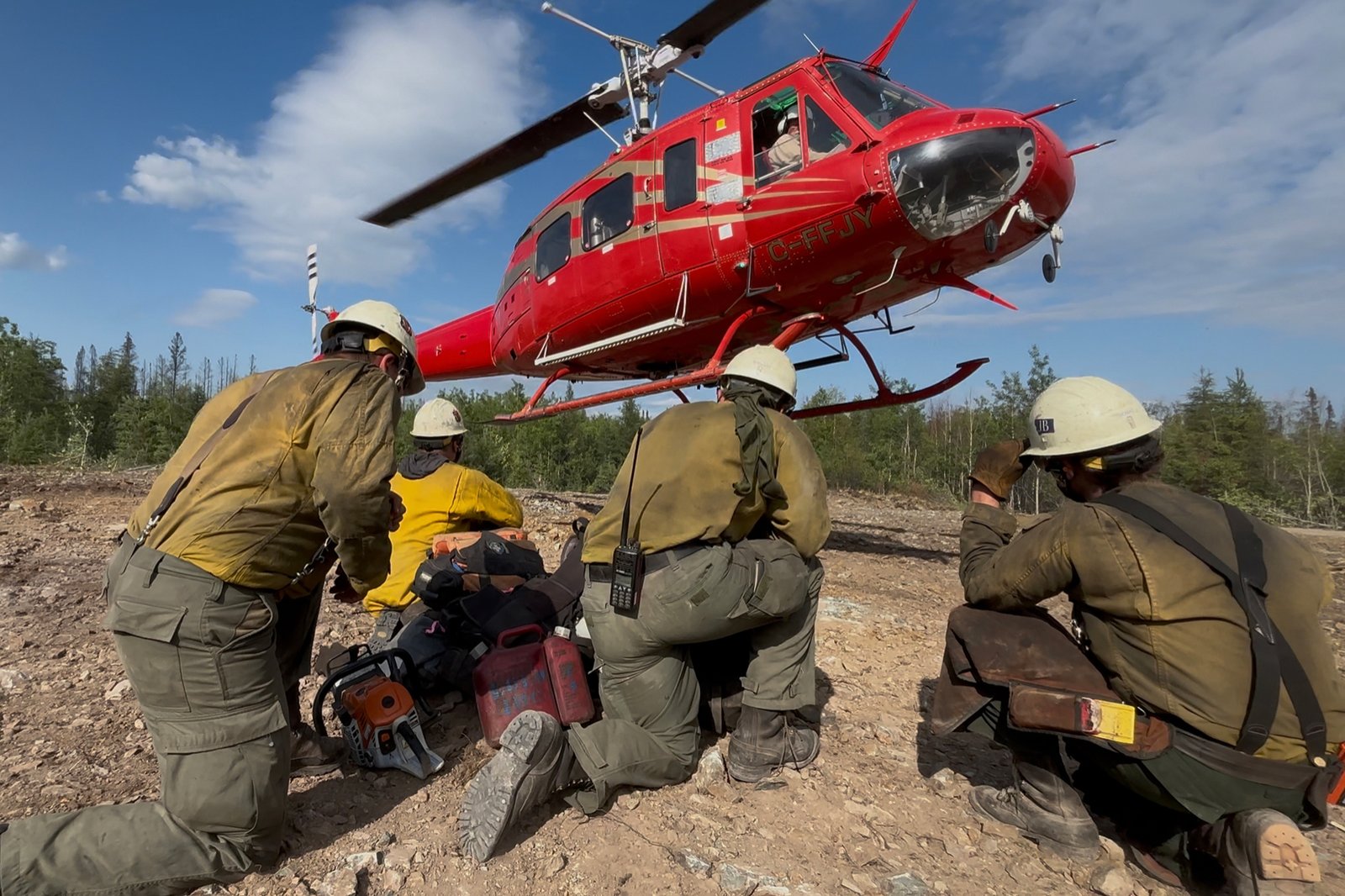
When wildfires began raging across France and Spain last month, the European Union sent aircraft and firefighters from nine other countries. The Pacific Northwest, where fires have forced tens of thousands to evacuate, has landed help from Australia and New Zealand.
Wildland firefighters have increasingly shared resources across borders, sending personnel and equipment to help in severe fire seasons. The trend is driven partly by climate change worsening wildfires, experts say. But now, wildfire seasons are becoming so bad they are stressing governments’ ability to share resources when they’re needed most.
“There’s more international cooperation happening, but it’s a double-edged sword because there’s more competition,” said Cordy Tymstra, a wildfire scientist and consultant in Canada. Just in the last month, out-of-control fires have torn through multiple countries and regions that typically send help to each other, he said. “There’s only so many resources, and the level of resourcing hasn’t risen commensurate with the need.”
Tymstra and other experts say increased reliance on international sharing over the last couple of decades helped close the gap as fire seasons intensified. But increasingly, it’s also revealing that firefighting capacity has failed to keep pace with climate change.
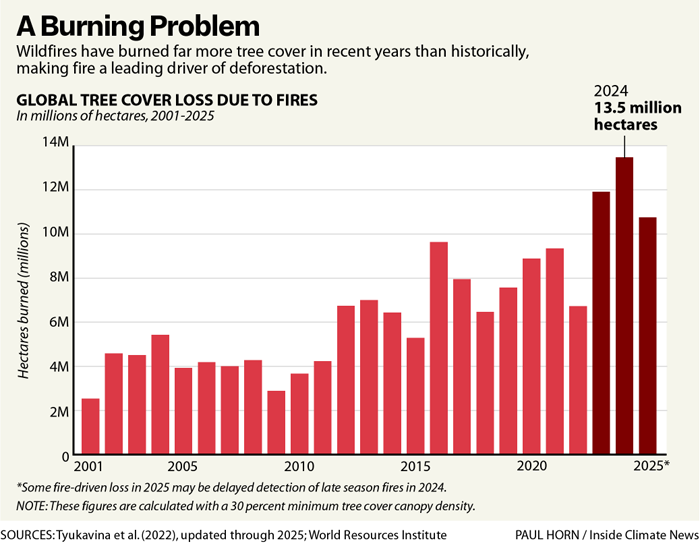
Wildfires now burn more than twice as much area annually as they did 20 years ago, according to data from the University of Maryland. Four of the five worst wildfire years this century have come since 2021.
Last year was Europe’s most destructive, but 31 percent more area has burned so far this year compared to the same period in 2025. Those fires have forced one of the largest evacuations in Europe since World War II.
In Spokane, fires have destroyed hundreds of homes and prompted comparison to a “war zone.” Across the United States, some 5.7 million acres have burned so far this year, more than all of 2025.
Canada had its second-worst season last year, trailing 2023. And new research is finding that reductions in pollution from vehicles, power plants and factories is being offset by increased wildfire smoke, which a study suggests is now a bigger health threat to babies in the womb.
Climate change is driving much of that increase, scientists say. A rapid attribution study found that the hot, dry conditions that fueled the flames across Spain were 20 times more likely now than in a pre-industrial climate.
“There’s a basic relationship between how hot a summer is and how much area burns,” said Robert Field, a fire and climate scientist at Columbia University.
Human behavior is also a factor. Most U.S. wildfires are started by people. More people are living in fire-prone areas. But there’s a simple physical relationship worsened by climate change, Field said, with warmer air drying vegetation faster. “The landscape is becoming more flammable.”
A study published in February found that hot, dry “fire weather” is occurring simultaneously across the globe more often. The paper divided the world into 14 regions and found that the overlap of this fire weather had increased significantly within 10 of them since 1979. Fire weather is also overlapping more frequently across regions, with 12 of the 14 seeing a significant rise.
The only region that saw a decline in synchronous fire weather was Southeast Asia, which the authors attributed to increased humidity.
Climate change is responsible for more than half of the increasing overlap of fire weather, according to the researchers, spread across institutions in three countries. The result is a shorter “window for firefighting coordination, potentially straining existing international firefighting cooperation efforts.”
The United States has agreements for sharing firefighting resources with Australia, Canada, Mexico, New Zealand and Portugal. Australia and New Zealand are particularly valuable partners because the two regions, in opposite hemispheres, rarely experience wildfires at the same time. In July, for example, the two countries sent 74 specialists to the U.S. to help in the Pacific Northwest.
Such sharing has become common—the United States has sent or received resources across borders in each of the last 10 years. In 2020, when the United States had a bad year, Canada sent more than 600 firefighters. In 2023, Canada’s worst year on record, the United States was one of 12 countries to assist, sending 2,774 firefighters north of the border.
The European Union shares resources across its membership and with partner countries including Turkey.
Bobbie Scopa, vice president of Grassroots Wildland Firefighters and a former fire chief with the U.S. Forest Service, said international partnerships play a critical role. In busy fire seasons the service tends to run out of people in mid-level management roles, she said, and teams from overseas step in.
But there’s evidence that this sharing has been strained in some years. The United States and Canada are now both at level 5 for fire preparedness, meaning resources are fully committed and fire danger is high. In other words, the two countries are effectively unable to share resources across the border at a time when both are in need.
This story is funded by readers like you.
Our nonprofit newsroom provides award-winning climate coverage free of charge and advertising. We rely on donations from readers like you to keep going. Please donate now to support our work.
A 2024 study found anecdotal evidence that sharing drops when multiple countries have bad fire years, such as 2017, but reported there was not enough data to establish a trend.
“The sharing model is based on the assumption that not all areas at all times will be in a disaster situation,” Tymstra said. The Pacific Northwest and British Columbia have had to look to Australia, New Zealand and Mexico for help this summer, rather than right across their border. Tymstra said it is too soon to say whether these limitations are on the rise, “but we’re seeing it right now.”
With resources stretching thin, experts point to the need to manage fires differently by learning to not only suppress them but also to live with them.
“Any activity with fire suppression is an activity that is needed if we have not been successful in managing our lands,” said Johann Goldammer, director of the Global Fire Monitoring Center in Germany. In some places, fire is a natural part of the ecosystem, and suppressing all fires is unhelpful. Instead, Goldammer said, governments need to clear excess vegetation and use prescribed burns to keep fires more manageable, while also making sure homes and other buildings are more resilient to flames.
The situation is made worse by staffing cuts across the U.S. federal government, said Dave Calkin, a wildfire researcher and consultant who worked at the Forest Service until he accepted an early retirement offer last year.
Many of the people who manage wildfire response have unrelated, full-time government jobs, Calkin said, but they step in to help in times of need. Participation has been declining for various reasons recently, he said, but widespread staff cuts implemented by the Trump administration have strained resources even further.
“At a time when we’re seeing more significant, complex fires, we have fewer teams to manage them,” Calkin said. “There are requests for incident management teams that are going unfilled, teams are managing multiple complex events and we’re starting to see fatigue in the system.”
The U.S. Wildland Fire Service, which was established last year in a major shakeup of the country’s wildfire management, said in a statement that international partnerships “remain a valuable resource during periods of peak wildfire activity.” When asked if the agency has failed to keep pace with worsening fire conditions, it said, “The U.S. Wildland Fire Service was established to unify efforts, strengthen leadership, and enhance the safety and effectiveness of our wildland firefighters. This integration enables the Department of Interior [to] address the growing challenges posed by increasingly frequent and severe wildfires, while protecting lives, communities, vital infrastructure, and our public and tribal lands.”
The U.S. cuts have global consequences. The Forest Service has long sent experts overseas to help other countries build their own wildfire capabilities with training and other work.
“We started seeing more and more requests from countries that weren’t necessarily having a lot of fires, but now with climate change they are starting to,” said Riva Duncan, president of Grassroots Wildland Firefighters, who has worked on some of these overseas contracts.
As the Trump administration slashed programs across government last year, many of those contracts were cut, Duncan said.
The Forest Service did not respond to questions for this article.
Several experts also said they fear that hostility toward allies expressed by President Donald Trump and others in government could strain relations. Last month, after smoke wafted from Canada into the United States, sending unhealthy air across large areas, Trump and Republicans in Congress criticized the country. Trump threatened to implement additional tariffs on Canada in response.
Scopa said such rhetoric was unhelpful and ignored years of assistance Canada has provided. She recalled one year when she was stretched to capacity managing wildfires in the Okanogan-Wenatchee National Forest, which borders Canada in Washington state. A new blaze broke out deep in a wilderness area. Scopa had no one to send, and the area was more accessible from the Canadian side, so she turned to her partners in British Columbia, who sent a team.
“Those guys are coming across an international border to help me fight a fire that I couldn’t staff,” Scopa said. “How is that for the epitome of international relations? They didn’t get mad at me because I couldn’t fight a fire that was coming at them.”
Duncan said countries have no option but to increase cooperation as a warming climate drives worsening wildfires.
“It really is a global problem,” she said. “We have to figure out how to solve some of these issues and address them collectively, as the world. And we need to help each other.”
About This Story
Perhaps you noticed: This story, like all the news we publish, is free to read. That’s because Inside Climate News is a 501c3 nonprofit organization. We do not charge a subscription fee, lock our news behind a paywall, or clutter our website with ads. We make our news on climate and the environment freely available to you and anyone who wants it.
That’s not all. We also share our news for free with scores of other media organizations around the country. Many of them can’t afford to do environmental journalism of their own. We’ve built bureaus from coast to coast to report local stories, collaborate with local newsrooms and co-publish articles so that this vital work is shared as widely as possible.
Two of us launched ICN in 2007. Six years later we earned a Pulitzer Prize for National Reporting, and now we run the oldest and largest dedicated climate newsroom in the nation. We tell the story in all its complexity. We hold polluters accountable. We expose environmental injustice. We debunk misinformation. We scrutinize solutions and inspire action.
Donations from readers like you fund every aspect of what we do. If you don’t already, will you support our ongoing work, our reporting on the biggest crisis facing our planet, and help us reach even more readers in more places?
Please take a moment to make a tax-deductible donation. Every one of them makes a difference.
Thank you,

Reporter, New York