

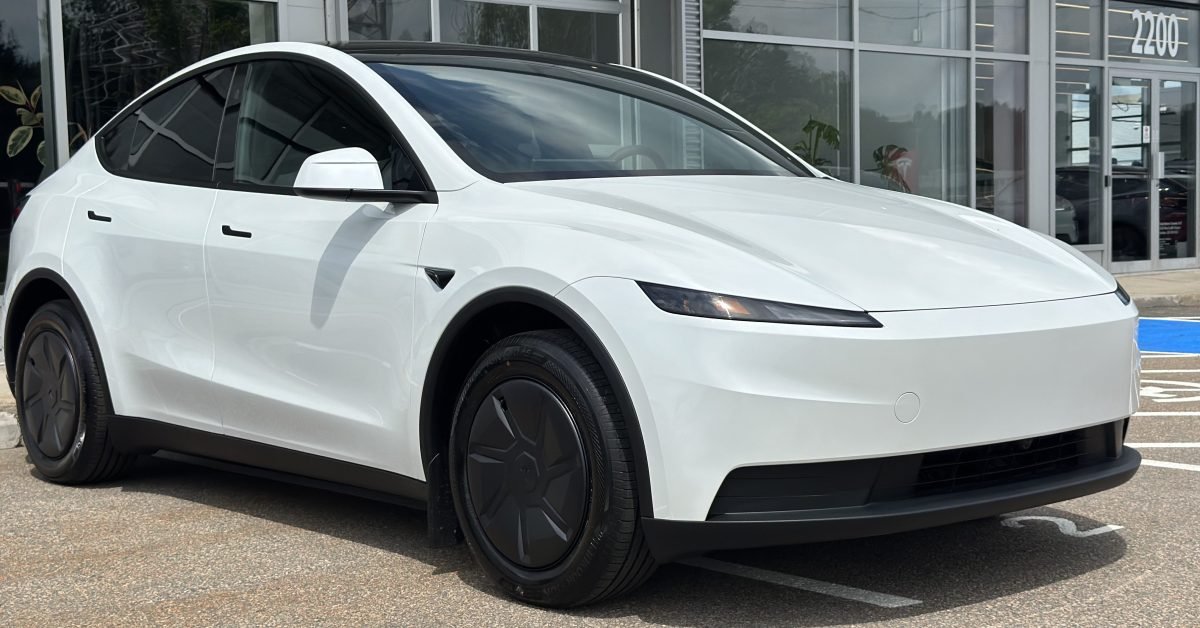

I drove the 2026 Model Y RWD (Standard) for about 550 km (342 miles) across a mix of highway, back roads, and city driving, and I enjoyed the efficiency and technology far more than the driving experience itself. For anyone shopping for an affordable Tesla built around the brand’s software and ecosystem, this standard trim is a real contender, but it drives more like a generic SUV than the brand promises.
Here is the full review:
Abstract
The 2026 Tesla Model Y RWD (Standard) I tested is the Canadian-market LFP version, rated for 463 km (288 miles) of range at 7.3 km/kWh (4.6 mi/kWh), that’s 136.4 Wh/km (219.6 Wh/mi), an efficiency figure I matched almost exactly over roughly 550 km (342 miles) of highway, backroad, and city driving.
Charging held up well too, with a 10-80% Supercharger session completed in 24 minutes, and the LFP chemistry adds a genuine bonus: V2X discharge of more than 12 kW without worrying for battery degradation. Acceleration is the trade-off; at 7.2 seconds 0-100 km/h, it’s the slowest Tesla yet.
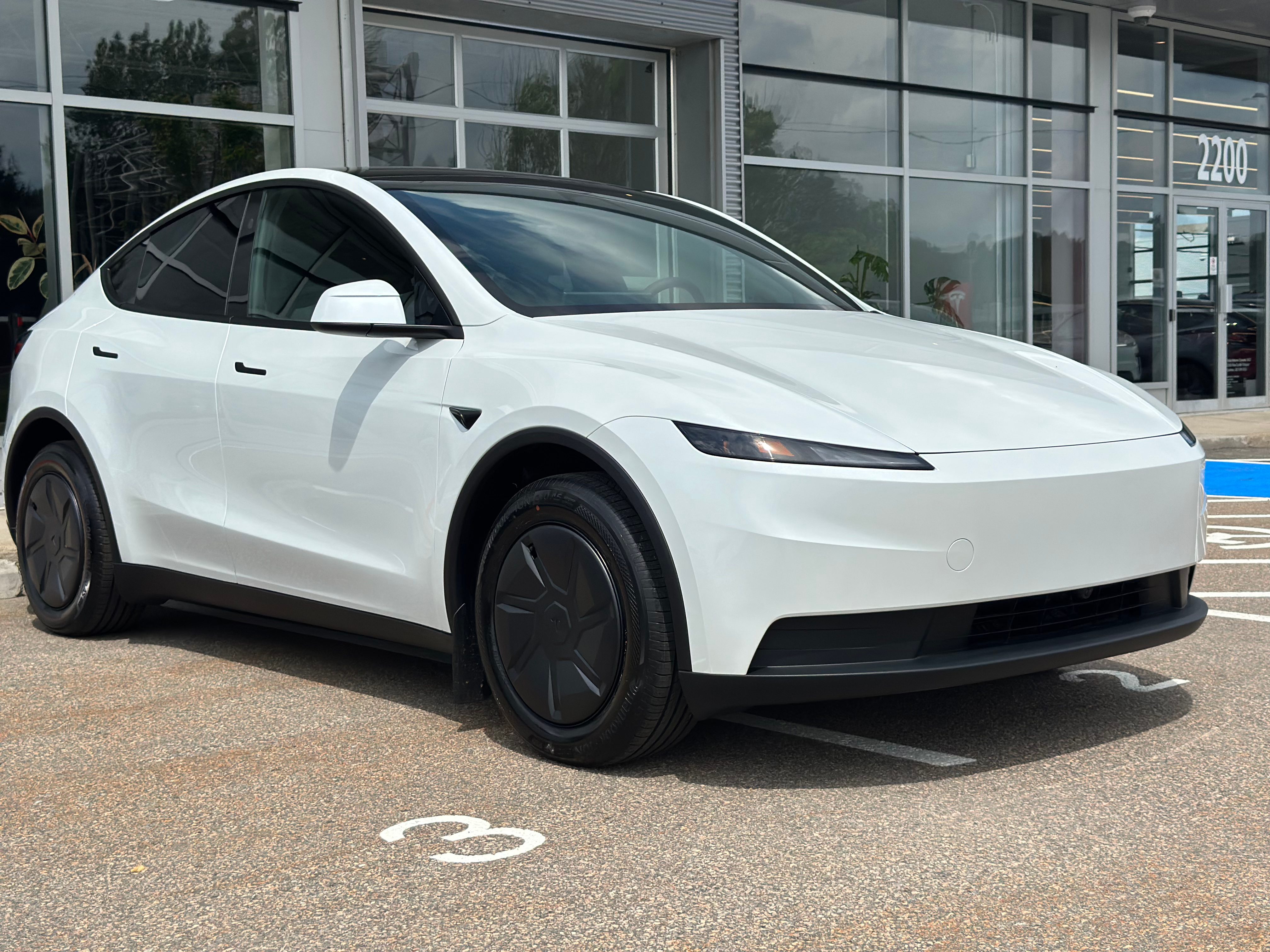
Storage is a genuine strength, with a spacious frunk, a deep subfloor trunk bin, and a nice open center console. It is fitted with one of the best user interfaces I have tested, even without a dedicated driver screen. The trade-offs of the Standard trim show up elsewhere: windows isolation is basic without double-paned, the closed roof feels cramped, and the 7-speaker sound system is a real disappointment coming from other Teslas.
Dynamically, this is the least Tesla-like Tesla I have driven; handling feels closer to a generic SUV than to the precise, planted feel I associate with the brand, and the blended brake-by-wire pedal takes some getting used to.
Driver assistance more than makes up for it: FSD (supervised) remains the best point-to-point Level 2 system available in North America, though it comes at a $99 monthly subscription, with Autosteer (lane-centering) no longer offered outside of it.
Overall, this standard trim’s $ 39,990 USD ($ 49,990 CAD) price undercuts the Premium by $ 6,000 USD, or $ 15,000 CAD, but it strips out meaningful equipment, from the panoramic roof’s opacity to the missing tow package.
It’s not quite the affordable EV breakthrough Tesla once promised, but for buyers who value the software and efficiency over outright driving dynamics, it remains a compelling entry point into the Model Y lineup.
Scores by category
Total score:
80.2 / 100
Engineering
(7.9 / 10)
For the 2026 model year of the base Model Y, Tesla offers 2 different battery packs depending on where the vehicle is built. For the US, with the vehicle built in Fremont or Austin, it is fitted with a 69.5kWh battery, smaller than the Premium trim (~80kWh) but composed of the same NCA cells in fewer numbers. They removed some of the paralleled cells and manage to reduce the energy capacity while keeping the same number of cells in series and so the same 400V max voltage. This new battery pack would be a 96S40P architecture, instead of the 96S46P of the Premium trim.
Elsewhere in the world, meaning a Y produced in Shanghai or Berlin, the Y RWD is fitted with an LFP battery pack of about 63kWh. Living in Canada, this is the vehicle I was able to test drive as we cannot get our Teslas from the US, even if that would make the most sense logistically and environmentally, thanks to dumb tariffs.
The battery pack engineering being weighted in this category, the score will reflect the vehicle I drove, equipped with the LFP battery, which is a nice upgrade in technology, bringing a much longer life out of the pack, the ability to daily charge to 100% without second thought on the battery degradation, and great charging performance. It is a nice upgrade over an NCA or NMC battery pack for the same energy capacity. It is not, however, the best LFP battery out there, far from BYD and CATL’s current generation.
If I were to review the US vehicle, my appreciation in this category would be lower, as the pack is an alternate version of aging 2017 technology. It was the best pack at the time, but nearly 10 years later, very few upgrades were made and charging performance actually decreased. Fortunately, 3 & Y energy efficiency has improved tremendously over the past decade, making up for the lack of battery improvements.
However, with the LFP version I got to drive, the improvements in the powertrain are added to battery improvement, resulting in quite a nice package.
Speaking of powertrain, this Model Y is equipped with a brand-new motor and drive combo, its only one, mounted on the rear axle. It is an evolution of the motor introduced in 2017 with the Model 3, with a redesigned rotor, stator and inverter for a lighter and more efficient powertrain, and I must say it is quite impressive for its efficiency. More on that in the next category.
It is nice to see Tesla still improving its vehicle powertrains, especially since its powertrains are already at the top and it could become complacent, as it did with its batteries.
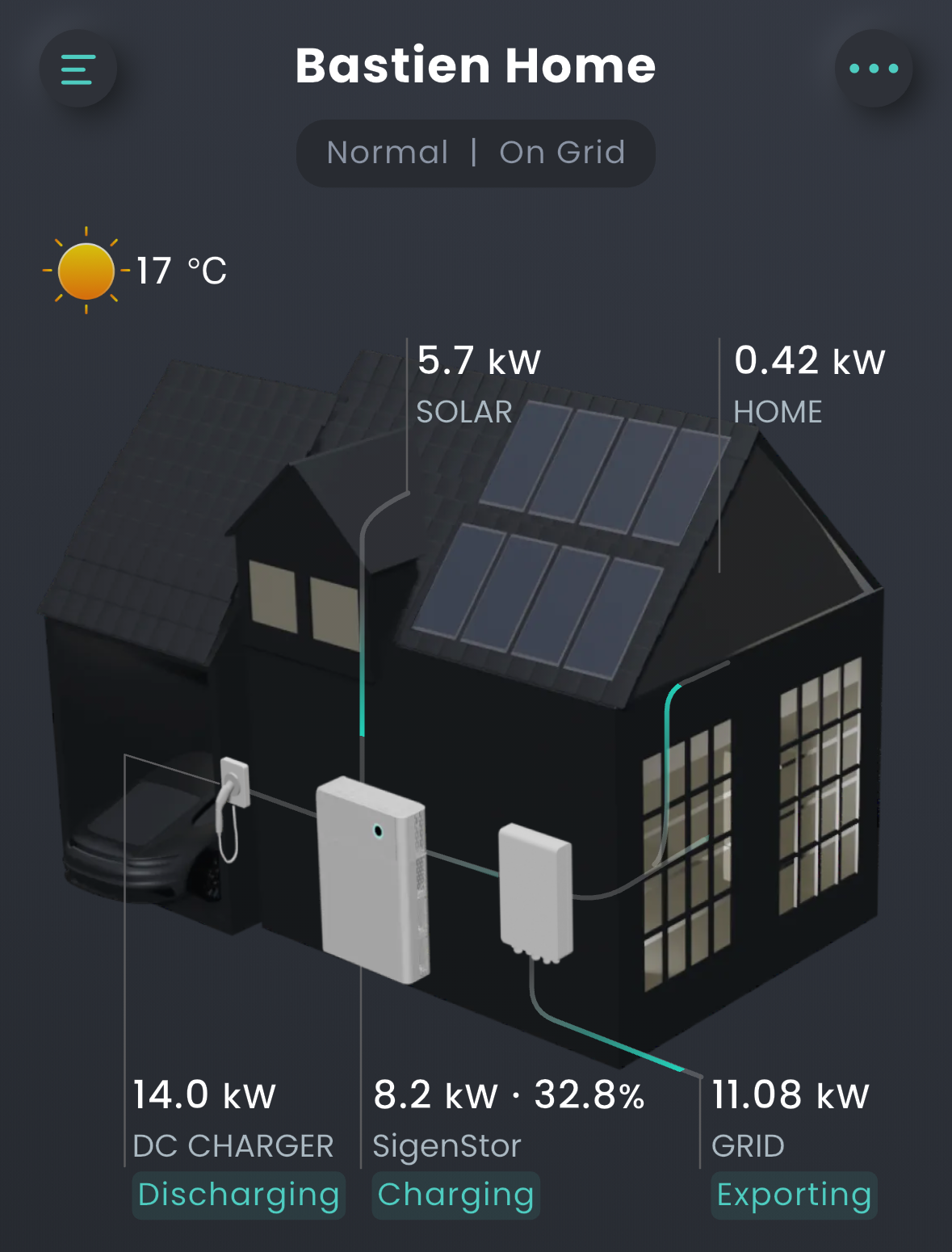
A welcome addition, even nicer with an LFP battery pack with a cycle life so much longer than the vehicle, is the possibility to discharge the battery through a V2X (vehicle-to-everything) system at powers in excess of 12kW (I personally reached 14kW) without the vehicle’s ECU throwing an error. This means, with the proper home installation, you are not buying just a vehicle, but also a backup battery of ~60kWh for your home. This feature also works with other trims of the Model Y, so the US Model Y RWD should have it too, and I hope it will not be removed by a software update. For example, I can also discharge my 2018 Model 3 using my V2X system, but the power must be limited to less than 4kW to prevent the vehicle’s ECU from tripping and thereby canceling the discharge.
Electric Performance & Charging
(17.1 / 20)
The Model Y RWD (Standard) I drove is rated for an amazing efficiency of just 7.3 km/kWh (4.6 mi/kWh), that’s 136.4 Wh/km (219.6 Wh/mi), for a total range of 463 km (288 miles). During my few days with it I achieved an average of 7.4 km/kWh (4.6 mi/kWh), that’s 135.9 Wh/km (218.6 Wh/mi), on my ~550 km (342 miles) road test, composed of mostly highway and backroads, meeting th eofficial efficiency.
On back roads only, at an average speed of 78 km/h (48 mph), it achieved an efficiency of 8.0 km/kWh (5.0 mi/kWh), that’s 124.7 Wh/km (200.7 Wh/mi), on a 140 km (87 mile) trip. That’s more than impressive considering the size and weight of it! Otherwise, I’m pleased to report the rated efficiency can be achieved while driving normally, or at least with my driving style as it is not the case for all the vehicle I review.
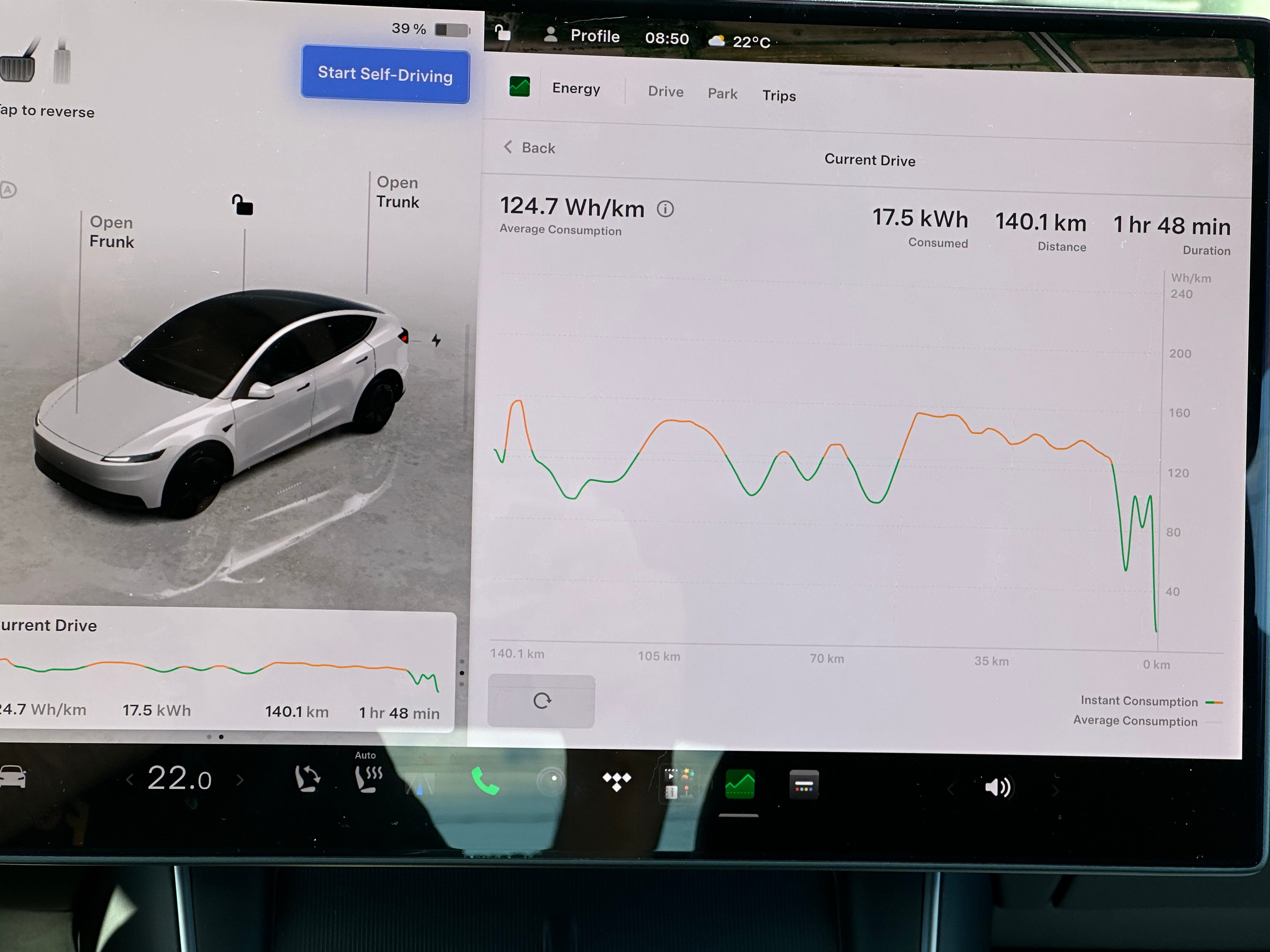
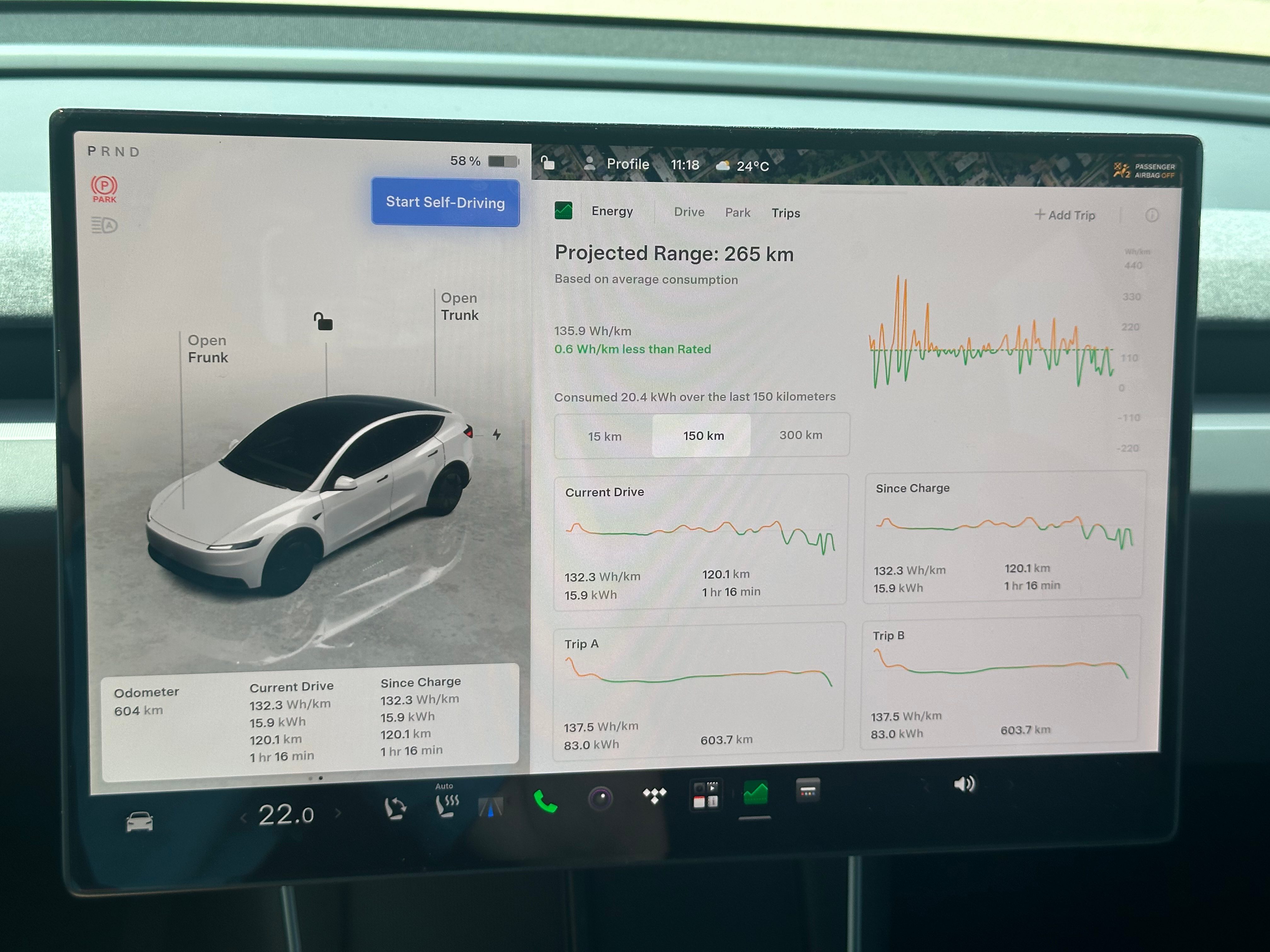
The 2026 Model Y RWD is as efficient as the 2026 Model 3 RWD, while being bigger, and it’s thanks to the new powertrain Tesla is debuting. I’m crossing fingers for this powertrain to make the jump into the Model 3 next.
The LFP battery pack is limited to 175kW of peak charging power, or 2.77C, but since it held it for a while and can maintain more than 100kW (1.58C) at 65%, my 10-80% charging test result in 24min on a Supercharger V2 capped at 143kW, for an average charging power of 110kW or 1.75C. This is a very good result, in line with what I want to see from a new EV, and I expect a full 0-80% charging session on Supercharger V3 at 175kW to last the same 24min at an average charging power of exactly 2C, or in other words capable of charging up to 370 km (230 miles) in 24min.
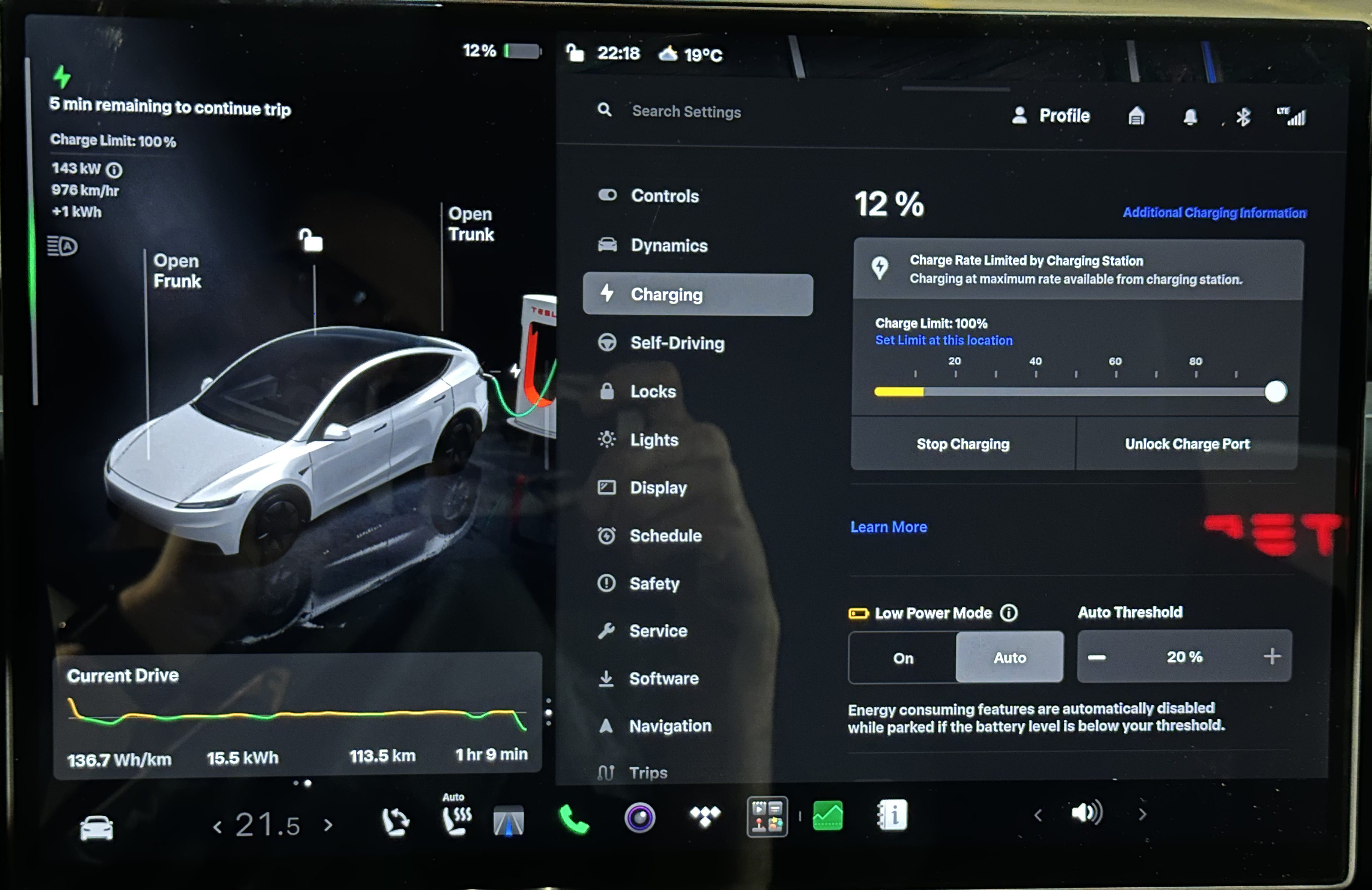
The charging performance of the US model is expected to follow those of the Premium trim which are at an average of about 32min for a 0-80% resulting in an average charging power of 103kW or 1.5C, and based on the EPA rating, it is good for a range of 516 km (321 miles), which means, in 32 minutes, up to 412 km (256 miles) can be recharged.
From now on I will include in my reviews the amount of range recharged as well as the 0-80% charging time as I think it is an easier metric to understand. For example, the Lucid Gravity I drove earlier this year charged from 0 to 80% in the same 24 min on a proper charging station. But the range recharged can be as high as 579 km (360 miles) in this time span, clearly not the same value. Note, I use the Gravity as an example only, it cannot be compared to the Y in any realistic metrics.
Acceleration is the Model Y RWD’s weak point, making it the slowest Tesla yet. At 7.2s 0-100km/h, it’s far from bringing the “Tesla Smile” when pressing the throttle at standstill. I think the power delivery is clearly limited by software, as the amount of power and torque available from a standstill feels noticeably less than at around 40 mph (64 km/h) while cruising. My guess is this is a software lock meant to create a gap between the Standard and Premium models, even though I suspect both are running the same motor and drivetrain hardware.
Ergonomics, Cabin & Storage
(16.2 / 20)
Cabin refinement is decent, if not flawless for an entry trim vehicle. Materials used are nice to touch, and the minimalist approach looks clean. Maybe a little too much for some.
Road noise Isolation is excellent, and cabin noise in general is low at 66db. However, wind noise creeps in at the windows, most likely because this Model Y skips double-pane glass, and the closed roof, while giving the black trim a clean look, makes the cabin feel more cramped than I’d like. Climate control, on the other hand, is good and intuitive, as with any Tesla, and you can even option oscillating vents that swing the airflow for both the driver and the passenger, which is a first for me, and I liked that feature. You have to get used to doing everything on the display though.
Seats are average, with fabric upholstery that keeps them from getting too hot, though ventilation isn’t offered, only heating and only for the front row.
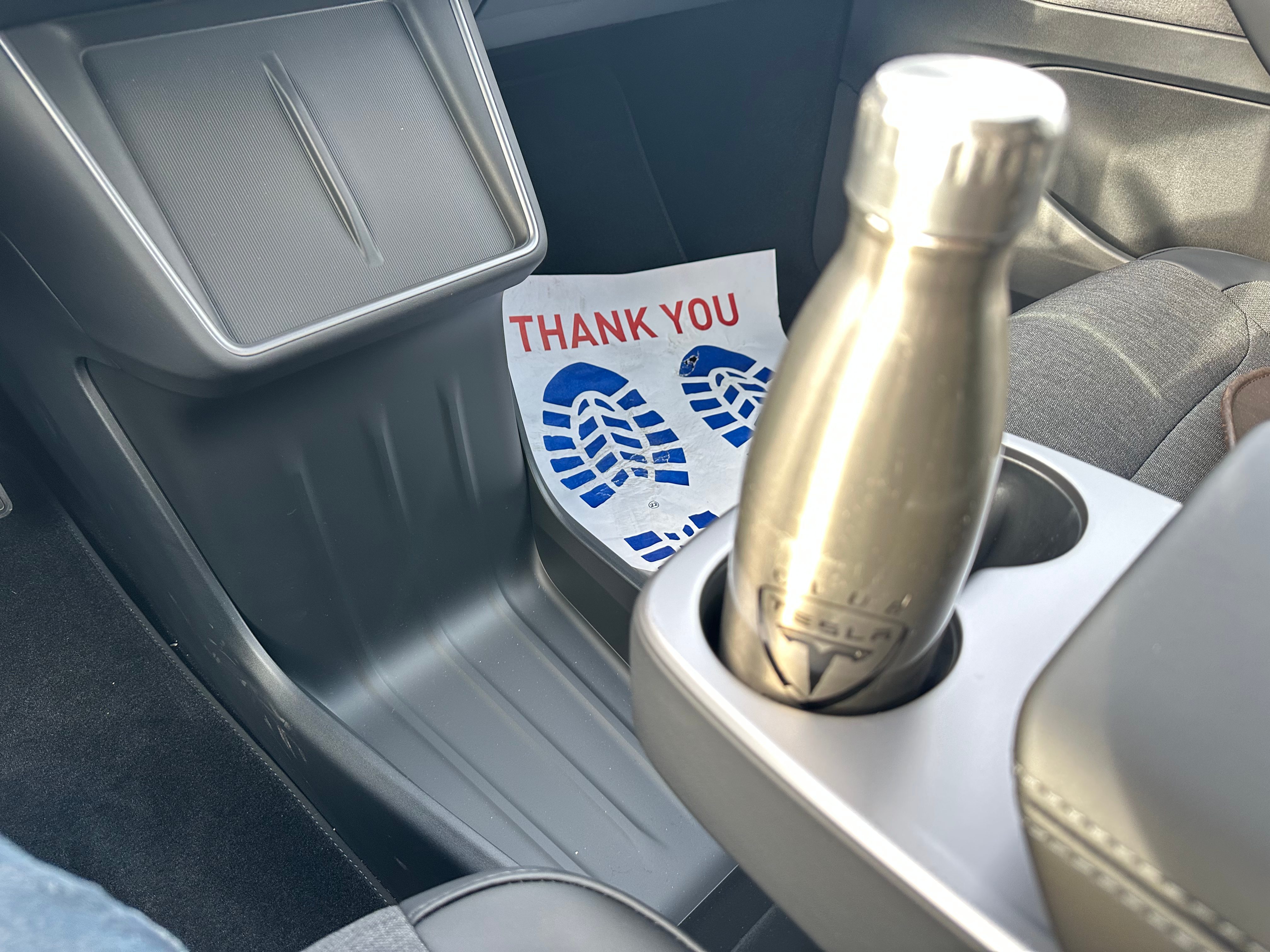
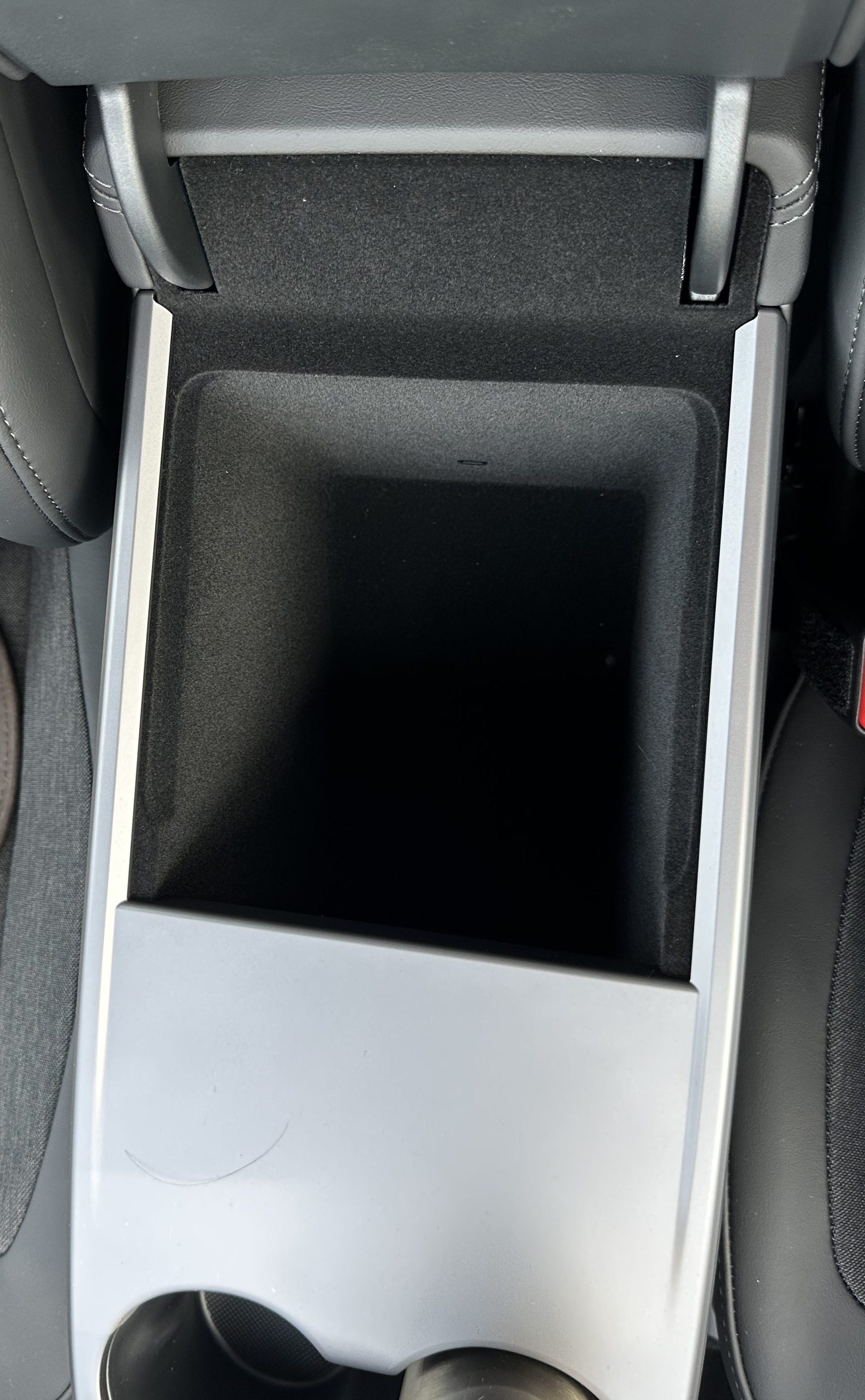
Storage is an area where the Model Y shines. It has plenty of storage in the cabin with a minimalist central console, resulting in quite a bit of open space, which I actually enjoy as it allows fitting multiple items, and bigger ones too, compared to the closed central console we’re used to.
The trunk, with its electric opening even for a low-cost trim, is more than adequate for this category of vehicle, with 2 deep pockets on each side behind the rear wheels, as well as a subfloor bin competition should take note of. Added to that tremendous amount of storage is a frunk which I find quite useful when going somewhere for 2 days with the wife, toddler and dog; stroller and dog in the trunk, luggage in the trunk’s subfloor bin and both pockets and groceries in the frunk.
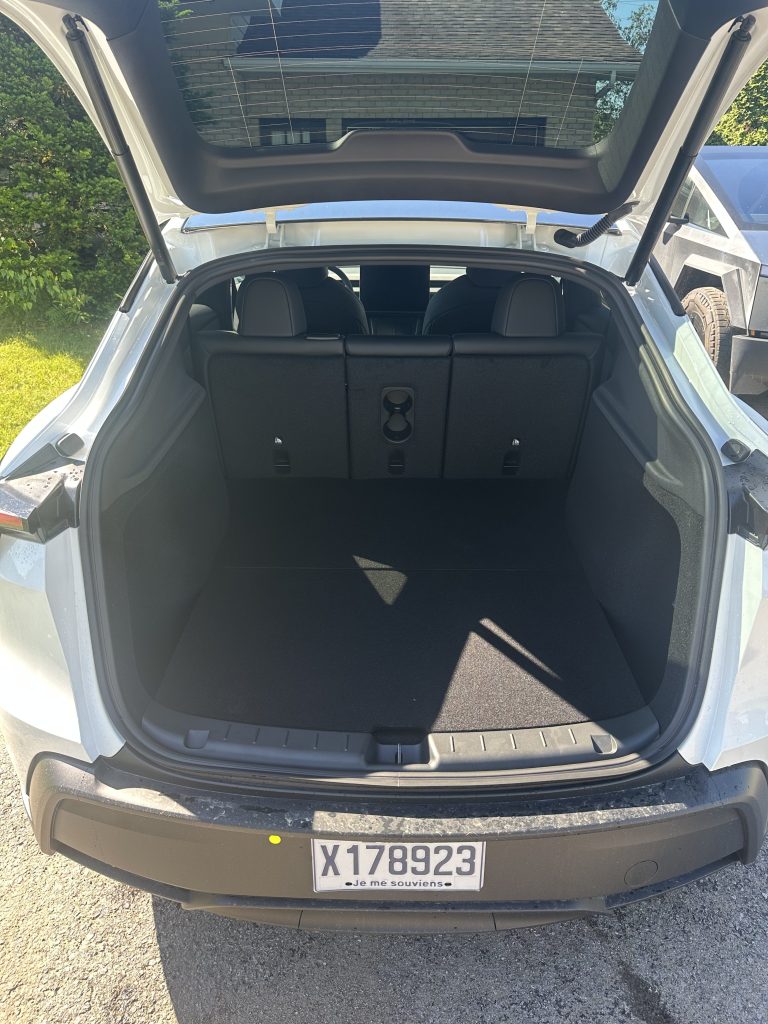
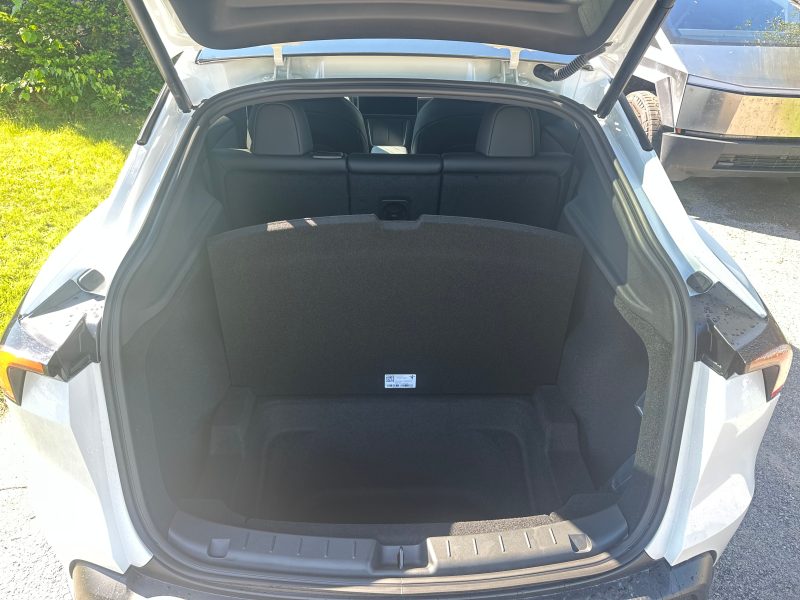
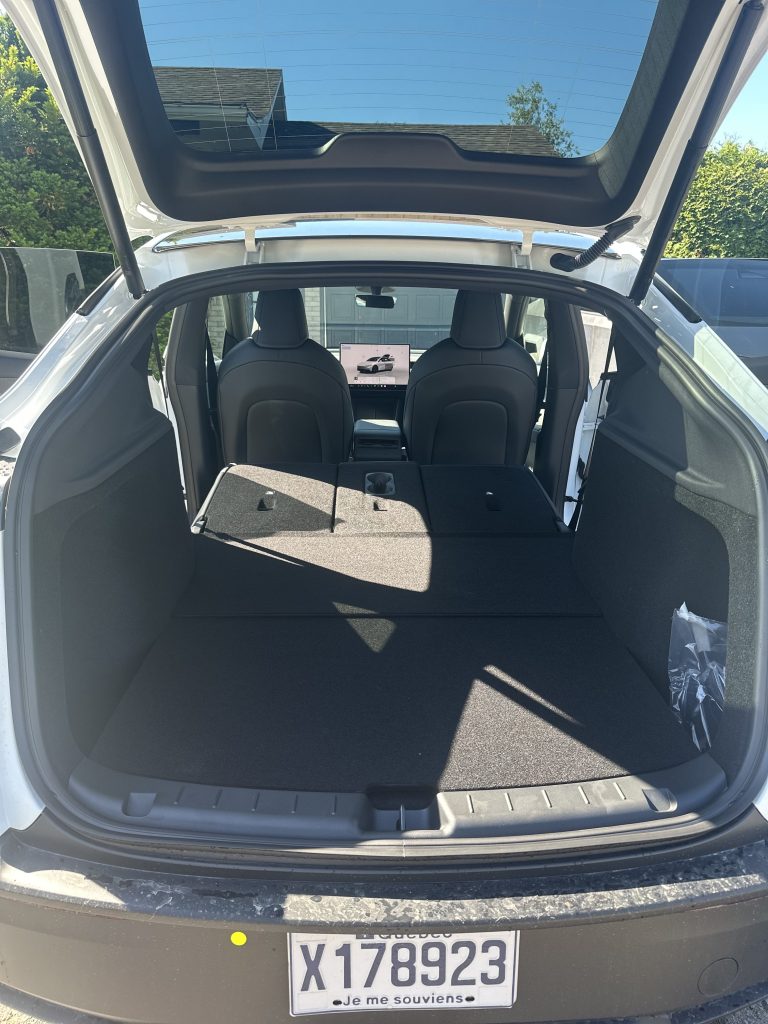
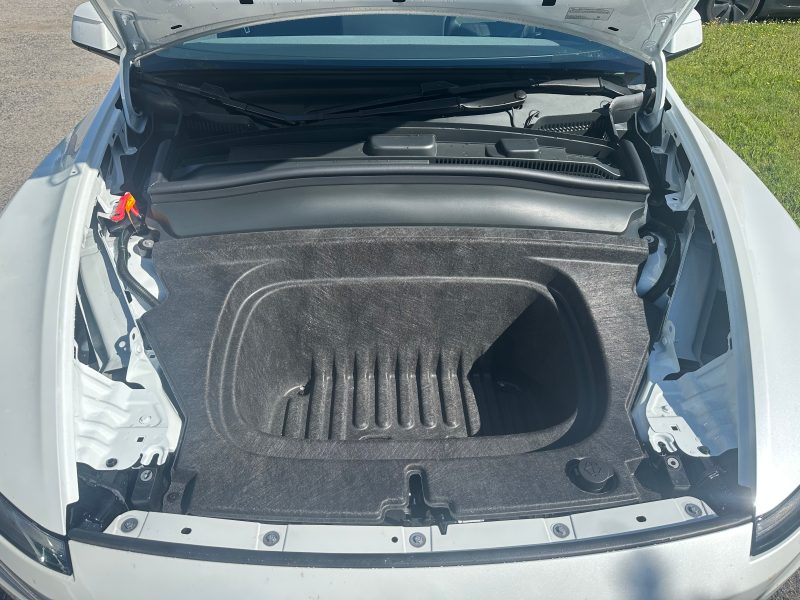
For this standard trim of the Model Y, strangely enough, the frunk isn’t sealed, so you get to select which type of luggage you use it for, depending on the weather. Also worth noting, the hood is made of steel instead of aluminum on other trims. Tesla states they do this for cost-cutting, though I do not think they have enough volume of this part, since it’s only for the entry trim, to make it actually cheaper than the aluminum one used on about a million vehicles a year. It’s a bummer for those living up north, as steel hoods tend to be pitted by the sand/salt on the road and are prone to corrode, whereas aluminum will last longer.
Wireless charging for 2 phones also sits in a convenient spot for the driver and passengers, not blocking anything and working well in our tests. Unlike with my Cybertruck, I could charge my iPhone 14 Pro with sufficient power on this wireless charging pad without any temperature derating; however, it’s not the fastest wireless phone charger I’ve tried. Yes, my phone heats up, but not enough to cancel the charge, which, for me, is the baseline for a wireless phone charger.
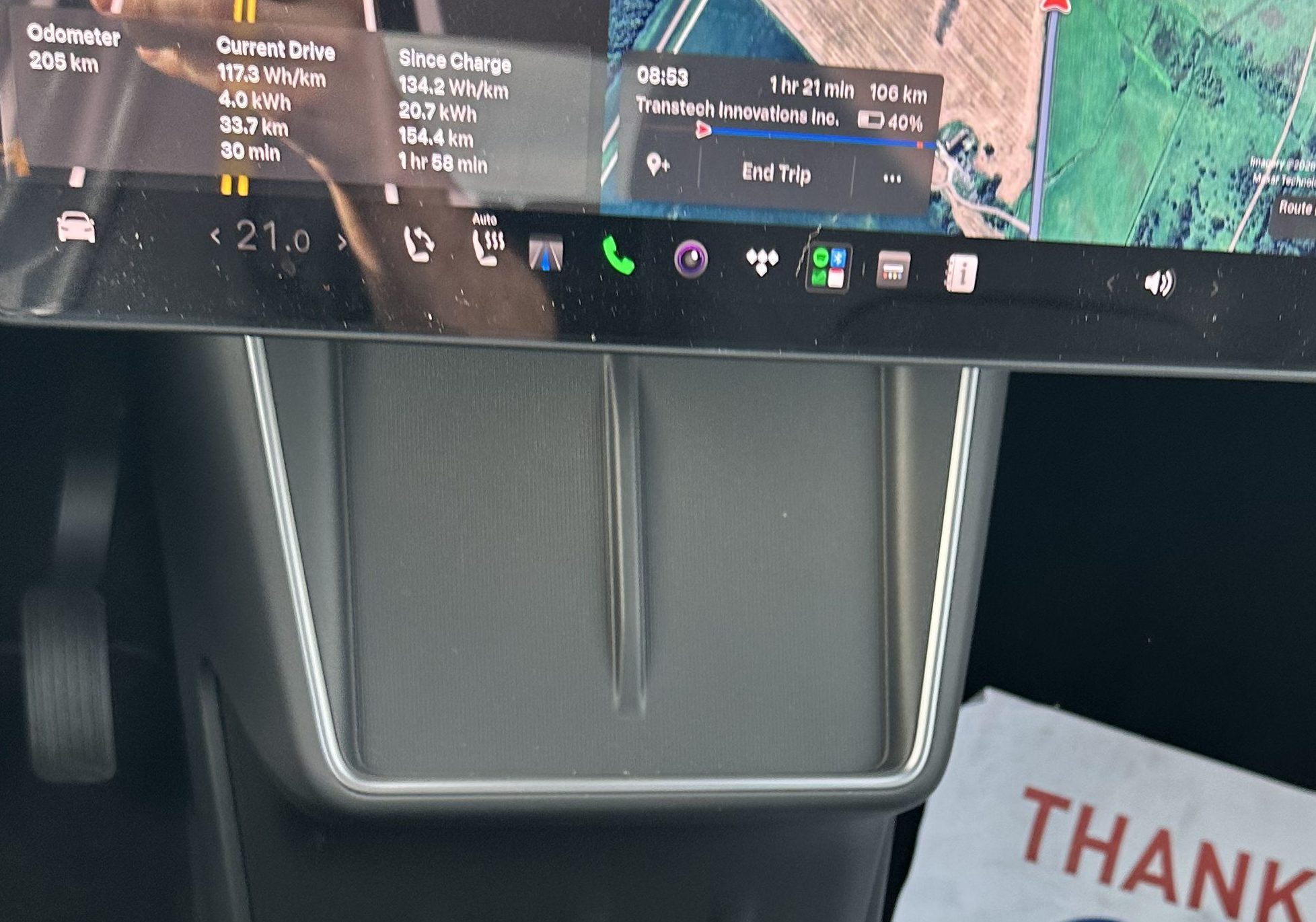
One more minor gripe: there’s no auto-dimming for the side mirrors, like in most low-cost vehicles; you’ll be blinded at night by the reflection from the following vehicle’s headlight. I know some drivers don’t like auto-dimming mirrors; that’s not the case for me!
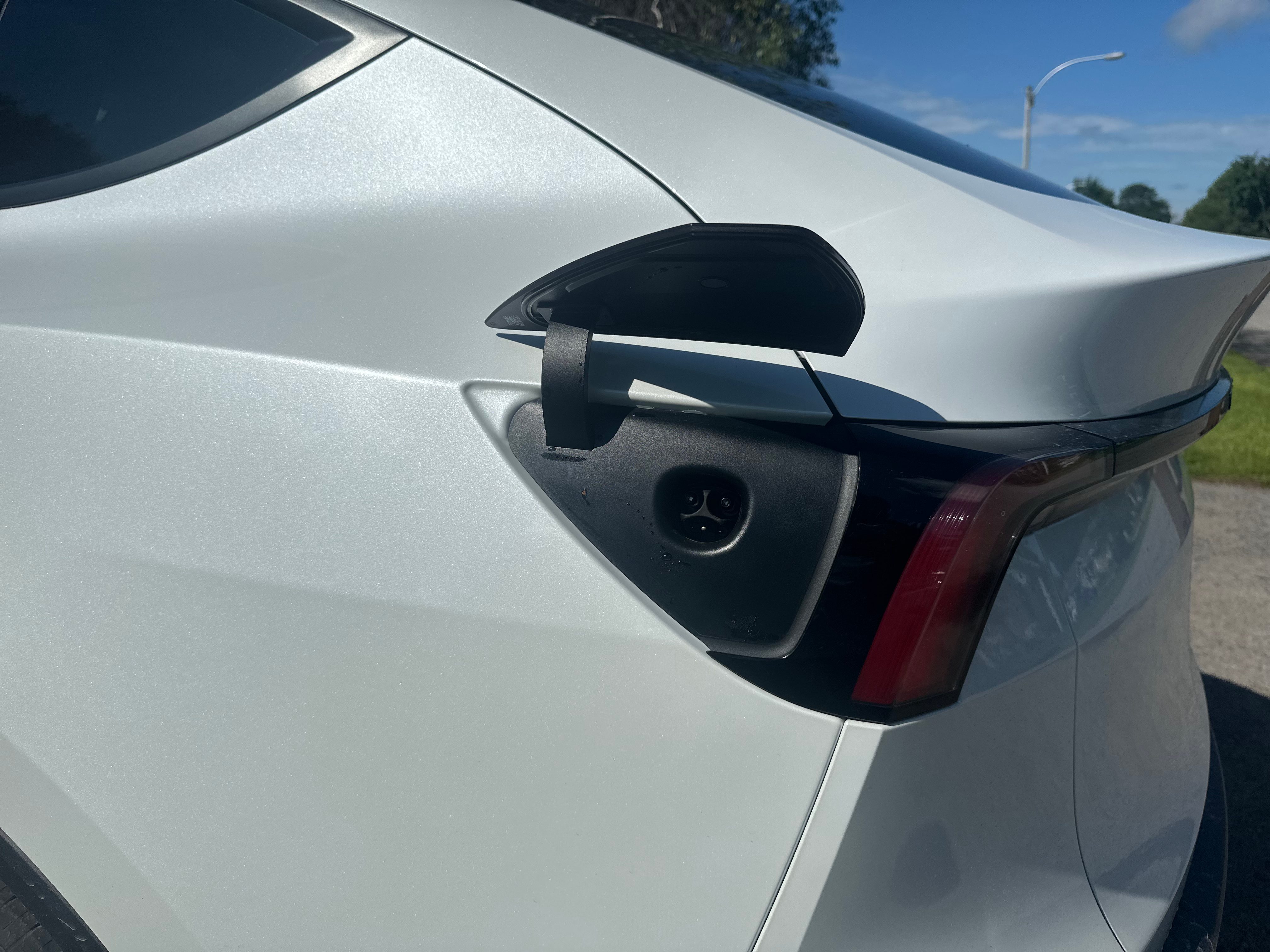
Unlike other Teslas, the charge port door on this Model Y doesn’t open when you press the button on the charger handle; you have to open it by touching it, or via the phone app or the vehicle UI. It’s a small inconsistency to find on a car built on the same platform as the rest of the line-up.
Software & User Interface
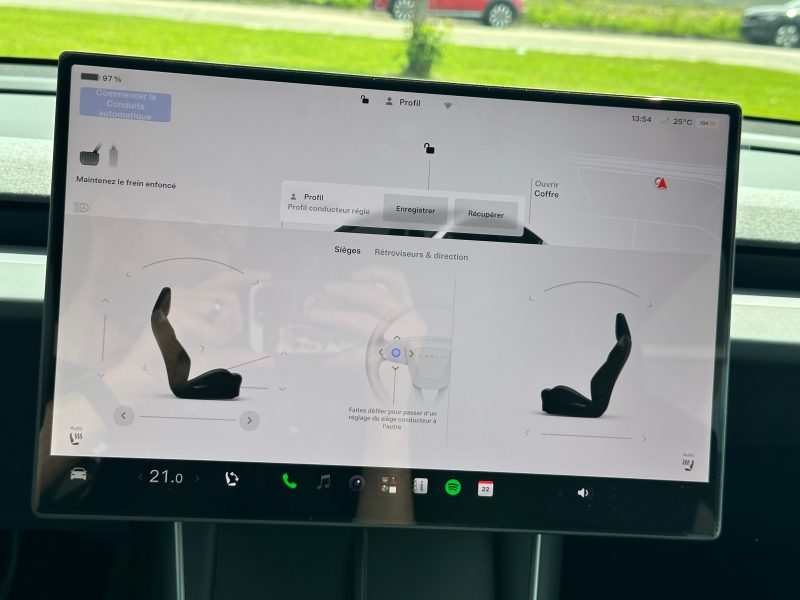
For the first time, seat controls live on the screen rather than as physical buttons on the seats themselves, and honestly, it works fine for me; I rarely adjust my seat while driving anyway, maybe during the first few minutes to find my ideal position, and after that I never touch it again. However, if you are one of those who constantly adjust your seat while driving, this is not for you; you will find it cumbersome unless you rely heavily on FSD (supervised), more on that later.
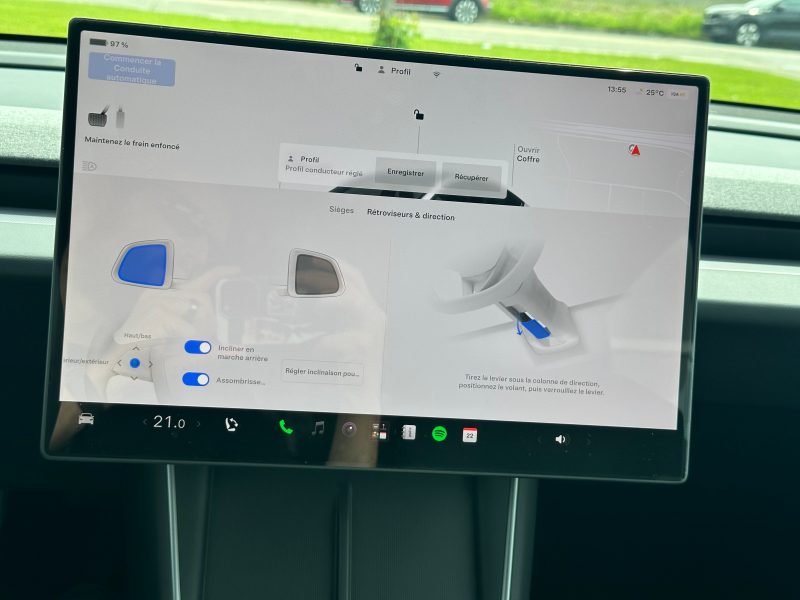
Speaking of the screen, the UI is one of the best I tried. You have to get used to having only one center screen and no information or instrument cluster behind the wheel; something that I got used to quickly to the point that I find most integration of screens by other manufacturers to be dumb, as way too often the instrument cluster behind the steering wheel isn’t visible in its entirety… thanks to the steering wheel in front of it! So, no screen behind the steering wheel is a good solution in my opinion.
Then there’s the UI’s actual layout and capabilities; the screen is divided into two sections, with about a third on the left used mostly for vehicle-mandatory information such as speed, flashers, and headlights indication, power output (I’d like to have actual numbers instead of just a progressive bar), battery state of charge and trip meters. The rest of the screen will be used by the navigation. On the bottom of the screen, there is a menu bar, with access to the HVAC system, controls/parameters of the vehicle, quick access to the seat controls, and the application drawer. Up to 6 applications can be added to the bar for quick access.
Speaking of the applications, the Model Y, like all Teslas, doesn’t disappoint. You’ll find an Energy app to track your efficiency, a web browser, streaming apps such as Netflix, games, goodies, music streaming platforms, Zoom, a calendar synced to your phone’s, and others. When you open an app, it will be layered over the navigation, with critical navigation information moving to the left side of the screen for the driver’s attention.
There is no Apple CarPlay or Android Auto, and frankly it’s not necessary. Everything responds super fast and is clear and easy to understand. You can play around with the navigation, dragging and panning as you would on your phone, with the same sensitivity. It remains, hands down, one of the best infotainment systems on the market.
Only the stalk is present on the left side of the steering wheel, only for the turn signals; everything else is controlled from the wheel or screen, which takes some getting used to. That’s a recurring issue with Tesla: there can be three different wheel-button configurations across the line-up, which is a bit of a nuisance. I don’t mind it myself, though, but it’s worth trying before deciding whether it works for you.
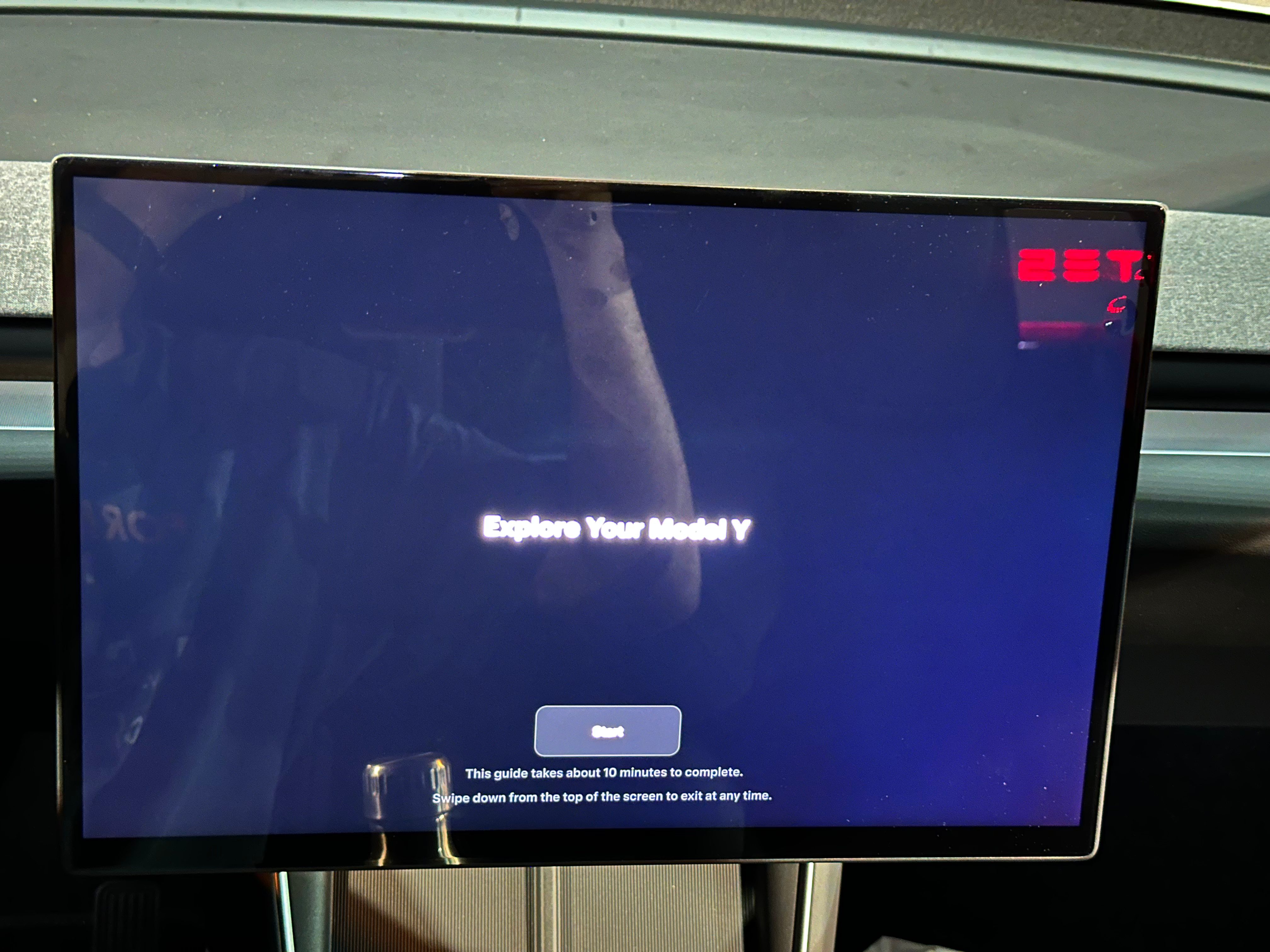
Onboarding is great, with plenty of useful information shown on the central screen to help configure the car. I’ve been driving Teslas for the last eight years, though, so I’m probably not the best judge of whether it’s good or bad for someone completely new to the brand.
Driving Experience
(10.1 / 15)
The driving feeling is where the Model Y RWD (Standard) disappointed me. Driving it felt more like driving a standard low-cost SUV than a Tesla, at least dynamically. For me, Teslas are about precision in handling and acceleration, which you won’t find with this trim of the Model Y.
Suspensions are comfortable though, and isolation from the road is pretty good. However, the rear end gets a bit bouncy and overall handling feels so-so; the car doesn’t feel very planted on the road. Whether that comes down to suspension tuning or the tires remains to be investigated. The handling felt more like a generic SUV, something that may appeal to the majority of buyers, after all, those vehicles are the most sold on the planet; it’s just a shame the Model Y RWD (Standard) doesn’t manage to distinguish itself here.
The main process I dislike on this vehicle is the blend of regenerative and hydraulic braking on the brake pedal. It felt to me the first few inches of travel simply activate the switch that brings on regeneration, and after that you get the hydraulic power, which is quite firm underfoot, thanks to a brake-by-wire design. Anyone who has a racing simulator at home, such as a Logitech G923 with a game such as Forza, will understand the feeling; it’s working the same way in the vehicle, the brake pedal is just mounted on a strong spring and sensor. As you push it, it sends a signal to the braking system, which applies hydraulic pressure to the braking system. This way isn’t new; many vehicles have used it for years. For the Model Y, it could have been implemented better in my opinion. I recommend you try it for yourself and see if you like it. I might be picky, but for me, the brake pedal should be hydraulic-only, with an option to add more regen either via a button behind the steering wheel, as GM does, or as a menu setting. I prefer keeping everything under the control of my right foot, on the throttle, for a precise one-pedal driving experience, and I don’t like how this blended brake pedal feels.
The sound system is a real disappointment. It sounds muffled, heavy on bass, and light on mids, to the point that I can’t hear voices properly; that’s the biggest downgrade on this vehicle by far, coming from the excellent sound systems in the Premium Model Y, Model 3, or Cybertruck. If you care about sound quality, this is not for you. Even the old standard speaker set available on previous Model Y generations was better in my opinion. That said, most people probably don’t pay much attention to it, and even as-is, it still beats listening through your phone, laptop, or tablet, so it makes sense on a low-cost model.
A recurring topic in my reviews is the ease of road-tripping, and the Model Y technology doesn’t disappoint. Thanks to the quick and reliable charging, amazing efficiency, a wonderful ADAS (more on that in the next category), and the best User Interface I’ve tested, with a nearly flawless navigation system, road trips are no-brainers.
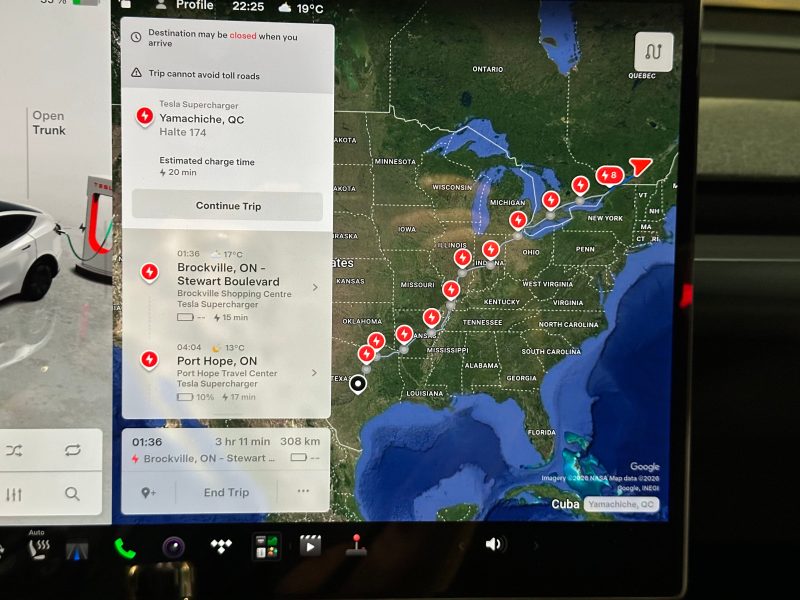
You can easily enter a destination in the Navigation system, and it will calculate the number of charging stops required, based on real-world data such as elevation, speed, and weather conditions. It will also show the waiting time at each charger, and you can add stops or preferred locations to go through to reach your end destination.
There is a level of voice-enabled commands you can use for the navigation, if you like this sort of thing.
The battery will be preconditioned on the route to a fast charger, as long as it is set in the navigation. Preconditioning works all the time when navigating to a Supercharger and most of the time when going to another charging network.
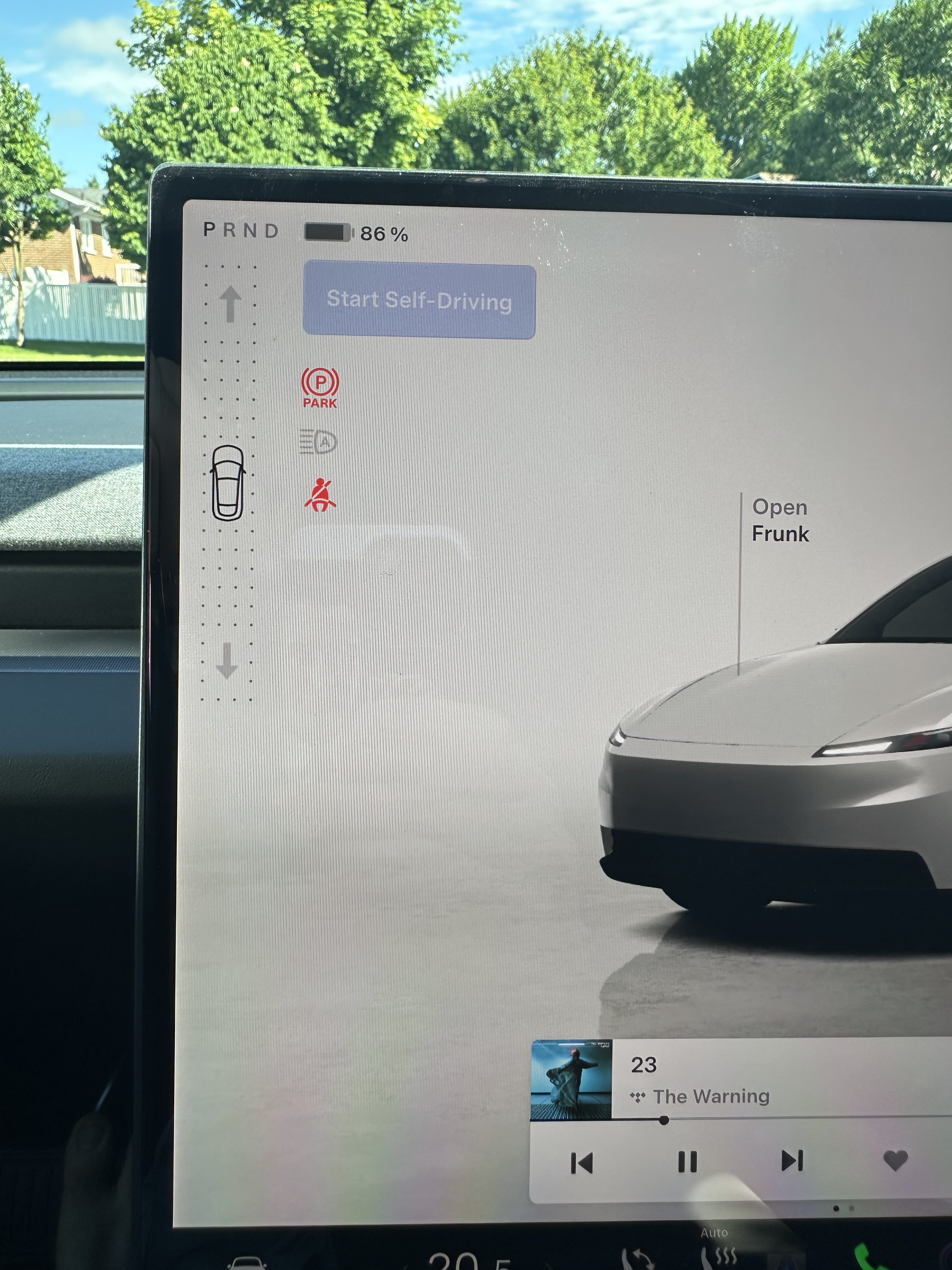
On a positive, even this base trim of the Model Y offers the Auto-Shift feature that automatically shifts forward or backward depending on the surroundings and the driver’s inputs. It is a feature I like much more than having to shift gears on the touchscreen, since there is no stalk or button for it. Shifting into gear using the touchscreen is okay most of the time, except during a 3-point turn. Thankfully, this Auto-Shift feature can take care of that.
The Model Y RWD (Standard) is a genuinely capable SUV, with plenty of storage, an okay range, and room to fit 5 adults. Unfortunately, there is no official towing package for this trim, so an upgrade to the Premium trim is required.
Driver Assistance Systems
(9.1 / 10)
ADAS on this Model Y is genuinely impressive. It is one of the best driver-assistance systems available at this price point.
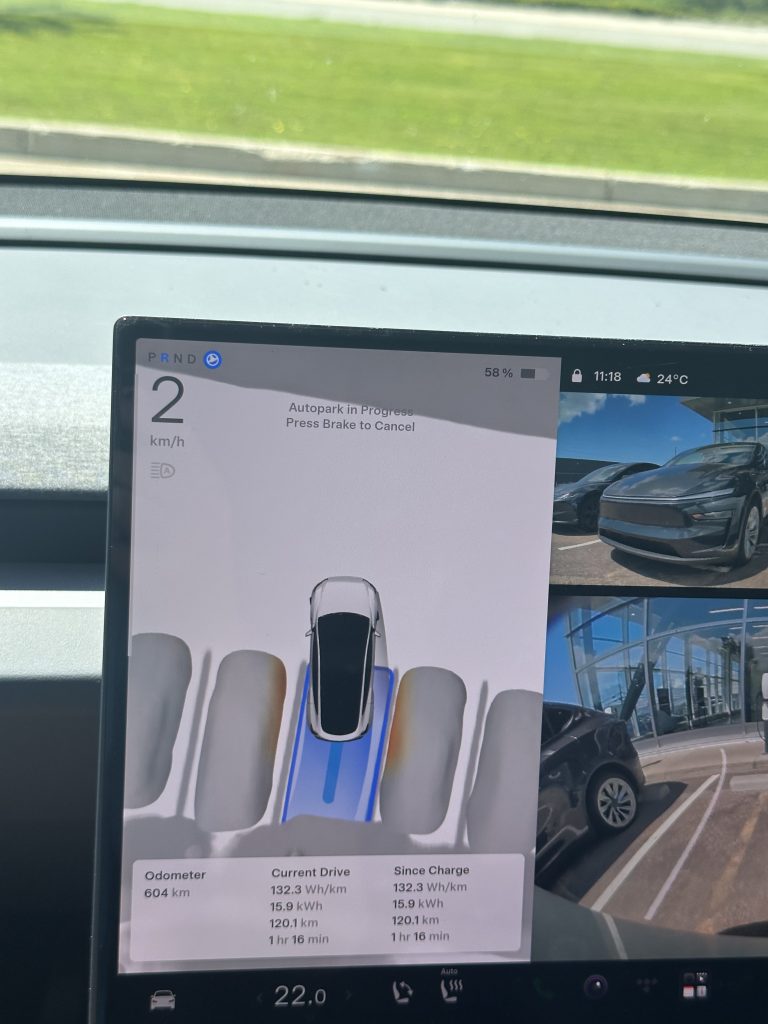
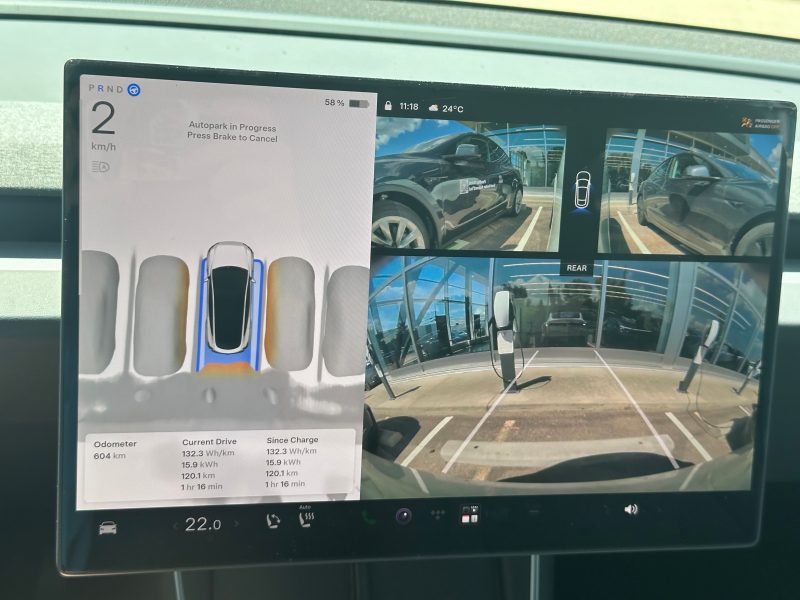
As a Level 2 ADAS, Tesla’s FSD (Supervised) is the best system available in North America, also currently the only point-to-point Level 2 system. You can literally get in your car, fasten your seat belt, then start FSD (Supervised) and enjoy the ride. Don’t forget to input your destination into the navigation, or you are in for a surprise random destination.
The system will handle stop signs, traffic lights, and all the necessities to drive on public roads. It is an Advanced Driver Assistant System, though, and you have to pay attention to what it does and be ready to take over at any time. It WILL make mistakes.
Lane following is working nearly flawlessly, even on poorly marked or unmarked roads, such as snow or gravel. Speed control and acceleration from standstill are very comfortable, reducing the possible motion sickness.
During my testing, there were two areas of improvement. The first is the vehicle’s parking space selection. It tried multiple times to use a disability parking spot or a forbidden parking spot. For a Level 2 system, though, it’s a minor discomfort.
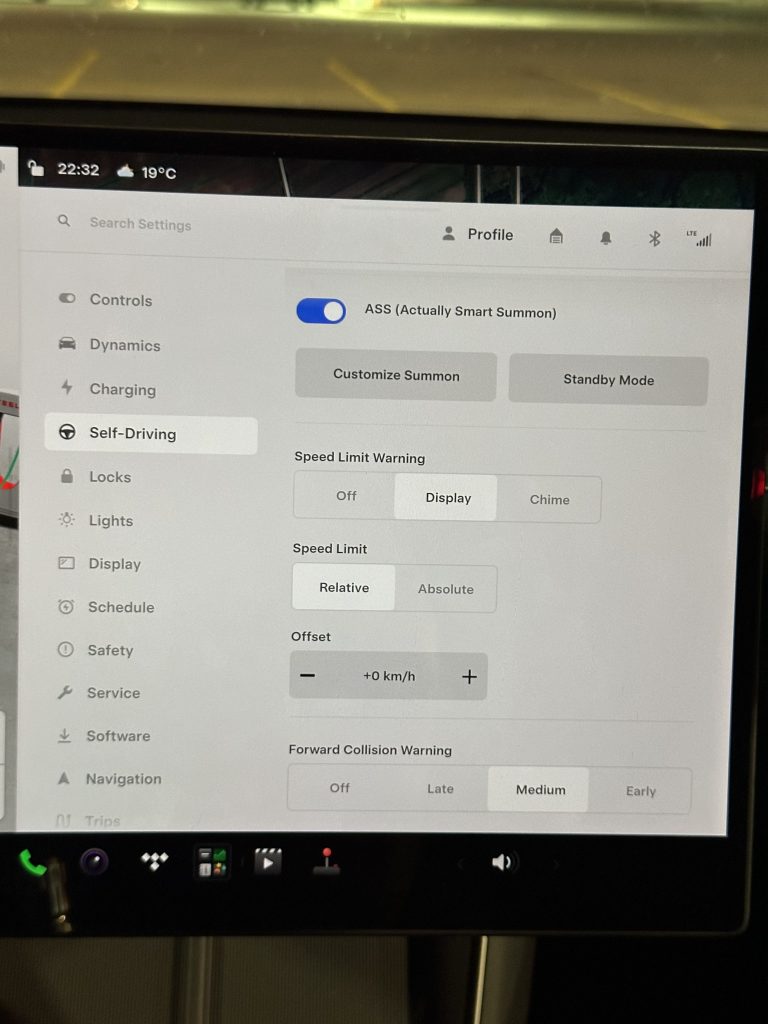
The second area for improvement is speed limit sign recognition and compliance. Unfortunately, the system does not recognize a new speed limit, resulting in the vehicle going either too slow for the new allowed speed limit or too fast, depending on the sequence of speed limit signs. At other times, specifically in rural areas where the speed limit is 50km/h, the system can completely ignore the limit and go more than 25 km/h over it.
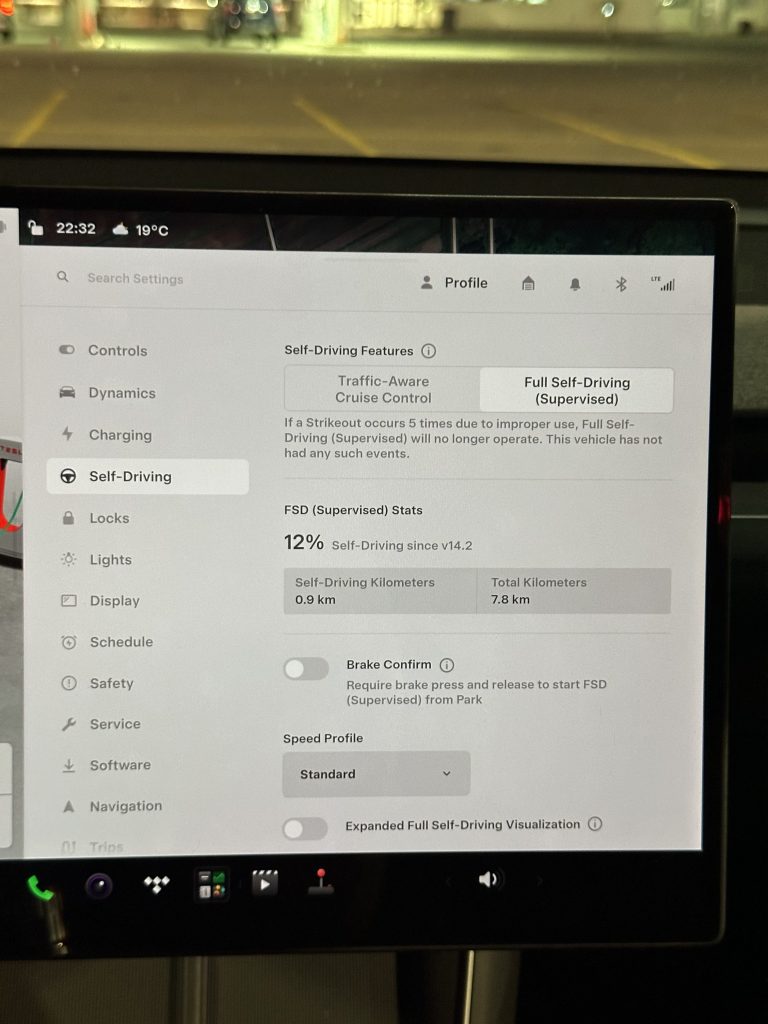
It is to be understood that there are 5 different profiles for the system, all impacting the speed and acceleration targets. Sloth, Chill, Standard, Hurry, and Mad Max. All of my testing was done on the Standard profile, which most resembles my driving style, with about +10km/h over the speed limit and quick enough accelerations without discomfort. However, there is no way to set a hard speed limit that could result in a ticket, for which you, the driver, would be responsible.
Generally, this ADAS works so well that you might be tempted not to pay attention to the road, which could be a fatal mistake. It is amazing, I would say, 98% of the time, but you need to be alert to the other 2% when it messes up. I like it a lot, though, as it drives very smoothly and feels natural and effortless.
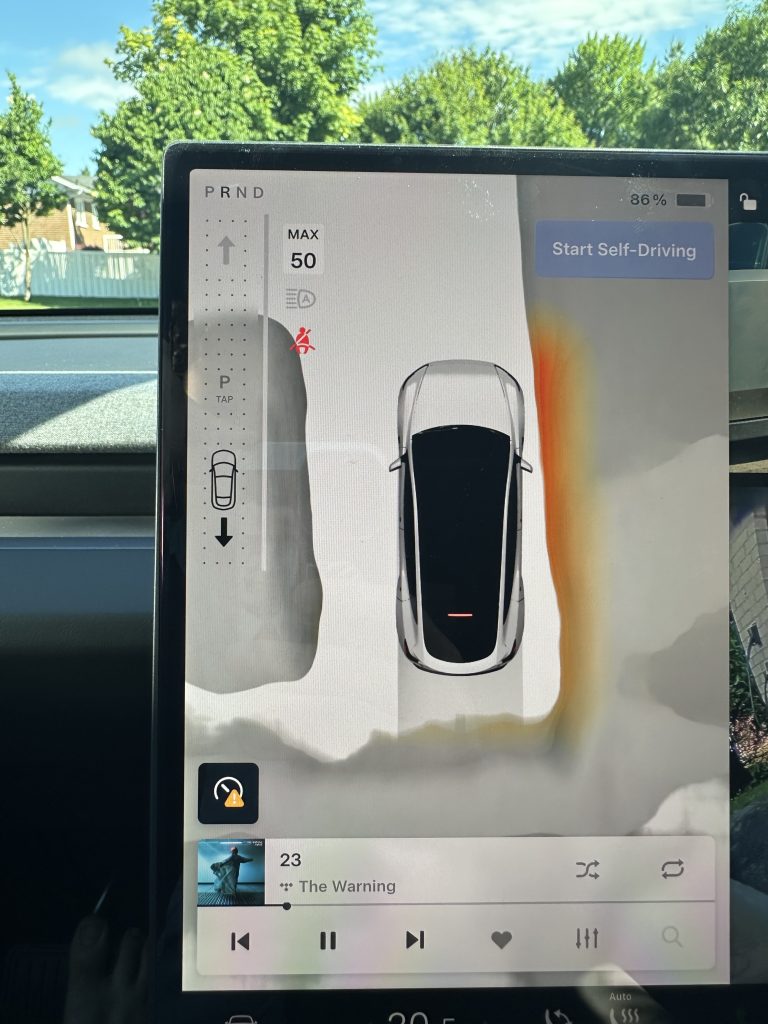
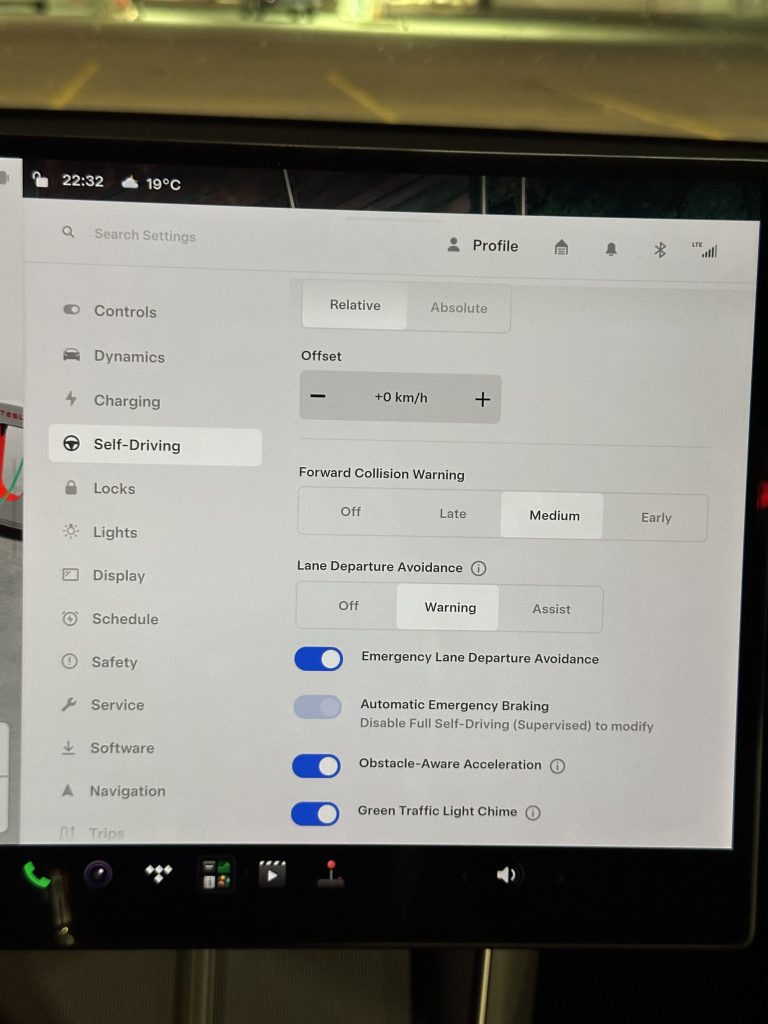
That’s for when you are paying the required $99 a month for the system. If you don’t, you only have access to the active safety features (Lane departure assist/avoidance, Blind spot monitoring, rear cross traffic alert, Auto Emergency Braking, Forward collision warning) and Traffic Aware Cruise Control, which is Tesla’s version of adaptive cruise control. Autosteer, or lane centering, isn’t available anymore outside of FSD (supervised); I do not like that.
Autosteer coupled to TACC is what we called Autopilot in the past, and removing it is a real downgrade for new owners as not everyone finds value yet in a point-to-point system like FSD (supervised), and this system needs you to pay a subscription which feels wrong to me when owning a vehicle where the hardware is present regardless.
For this category, I’ve reviewed the vehicle as I tested it, so with FSD (supervised) enabled, on Quebec’s roads. Without it, the score would be way lower at 4/10 since only the active safety features and TACC would be present.
Extra is a category Teslas naturally fall into; they were the first to bring real goodies and entertainment to a car, and the Model Y RWD (Standard) doesn’t take any of it away.
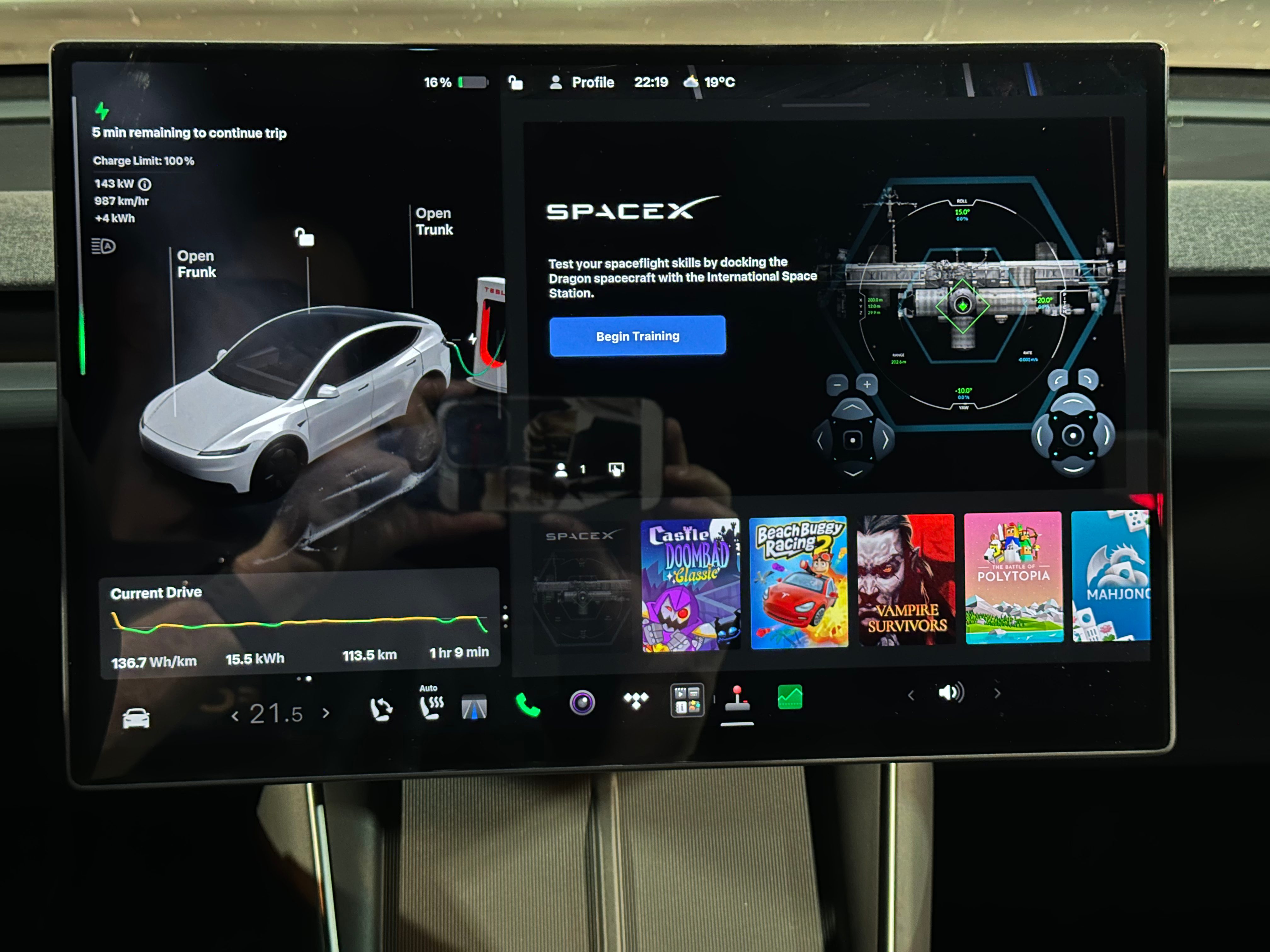
The Toy Box alone is worth exploring; there’s a sketch pad, which my two-year-old daughter loves, along with the option to have the car’s on-screen model rendered as a Tron Light Cycle or Santa’s sleigh, and no shortage of easter eggs to find along the way.
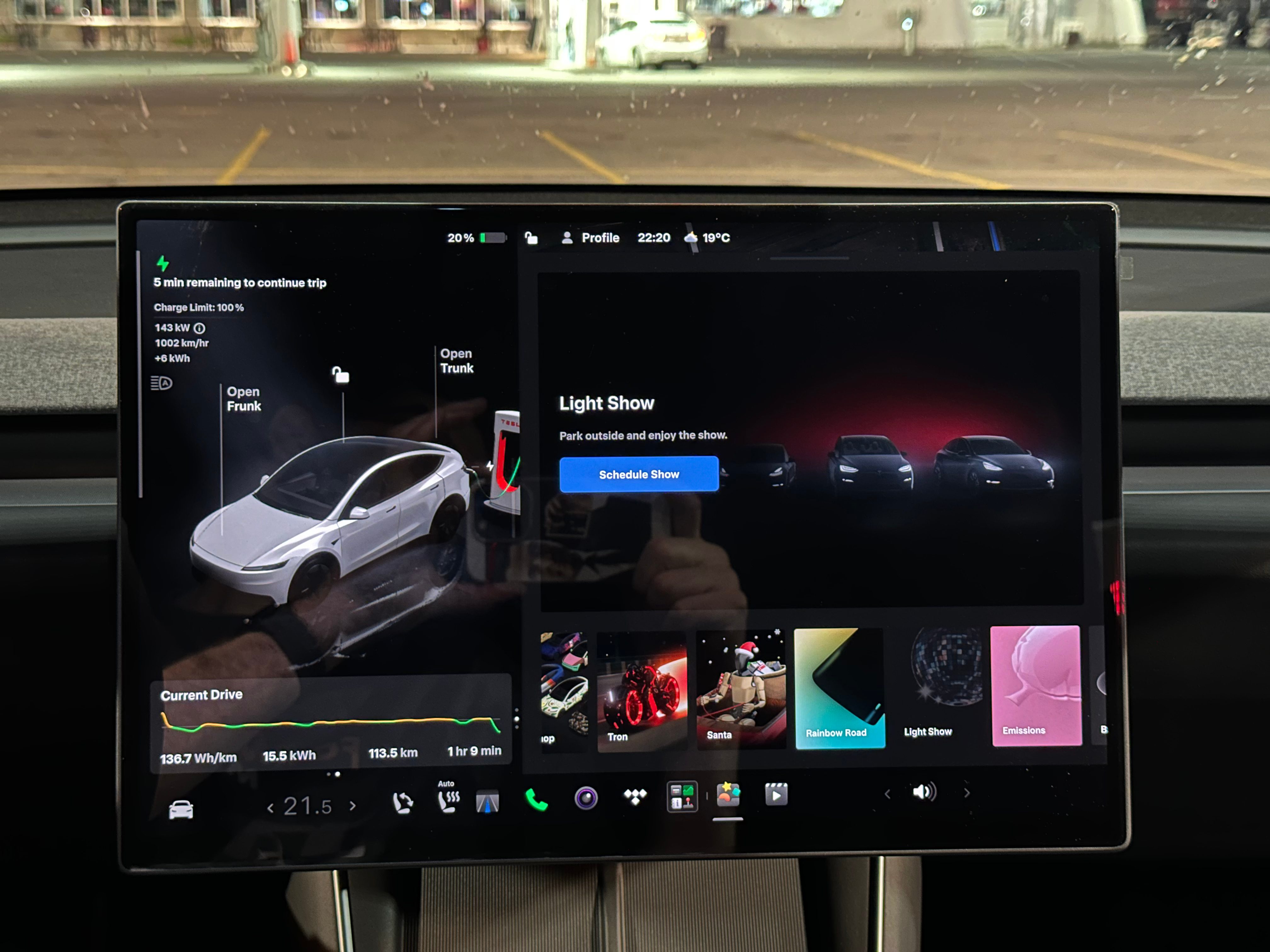
Streaming is built right into the UI, with YouTube and Netflix natively supported. There’s also a full internet browser, which I’ve found genuinely useful for road-tripping, whether I’m looking up a place to visit or checking its opening hours. The same browser can also play full-screen video and audio, so you can pull up Prime Video, Disney+, or whatever streaming service you prefer; video is locked to only play while the vehicle is parked, of course.
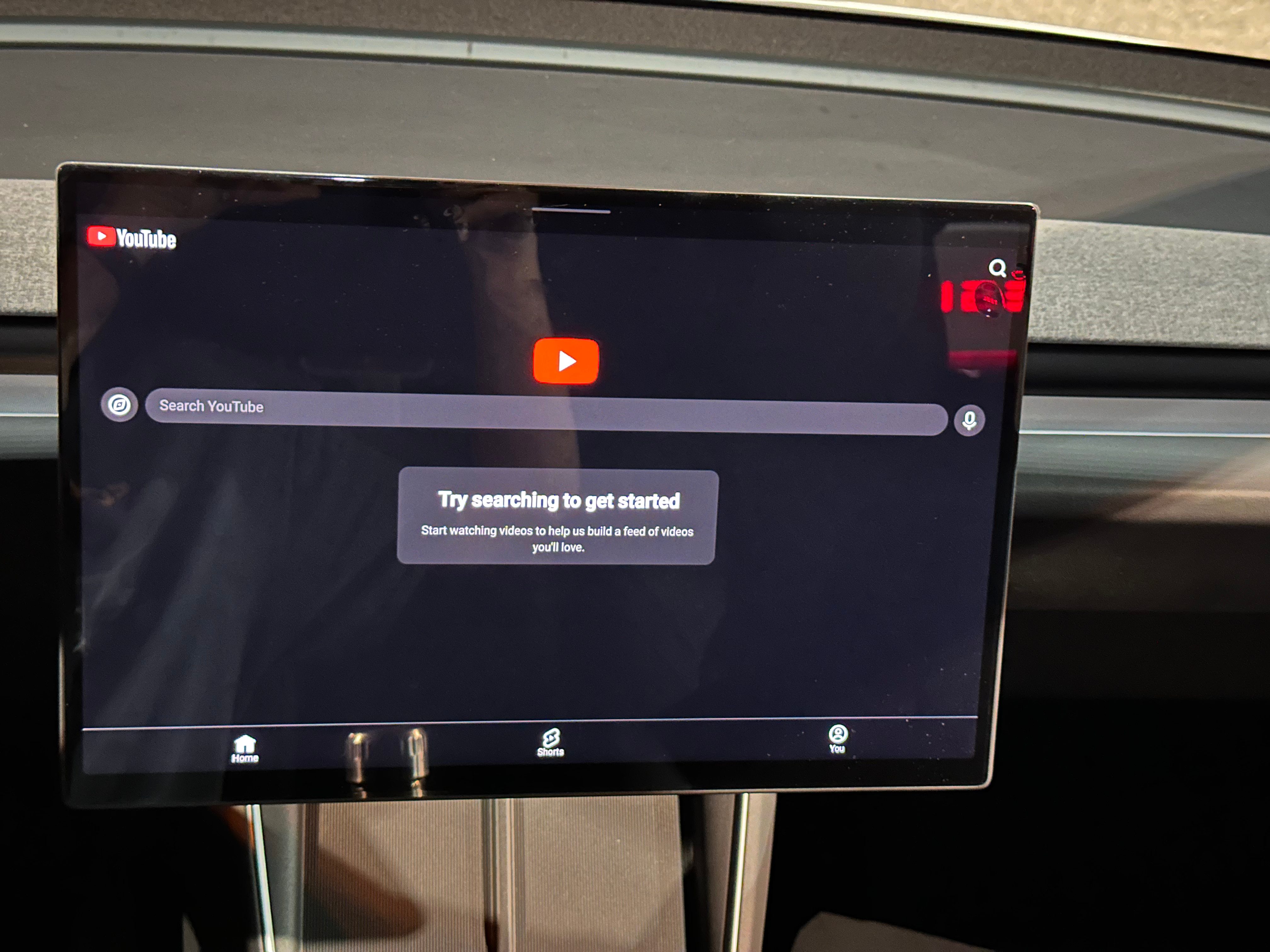
On top of all that, there’s a solid line-up of games available directly on the car, such as Stardew Valley, Beach Buggy Racing, and Fallout Shelter, to name a few.
Value
(6.8 / 10)
The perceived value of the Model Y RWD (Standard) is where it gets dicey. And it’s different in the US versus in Canada. Below is a list of all the features removed from the premium trim, for a decrease of $6,000USD in the US to $39,990USD and $15,000CAD in Canada for $49,990CAD:
Performance & Range, the only category with differences between the countries
- (US Only) 0-60 mph drops from 5.4s to 6.8s
- (US Only) Battery capacity is trimmed to 69 kWh, down from 78.1 kWh on the Premium version, dropping range to 321 mi (516 km) vs 357 mi (575 km) on Premium
- (Canada Only) RWD vs AWD since the Premium RWD trim isn’t offered
- (Canada Only) 0-100 km/h drops from 4.8s to 7.2s
- (Canada Only) Battery capacity is trimmed to 63 kWh, down from 78.1 kWh on the Premium version, dropping range to 463 km (288 miles) vs 542 km (337 miles) on Premium
- (Both) Charging power is downgraded to 175kW peak, down from 250kW on Premium
Exterior
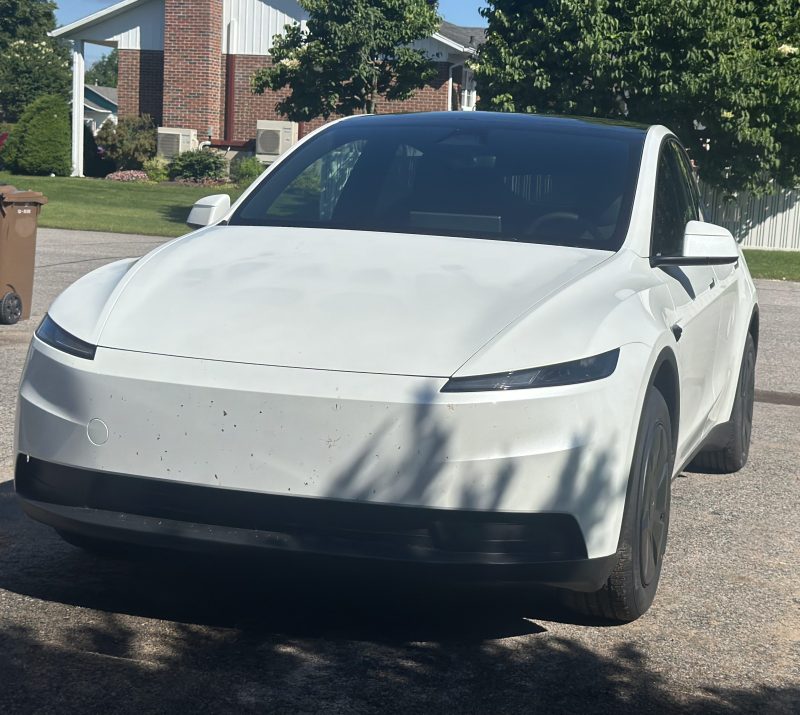
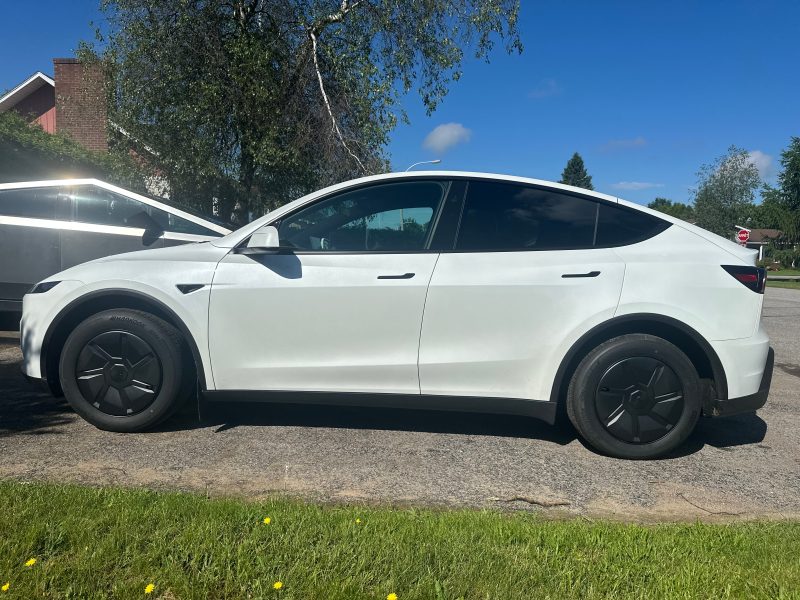
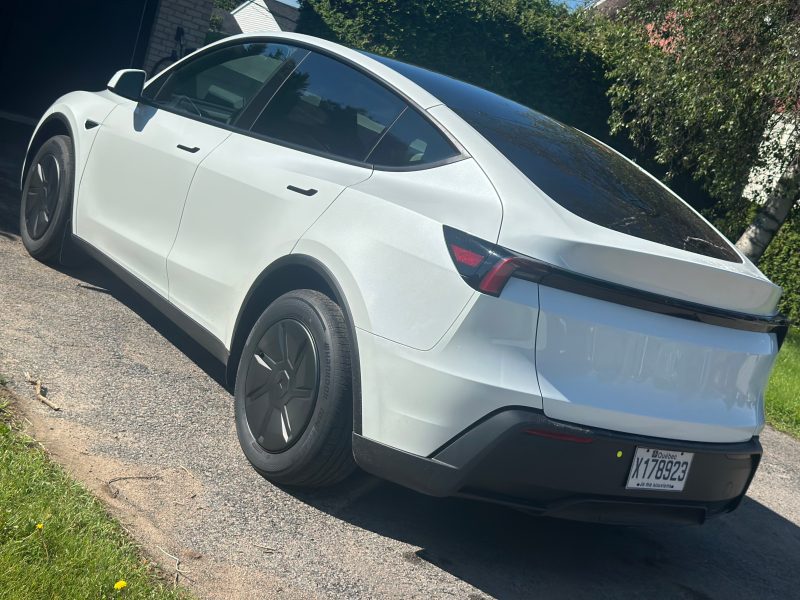
- 19-inch aluminium wheels are swapped for basic 18-inch steel wheels with plastic wheel coverings
- Front and rear LED light bars are removed, replaced with redesigned single-unit headlights that lack adaptive Matrix high-beam function but Auto High-beam is present.
- Headlights are dimmer and illuminate closer to the vehicle than the Premium. It is acceptable though, comparable to other base vehicles.
- Manual folding only and no auto-dimming side mirrors
Ride & comfort
- Passive cheaper suspension replaces the more advanced shocks found on Premium
- Regular particulate filter instead of a HEPA filter
Audio
- Simple 7-speaker setup, with no FM radio instead of the amazing 15-speaker system with subwoofers
Interior/Seats
- Dual-tone vegan leather/cloth mix with only front seats heating versus the full vegan leather heated seats front and rear, and ventilated front seats.
- Rear seats fold manually instead of power-folding
- No positioning buttons on the front seats, done in the screen instead.
- The rear 8-inch touchscreen for climate/entertainment controls is missing
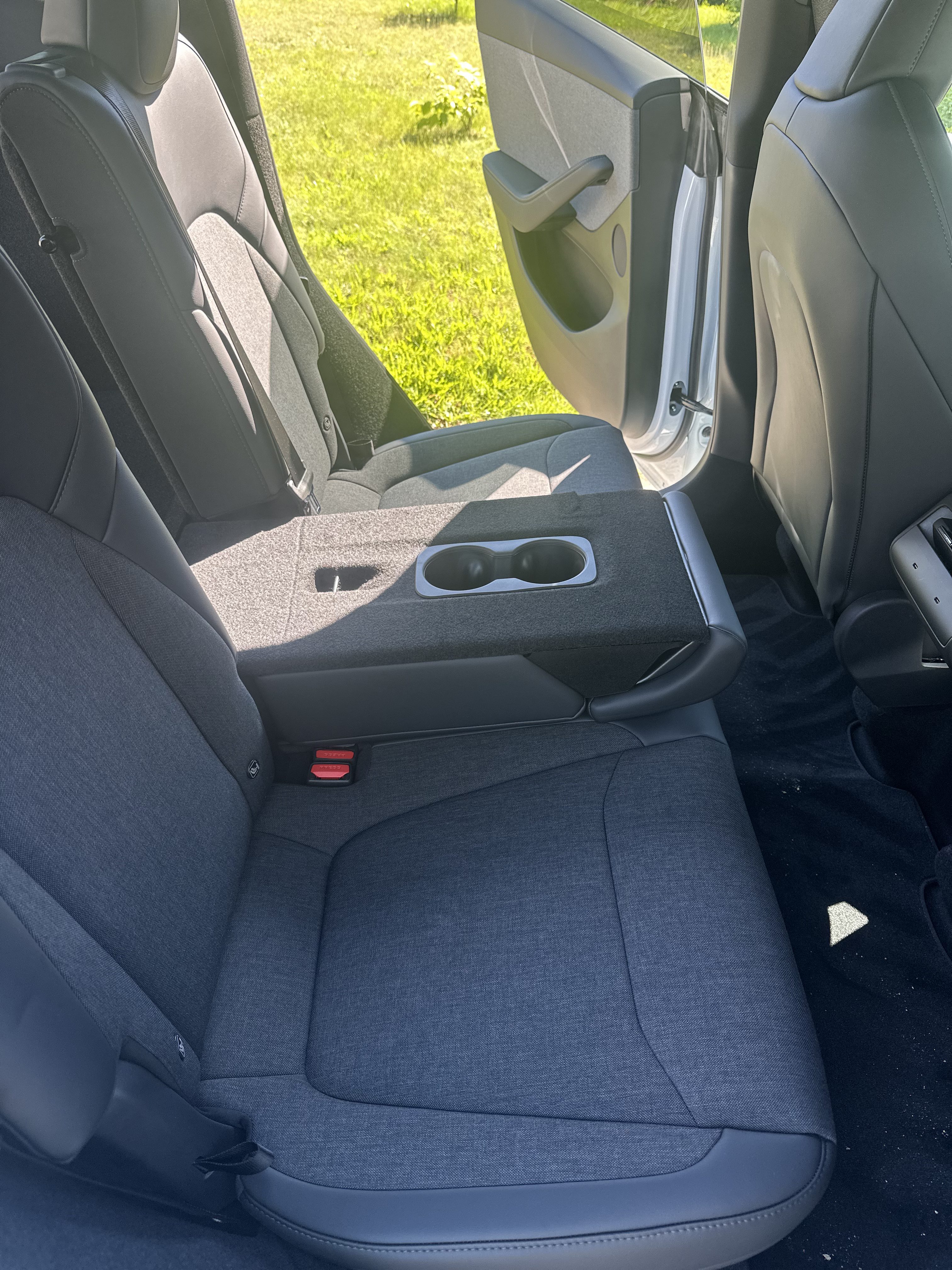
- The rear center armrest is removed entirely, and the rear cupholder access requires folding down the middle seat
Roof
- The panoramic glass roof is retained physically, but fully covered with an opaque fabric headliner so it’s no longer see-through
Other reported omissions
- No frunk isolation and drain plug
- No interior jacket hooks
- No Towing package available at the manufacturer level
- No response of the charging port door to the button click of the handle
That said, what isn’t compromised at all is the technology and the top-of-the-line UI experience. It is running exactly the same software as any other Tesla, without any hidden or locked features.
I’ll let you be the judge of whether the price decrease relative to the premium trim makes sense for you. For tech-oriented people, where UI and software are highly valued, the Model Y RWD (Standard) is highly valuable. For those who don’t care about software and are more about the driving experience, it’s going to be a hard sell, and I recommend going with the premium trim.
Compared with competitors’ base trims, the Model Y RWD (Standard) falls in the middle of the pack in price while offering an arguably better UI and ecosystem, and similar driving performance.
I must admit I do not understand the choice to block the glass roof with fabric. It cannot be cheaper than leaving the glass roof as is, since it is installed anyway. Other than differentiating the standard trim from the premium one, I don’t see the point. Tesla could have offered a nicer vehicle, for the same entry price point, and it would have cost them less money to keep the glass roof visible.
Unfortunately, it isn’t priced at the entry models for the masses we were expecting, or even promised, which tints the score in this category. Getting it below $35,000 USD in the US and $42,000 CAD in Canada would have been a game changer for mass EV adoption.
In Canada, though, the pricing is another story. While it fits in the middle of the pack against direct competitors, you can currently get a Model 3 with nearly all the premium features, except for the sound system, for $39,490 CAD (~$28,000 USD), cheaper than the base stripped Model 3 in the US, which is priced at $36,990 US, thanks to the ability to import vehicles from China into Canada. While this Standard Model Y asks for a noticeably higher price, it offers far fewer features and that math doesn’t quite add up. I hope Tesla will replace the current Model Y RWD (Standard) offering in Canada, which is made in Berlin, with a Premium RWD version from Shanghai for a similar price to the Model 3, at around $ 45,000 CAD. That would sell like hot cakes! As it stands right now, potential buyers in Canada had better be locked into owning an SUV as you can get a much better vehicle for cheaper if you can sacrifice on the storage and ease of entering the vehicle.
Finishing on this topic, having to subscribe for $99 a month to get FSD (supervised), with no option for purchase, isn’t great. It means you could lose the feature if the company went under, much like we are seeing with digital media purchases, such as games and movies, or, most likely, the price will trend upward as the take rate increases, having you pay more and more for your vehicle. I really don’t like that. Moreover, the hardware is already on the vehicle, so either you have already paid for it or Tesla is losing money when people do not subscribe. Since the majority of buyers aren’t subscribing yet, I’m more inclined to think the first.
I get it: the software needs constant work to improve, and they have to find a way to pass that cost on to the customer, but instead of going the full SAAS way, I would prefer to have a base version of the system included with the purchase of the vehicle and then pay for a significant update. This way, if you are perfectly happy with the system, you don’t need to pay more money, you actually own something physically, and you have the freedom to choose. Even the previous model, where you could choose between a full purchase of the system for a hefty price or a subscription-only option, was better than today’s. You had freedom of choice. I’m concerned about this trend of manufacturers pushing more subscriptions into everyday products, and I do not see the competition coming in to undercut that and bring better products for less money, as it should be in a healthy market.
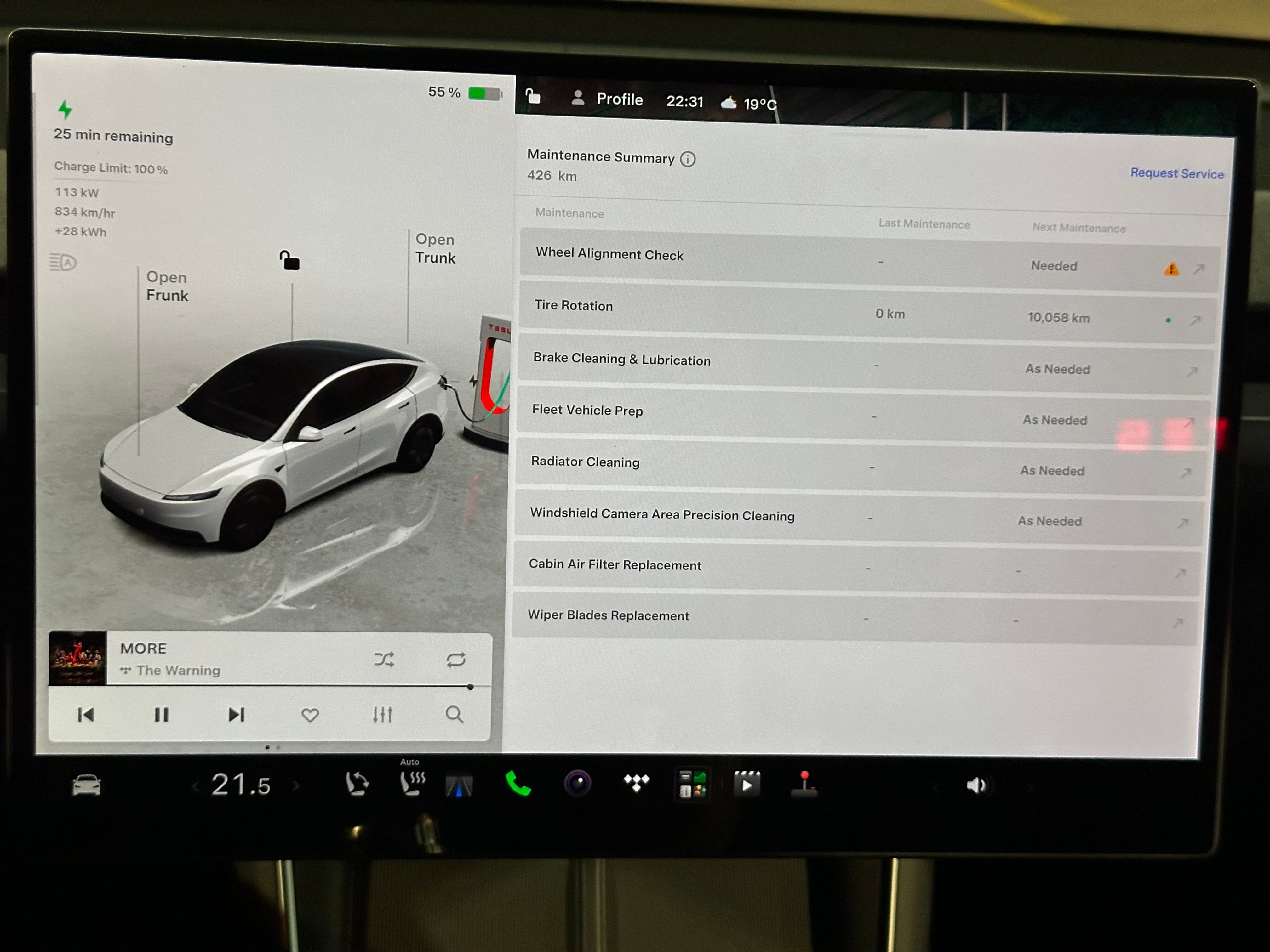
One word on the mandatory servicing of this vehicle: I like that Tesla is basically stating, “don’t service it unless you need to” for most parts.
Fitness for Purpose
(3 / 5)
As an SUV, the Model Y RWD (Standard) fits its purpose with plenty of storage, good EV capabilities, and seating for 5 adults. The only miss is towing capability, which Tesla doesn’t offer on this trim. The Premium trim can tow up to 3,500 lbs; it would have been nice to get some towing capacity on the entry model too, since they share the same frame and powertrain.
As the game-changing affordable EV it was supposed to be, it doesn’t quite deliver on that promise; instead, we’re left with a middle-of-the-pack-priced SUV, which is disappointing.
Safety
(5 / 5)
Safety is where this Model Y earns its perfect score, with little debate. NHTSA gives the 2026 Model Y a five-star overall rating, with five stars in every individual assessment as well.
This version is also the first vehicle to pass NHTSA’s newly updated advanced-driver-assistance testing, clearing the bar for pedestrian automatic emergency braking, lane-keeping assistance, blind-spot warning, and blind-spot intervention, all of which come standard.
The IIHS hasn’t published its own results for the 2026 model yet, but between the federal testing and the standard active-safety suite, it’s hard to find much to fault here. Moreover, Euro NCAP rated the refreshed Model Y from 2025 as the Best in Class in its safety tests.
Electrek’s take
I was skeptical of this version of the Model Y. Since we were expecting a new entry-level model with a really low price point, I was disappointed when the Model Y Standard was first unveiled (before being named Model Y RWD). However, I must say after testing it and comparing it to the competition, I now think Tesla brought something compelling to the market.
To appreciate it, you need to forget what you know about the handling capabilities and joy of driving of a Tesla and instead approach it as a vehicle for newcomers to the brand. The impeccable software ecosystem and UI will be of great value to tech enthusiasts who have never experienced them before, and the price of this trim is competitive compared with equivalent feature sets. I am very impressed by the efficiency, a testament to the fact that Tesla hasn’t stopped innovating on that front and won’t lose its crown without a fight. Energy efficiency is one of my main interests and too few manufacturers are giving it thought.
There are some things I find dumb, like the glass roof covering and the switch from aluminum to steel for the hood. Removing the frunk seal isn’t ideal either, as it limits its usefulness. I would have removed the electric trunk door opening before this seal.
Also, I personally don’t like the brake pedal feel and behavior in this vehicle at all. There are some people who like it though, so try it, you might be one of them.
I would have liked the acceleration to be a little better; targeting 6.5s from a 0-100km/h instead of 7.2s would make a big difference and put this vehicle more in line with the brand while still remaining the slowest Tesla.
I’ve owned a 2023 Model Y Dual Motor for 2 years, and comparing them, I can say the 2026 RWD (Standard) is quieter, more comfortable, and way more efficient, resulting in nearly the same real-world range and faster charging (with the LFP battery). However, Handling, acceleration, sound system, brake feeling, and towing capabilities sharply distinguish them.
Last thoughts: I dislike the driving experience of this trim of the Model Y, mostly because it drives like any other soulless SUV, but on every other metric it scored pretty well, earning it a nice overall score. This shows that my scoring system is more about technology and capabilities than about the subjectivity of experiencing a vehicle. Let me know if you’d like me to change the weighting of each category accordingly.
Planning to purchase a Model Y? Get 3 months of Full Self-Driving (Supervised) with my referral link.
Limited to the first 10 person ordering with the link


FTC: We use income earning auto affiliate links. More.