

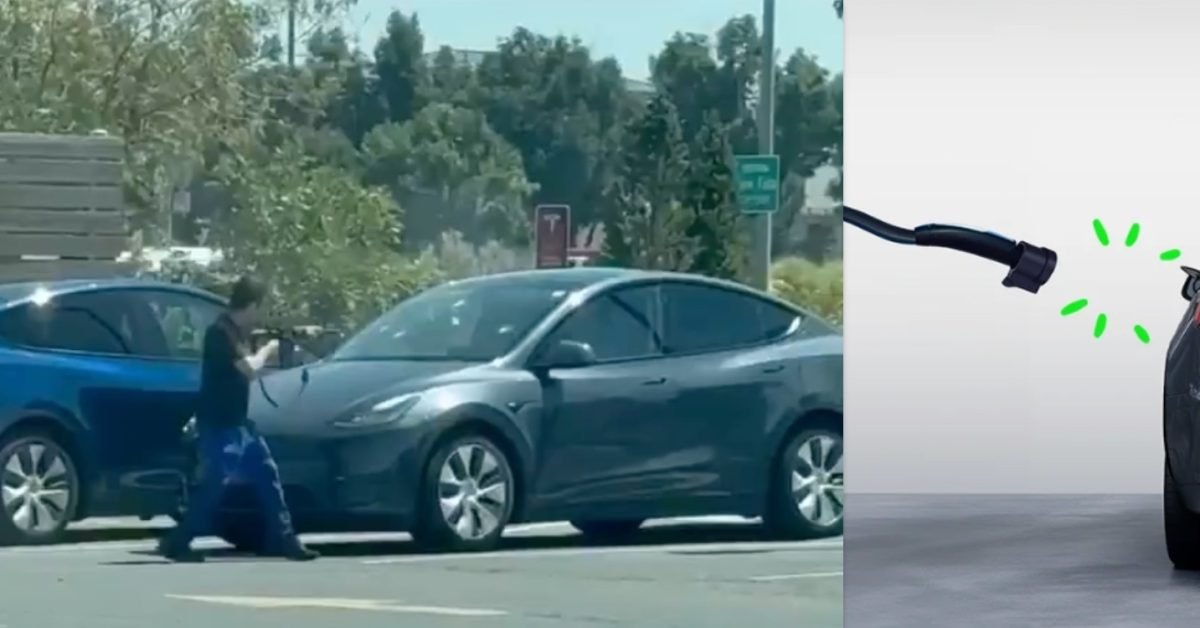
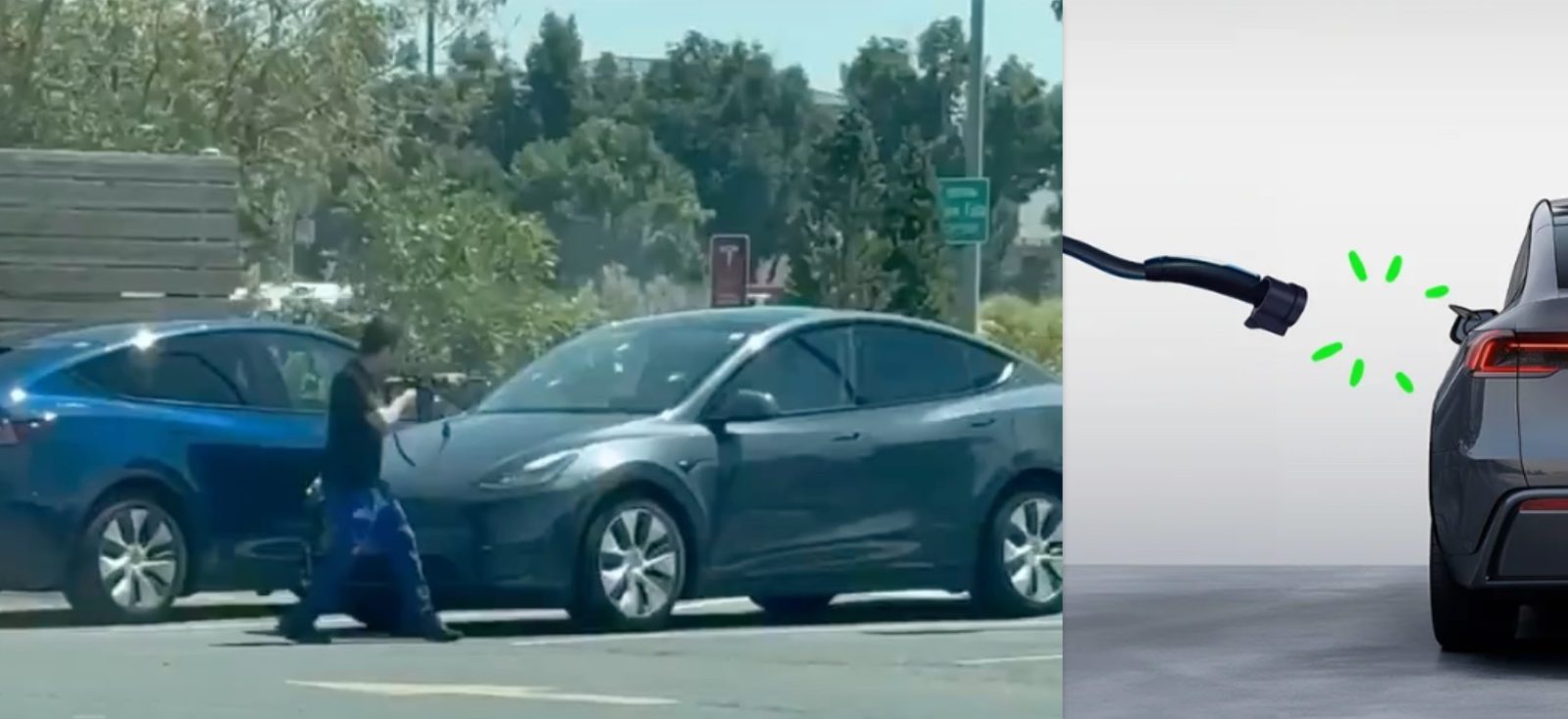
After a gunman opened fire at a Twin Falls, Idaho, In-N-Out with an attached Tesla Supercharger last week, EV owners flooded social media with the same suggestion: buy an EVject.
The breakaway charging connector lets you drive off while still plugged in. It sounds like an obvious fix for a horrifying scenario — but it’s a controversial device that doesn’t actually solve the problem, and it points to something Tesla and every other automaker should be building instead.
What happened, and why it hit a nerve
On August 1, a shooter targeted the crowd outside a newly opened In-N-Out in Twin Falls. A Supercharger sits in the same lot, and video circulating online appeared to show the gunman firing into a Tesla that was plugged in and charging. Three people were killed and several injured, including a driver who was charging his Tesla and survived.
The detail that set off EV owners is a real one: when a car is charging, you can’t just floor it and leave. The connector physically locks into the port while power is flowing. To go, you normally have to tap “unlock charge port” on the screen or use the manual release, then wait for the cable to disengage. In a situation where seconds matter, that’s a genuine vulnerability.
That’s the gap EVject fills. The $299 “Escape Connector” sits between the Supercharger cable and your port and is designed to break away when you drive off, so you can leave immediately without unplugging.
Right after the events of this weekend, hundreds of Tesla owners on X started to share the EVject device with referral codes to promote it as a solution to this tragic event.
The device Tesla tried to kill
Here’s the part the viral posts leave out: this is the same accessory Tesla sued in 2024, calling it a safety risk.
Tesla argued in a California court that the connector could reach dangerous temperatures — its filing claimed surface temperatures as high as 100°C after 30 minutes of high-current charging — and that there was no over-temperature protection in the design. EVject later released an updated version with built-in thermal protection, and Tesla dropped the suit.
So the product now being promoted as the answer to a shooting is a third-party adapter that Tesla itself was in court over less than two years ago. That doesn’t make it useless, but it’s a strange thing to recommend without the asterisk.
A device doesn’t make you safe
Even setting the controversy aside, EVject only helps if you recognize the danger and act on it in time.
That’s the harder truth about the Twin Falls situation. A breakaway connector assumes you have the seconds and the awareness to shift into drive and go. In a sudden, chaotic attack, the people in those cars almost certainly had little opportunity to process what was happening, let alone execute an escape maneuver. No accessory changes that.
A tool that shaves a few seconds off an escape is worth something. But selling it as the solution to random violence oversells what a $299 adapter can do, and it risks giving owners a false sense of security.
This isn’t a Tesla-only problem
It’s also worth being clear that this isn’t unique to Tesla.
The charging connector locks during a session on every EV. It’s a safety requirement baked into the NACS, CCS, and J1772 standards — the plug latches so it can’t be pulled out while high-voltage power is flowing, which prevents arcing and accidental disconnection. Any EV plugged into a DC fast charger has the same constraint. Tesla’s Supercharger network is just where most people encounter it because it’s the largest.
That’s exactly why the fix shouldn’t be an aftermarket band-aid.
Electrek’s Take
The real answer here is a native emergency disconnect, built into the vehicle, that works from the driver’s seat. Well, in fact, the real answer is more likely gun control and serious invesments into mental health, but that’s out of our scope of expertise.
Tesla is well positioned to do an in-car solution. It controls both the car and the charger, so it could safely cut power, release the latch, and let you drive away with a single deliberate action — the kind of thing you’d want gated behind a confirmation and maybe a fee to prevent abuse and cover any equipment damage. Owners have been asking for exactly this since the shooting, and it’s a reasonable ask. It would be far safer than a breakaway adapter that mechanically separates a live connector.
But this shouldn’t be a Tesla-only feature, and it shouldn’t require buying a gadget that the manufacturer once called a fire risk. Every automaker and charging network should be thinking about how a driver safely leaves a stall in an emergency. The locking connector exists for good engineering reasons, so the escape path has to be engineered too — by the people who build the cars and the chargers, not bolted on afterward.
If you’re charging an EV at home, powering it with solar is one of the best ways to lock in low running costs. With electricity rates climbing nearly 10% last year, home solar protects you against future rate increases. And with lease and PPA options, you can go solar with zero upfront cost and start saving immediately. If you want to find the best deal, check out EnergySage. It’s a free service with hundreds of pre-vetted installers competing for your business, so you save 20 to 30% compared to going it alone. No sales calls until you pick an installer. Get your free quotes here.


FTC: We use income earning auto affiliate links. More.