

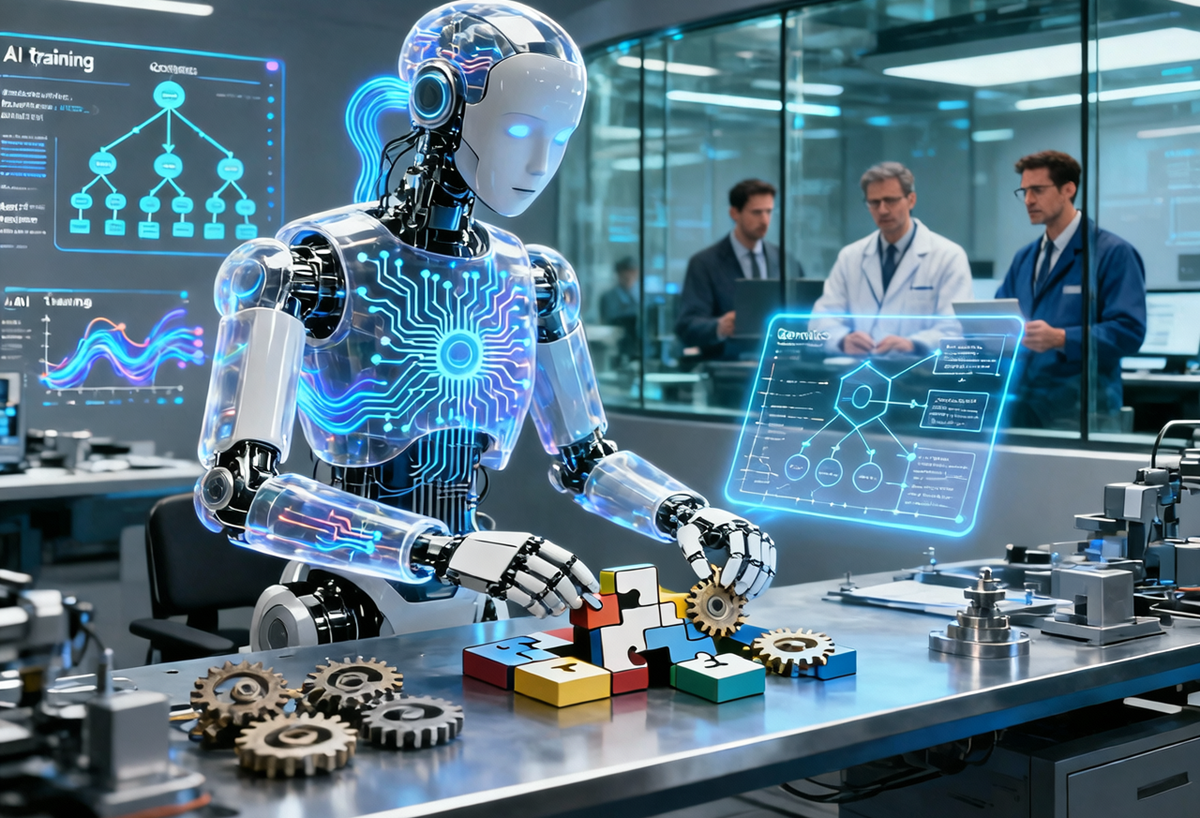
Artificial intelligence is rapidly moving beyond screens and into the physical world. One of the biggest breakthroughs shaping this transition is Gemini Robotics 1.5, Google’s advanced AI system designed to help robots understand, reason, and interact with their surroundings like never before. This update marks a major leap from traditional robotic control models, giving machines cognitive abilities that resemble human-like decision-making.
In 2025, robotics is no longer just about movement. It is about perception, reasoning, context awareness, and intelligent action — the exact strengths embedded in Gemini Robotics 1.5. This article breaks down how the system works, why its multimodal reasoning is revolutionary, and how it is shaping the next generation of physical AI agents.
What Is Gemini Robotics 1.5?
Gemini Robotics 1.5 is an upgraded version of Google’s robotics-focused AI models. It integrates the core capabilities of Gemini’s multimodal engine with advanced robotic control, allowing robots to process visual inputs, sense objects, understand instructions, and perform actions autonomously.
Unlike traditional robots that rely on rigid, pre-programmed instructions, this system enables robots to learn from demonstration, reason through tasks, and adapt to new environments.
Key Advancements in Version 1.5:
- Enhanced real-time multimodal perception
- Better spatial understanding
- Improved physical manipulation skills
- Task decomposition and planning
- Reduced training time
- Stronger agentic action capabilities
Together, these features create robots that think before they act.
Multimodal Intelligence: The Heart of the System
The major breakthrough powering Gemini Robotics 1.5 is its ability to combine different forms of input. Just like humans rely on sight, touch, memory, and logic, Gemini combines:
- Visual: Cameras, images, video feed
- Sensor data: Depth sensors, pressure feedback
- Language: Voice or text instructions
- Contextual reasoning: Past interactions, learned behavior
This blended understanding allows the robot to analyze situations holistically. For example, if you say, “Pick up the red cup next to the laptop,” the robot can:
- Identify the laptop
- Recognize the cup
- Distinguish between colors
- Estimate distance
- Plan a path
- Pick it up safely
All without any manual programming.
How Robots Learn Tasks Using Demonstrations?
One of the most impressive features of Gemini Robotics 1.5 is learning from human demonstration, also known as imitation learning.
Here’s how it works:
- A human performs the task once (e.g., setting a table).
- The robot observes through cameras and sensors.
- Gemini processes the movements, object interactions, and sequence.
- The model generalizes the pattern.
- The robot repeats the task — even in a slightly different environment.
This capability drastically cuts training time and opens robotics to non-engineers, because anyone can teach robots simply by showing them what to do.
Reasoning and Task Planning
Robots usually struggle with tasks that require thinking or problem-solving. But Gemini Robotics 1.5 introduces advanced reasoning abilities.
Robotic Reasoning Examples:
- Choosing the best tool for a task
- Planning multiple steps ahead
- Avoiding obstacles in dynamic spaces
- Evaluating options and selecting the safest action
- Adjusting to new environments without reprogramming
For example, if the robot needs to fetch an object but finds the path blocked, Gemini enables it to find an alternative route or move the obstruction safely.
This level of decision-making is what makes the system truly agentic — robots can complete tasks without constant human input.
Improved Motion and Manipulation Skills
Physical precision is essential for robotics. With Gemini Robotics 1.5, robots gain smoother, more human-like movement.
Enhancements Include:
- Accurate gripping and force control
- Stabilized walking and navigation
- Object manipulation with reduced errors
- Faster adaptation to object shape and weight
- Safety awareness in human environments
These improvements make robots reliable partners in homes, warehouses, healthcare facilities, and manufacturing units.
Applications of Gemini Robotics 1.5 in the Real World
1. Home Assistance
Robots can help with cleaning, organizing, setting tables, or assisting elderly individuals with daily tasks.
2. Manufacturing & Warehousing
From assembly lines to inventory management, robots can perform repetitive tasks with improved accuracy and safety.
3. Healthcare Support
Robots can assist nurses, deliver supplies, move equipment, or even help in rehabilitation environments.
4. Hospitality & Services
Hotels and restaurants are adopting robots for serving food, cleaning, or guiding guests.
5. Research & Education
Robotics students can now train advanced robots without needing to code complex behaviors.
As these industries embrace agentic robots, efficiency, accuracy, and safety significantly increase.
Agentic Robotics: The Future of Physical AI
The evolution of Gemini Robotics 1.5 indicates a shift toward agentic physical AI — robots that:
- Understand their environment
- Set goals
- Think through decisions
- Adapt to new contexts
- Execute multi-step tasks
This is far beyond simple automation. It represents a new generation of intelligent machines capable of working alongside humans as collaborative partners.
Conclusion
Gemini Robotics 1.5 is transforming the way robots understand, reason, and act. With advanced multimodal intelligence, imitation learning, and agentic decision-making, it pushes robotics into a future where machines are more adaptable, helpful, and intelligent. Whether in homes, industries, or hospitals, these next-generation robots mark the beginning of a new era in physical AI.