

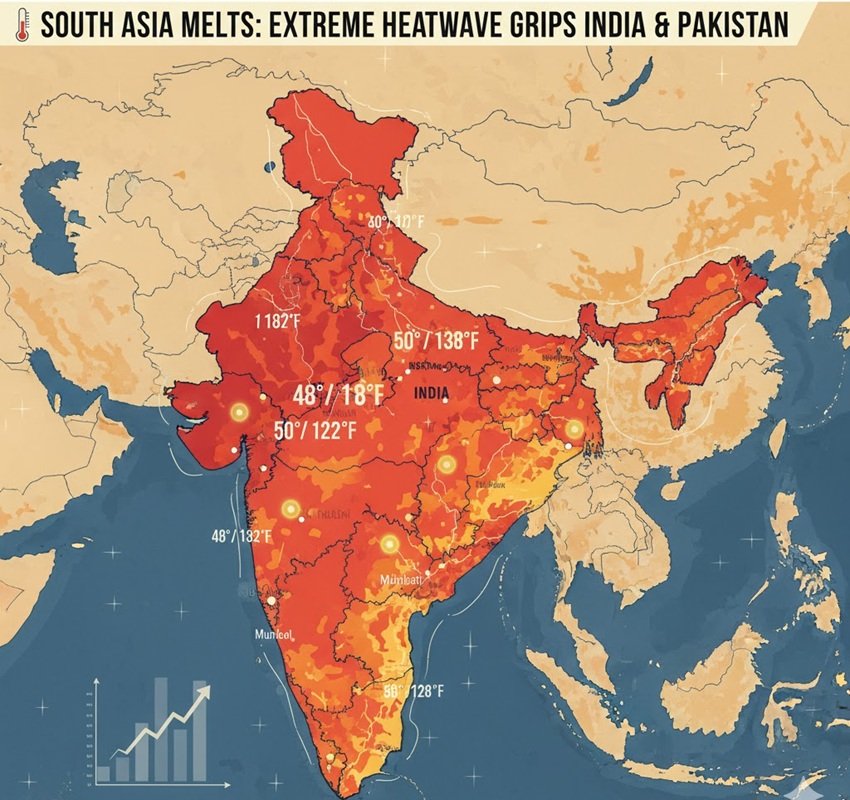
The India Pakistan heat wave 2025 has emerged as one of the most extreme climate events in South Asia in recent years, raising urgent questions about regional preparedness, cross-border cooperation, and the accelerating impact of global warming. Temperatures crossing 50°C (122°F) in several districts of Rajasthan, Sindh, Gujarat, and Punjab have pushed millions into dangerous heat conditions, overwhelming health systems and straining energy and water resources across both nations.
As global climate patterns shift unpredictably, meteorologists warn that the 2025 heat wave is not an isolated incident but a preview of future extremes that South Asia may face.
What’s Driving the Extreme Heat Across India and Pakistan?
Climate scientists attribute the severity of the 2025 heat wave to a combination of natural and human-driven factors. Rapid urbanization, shrinking green cover, high population density, and long-term warming trends have intensified temperature spikes.
Rising Global Temperatures Amplifying Local Extremes
According to climate models shared by regional weather agencies, South Asia has been warming at nearly double the global average rate over the last three decades. This long-term rise has made the region a hotspot for deadly heat waves.
Experts highlight three major triggers:
- A persistent high-pressure heat dome trapping hot air over the subcontinent
- Weak pre-monsoon winds, reducing natural cooling
- Urban heat island effect in major cities like Delhi, Lahore, Karachi, and Jaipur
Dr. Farah Khan, a climate researcher based in Islamabad, noted,
“South Asia is experiencing heat waves earlier, more frequently, and with greater intensity. The India Pakistan heat wave 2025 stands out because it has pushed climate thresholds beyond historical limits.”
How the Heat Wave Is Impacting Daily Life and Critical Sectors?
The consequences of the heat wave have been far-reaching, affecting public health, agriculture, energy systems, water supply, and regional economies.
Health Emergencies Surge Across Borders
Hospitals across northern India and southern Pakistan have reported a steep rise in cases of:
- Heatstroke
- Severe dehydration
- Respiratory stress
- Kidney-related complications
Local governments have issued red alerts, urging residents to avoid outdoor work during peak hours. School closures, delayed work shifts, and restrictions on construction activities have been implemented in multiple districts.
Agriculture and Food Security at Risk
The heat wave has come at a critical time for wheat and vegetable crops. Farmers in Punjab and Sindh report wilting fields and declining yields.
Agricultural experts warn:
- Soil moisture has dropped sharply
- Tube-well usage has surged, raising electricity demand
- Livestock mortality has increased in several rural belts
This could lead to supply shortages and price spikes, especially in border regions.
Energy and Water Stress Intensifies
As temperatures rise, power consumption has hit record highs in both nations. Demand for air conditioning, refrigeration, and irrigation pumps has surged, causing:
- Localized power outages
- Pressure on coal and gas supplies
- Overloaded transmission networks
Water scarcity has become another urgent challenge. Reservoir levels in Rajasthan and parts of Pakistan’s Sindh province have fallen sharply, prompting emergency water distribution measures.
How Governments Are Responding?
Both India and Pakistan have deployed short-term and long-term strategies to mitigate heat impacts.
Emergency Measures Activated
- Heat shelters set up in major cities
- Free water distribution centers
- Mobile health clinics for rural areas
- Alerts via SMS, radio, and local administration
Authorities are issuing workplace safety guidelines for construction workers, delivery staff, farmers, and industrial laborers.
Long-Term Climate Adaptation Plans
Urban planners and environmental experts emphasize the need for:
- Increasing green cover
- Heat-resilient urban infrastructure
- Improved forecasting systems
- Investment in renewable energy
- Heat-wave action plans for vulnerable districts
Both countries have partnered with international organizations for climate finance and adaptation projects.
Cross-Border Climate Cooperation: A Growing Need
While India and Pakistan often remain politically divided, environmental experts insist that the India Pakistan heat wave 2025 is a strong reminder that climate change does not respect borders.
Joint initiatives could include:
- Shared heat-wave forecasting models
- Coordinated disaster response plans
- Knowledge exchange on heat-resilient agriculture
- Cross-border river water management frameworks
Climate forums at SAARC and UNFCCC have already highlighted the need for cooperation to handle escalating climate risks in South Asia.
Why 2025 Marks a Turning Point for South Asian Climate Policy?
Scientists believe the 2025 heat wave will influence future climate decisions for both nations. Studies show that without significant emission cuts and adaptation strategies, heat waves in South Asia could become 10 times more frequent by mid-century.
Cities like Karachi, Delhi, and Lahore may experience more days where wet bulb temperatures — which combine heat and humidity — reach dangerously high levels for human survival.
Future Outlook: Preparing for a Hotter, More Unpredictable South Asia
As the India Pakistan heat wave 2025 continues to disrupt daily life, one thing is clear: South Asia is entering an era where extreme heat will be a recurring reality. Scientists warn that the coming years may bring:
- Earlier onset of heat waves
- Longer-duration heat spells
- Increased nighttime temperatures
- Higher mortality and economic losses
Climate specialists emphasize that adaptation must be rapid and science-driven.
“What we are witnessing today is just the beginning,” said Delhi-based environmental analyst Arvind Mehra.
“If we fail to prepare now, the next decades will challenge the survival of millions across the region.”
Conclusion
The India Pakistan heat wave 2025 is more than a weather event — it is a major climate warning for the entire subcontinent. Its intensity has exposed vulnerabilities in healthcare, infrastructure, agriculture, and disaster preparedness. As temperatures continue to rise, both countries must prioritize climate resilience, invest in early-warning systems, and adopt sustainable solutions.
Only through long-term planning, robust policy decisions, and regional cooperation can India and Pakistan protect millions from the escalating threats of a warming climate