


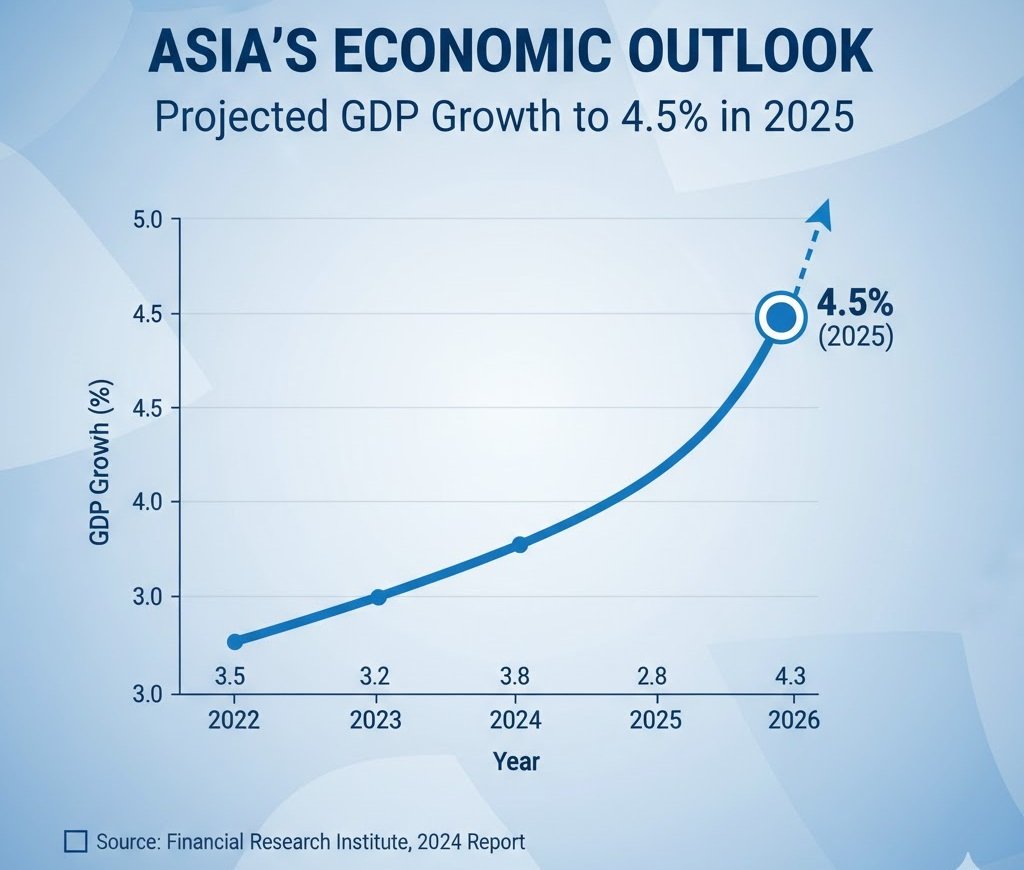
Asia’s economic outlook for 2025 is showing renewed momentum as the International Monetary Fund (IMF) has revised its regional growth projection to 4.5%, up from its earlier estimate of 4.2%. The latest update positions Asia as the strongest performing region globally, driven by robust domestic demand, recovering trade flows, and improving investor confidence.
The upward revision reflects a more resilient economic landscape across emerging and advanced Asian economies, despite ongoing risks tied to geopolitics, energy markets, and global financial tightening. The IMF’s report signals cautious optimism as Asia continues to anchor global expansion.
Why the IMF Raised Asia’s 2025 Economic Forecast?
The IMF’s improved projection is supported by a combination of cyclical improvements and long-term structural shifts. Economists noted that Asia remains a global growth engine, contributing nearly 60% of worldwide GDP expansion.
Key drivers include:
- Stronger-than-expected domestic consumption across India and Southeast Asia
- Improved export performance, especially in electronics and services
- Tourism revival in nations like Thailand, Malaysia, and Japan
- AI-led transformation across advanced economies such as South Korea, Singapore, and Japan
- Better monetary stability, with inflation cooling in major markets
The IMF report highlights that the region’s economies are adapting quickly to global changes, allowing for a more favorable 2025 landscape.
Country-by-Country Performance: Mixed but Positive
India: The Region’s Fastest-Growing Major Economy
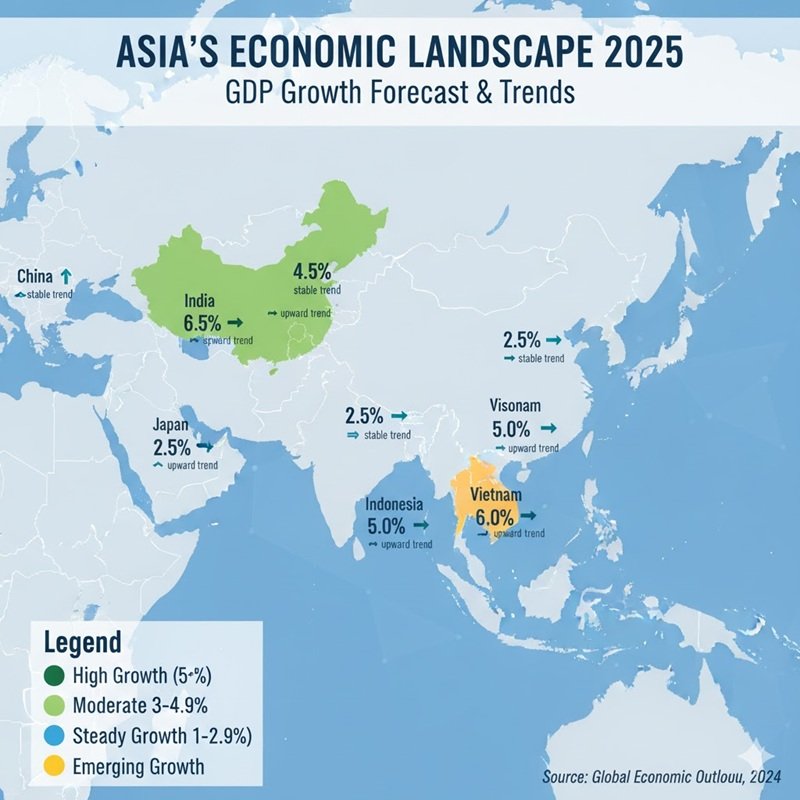
India continues to surge ahead with projected growth of 6.5%, supported by strong services, manufacturing expansion, increased digital adoption, and robust capital inflows. The IMF cited India as a “pillar of regional stability,” contributing significantly to Asia economic growth 2025.
China: Stabilizing After a Sluggish 2024
China’s economy is expected to grow at 4.2%, slightly higher than earlier forecasts. While property-sector challenges persist, targeted government stimulus and rising consumer activity are helping stabilize momentum.
Southeast Asia: Tourism and Manufacturing Recovery
Economies like Vietnam, Indonesia, and the Philippines are benefiting from:
- Supply-chain diversification
- Tourism normalization
- Strong FDI inflows
- Rapid digital economy growth
Vietnam remains one of the standout performers, driven by foreign manufacturing investments.
Japan & South Korea: Moderate Growth Amid Structural Challenges
Japan is expected to see modest gains due to stable demand and corporate investment, while South Korea’s semiconductor rebound is a major contributor to regional export strength.
Key Economic Forces Shaping Asia’s 2025 Outlook
1. Digital and AI-Led Transformation
Generative AI and automation are accelerating productivity across technology, logistics, banking, and manufacturing. Governments across Asia are increasing AI-related investments, particularly in Singapore, Japan, India, and South Korea.
Analysts believe AI adoption could contribute up to $1.5 trillion to Asia’s GDP over the next decade.
2. Rebound in Global Trade
Asian exporters benefited from easing supply-chain constraints and rising demand for:
- Semiconductors
- Automotive components
- IT services
- Renewable energy equipment
The IMF expects global trade to grow 3.5% in 2025, supporting Asia’s export-heavy economies.
3. Tourism Revival Strengthens Service Sectors
Travel recovery is accelerating across Asia. Countries such as Thailand, Indonesia, and Japan have seen tourist arrivals rise sharply, boosting hospitality, retail, and transport sectors.
4. Growth in Renewable Energy and Green Infrastructure
Massive investments in solar power, hydrogen, and electric vehicle infrastructure are creating new economic opportunities.
China, India, and Southeast Asia are leading green-energy deployment at scale.
Risks That Could Slow Asia’s Growth in 2025
Despite strong performance indicators, the IMF warns of several challenges that could derail the region’s upward trajectory.
Geopolitical Tensions
U.S.–China competition continues to influence trade routes, technology flows, and investment decisions. Conflicts in the Middle East also pose risks to energy-importing nations.
Commodity Price Volatility
Sharp movements in oil and natural gas prices can significantly impact inflation and fiscal budgets across developing Asian economies.
Climate and Natural Disasters
Asia remains highly vulnerable to extreme weather events — including typhoons, heat waves, and flooding — which can disrupt agriculture, infrastructure, and supply chains.
Debt Vulnerabilities
Nations like Pakistan, Sri Lanka, and Laos face ongoing debt-related pressures that may require additional fiscal discipline and external support.
Sector Analysis: Who Gains the Most in 2025?
Technology and Electronics
The semiconductor sector’s revival is expected to benefit South Korea, Taiwan, and Singapore. AI-related innovations are also likely to drive economic value.
Travel & Tourism
Asian tourism is projected to return to pre-pandemic levels by late 2025, boosting economic recovery in Southeast Asia.
Manufacturing and Supply Chain Diversification
India, Vietnam, and Indonesia remain top destinations for global companies diversifying away from traditional hubs.
Energy and Infrastructure
Large-scale renewable energy projects are creating long-term economic opportunities and promoting sustainability-focused growth.
Asia’s Future Outlook: Strong, Resilient, and Transformative
The IMF’s revised forecast underscores Asia’s position as the world’s most dynamic economic region. While challenges remain, strong domestic demand, rapid digital transformation, and improving global conditions suggest a stable and promising 2025.
Experts say Asia will continue to shape global growth patterns, supported by its expanding workforce, rising consumption power, and fast-paced technological adoption.
With the region now projected to grow at 4.5%, Asia’s economic foundation entering 2025 appears more resilient than eve