

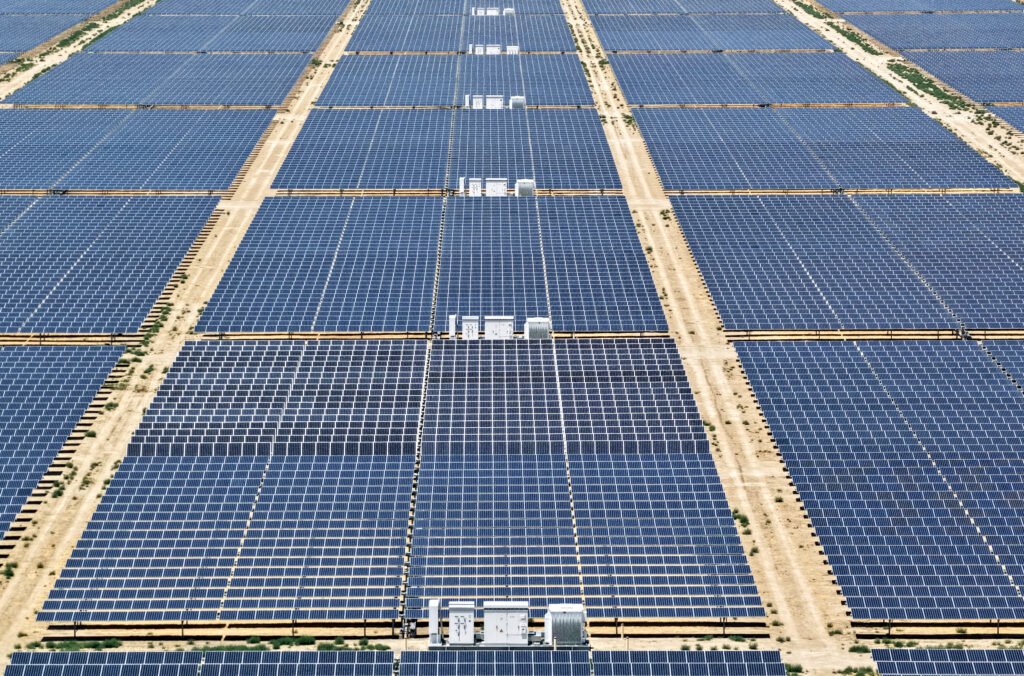
It’s good to be in the utility-scale solar business, even in the United States.
Despite tariffs and shifting tax credit policies, business is booming. Amid high electricity demand and rising concerns about consumer rates, solar’s low cost and short construction timeline make it an attractive option.
I spoke this week with solar developers, analysts and others to get a sense of how they’re feeling at the halfway point of 2026.
“Utility-scale solar is doing very well right now,” said Chris Bullinger, president and CEO of Hecate Energy of Chicago, one of the country’s top developers of solar and battery energy storage.
The company, which he co-founded in 2012, is preparing for an initial public offering of its stock and shifting its focus to long-term ownership of some projects, rather than building and then selling them.
Bullinger sees an opportunity to build and own “energy parks,” which are projects that combine multiple energy sources to provide reliable power, often directly to an on-site customer, such as a data center. A typical setup would include solar, battery energy storage and natural gas power.
The demand for energy parks is coming from data centers and other large users that want to get operational as soon as possible. One way to make that happen is to build data centers alongside power plants.
The boom in data centers is contributing to an increase in plans for natural gas power plants across the country, a trend that has drawn attention because of concerns about rising consumer gas prices, high emissions and other negative effects. But the increase in electricity demand is a boon for just about the entire power sector, including renewables.
This is despite the Trump administration’s hostility for renewable energy, which has hit onshore and offshore wind development, but is less of a factor for solar and batteries.
The United States is on track to add 42,971 megawatts of utility-scale solar this year, which is the sum of the 9,070 megawatts built from January to May and the 33,901 megawatts that are on track to be completed between June and December, according to the federal government’s Energy Information Administration.
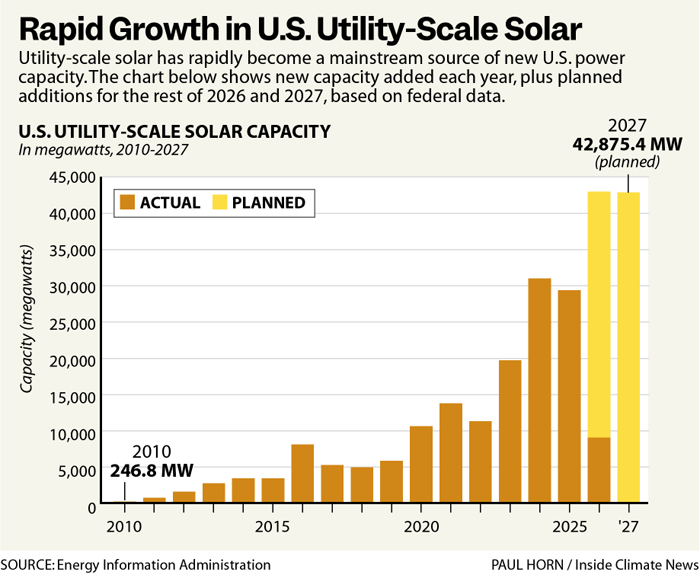
Those are huge numbers, much higher than any other power plant technology and about a 45 percent increase over the utility-scale solar built in 2025.
And the strong showing in 2026 won’t be an outlier. Developers plan to build 42,875 megawatts that would go online in 2027.
For perspective, it was a big deal in 2020 when the country’s annual utility-scale solar projects exceeded 10,000 megawatts for the first time. Back then, the idea of 40,000 megawatts being built in a year stretched the limits of belief. This year, it’s just normal.
A perpetual caveat: Looking at megawatts of solar capacity can be misleading when comparing it to energy sources that run around the clock, since solar only produces when the sun shines. But even with this note, the scale of the growth in utility-scale solar is impressive. And the intermittent nature of solar is partially mitigated by the rapid growth of battery storage.
M.A. Mortenson Co. of Minneapolis is an engineering and construction firm that is among the national leaders in building solar and batteries. Trent Mostaert, a vice president, said the current moment is strikingly good for utility-scale solar.
“I would put this right up there with the best of times,” he said.
I asked him what’s not working, or what could be better. He said the biggest challenges are connecting to the grid, dealing with policy uncertainty and mobilizing a skilled work force, all while trying to complete projects fast enough to keep up with demand.
Also, the sites he’s working on are often less ideal than before, largely because the best locations were developed first.
What’s an ideal location for solar? Anywhere flat, sunny, available for lease and close to a major power line with available capacity.
People across the solar industry told me that sudden shifts in tax credits are a major headache. President Joe Biden signed the Inflation Reduction Act in 2022, which included an extension of clean energy tax credits. President Donald Trump signed the One Big Beautiful Bill Act in 2025, which led to a rapid phaseout of some of those credits, including the one for utility-scale solar development.
The main problem isn’t that the tax credits are going away; it’s that the repeated changes make it difficult to plan long-term investment. And, Bullinger said, any changes have a lag time as agencies figure out the finer points of the rules, which delays action for companies eager to pursue projects.
Several people listed tariffs as a problem. Solar panels cost more in the United States than elsewhere because of tariffs that have existed in various forms for more than a decade.
The upside of tariffs on imported panels is that U.S.-based manufacturers are more able to compete. U.S.-based panel factories continue to ramp up, although most panels in this country are still imported, primarily from Southeast Asia.
This story is funded by readers like you.
Our nonprofit newsroom provides award-winning climate coverage free of charge and advertising. We rely on donations from readers like you to keep going. Please donate now to support our work.
Sylvia Leyva Martinez, research director for Americas power and renewables for Wood Mackenzie, a research firm, said it’s a good time to be a solar developer, but only under certain conditions.
“Larger, well-capitalized players have a natural advantage in procurement and financing,” she said in an email. “Developers who have been efficient planners, built strong supplier relationships, and are disciplined about documentation and compliance will also show a higher success rate of their projects.”
Natural gas power plants are growing as a complement to solar and storage, as all benefit from rising demand, she said. “Gas has its own lead time and cost constraints, so in practice we’re seeing gas and solar-plus-storage being developed in parallel to meet the same wave of demand, not one replacing the other.”
Pavel Molchanov, a senior investment strategist at investment bank Raymond James, said U.S. solar developers are having a great year, but the most successful developers have some notable advantages.
“All you need to start a solar developer is some capital, that’s it,” he said. “What’s hard is to have a sustainable competitive advantage compared to everybody else that’s doing it.”
He listed two advantages that distinguish successful developers. The first is a low cost of capital, which means they can finance projects at a lower cost than other developers. The second is operational competence, which means skill in obtaining permits, dealing with local public opinion and a general know-how in turning a proposal into a completed project.
“There is a skill set in managing this whole process,” he said.
I’ve seen this in the rural Midwest, where some developers are proactive about communicating with local communities and building support, and others seem several steps behind opponents to development.
This brings me back to Bullinger of Hecate, a company named after the Greek goddess of the crossroads. I asked him which parts of the United States are most attractive for investment.
He listed Texas, which isn’t a surprise since that’s the leading solar market, along with Illinois and New Mexico.
The distinguishing feature in those states is clear rules and policy stability, he said. If a state has clear rules, developers have good information to help choose whether to invest. If the rules keep changing, it’s more difficult.
Looking ahead, the solar industry can anticipate strength for the rest of this decade. The Trump legislation said that projects must have started construction by July 4 of this year and be completed by 2030 to qualify for tax credits, which is contributing to the building boom now underway.
Considering how much has changed in the last few years, I’m going to find some comfort in this predictability and not ask what happens after 2030, at least not yet.
Other stories about the energy transition to take note of this week:
Google and Amazon Increase Emissions While Emphasizing Efficiency: Google and Amazon have issued reports that show big increases in their emissions, reflecting their use of massive amounts of electricity to power AI systems. The companies are emphasizing that they are becoming more efficient in their electricity use, which seems to overlook the fact that efficiency gains are less meaningful if emissions are rising, as Lisa Martine Jenkins reports for Latitude Media. This is part of a larger conversation about how tech companies are balancing their public statements about reducing emissions with the competitive pressure to ramp up AI operations.
Data Centers Driving Record Electricity Consumption Forecast: U.S. electricity consumption will grow from a record high in 2025, with new highs in 2026 and 2027, according to the Energy Information Administration’s short-term forecast. The growth of data centers is driving the overall increase and is one reason that electricity consumption from commercial users will exceed that of households this year for the first time on record, as Scott Disavino reports for Reuters. Natural gas will remain the country’s leading fuel for producing electricity, with 40 percent market share in 2026 and 2027, the same as in 2025. Renewables will gain market share, reaching 25 percent in 2026 and 27 percent in 2027, up from 24 percent in 2025.
A Problem With Solid-State Batteries May Now Have a Solution: Battery companies have talked for years about the potential for solid-state batteries—meaning charged particles pass through a solid rather than a liquid—to expand the range of electric transportation. But there has been a persistent problem: the batteries’ tendency to develop spiky structures called dendrites. Researchers at the Massachusetts Institute of Technology and the Technical University of Munich say they’ve figured out a major cause of dendrites and may have a solution, as Suvrat Kothari reports for InsideEVs.com. The cause is related to a hidden electrical imbalance that makes it more difficult for lithium ions to move, and, the researchers found, can be reduced.
Researchers Find Big Efficiency in Using DC Power for Heat Pumps: Purdue University researchers have published the results of a study of how a house could use a direct current “nanogrid” to run an air source heat pump in a way that uses less electricity than alternating current, as Emiliano Bellini reports for PV Magazine. Much of the efficiency comes from not having to convert direct current from solar panels and batteries into alternating current for household use. The cost savings exceeded 15 percent, enough to lead the researchers to view this as a promising opportunity.
Inside Clean Energy is ICN’s weekly bulletin of news and analysis about the energy transition. Send news tips and questions to [email protected].
About This Story
Perhaps you noticed: This story, like all the news we publish, is free to read. That’s because Inside Climate News is a 501c3 nonprofit organization. We do not charge a subscription fee, lock our news behind a paywall, or clutter our website with ads. We make our news on climate and the environment freely available to you and anyone who wants it.
That’s not all. We also share our news for free with scores of other media organizations around the country. Many of them can’t afford to do environmental journalism of their own. We’ve built bureaus from coast to coast to report local stories, collaborate with local newsrooms and co-publish articles so that this vital work is shared as widely as possible.
Two of us launched ICN in 2007. Six years later we earned a Pulitzer Prize for National Reporting, and now we run the oldest and largest dedicated climate newsroom in the nation. We tell the story in all its complexity. We hold polluters accountable. We expose environmental injustice. We debunk misinformation. We scrutinize solutions and inspire action.
Donations from readers like you fund every aspect of what we do. If you don’t already, will you support our ongoing work, our reporting on the biggest crisis facing our planet, and help us reach even more readers in more places?
Please take a moment to make a tax-deductible donation. Every one of them makes a difference.
Thank you,

Reporter, Clean Energy
Dan Gearino covers the business and policy of renewable energy and utilities, often with an emphasis on the midwestern United States. He is the main author of ICN’s Inside Clean Energy newsletter. He came to ICN in 2018 after a nine-year tenure at The Columbus Dispatch, where he covered the business of energy. Before that, he covered politics and business in Iowa and in New Hampshire. He grew up in Warren County, Iowa, just south of Des Moines, and lives in Columbus, Ohio.