

NEW YORK—When Mayor Zohran Mamdani announced that $20 million from the city’s congestion pricing revenue would be redirected to fight childhood asthma in the Bronx, Javier Marchand celebrated.
But Marchand, the air quality advocate for the community advocacy group South Bronx Unite, knows the new funding will not be enough to fix the pollution problem in his neighborhood.
Every summer, New York City’s emergency communication system floods residents with air quality warnings. The warnings signal the arrival of wildfire smoke from Canada, or the presence of ground-level ozone, which forms when pollutants emitted by vehicles, power plants or refineries chemically react in the presence of sunlight.
In the Bronx, though, some neighborhoods experience poor air quality year-round, with lasting health consequences.
“It’s the stuff that’ll go into your lungs, into your body, into your blood for years,” Marchand said. “You don’t taste it, you don’t see it or anything, you just breathe it.”
Nineteen percent of Bronx children have been diagnosed with asthma at some point in their lives, compared to 12 percent of children across the whole of New York City.
Citywide, the annual rate of asthma hospitalizations for children younger than four, who are especially susceptible, is around 200 per 10,000. But in the Bronx, it is about 340 per 10,000, according to the most recent city data.
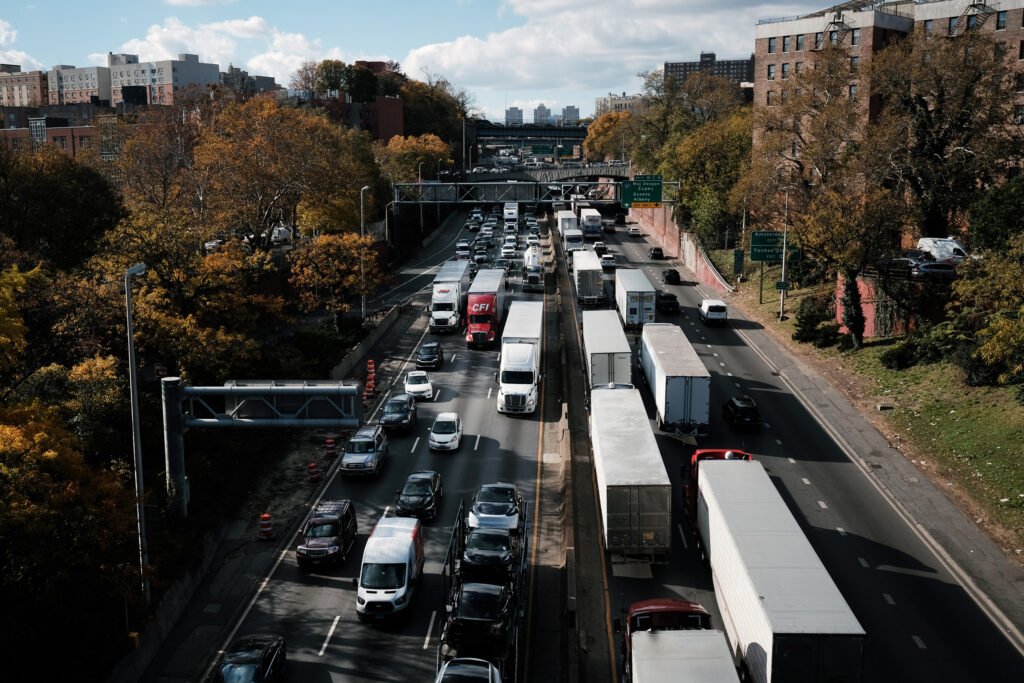
A history of redlining has led to a concentration of power plants and highways across the borough. The South Bronx, in particular, is a common destination for diesel trucks—which deliver food, packages and waste to distribution centers and waste transfer stations.
A recent preliminary report by Columbia University scientists partnering with South Bronx Unite, which has not yet been peer-reviewed, found that even congestion pricing, a policy meant to improve air quality, increased the concentration of toxic air particles in the area by 2 percent.
Breathing in the Bronx
Exhaust from diesel engines contains fine particulate matter—small particles containing a nasty brew of chemicals and heavy metals—and gases like nitrogen oxides. When inhaled, both can irritate a person’s lower airways, said Stephanie Lovinsky-Desir, who has spent much of her career as a pediatrician studying how environmental and social factors affect respiratory illness, especially in children.
That repeated irritation, she said, causes a kind of “remodeling” in the lungs, making them more sensitive and easier to trigger, leading to the chronic inflammation known as asthma.
Four natural gas-fired power plants in the neighborhood also emit these pollutants.
A 2022 pilot study of New York City children with asthma, co-authored by Lovinsky-Desir, found that their exposure to ambient nitrogen dioxide contributed to reduced lung function after exercise. These nitrogen oxides also contribute to the formation of ground-level ozone, often creating smog, which gives the horizon a hazy appearance.
Ozone pollution can even affect healthy people, causing coughing and a sore throat, according to the Environmental Protection Agency, but the worst effects are typically experienced by people with lung diseases such as asthma.
Ozone pollution often triggers air quality warnings in New York during summer. Another common culprit is northern wildfires, specifically from Canada, which bring fine particulate matter to the city. Though this affects all New Yorkers, Bronxites may feel it more keenly because many already suffer from air-quality-related health issues.
The 10-year average for area burned in Canada has nearly quadrupled since the 1970s, said Mike Flannigan, the science director of the Canadian Partnership for Wildland Fire Science at the University of Alberta.
“We’ve had three bad fire years in Canada in our modern-day records regionally,” he said. “You get another bad fire year, your narrative will change to say expect a bad fire year.”
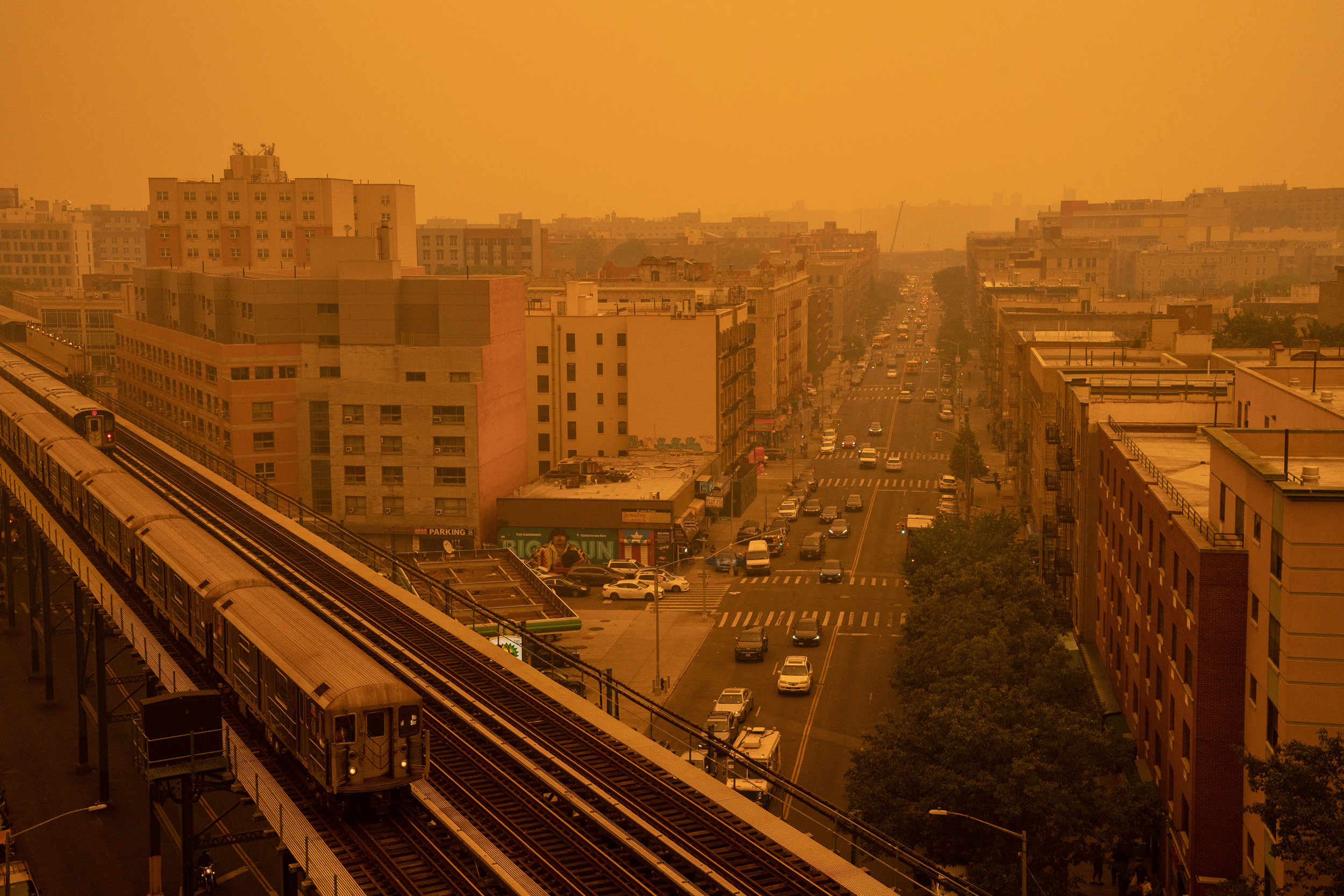
He attributes much of this to human-caused climate change. Warmer temperatures, he said, lead to longer fire seasons, and they can have a drying effect on vegetation, which fuels fires. If the wind conditions are right, some smoke can reach the Eastern Seaboard.
“Smoke doesn’t know borders,” he said.
Trucking Along
Though emissions from all kinds of diesel- and gas-powered vehicles are harmful, those from large diesel trucks are even more so. Breathing in diesel exhaust can lead to respiratory problems like asthma or worsen existing heart disease.
The city remains heavily reliant on diesel-powered freight to transport goods and waste even with the gradual adoption of electric trucks. Last November, the Department of Transportation proposed to redesign its established routes for heavy-duty trucks.
The plan includes an increase of around 3 percent in truck route mileage across the city, with roughly 21 miles of that on highways “to shift heavy vehicle traffic away from local streets.” If approved, the plan would still add more truck routes to freight-heavy areas of the Bronx, including the South Bronx.
The city’s freight, nearly 90 percent of which is delivered by truck, places a disproportionate burden on places like the South Bronx because of the placement of last-mile warehouses—facilities that sort and distribute packages across the city—and waste transfer stations, which receive, sort and redistribute waste to landfills and incinerators across the state and country.
According to city agencies, around 75 percent of the city’s waste is processed in a handful of environmental justice neighborhoods, including one in the South Bronx.
This story is funded by readers like you.
Our nonprofit newsroom provides award-winning climate coverage free of charge and advertising. We rely on donations from readers like you to keep going. Please donate now to support our work.
Efforts have been made at the federal, state and local levels to reduce truck pollution. During the Biden administration, the EPA pushed for more stringent emissions limits for diesel trucks—though the agency announced last year under the Trump administration that it was reconsidering the change.
The NYC Clean Trucks Program, which began in Hunts Point before expanding citywide, offers rebates to owners of truck fleets willing to switch to low- or zero-emission vehicles. In April, Mamdani redirected $20 million in congestion pricing funds to the program as “an investment in our lungs.”According to a city press release, the program has led to the replacement of 714 diesel trucks since 2012.
Some local groups are also trying to make a difference in the South Bronx. Empire Clean Cities, a nonprofit dedicated to electrifying truck fleets across the city, wants to add an electric truck charging hub across the street from the Hunts Point Food Distribution Center, which the city estimates distributes around 4.5 billion pounds of food to businesses across the region every year, mostly via diesel trucks.
Other organizations, including the Greater Hunts Point Economic Development Corp., are also involved in the project, which is funded through a grant from the state’s Energy Research and Development Authority.
According to Jonah Kasdan, a program manager at Empire Clean Cities, the group is already working to convert local truck fleets to electric. The work is slow—so far, only three local companies have agreed to make the gradual transition to electric.
Federal actions are hitting the nonprofit hard. The Trump administration convinced Congress to eliminate tax credits for electric vehicles. Last year, the U.S. Department of Energy cut funding for one of Empire Clean Cities’ projects without warning. Lauren Kesner O’Brien, the organization’s policy and partnerships manager, said they are still waiting to see whether the funding will be reinstated.
Another federal grant, this one directing $5 million to the city of New York, allowed Empire Clean Cities, in partnership with city agencies, to pilot the transport of food via boat. Fresh seafood made its way from a pier in Hunts Point to Pier 16 in Lower Manhattan using the U.S. Coastal Service’s freight ferry.
“What we’ve been doing right now is talking to different fleets that operate out of Hunts Point to try to find the right commodities to transport,” Kesner O’Brien said. “It doesn’t work for large pallets, because … the last mile of the delivery is an electric cargo bike.”
Although this year is the final year of the funded project, which is part of the city’s Blue Highways program, she hopes that private companies will build on her organization’s work by shifting some food delivery from trucks to boats.
Delayed Retirement
The state-owned public power organization, the New York Power Authority, operates four “peaker” gas-fired power plants in the South Bronx neighborhoods of Mott Haven and Port Morris. The plants provide electricity during high-demand times—usually in the summer when air conditioners are used more frequently.
“If there’s an old power plant, they’ll just run that infrequently to meet these needs, but because of that … they’re older, they’re less efficient,” said Karan Shetty, a clean energy transition scientist at PSE Healthy Energy, an independent research institute that publishes a peaker power plant mapping tool.
The power plants also impose an additional environmental burden on already suffering communities, like those in the South Bronx, by emitting nitrogen oxides and fine particulate matter.
As New York heats up because of global warming, the peaker power plants may have to be used more frequently—if the state cannot find a cleaner solution. Federal hostility to offshore wind and regulatory delays have complicated the state’s journey to net-zero.
The Champlain Hudson Power Express, a massive power line that brings Canadian hydropower into New York City, went online last month. It is supposed to help alleviate some of the pressure on the grid, especially in the summer months.
Under the state’s “Peaker Rule,” New York must retire all peaker plants by 2030—though the rule was developed under the state’s original Climate Act greenhouse gas emissions targets. New York Gov. Kathy Hochul has since moved the goalposts.
An April report by the state’s grid operator stated that two Brooklyn peaker plants, which were once slated for retirement in 2025, will remain operational until May 2029. Though no announcement on the topic has been made, the retirement of additional peaker plants may need to be delayed to keep the city running.
All the while, Bronxites will keep breathing in that polluted air.
About This Story
Perhaps you noticed: This story, like all the news we publish, is free to read. That’s because Inside Climate News is a 501c3 nonprofit organization. We do not charge a subscription fee, lock our news behind a paywall, or clutter our website with ads. We make our news on climate and the environment freely available to you and anyone who wants it.
That’s not all. We also share our news for free with scores of other media organizations around the country. Many of them can’t afford to do environmental journalism of their own. We’ve built bureaus from coast to coast to report local stories, collaborate with local newsrooms and co-publish articles so that this vital work is shared as widely as possible.
Two of us launched ICN in 2007. Six years later we earned a Pulitzer Prize for National Reporting, and now we run the oldest and largest dedicated climate newsroom in the nation. We tell the story in all its complexity. We hold polluters accountable. We expose environmental injustice. We debunk misinformation. We scrutinize solutions and inspire action.
Donations from readers like you fund every aspect of what we do. If you don’t already, will you support our ongoing work, our reporting on the biggest crisis facing our planet, and help us reach even more readers in more places?
Please take a moment to make a tax-deductible donation. Every one of them makes a difference.
Thank you,

Reporter, New York City
Lauren Dalban is a New York City-based reporter with a background in local journalism. A former ICN fellow, she now covers environmental issues in all five boroughs. Originally from London, she earned a B.A. in History and English from the University of Virginia, and an M.S. from Columbia Graduate School of Journalism.