

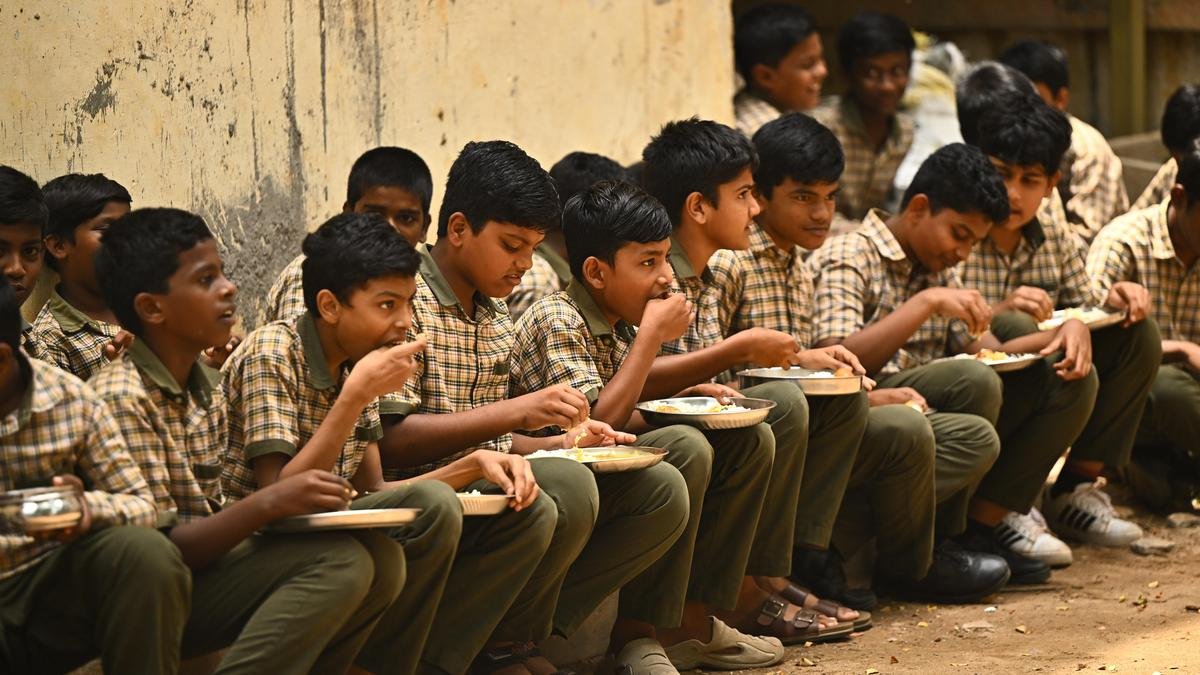

‘Schools can address this through improved midday meals, healthier canteens and food demonstrations that teach students how to build balanced plates.’ File image
| Photo Credit: The Hindu
As schools across the country reopened after summer vacation, classrooms were filled once again with the energy, aspirations and anxieties of millions of adolescents. Yet hidden behind their growing ambitions lies a silent public health emergency — adolescent malnutrition. The recently released NFHS-6 (2023-24) findings are stark. Obesity among women aged 15-49 years has risen from 24% to 30.7%, and among men from 22.9% to 27.3%. High blood sugar among men aged 15 and above jumped from 15.6% to 20.9%, and among women from 13.5% to 17.8%. What is most alarming is that lifestyle changes once associated with cities and affluent communities such as sedentary behaviour, processed diets, stress and rising obesity, are now affecting rural populations too. India faces a double burden: undernutrition among children and surging obesity among adults, with obesity driving diabetes, heart disease and stroke. These crises do not begin in adulthood. Their roots lie in adolescence, making schools the most critical setting for prevention.

Addressing diets differently
Schools must recognise that malnutrition is no longer only about thinness. India is witnessing the ‘thin-fat’ phenotype —children who appear lean yet carry dangerous metabolic risk. According to the Comprehensive National Nutrition Survey (CNNS, 2019), 27.4% of Indian adolescents are stunted. At the same time, obesity is rising, particularly among the urban youth. More strikingly, 35% of children under five are stunted yet carry adult-level triglycerides, which is like a metabolic time bomb associated with adult-onset diabetes and cardiovascular disease. Preventing these diseases must begin in school, not in hospitals decades later.

Studies on Delhi school adolescents confirmed that the consumption of milk and dairy products, green leafy vegetables and fruits is lower than what is recommended. Far too many children consume cereal-heavy diets while proteins and protective foods remain woefully inadequate. Schools can address this through improved midday meals, healthier canteens and food demonstrations that teach students how to build balanced plates. The Dietary Guidelines for Indians 2024 recommend that half the plate by volume should consist of fruits and vegetables. Yet research confirms that sedentary and screen-heavy behaviours are inversely associated with daily fruit and vegetable intake — a dangerous compounding effect. School gardens, fruit breaks, and local seasonal produce can normalise healthier eating habits.
Addressing sugar and UPFs
Moreover, the bitter truth about sugar has to be revealed. Sugary drinks, High fat sugar and salt (HFSS) foods, and Ultra-Processed Foods (UPFs) are rapidly replacing traditional foods. Studies highlight alarming trends in free sugar and UPF consumption among Indian adolescents. A recent World Health Organization study has revealed that UPF consumption in India has been surging at more than 13.7% year-after-year. The bitter truth is that the excess sugar consumed today becomes a metabolic risk tomorrow. Schools must actively discourage sugary beverages and display sugar boards showing hidden sugar content. Reinforcement, not one-time campaigns, converts knowledge into practice.
Also Read | As Bengal drops eggs from mid-day meals, Tamil Nadu and Odisha show another way
Physical inactivity must be treated as seriously as poor diet. Schools should guarantee structured physical activity and sports as core educational components, not optional extras. This is especially urgent as urban lifestyle habits such as reduced movement, changing diets, and rising obesity are now affecting rural communities too, making inactivity a nationwide epidemic, not only city schools’ problem.

Thus, among the most common risk factors for non-communicable diseases in children and adolescents are unhealthy diets and insufficient physical activity. The rapid rise of adolescent obesity increases the risk of early-onset Type 2 diabetes, hypertension and heart disease, and will lead to substantially greater healthcare spending. UPF-free school zones must become a national movement backed by consistent policy.
Editorial | Catch them young: On overweight or obese children in India
Schools advancing public health
It is here that the Let’s Fix Our Food (LFOF) initiative offers a compelling direction. Led by the Indian Council of Medical Research-National Institute of Nutrition (ICMR-NIN), the LFOF consortium is a multi-stakeholder initiative working to create healthier food environments for adolescents by advancing evidence-based policy, empowering youth through nutrition literacy, and campaigning for regulatory frameworks. Its outputs include recommendations for regulating HFSS food advertising, taxation on unhealthy beverages, a model school nutrition curriculum and a food label reading kit.
A 2025 Lancet study projected that 21.8 crore men and 23.1 crore women in India will be overweight by 2050, with the steepest rise expected among adolescents and young adults aged 15-24 years.
Schools must move beyond textbook nutrition education and adopt skill-based approaches such as reading food labels, recognising portion sizes, understanding marketing tactics, and basic cooking. Schools are not merely educational institutions; they have the potential to be powerful public health promoting institutions. School-based interventions in India have demonstrated measurable improvements in dietary behaviour and reductions in sugary beverage consumption. A child protected from unhealthy diets today is far less likely to become a patient tomorrow.
SubbaRao M. Gavaravarapu is Scientist G at the ICMR-National Institute of Nutrition and leads the Let’sFixOurFood Initiative. Bharati Kulkarni is Director, ICMR- National Institute of Nutrition
Published – June 29, 2026 12:40 am IST