

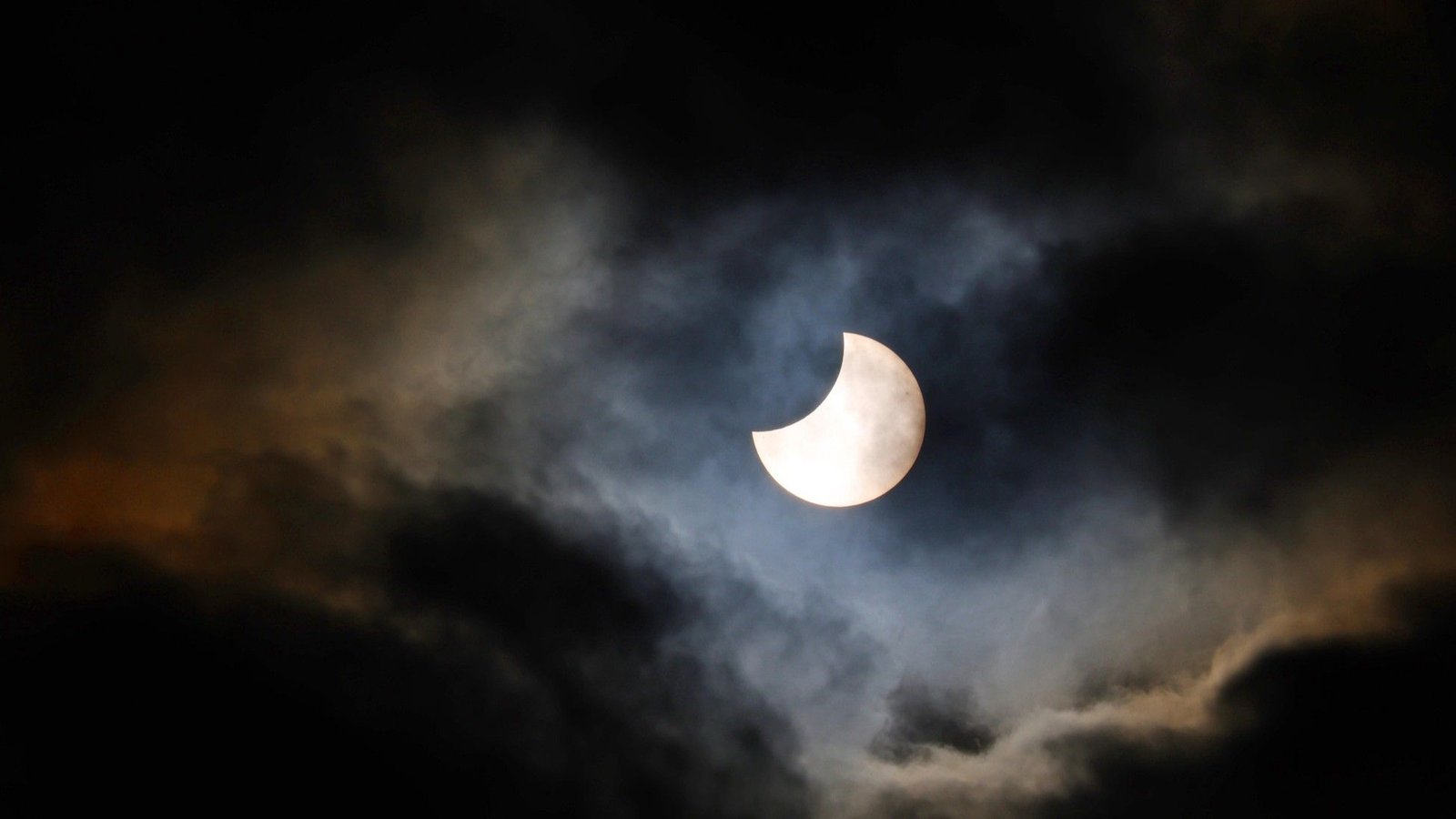
It’s hardly a “Great American Eclipse,” but on Aug. 12, 2026, some parts of the North American continent will see a partial solar eclipse.
Will it be as impressive as on April 8, 2024, when totality visited Mexico, 15 U.S. states and six provinces in Canada? No, yet in some parts of the U.S. and Canada, astronomers will be out in force to capture a significant chunk of the sun as it is obscured by the new moon.
The spotlight may be on the total solar eclipse in Greenland, Iceland, and Spain, but millions across North America can still see the moon take a bite out of the sun on Aug. 12. The farther northeast you are, the deeper the eclipse. Here’s everything you need to know about the partial solar eclipse in North America.
During a partial solar eclipse, it is NEVER safe to look directly at the sun without solar eclipse glasses designed for solar viewing. Read our guide on how to observe the sun safely.
Where to see the partial solar eclipse in the U.S.
Between 7:34 a.m. AKDT and 2:52 p.m. EDT, 20 U.S. states will see something of the partial solar eclipse, though only northeastern states will get a good view. Here’s a sample of locations and the time of maximum eclipse. Note that the partial eclipse begins (first contact) and ends (last contact) around 55 minutes before and after the time of maximum eclipse given here.
|
Location |
Maximum eclipse |
Time (local) |
|
Fairbanks, Alaska |
37% |
8:27 a.m. AKDT |
|
Presque Isle, Maine |
28% |
1:50 p.m. EDT |
|
Bangor, Maine |
23% |
1:53 p.m. EDT |
|
Portland, Maine |
19% |
1:53 p.m. EDT |
|
Montpelier, Vermont |
17% |
1:49 p.m. EDT |
|
Manchester, New Hampshire |
16% |
1:53 p.m. EDT |
|
Boston, Massachusetts |
16% |
1:55 p.m. EDT |
|
Providence, Rhode Island |
15% |
1:55 p.m. EDT |
|
Springfield, Massachusetts |
14% |
1:53 p.m. EDT |
|
New Haven, Connecticut |
12% |
1:54 p.m. EDT |
|
Bridgeport, Connecticut |
11% |
1:54 p.m. EDT |
|
New York City, New York |
10% |
1:54 p.m. EDT |
|
Newark, New Jersey |
9% |
1:53 p.m. EDT |
|
Rochester, New York |
9% |
1:43 p.m. EDT |
|
Allentown, Pennsylvania |
8% |
1:52 p.m. EDT |
|
Buffalo, New York |
7% |
1:42 p.m. EDT |
|
Philadelphia, Pennsylvania |
7% |
1:53 p.m. EDT |

Where to see the partial solar eclipse in Canada
Between 8:38 a.m. MST and 4:38 p.m. NDT on Aug. 12, every province in Canada will be able to see some kind of partial solar eclipse, but those in the east of the country will see something much more significant. Here’s a sample of locations and the time of maximum eclipse. Note that the partial eclipse begins (first contact) and ends (last contact) around 55 minutes before and after the time of maximum eclipse given here.
|
Location |
Maximum eclipse |
Time (local) |
|
Iqaluit, Nunavut |
61% |
1:24 p.m. EDT |
|
St. John’s, Newfoundland and Labrador |
53% |
3:34 p.m. NDT |
|
Moncton, New Brunswick |
32% |
2:55 p.m. ADT |
|
Halifax, Nova Scotia |
31% |
3:00 p.m. ADT |
|
Churchill, Manitoba |
27% |
12:02 p.m. CDT |
|
Quebec City, Quebec |
24% |
1:46 p.m. EDT |
|
Whitehorse, Yukon |
23% |
9:26 a.m. MST |
|
Trois-Rivières, Quebec |
21% |
1:45 p.m. EDT |
|
Sherbrooke, Quebec |
20% |
1:48 p.m. EDT |
|
Montreal, Quebec |
18% |
1:45 p.m. EDT |
|
Ottawa, Ontario |
15% |
1:42 p.m. EDT |
|
Kingston, Ontario |
12% |
1:43 p.m. EDT |
|
Toronto, Ontario |
8% |
1:40 p.m. EDT |
|
St. Catharines—Niagara, Ontario |
8% |
1:41 p.m. EDT |
|
Kitchener, Ontario |
7% |
1:38 p.m. EDT |
|
Hamilton, Ontario |
7% |
1:40 p.m. EDT |
|
London, Ontario |
5% |
1:38 p.m. EDT |
|
Windsor, Ontario |
3% |
1:36 p.m. EDT |
What to expect
This is a small partial solar eclipse in North America, which occurs at lunchtime. In the east of the continent, it will occur high in the sky — about two-thirds of the way between the horizon and the zenith — in the south-southwest. At maximum eclipse, the partially eclipsed sun with resemble a thick crescent or a smile. It won’t get dark — that only happens within the path of totality — nor will daylight be affected.
Those using a telescope to observe or image the partial eclipse (using a solar filter) should also consider that Venus — which will be visible just after sunset — reaches dichotomy on Aug. 12. This is the point in its current apparition as the “Evening Star” that it starts becoming interesting in a telescope. Dichotomy sees it reduce to 50%-lit and gradually become an ever-shrinking crescent.
Perhaps more importantly, the early hours of Aug. 13 see the peak of the annual Perseid meteor shower.
When is the next solar eclipse visible from the US after August 2026?
The next solar eclipse on Aug. 2, 2027, will be seen in Newfoundland, Canada, where a 23% partial eclipse will occur at the province’s southwestern tip.
On Jan. 26, 2028, during an annular solar eclipse across northern South America, eastern U.S. states and eastern Canada will see a very small partial solar eclipse shortly after sunrise. Florida will have the best view, with around 15% of the sun blocked.
On Jan. 14, 2029, a large partial solar eclipse will be seen in the morning sky across all of North America — up to 81% in northern Canada and 74% in northwestern U.S. states. On June 12, 2029, a smaller partial solar eclipse will peak at 34% just after sunrise from Nunavut, the Northwest Territories and the northern tips of Alberta and British Columbia.