

Close Menu

    Subscribe to Updates

    Get the latest news information from worldwide businesses.

    What's Hot

    Natural Gas Dominates PJM’s First Reformed Grid Queue, Driven by Data-Center Demand

    August 8, 2026

    3 Reasons why WWE quietly stripped Rhea Ripley of Women’s Championship 

    August 8, 2026

    Is vomiting good for you? Experts explain why it happens and when to worry

    August 8, 2026
    Facebook Instagram YouTube LinkedIn X (Twitter)
    Trending
    • Natural Gas Dominates PJM’s First Reformed Grid Queue, Driven by Data-Center Demand
    • 3 Reasons why WWE quietly stripped Rhea Ripley of Women’s Championship 
    • Is vomiting good for you? Experts explain why it happens and when to worry
    • Towards nutritional literacy: navigating food labels, social media feeds and traditional wisdom to arrive at better diets 
    • 16 New Phages Show Promise Against Resistant Bacteria
    • India warned Diageo that its whisky’s ‘matured in American oak casks’ claim was misleading
    • Rain to continue across South India till August 13; heavy downpour likely in Kerala, Karnataka | India News
    • Miss North Carolina USA Boltinhouse claims faith cost her the crown
    Newspublicly
    • About Us
    • Advertise & Partner with us
    • Pitch Your Story
    • Contact Us
    Facebook Instagram LinkedIn X (Twitter)
    Subscribe
    • Home
    • World News
      • Asia
      • India
      • USA
      • UK & Europe
      • Middle East
    • Economy & Business
      • Global Economy
      • Corporate & Industry
      • Finance & Markets
      • Policy & Trade
    • Technology
      • Gadgets & Devices
      • Software & Apps
      • AI & Machine Learning
      • Robotics & Automation
    • Health & Medicine
      • Fitness & Nutrition
      • Research & Innovation
      • Disease & Treatment
      • Doctors, Clinics & Patient Care
    • Travel & Tourism
    • Automobile
      • Electric & Hybrid Vehicles
      • Auto Industry Insights
    • Sports
    • More
      • Education
      • Real Estate
      • Environment & Climate
      • Space & Astronomy
      • War & Conflicts
    Newspublicly
    Home»More»Space & Astronomy»The SolarQuest mount is essential for tracking the sun with a telescope
    Space & Astronomy

    The SolarQuest mount is essential for tracking the sun with a telescope

    AdminBy AdminAugust 8, 2026No Comments9 Mins Read0 Views
    Share
    Facebook Twitter LinkedIn Copy Link WhatsApp


    Specifications

    Resolution: 2,073,600 counts/rev; 0.625 arc-second

    Slewing speeds: 16x and 1200x

    Payload capacity: 8.8 lbs/4kg

    Dovetail saddle: 45mm Vixen-style

    Controls: Power button and 8-way sliding switch

    Power: 8x AA batteries (not supplied)/external 12V DC via adaptor panel

    Mount head weight: 2.9 lbs/1.3kg

    Total weight with optional tripod: 8.8 lbs/4.05kg

    Tripod: 31.7-59.8 inches/80.5-152cm adjustable aluminum tripod with accessory tray, bubble level and 3/8-inch screw fitting

    Finding the sun sounds easy, right? Many people think of the sun as big and bright, but it’s actually rather small in the sky — it’s got an angular diameter of just half a degree, in fact, the same as the moon. Put an all-important solar filter on a telescope, and you’re left with the challenge of finding a tiny orange or white circle in a sea of black. Even if you manage to find the sun, nudging a solar telescope back into position every few minutes to keep it in the field of view quickly gets irritating.

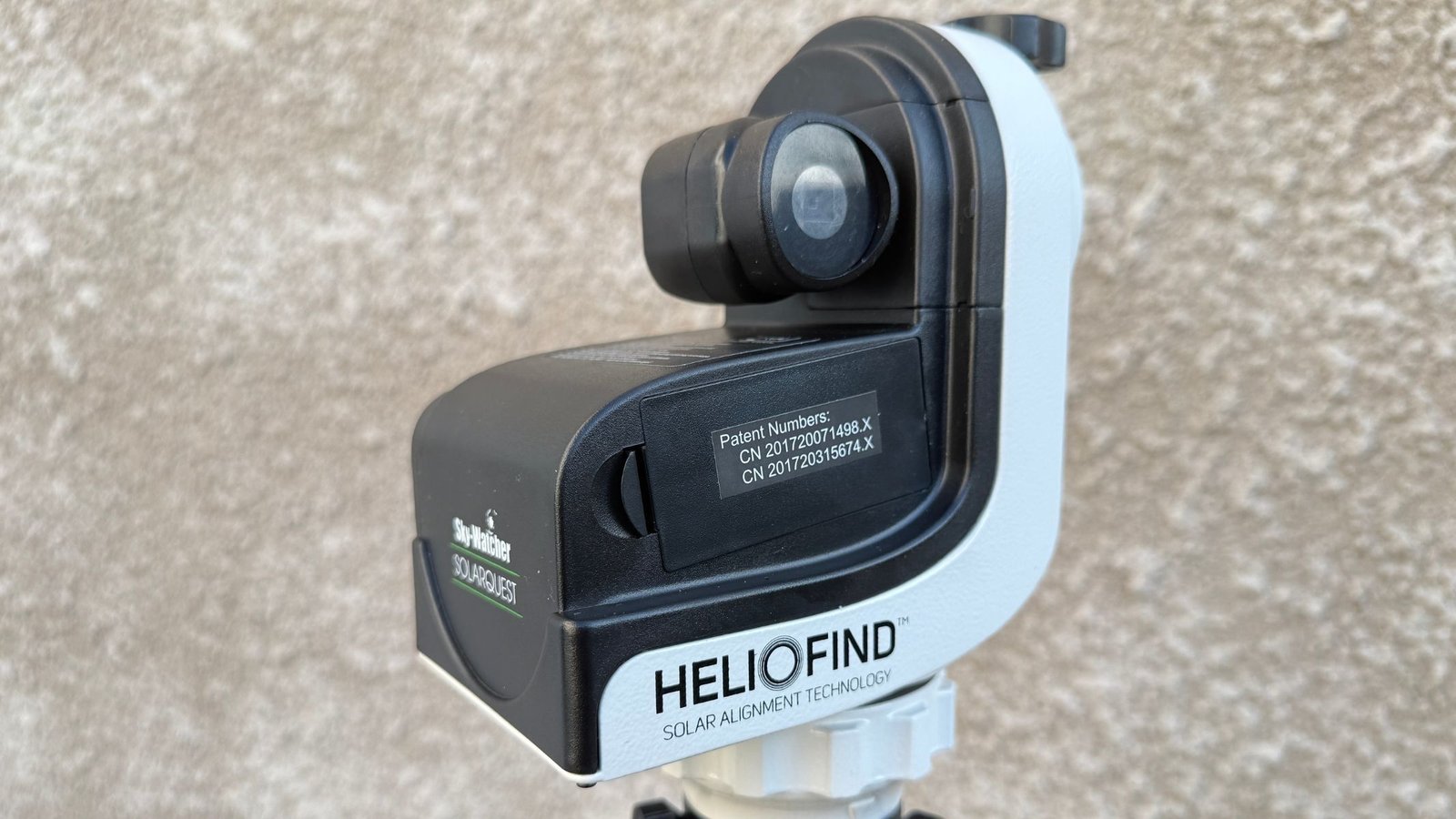
    A close-up of the Sky-Watcher SolarQuest solar telescope mount, showing text reading 'HelioFind' along the side of it.

    Dual-axis alt-az tracking keeps the sun in view during observing sessions. (Image credit: Jamie Carter)

    Cue the Sky-Watcher SolarQuest mount, a simple grab-and-go product that exists to solve exactly that problem. Costing around $585/£259-£359 (the latter with a tripod), it is not a general Go-To astronomy mount and it is not trying to be one. It is best understood as a dedicated solar tracking platform for small solar telescopes. That could range from regular telescopes wearing solar filters, most likely during a solar eclipse, to dedicated solar telescopes such as white-light-filtered refractors and H-alpha (Hydrogen-alpha) telescopes designed specifically for viewing the sun.

    • Sky-Watcher SolarQuest mount at Amazon for $499

    Sky-Watcher SolarQuest mount head: Design

    A close-up of the Sky-Watcher SolarQuest solar telescope mount, showing the telescope attachment, against a white textured wall.

    Its 8.8-lb payload suits compact white-light and H-alpha solar scopes. (Image credit: Jamie Carter)
    • Lightweight and compact mount head
    • Simple controls make it beginner-friendly
    • Vixen-style saddle suits small solar scopes

    The SolarQuest mount head weighs just 2.9 lbs/1.3 kg, accepts standard 45mm Sky-Watcher/Vixen-style dovetails and can be fitted to a tripod using a 3/8-inch screw. Meanwhile, the optional tripod is lightweight and easily adjustable, with a bubble level and accessory tray. Whatever tripod you use, it’s imperative to get it stable before using the SolarQuest because its ability to track the sun successfully depends on it.


    Image 1 of 3

    The Sky-Watcher SolarQuest solar telescope mount and tripod against a textured white wall.
    The Sky-Watcher SolarQuest comes with an optional sturdy tripod.

    (Image credit: Jamie Carter)

    The accessory tray on the tripod on the Sky-Watcher SolarQuest solar telescope mount
    The tripod comes with a handy accessory tray.

    (Image credit: Jamie Carter)

    The feet of the tripod on the Sky-Watcher SolarQuest solar telescope mount, standing on a wooden surface.
    The optional tripod includes grippers to keep the rig steady.

    (Image credit: Jamie Carter)

    With the optional aluminum tripod — which we used in our review — the total setup is still only around 9.9 lbs/4.05 kg, making it easy to set up inside and carry into the garden. Eclipse chasers travelling abroad will easily be able to store it in a carry-on camera bag.


    Image 1 of 2

    A close-up of the Sky-Watcher SolarQuest solar telescope mount against a white textured wall.
    HelioFind technology makes solar alignment fast and beginner-friendly.

    (Image credit: Jamie Carter)

    A close-up of the Vixen-style saddle on with Sky-Watcher SolarQuest solar telescope mount.
    A Vixen-style saddle accepts many small solar telescopes and spotting scopes.

    (Image credit: Jamie Carter)

    A close-up of the Sky-Watcher SolarQuest solar telescope mount against a white textured wall.
    A close-up of the Vixen-style saddle on with Sky-Watcher SolarQuest solar telescope mount.

    The mount itself has very few controls: A power button and an 8-way sliding switch. A long press of the power button finds the sun, with the second used to make manual adjustments. There are no menus and no alignment tasks.

    Sky-Watcher SolarQuest mount head: Performance

    The Sky-Watcher SolarQuest solar telescope mount with the Sky-Watcher Heliostar 76mm solar telescope attached and pointing at the sun.

    Its job is simple: Find the sun and keep it centered. (Image credit: Jamie Carter)
    • Finds the sun automatically in clear conditions
    • Fine-tuning controls keep the sun centered
    • Works well with solar telescopes

    At first glance, the promise of the Sky-Watcher SolarQuest mount head is so simple: you level the tripod using its built-in bubble or spirit level and point the attached telescope somewhere to the left of the sun. You then long-press the power button and step back. The built-in GPS calculates the date, time, and location, as well as the sun’s altitude and azimuth. The mount levels the telescope, pauses, then slews to the right altitude. Then its photodiode solar sensor (a small camera) hunts for the solar disc and locks on. In practice, the system gets impressively close to that ideal — but with some small caveats.

    A deep orange image of the sun taken with the Sky-Watcher Heliostar 76mm, Sky-Watcher SolarQuest solar telescope mount and a ZWO ASI174mm mono astronomy camera.

    A colorized image of the sun taken with a ZWO planetary camera on an H-Alpha telescope mounted on the SolarQuest. (Image credit: Jamie Carter)

    The sun needs to be in a clear sky, but it doesn’t have to be high. We reviewed the SolarQuest during a summer heatwave, when getting up very early was the only sensible way to observe the sun. Having got up early to take advantage of the cool morning air before the sun rose too high, we feared the SolarQuest would fail to find such a low sun. Luckily, there were no such issues, with SolarQuest taking just under 60 seconds to be perfectly aligned with the sun.

    Space

    A close-up of part of the Sky-Watcher SolarQuest solar telescope mount.

    The solar sensor uses four photodiodes to lock onto the sun. (Image credit: Jamie Carter)

    For visual observing, that’s transformative. Instead of spending the first part of a session aligning, shadow-aiming and nudging a scope into position, you can be looking at the sun within minutes. However, we did have to use the joypad on the SolarQuest to center the sun. Happily, the controls are very sensitive and move slowly, so we were able to have a perfect view of the sun in under two minutes from pressing the power-on button. That’s impressive.

    Sky-Watcher SolarQuest mount head: Functionality

    A close-up of the Sky-Watcher SolarQuest solar telescope mount with the Sky-Watcher Heliostar 76mm solar telescope attached.

    Built-in GPS calculates the sun’s position automatically. (Image credit: Jamie Carter)
    • Accurately tracks the sun
    • 8x AA batteries are old-fashioned
    • Payload is a limiting factor

    Tracking accuracy is very good, with a tiny adjustment on the joypad required perhaps every few hours. Since it largely follows the sun’s path through the sky, it should be suitable for a total or deep partial solar eclipse, when a crescent sun could confuse the sensor (to be sure, you could cover the sensor during totality so it doesn’t hunt for the sun and try to realign during an eclipsed crescent sun).

    However accurate it is, this is an alt-az mount. It can track the sun well but it cannot remove field rotation during much longer imaging sessions. For visual use and almost all solar use — including casual video capture — that is not a major issue. However, for long-duration solar imaging and creating time-lapses, it’s a limitation to keep in mind.

    A hand holding the a battery compartment with batteries inside, next to the Sky-Watcher SolarQuest solar telescope mount.

    The battery compartment takes eight AA batteries, though external power is available. (Image credit: Jamie Carter)

    One practical complaint is the battery compartment. Pop open the door (which detaches and becomes easily lost) and inside is a small plastic cradle that takes eight AA batteries. As if needing to take a trip to a store before being able to use the SolarQuest wasn’t annoying enough, it occurred to me that if I was going to an eclipse, I would need to travel with at least eight more AA batteries as spares — and possibly another 16x for true peace of mind. Not a pleasant prospect. Should any gadget like this be AA battery-powered in the age of Lithium-ion and USB-C? A resounding no. The box includes a 12V DC connection but there’s no cable. It all seems poorly thought through and old-fashioned.

    The Sky-Watcher SolarQuest solar telescope mount, showing the Sky-Watcher SolarQuest logo.

    The mount head weighs just 2.9 lbs, making it easy to carry outside. (Image credit: Jamie Carter)

    However, the main practical limitation of the SolarQuest is its 8.8 lbs (4 kg) payload, which sets it apart as an accessory for small solar telescopes. At its best when speed and simplicity matter, SolarQuest is a travel-friendly mount ideal for beginners and eclipse chasers seeking to remove a common frustration from solar observing — finding and tracking the sun — without adding complexity. It almost totally succeeds.

    How we tested the Sky-Watcher SolarQuest mount head

    Sideview of the Sky-Watcher Heliostar 76mm H-alpha solar telescope attached to the Sky-Watcher SolarQuest mount.

    We tested the Sky-Watcher SolarQuest mount with the Sky-Watcher Heliostar 76mm H-alpha solar telescope. (Image credit: Jamier Carter)

    We tried the SolarQuest for about two weeks with both a Celestron Regal M2 spotting scope (with a solar filter attached) for white-light observations of the solar disk and a Skywatcher HelioStar 76mm solar telescope. The latter was used to get some images of the sun in H-Alpha (Hα), in conjunction with a ZWO ASI174MM planetary camera.

    Should I buy the Sky-Watcher SolarQuest mount head?

    Buy it if:

    ✅ You want to get into casual backyard solar observing: The SolarQuest mount is great for those who have a small solar telescope or a regular telescope with a solar filter and want to start observing the sun more.

    ✅ You want fast, automatic solar finding and tracking: The SolarQuest mount makes solar observation super easy and super quick so finding the sun isn’t a chore and allows you to focus on observation.

    Don’t buy it if:

    ❌You want a mount for nighttime astronomy as well: It has one job, to find the sun, and doesn’t work for finding any targets in the dark night sky.

    ❌You don’t want to travel with lots of spare AA batteries: The mount is powered by eight AA batteries and if you are carrying spares, this means a lot of extra weight to carry around when travelling to observation locations.

    If you need something to support a solar or solar-filtered telescope under 8.8 lbs/4kg, the SolarQuest should be on your radar. It quickly finds the sun and tracks accurately, removing the need for manual alignment. It’s also really compact, operates quietly and has very simple controls.

    The included instructions are poor, the way it’s battery-powered is far from ideal, and it’s limited by its payload capacity, but it’s so easy to use and quick to work that it’s hard to criticize the SolarQuest too harshly — it’s a slick and simple accessory.

    If the Sky-Watcher SolarQuest mount head isn’t for you

    There are very few dedicated solar trackers like the Sky-Watcher SolarQuest. However, some star trackers do have a mode where you can choose the sun as the star to track, including the Benro Polaris. Once you’ve entered the sun in the frame using the virtual joystick, the Polaris can automatically track it. Another alternative is an equatorial mount, which, when well aligned, can handle solar observing for longer periods and/or for making time-lapse sequences.

    Sky-Watcher SolarQuest mount: Price Comparison


    Source link

    Author

    • Admin

      NewsPublicly.com is News & Articles Platform that creating SEO-focused articles on travel, lifestyle, and digital trends.

    Admin
    • Website

    NewsPublicly.com is News & Articles Platform that creating SEO-focused articles on travel, lifestyle, and digital trends.

    Related Posts

    On this day in space! Aug. 7, 1980: NASA’s Viking 1 Mars orbiter shuts down 4 years into a 90-day mission

    August 7, 2026

    ‘Not looking good right now’: Starship likely to be lost at sea 2 weeks after epic 13th test flight, Elon Musk says

    August 7, 2026

    SpaceX serious about building factories on the moon: ‘It’s going to happen,’ Elon Musk says

    August 7, 2026
    Leave A Reply Cancel Reply

    Demo
    Top Posts

    The Blue Moon rises on May 30— Where and when to see the second full moon of the month

    May 30, 202640 Views

    New SOCOM rifle allows barrel swapping and cartridge changes

    June 1, 202633 Views

    “Inside Gemini Robotics 1.5: How Robots Learn to Reason & Act

    November 22, 202527 Views

    525 pounds of cocaine seized after Nebraska K9 alerts troopers on I-80

    May 28, 202624 Views
    Don't Miss

    Natural Gas Dominates PJM’s First Reformed Grid Queue, Driven by Data-Center Demand

    August 8, 20269 Mins Read0 Views

    Natural gas surged to the top in the first round of power projects accepted into…

    3 Reasons why WWE quietly stripped Rhea Ripley of Women’s Championship 

    August 8, 2026

    Is vomiting good for you? Experts explain why it happens and when to worry

    August 8, 2026

    Towards nutritional literacy: navigating food labels, social media feeds and traditional wisdom to arrive at better diets 

    August 8, 2026
    Stay In Touch
    • Facebook
    • Twitter
    • Instagram
    • YouTube
    • LinkedIn
    • WhatsApp

    Subscribe to Updates

    Get the latest creative news from SmartMag about art & design.

    Demo
    NEWSPUBLICLY
    Facebook X (Twitter) Instagram LinkedIn

    Home

    • About Us
    • Leadership
    • Advertise & Partner With Us
    • Pitch Your Story
    • Media Kit & Pricing
    • Career
    • FAQs

    Guidelines

    • Editorial & Submission
    • Partnership
    • Advertising & Sponsor
    • Intellectual Property Policy
    • Community & Comment
    • Security & Data Protection
    • Send Your Opinion

    Quick Links

    • Cookie Policy
    • Payment & Billing Terms
    • Refund & Cancellation
    • Copyright Policy
    • Complaint & Support
    • Sitemap
    • Contact Us

    Subscribe Us

    Get the latest news and updates!

    Copyright © 2026 Newspublicly (DIGITALIX COMMUNICATION). All Rights Reserved.
    • Privacy Policy
    • Terms of Use
    • Disclaimer