

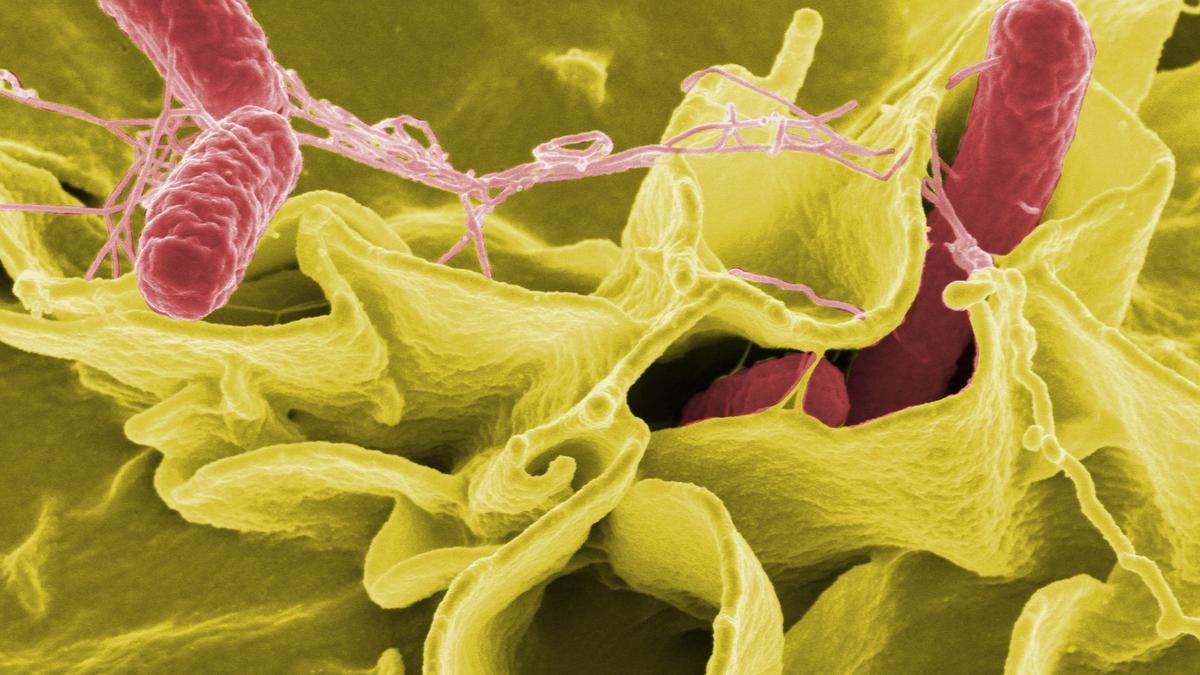
Salmonella is often linked to food poisoning, diarrhoea and typhoid. But the infection can range from mild gastroenteritis that gets better on its own to a serious bloodstream infection, and therefore, say experts, deserves more attention than it is currently being given. Typhoid also remains a major health burden in India. A Lancet study published this year, estimated 4.9 million typhoid cases and about 7,850 deaths in India in 2023. About 730,000 people were estimated to have been hospitalised, with fluoroquinolone-resistant infections accounting for 82% of these hospitalisations.
Salmonella is a group of bacteria that can cause different infections. Typhoid and paratyphoid or enteric fever, are caused by Salmonella Typhi and Salmonella Paratyphi. Unlike common food poisoning, typhoid can spread from the gut into the bloodstream, causing prolonged fever and, in severe cases, intestinal bleeding or perforation. It usually spreads through food or water contaminated with faeces The problem, however, is broader than typhoid. Non-typhoidal Salmonella infections, which often cause gastroenteritis, may go undiagnosed because many people recover without testing. At the same time, antibiotic resistance is making serious infections harder to treat.

Why infections turn serious
Non-typhoidal Salmonella commonly causes gastroenteritis, with diarrhoea, stomach cramps, fever and sometimes vomiting. It is often linked to poultry, eggs and other animal-based foods. Most healthy people recover with supportive care, but the infection can become serious and spread to the bloodstream, particularly in young children, older adults and people with weakened immunity.
“Salmonella should not be seen as only a cause of diarrhoea,” said Sweatha Kumar, associate consultant, infectious diseases, Rela Hospital, Chennai. “In some patients, especially young children, older adults and those living with other illnesses or weakened immunity, it can become invasive and life-threatening.”
Suresh Kumar D., senior specialist in infectious diseases, Apollo Speciality Hospitals, Vanagaram, Chennai, said the actual burden of non-typhoidal Salmonella is difficult to estimate as many mild infections are never diagnosed.

Contaminated water, food chain
Both typhoid and non-typhoidal Samonella infections spread through the faecal-oral route, but their sources are different.
For typhoid, humans are the reservoir. Someone with the infection, including someone who has no symptoms but carries the bacteria, can contaminate food or water. This makes safe drinking water, sanitation and hand hygiene central to prevention. Lack of access to safe water and adequate sanitation are major risk factors for typhoid.Non-typhoidal Salmonella has a wider ecology, involving animals, food and the environment. Poultry, eggs, meat and other animal-derived foods can be sources. Transmission can also occur when raw meat contaminates ready-to-eat food during preparation.
“Contamination can occur at multiple points, from farms, slaughterhouses and food processing to transportation, storage, restaurants and finally the household kitchen,” Dr. Sweatha said. “That is why Salmonella is very much a One Health problem involving humans, animals, food and the environment.”
Food handlers can play an important role in transmission, as those carrying the infection can contaminate food and potentially expose many people to the bacteria. But food safety cannot depend only on individual food handlers. The wider system needs better training, sanitation, refrigeration, monitoring and enforcement. While the Food Safety and Standards Authority of India has surveillance and testing systems, gaps remain, particularly in the large informal food sector.
At the household level, it is important follow: washing hands, using safe water, cooking poultry and eggs thoroughly, refrigerating perishable foods appropriately and keeping raw meat separate from ready-to-eat food.

Challenges and way forward
The major concern is the growing antimicrobial resistance in Salmonella.
India has seen a major shift in the resistance pattern of S. Typhi. A recent study in PLOS Neglected Tropical Diseases said, culture-confirmed isolates from 1977 to 2024 found that fluoroquinolone resistance rose sharply, reaching 85% in 2015-19, and remains high despite a subsequent decline.
“The emergence and spread of extensively drug-resistant typhoid shows what can happen when resistance accumulates across multiple antibiotic classes,” Dr. Sweatha said, “It can leave clinicians with very limited treatment options.”
A study published in Indian Pediatrics found of an enteric fever outbreak in Thane between April and July 2025 found that 44 of 167 culture-proven cases 26.35% were resistant to ceftriaxone. Tanker-water supply was significantly associated with ceftriaxone resistance in the outbreak.
Researchers have also documented carbapenem-resistant S. Typhi carrying the blaNDM-5 resistance gene in India, highlighting the possibility of resistance emerging even to antibiotics generally reserved for difficult infections.
Experts say the answer is not to simply use stronger antibiotics. Blood culture is the main test for suspected typhoid and should ideally be done before antibiotics are started. The Widal test has limitations and should not be used alone to diagnose typhoid. For uncomplicated non-typhoidal Salmonella gastroenteritis, treatment mainly involves adequate fluids and electrolyte replacement. Antibiotics are usually reserved for severe or invasive infections and people at higher risk of complications.
“Giving an antibiotic for every fever is not harmless,” said J.S. Kumar, professor and head of general medicine, SRM Hospital, Chennai. “Unnecessary antibiotic use is one of the things that drives antimicrobial resistance.”
For typhoid, antibiotics are necessary, but the choice should be guided by the local resistance pattern and, where possible, culture and susceptibility results.
Prevention remains as important as treatment. The World Health Organization recommends typhoid conjugate vaccines for children from six months of age; however, this not yet part of India’s universal immunisation programme.
The challenge is to treat the infections that genuinely require antibiotics while preventing the infections that can be prevented in the first place.
Published – August 28, 2026 10:28 am IST