



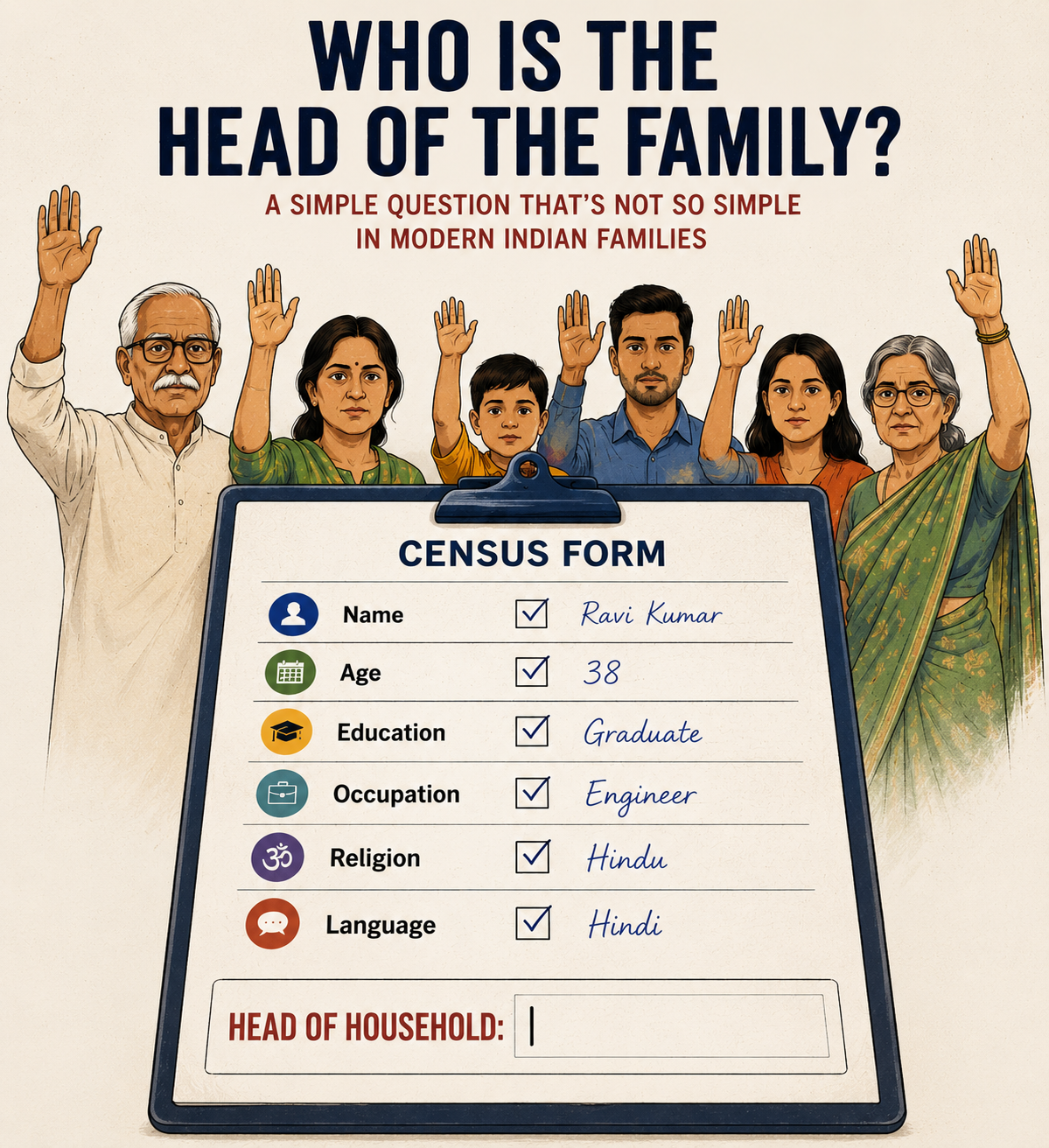
NEW DELHI: When India’s Census officials started knocking on doors across the country, they asked dozens of questions that most people answered without much thought. How many people live here? What is your occupation? What is your highest level of education?Then comes a question which often makes families pause and think about the answer.Who is the head of the household?The question means different things to different people.For some families, the answer comes instinctively: the father or the grandfather (in joint families). For others, it is the eldest grandparent, even if they no longer work or make household decisions. In many homes, everyone looks at each other before naming someone. Increasingly, there are households where the woman earns the most, manages the finances, raises the children and takes every major decision—yet the family may still identify the husband or an elderly father as the “head.“The awkward silence surrounding this seemingly simple question has resurfaced as India undergoes a survey for the upcoming Census. Many citizens have questioned why such a category still exists, particularly when there is no clear understanding of who actually qualifies as the “head” of a family.The confusion is understandable.
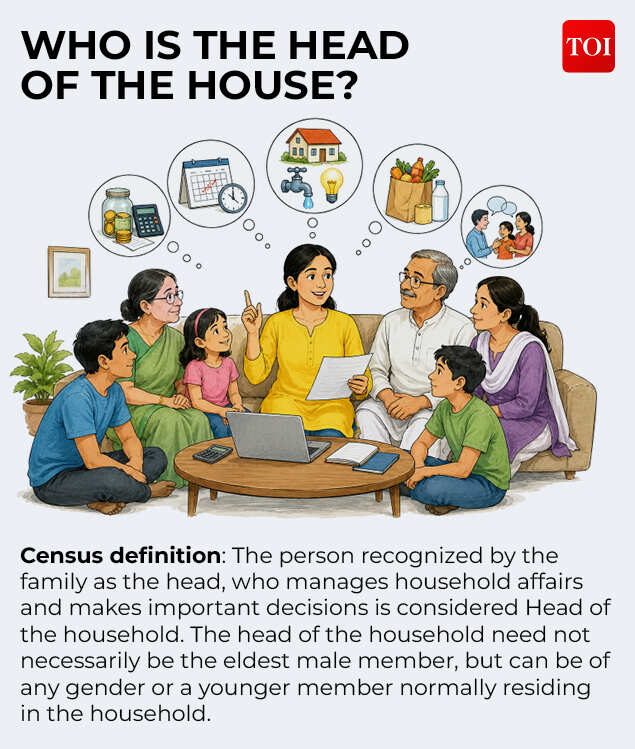
The Census website defines the “head of household” as “The person recognized by the family as the head, who manages household affairs and makes important decisions. The head of the household need not necessarily be the eldest male member, but can be of any gender or a younger member normally residing in the household.”The definition attempts to move beyond the traditional image of the patriarch. Yet, experts argue that in practice, the question still carries decades of social baggage. While legally meaningless, it continues to reflect—and sometimes reinforce—deeply embedded ideas about authority inside Indian homes.We reached out to the Office of the Registrar General & Census Commissioner to understand what was the definition and purpose of this question in the survey. We are still awaiting a response and will update the story accordingly.The larger question, therefore, is not simply who the head of the household is? It is whether the idea itself still makes sense.
The invisible weight of a simple question
If the category has no legal standing, why does it continue to generate debate? Because, sociologists argue, the phrase “head of the household” is far from neutral.“The HoH is a socially existing category which has found its way into statistical exercises, primarily to identify the person who is considered capable of answering questions about the socio-economic status of a household,” said Aardra Surendran, sociologist and teacher at IIT Hyderabad.“As such, therefore, it is not a sociological category, but a patriarchally inflected common sensical term denoting conventional power dynamics within family units.”That distinction is important.The census may only intend to identify someone who can answer questions accurately. But the language it uses inevitably draws upon social norms that have historically privileged men as household decision-makers.“Academic research, particularly feminist academic research, has questioned the assumptions inherent in this kind of framing of the household,” said Surendran.If all information about a family is routed through one designated individual, important aspects of household life may never be captured accurately.“It has also pointed to the fact that even the basic purpose of data collection may be incomplete if you ask all questions to only the head of the household – as this person may not have a comprehensive understanding of many aspects of household life, handled typically by other members of the family, mostly women.”The consequences, she notes, have been significant. “This has in the past led to underreporting of many aspects of women’s and children’s lives, including nutrition, their contributions to household survival and issues of domestic abuse and violence.”A category designed for convenience can therefore end up shaping the very data governments rely upon for policymaking.
Recognition versus reality
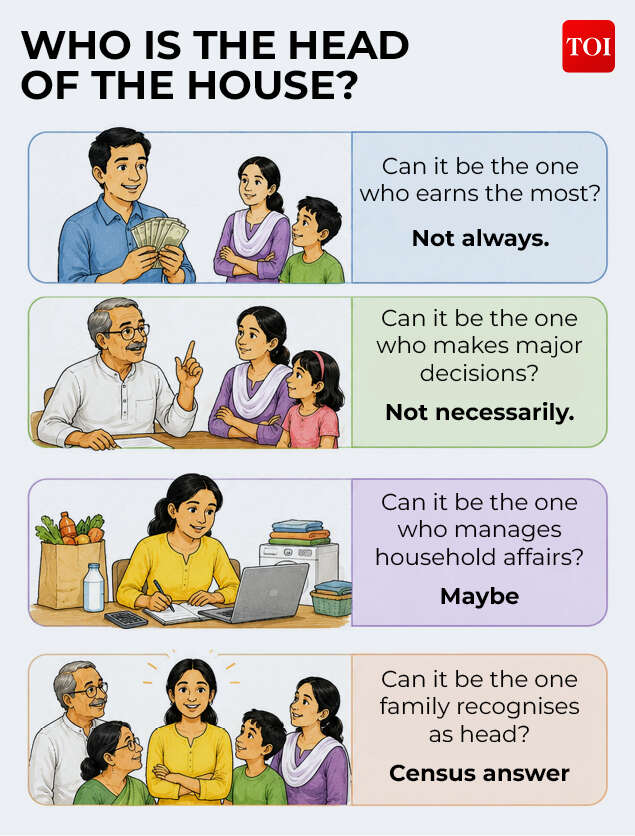
One reason the debate still persists is that recognition inside families often differs from actual decision-making.A retired father may still be introduced as the head of the household even though his daughter-in-law manages finances, his son earns the income and his wife takes everyday decisions.Former JNU School of Social Sciences Dean Amitabh Kundu says this distinction has always existed. “The census generally goes by who is recognised as the head of the family by family members and not who is managing or is the key decision maker.”That means families often identify people based on respect, age or tradition rather than actual authority.“Sometimes, the elderly person, who is 80 years old, doesn’t have anything to do with decisions of the household. Then if the family decides that this person is the head of the household, no one can counter the question.”Only when family members themselves cannot agree should the enumerator probe further by asking who manages the household or earns the income, he said.In many ways, this reflects how Indian families function. Authority is often symbolic. Decision-making is often shared. Recognition may belong to one person while responsibility rests with another.The census simply records whichever version the family chooses to present.
Families have changed. Has the question?
India today looks very different from the India of previous census decades. The last Census exercise took place 15 years ago.Over the years, joint families have steadily given way to nuclear households. Women participation in the workforce has increased significantly. Multiple generations may live separately but remain financially connected. Decision-making itself has become far more collaborative.“With changing family dynamics and also large-scale male migration, leaving women in charge of agriculture and other household responsibilities, the dynamics of decision making is undergoing significant shifts, which statistical exercises need to be able to adequately account for to ensure more accurate data collection,” Surendran said.The problem is not merely that families have changed. It is that the category itself assumes households can be represented by one individual.In the Indian setup, children often support ageing parents while parents continue to occupy symbolic positions of authority.
A social category, not a legal one
One of the biggest misconceptions surrounding the Census question is that identifying someone as the head of the household somehow gives them legal recognition or authority.It does not.“There is no uniform legal definition of ‘head of family’ or ‘head of household’ under Indian law,” explains Shwetta Lohia, legal officer at Delhi department of women and child development. “The term is generally used for administrative, statistical, or welfare purposes, and its meaning depends on the context in which it is used.”Rupali Jain, Supreme Court and Delhi High Court lawyer, pointed out that Indian law only recognises a comparable concept in very specific contexts, such as ‘Karta’ of a Hindu Undivided Family (HUF), which is a separate legal institution governing joint family property.Outside such limited situations, there is no overarching law that creates a universal status of “head of family.”Even census records themselves carry little legal value.“Identification in the Census is solely for statistical purposes under the Census Act, 1948. It confers no legal rights, powers, or liabilities in property, inheritance, guardianship, or family matters,” Jain said.In other words, if a person’s name appears as the head of the household in census records, it cannot by itself establish ownership, inheritance, guardianship or decision-making authority in court.The law, therefore, is surprisingly clear. The confusion lies elsewhere — in society.
Does the question still have value?
A single “head” may no longer exist in any meaningful sense. However, not everyone believes the category should disappear altogether.Kundu argues that while it may have limited practical use for most census analysis, it still carries value for researchers studying social structures. “I think this question is losing its relevance gradually, but if somebody wants to do some sociological research, this question gains relevance.”He points to examples where identifying who families recognise as household heads can reveal interesting demographic patterns, such as higher proportions of elderly men continuing to be identified as heads in certain states. “But if somebody wants to work on workforce data, literacy data, I don’t think this question has any meaning,” he said.In that sense, the question may have shifted from being administratively useful to becoming sociologically revealing.While it no longer tells us much about who makes decisions, it still tells us who society chooses to recognise.
Can statistics reinforce social bias?
The Census is often viewed as an objective exercise. Yet every survey category reflects the assumptions of their time.“It has been established that the Census and other large scale data gathering exercises may reinforce many of the biases and prejudices present in societies globally – biases in terms of categories of gender, race, ethnicity etc have been identified in many other parts of the world as well,” Surendran said, adding that scholarly research has also helped correct many such biases over time.As societies evolve, so must the questions governments ask. Otherwise, outdated categories risk preserving outdated ways of thinking.
Perhaps the problem is the word “head”
Interestingly, none of the experts argue that the census should stop identifying someone who can provide household information.Rather, they question whether calling that person “head” remains appropriate.Surendran suggested a simple but significant change. “Since the instrumental purpose of identifying a HoH is accurate data collection, the important corrective would be to identify the relevant member(s) of the household who are able to furnish such information, and rename the category as a relevant Point of Contact (PoC).”That shift would better reflect the actual purpose of the exercise.Instead of asking families to identify a symbolic authority figure, the Census would simply identify the person—or even persons—best equipped to answer its questions accurately.The change may appear semantic. But language shapes perception. And perception shapes data.
More than a census question
Perhaps that is why this small Census entry continues to spark outsized debate.Legally, it changes nothing. Administratively, it serves a practical purpose. Sociologically, however, it opens a window into how Indians continue to understand authority, gender and family itself.For some households, naming a head is effortless. For others, it prompts discussion. For still others, it exposes an uncomfortable gap between who carries responsibility and who receives recognition.As Indian families become smaller, more egalitarian and increasingly diverse, the idea of one unquestioned household head feels less like a universal reality and more like a relic of an older social order.The Census may not be trying to preserve patriarchy. But when a question assumes that every family has a singular “head,” it inevitably carries echoes of a time when households were expected to revolve around one recognised authority.Perhaps the real question India should now be asking is not who the head of the family is. It is whether families need one at all.