

The Trump administration on Friday defended its legal authority to order coal plants to stay open, arguing before a panel of federal judges that it alone has the power to decide whether an energy emergency exists.
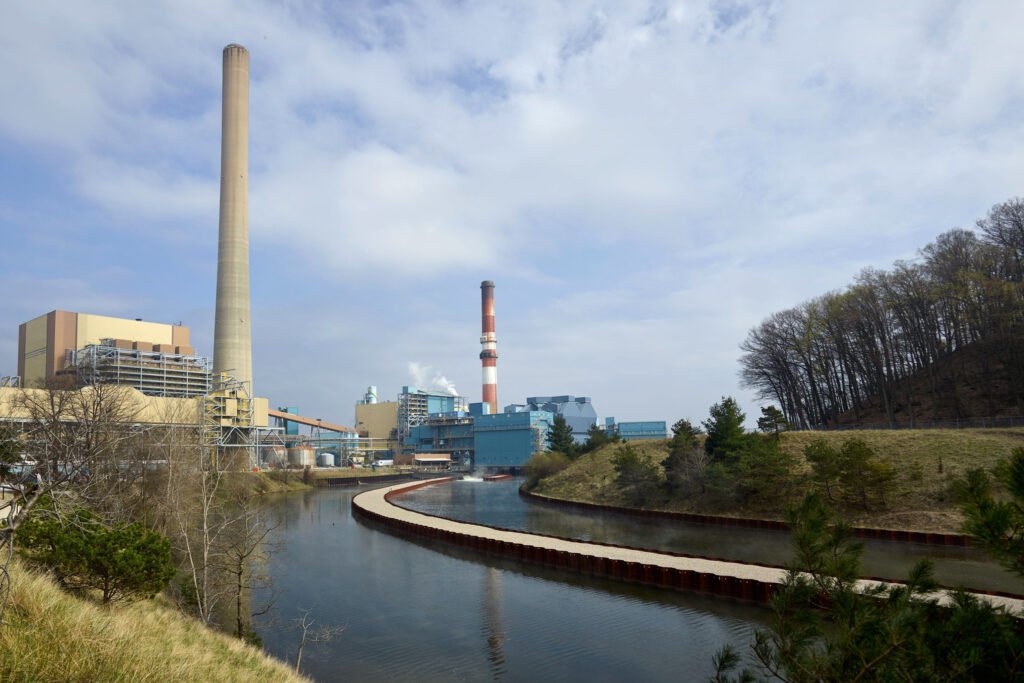
The case before the U.S. Court of Appeals for the D.C. Circuit is focused on the J.H. Campbell power plant on the banks of Lake Michigan, the first of six aging coal and oil plants that Energy Secretary Chris Wright has blocked from planned retirement. The precedent the case sets could be far-reaching.
The state of Michigan and environmentalists argue that, under President Donald Trump, the Department of Energy has swept aside the procedures and safeguards of the 91-year-old Federal Power Act. That’s the law spelling out that utilities, states and regional planning authorities decide whether electricity resources are adequate, with input from the public.
“The department’s claim of authority here is unprecedented,” said Lucas Wollenzien, assistant attorney general for Michigan. “If unchecked, it would transform the structure of power for regulating resource planning as it has been commonly understood for decades.”
But the Trump administration’s lawyer maintained that the emergency authority that Congress included in the law gives the energy secretary broad power to decide if immediate action is needed.
“The secretary of energy is not required to wait for a blackout to happen before invoking” the law’s emergency powers, said Robert Stander, deputy assistant attorney general for the Department of Justice. “Congress delegated sole discretion to the secretary to determine how much risk is too much risk, how much of a shortage is too short.”

He argued that because a coal plant, once retired, cannot be easily ramped up again, Campbell’s scheduled retirement at the end of May 2025 was an appropriate impetus for action, given the strain that the system was expected to experience last summer, in the view of the North American Electric Reliability Corporation (NERC), the nonprofit entity that assesses the adequacy of resources throughout the grid each summer and winter.
But Benjamin Chagnon, a senior counsel for the group Earthjustice who represented a coalition of environmental groups at the hearing, said the Energy Department was misconstruing the NERC assessment. NERC was warning states in the Midwest that the region’s “reserve margin,” or energy surplus, was lower than in the past, and they might need to import electricity from neighbors, curtail power exports or reduce demand on the system, especially on hot days.
“As the surplus is lower, the increased risk would be one of needing to use these mitigation measures,” Chagnon said. “It wouldn’t be a huge risk that there will actually be blackouts on the grid.”
He said issuing an emergency order was an inappropriate use of what is meant under the law to be an option of last resort. “If we’re driving along in a car and we see we need to stop at this red light up ahead, I think we would look first to the regular brake, not the emergency brake,” Chagnon said.
In past administrations, the secretary of energy has used emergency authority under the Federal Power Act—so-called section 202(c) orders—only occasionally, primarily during winter storms, hurricanes and other large-scale disruptions. But over the past year, Wright has issued 13 such orders keeping open five coal plants in Colorado, Indiana and Washington state as well as Michigan, and an old natural gas and oil-powered plant in Pennsylvania.

“What we’ve seen over the past year is the Trump administration twisting the use of this emergency authority beyond all recognition,” said Greg Wannier, staff attorney for the Sierra Club, one of the environmental groups that intervened in the case, in an availability with reporters after the oral arguments.
In justifying the orders, Wright often has cited the increased demand on the power system due to the proliferation of new data centers powering artificial intelligence. He has said keeping the fossil fuel plants open was necessary not only to mitigate blackouts but to “maintain affordable, reliable, and secure electricity.”
But electricity rates rose 5 percent nationwide in 2025, and keeping coal plants open is adding to consumer bills. The operator of the Campbell plant, Consumers Energy, which had made closure of the plant part of a strategy to save customers $600 million through 2040, appeared before the court to stress that any order should not undermine its ability to recover its additional costs from Midwestern consumers. The lawyer for Consumers Energy said the net costs of Wright’s orders had been $43 million so far, but those fighting the order—including the state of Michigan—have estimated much higher costs.
Michigan and the environmental groups argued that the energy secretary’s section 202(c) authority was only meant to be used when an emergency was imminent and there were no other alternatives available. The three judges on the D.C. Circuit panel, all appointees of President Barack Obama, questioned the attorneys on what constitutes that type of emergency.
This story is funded by readers like you.
Our nonprofit newsroom provides award-winning climate coverage free of charge and advertising. We rely on donations from readers like you to keep going. Please donate now to support our work.
“Is climate change an emergency?” Judge Robert Wilkins asked Wollenzien, the state of Michigan’s lawyer. “Lots of people would say that it is. It’s not something that is going to result in devastation—according to scientists—tomorrow, but in the future, and therefore you need to take action now to avert that risk.”
Wollenzien said section 202(c) should only be used when no other alternatives are available. He said state regulations, regional plans and other mechanisms under the Federal Power Act—including procedures in which the secretary of energy can intervene—are available to address emergencies like climate change.
“I would hope that the other regulators that have these long-term planning responsibilities under the statutory scheme would take it seriously in proceeding with a sense of urgency,” Wollenzien said.
Judge Cornelia T.L. Pillard asked the Trump administration’s lawyer if there are any limitations to the energy secretary’s authority to declare an energy emergency and issue a 202(c) order.
“What is the line—I’m not sure that you have one—for the discretion of the secretary and the ability to foresee a potential shortfall? … What’s the limiting factor in your reading?” she asked.
Stander said any order must be supported by “substantial evidence commensurate with the scope of the order.” In the case of Wright’s order, Stander cited, in addition to NERC’s summer 2025 assessment, a report on energy system reliability that Wright’s own department produced after it began issuing the emergency orders keeping coal plants open.
The health and environmental costs of Wright’s orders are staggering, environmentalists said after the oral arguments.
“These … orders have caused the release of millions of pounds of air pollutants that harm health and lead to premature deaths,” said Michael Lenoff, senior attorney for Earthjustice. “They’ve led to more toxic coal ash threatening our water. They’ve caused haze that shrouds national treasures like Rocky Mountain National Park.”
He said the climate impact is equivalent to the carbon dioxide pollution of 1.3 million more cars driven on roads for a year. But the case now before the court doesn’t turn on those impacts; it rests on how the court interprets the meaning of an emergency under the law.
The D.C. Circuit is expected to decide the Campbell plant case later this year. That decision could then be appealed, giving the Supreme Court another chance to weigh in on the Trump administration’s broad claims of executive power.
About This Story
Perhaps you noticed: This story, like all the news we publish, is free to read. That’s because Inside Climate News is a 501c3 nonprofit organization. We do not charge a subscription fee, lock our news behind a paywall, or clutter our website with ads. We make our news on climate and the environment freely available to you and anyone who wants it.
That’s not all. We also share our news for free with scores of other media organizations around the country. Many of them can’t afford to do environmental journalism of their own. We’ve built bureaus from coast to coast to report local stories, collaborate with local newsrooms and co-publish articles so that this vital work is shared as widely as possible.
Two of us launched ICN in 2007. Six years later we earned a Pulitzer Prize for National Reporting, and now we run the oldest and largest dedicated climate newsroom in the nation. We tell the story in all its complexity. We hold polluters accountable. We expose environmental injustice. We debunk misinformation. We scrutinize solutions and inspire action.
Donations from readers like you fund every aspect of what we do. If you don’t already, will you support our ongoing work, our reporting on the biggest crisis facing our planet, and help us reach even more readers in more places?
Please take a moment to make a tax-deductible donation. Every one of them makes a difference.
Thank you,

Bureau Chief, Washington, D.C.
Marianne Lavelle is the Washington, D.C. bureau chief for Inside Climate News. She has covered environment, science, law, and business in Washington, D.C. for more than two decades. She has won the Polk Award, the Investigative Editors and Reporters Award, and numerous other honors. Lavelle spent four years as online energy news editor and writer at National Geographic. She spearheaded a project on climate lobbying for the nonprofit journalism organization, the Center for Public Integrity. She also has worked at U.S. News and World Report magazine and The National Law Journal. While there, she led the award-winning 1992 investigation, “Unequal Protection,” on the disparity in environmental law enforcement against polluters in minority and white communities. Lavelle received her master’s degree from Columbia University Graduate School of Journalism, and is a graduate of Villanova University.