

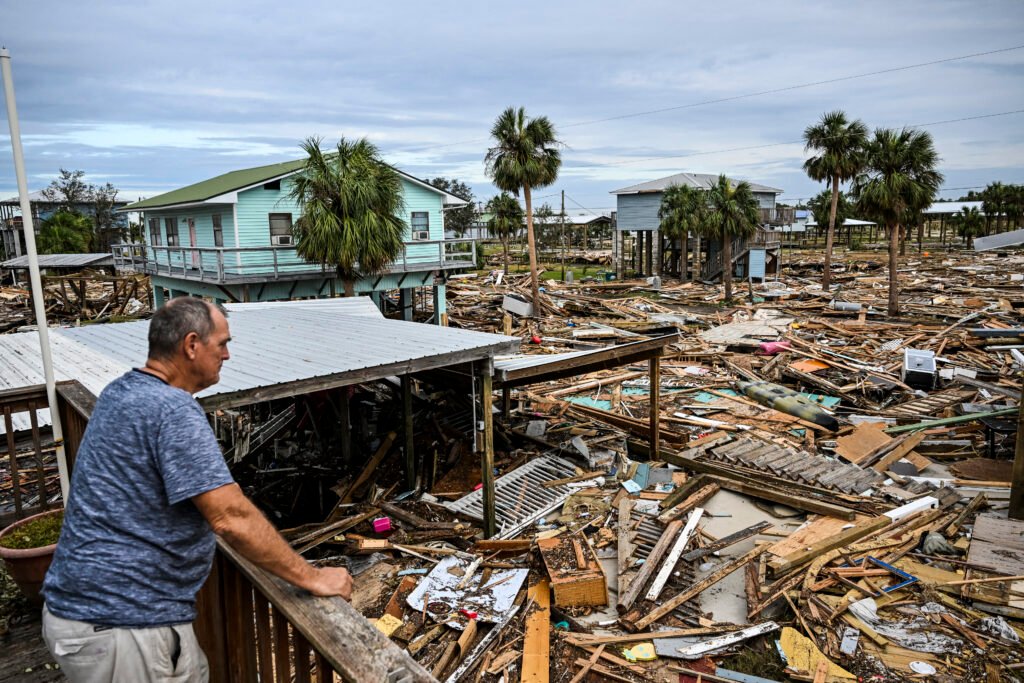
An aggressive downpour over the weekend in the eastern areas around Tennessee’s Great Smoky Mountains triggered severe flooding and multiple mudslides across the region. The watery assault hit particularly hard in Del Rio—a community still recovering from 2024’s Hurricane Helene.
“The flooding today was not a county-wide event on a ‘Helene scale’, but for some of the people of Del Rio, the damage and impact was worse,” the Cocke County Emergency Management Agency Director Joseph Esway said in a social media post Saturday. “Folks, the heart of Del Rio looks like a bomb was dropped on it.”
Del Rio’s situation is one example of the cycle of emergency and recovery that can lead to a growing psychological risk, as climate change fuels more frequent and severe weather disasters around the world: disaster fatigue. Experts say communities facing repeated floods, wildfires and hurricanes are more prone to stress, anxiety and burnout, particularly as severe and compounding disasters hit with less time in between for rebuilding. Research shows this mental toll can have major consequences for future resilience—and even deter people from evacuating when extreme weather strikes again.
Disaster Fatigue
As my past few newsletters make clear, it’s already been a summer of weather extremes. Heat waves in the U.S. and Europe have been linked to thousands of deaths, while many more struggle to stay cool in aging infrastructure throughout England, France and Spain. At the end of June, large wildfires broke out across the drought-stricken Western U.S., several of which are still spreading. Meanwhile, flash flooding has swept through communities across the south, northeast and midwestern U.S. There are more costly extreme weather disasters now than ever before: A data analysis showed that 2023 to 2025 ranked as the most expensive years for weather and climate disaster damages since 1980.
People in many of the most impacted areas are no stranger to these types of disasters. Experiencing several severe extreme weather events in relatively short time periods can trigger community-wide disaster fatigue, which is often associated with physical, emotional and mental weariness, according to Lee Ann Rawlins Williams, a researcher at University of North Dakota who works on disaster planning and recovery.
“I think the fatigue also is not just physical exhaustion, but it’s the emotional loss … it’s having to repeatedly start over,” she told me.
Surviving a wildfire or hurricane is just the start of a recovery process that can take years, she added. Worse, disasters often beget disasters. As I’ve reported in the past, burn scars from wildfires can exacerbate flooding, while trees toppled by hurricanes can provide fuel for future blazes. In many cases, disaster survivors are exposed to long-term health risks due to exposure to pollutants and increased stress, which Nina Dietz covered in an Inside Climate News series following the Los Angeles metro area wildfires in 2025.
Post-disaster recovery can be further complicated by socioeconomic disparities. Following an extreme weather event, people are frequently forced to deal with inequitable resource distribution, an influx of scammers offering fraudulent contractor services and time-consuming insurance negotiations. Research shows this back-and-forth with insurance companies can be especially traumatic, potentially triggering feelings of depression or anxiety and requiring a person to go through the emotional process of documenting all their losses shortly after the extreme weather event. Last year, flood, storm and fire survivors pushed back against the Trump administration’s proposed steep cuts to the Federal Emergency Management Agency, my colleague Anika Jane Beamer reported in December. The administration has made major cuts across the agency, which communities and emergency managers say have impacted disaster recovery.
Complex Recovery
Financial and resource donations can help communities recover faster and prevent fatigue—but only if it’s support survivors actually need, Rawlins Williams said. For example, after the 2025 L.A. wildfires, survivors were inundated with mountains of clothing donations that far exceeded the demand, a common post-disaster trend that can actually impede recovery when volunteers must sort through items or send truckloads to landfills or other areas, LAist reports.
Rawlins Williams has also seen communities come together to strategically sort through and place donations in designated buildings to prevent confusion, which happened in North Carolina following Hurricane Helene.
Even if an individual seems to have recovered after an extreme weather event, other psychological risks can simmer below the surface, experts say. Post-traumatic stress disorder is prevalent among natural disaster survivors, sometimes spiking more than 30 percent following an event, research shows. Residents of Paradise, California, who survived a 2018 fire that killed 85 people and destroyed more than 18,000 structures experienced PTSD and anxiety when they received evacuation warnings for a nearby fire in 2024, The Guardian reports.
“It’s got us all riled up,” Stephen Murray, a Paradise resident who helped evacuate mobile home residents in the 2018 fire, told the news outlet. “Last night laying my head down, I remember people died the day of the fire because they went to bed and never woke up so I went to bed with nightmares.”
A more subtle—but also dangerous—potential psychological side effect caused by living through multiple disasters is a shift in risk perception and reactions to future extreme weather, a growing body of research and anecdotal reports find. A 2019 study found that if someone evacuates during a disaster such as a hurricane and felt that it was unnecessary, they are less likely to plan to evacuate in the future. The same can be true if a person has repeatedly lived through hurricanes in Florida and may feel a certain sense of invincibility, as Orlando News 6 reported.
Though scientists stress there is no “climate haven,” data shows that certain parts of the U.S. and world are particularly vulnerable to repeated weather disasters. So why don’t communities in these areas move somewhere else? The answer to that seemingly simple question is incredibly complex—and often depends on a number of emotional factors related to that person, Rawlins Williams said.
“I think that sometimes we try to put logic on things that we do not understand,” she said, adding that ties between peoples’ homes and their identities can be very strong. But persistent climate-fueled weather disasters can stretch those ties to their limits, Rawlins Williams said.
“Rebuilding is beginning to really wear people out.”
More Top Climate News
On Friday, the Trump administration finalized a rule rescinding many of the habitat protections offered by the Endangered Species Act, which legal experts say is one of the most severe rollbacks to the law since it was first enacted in 1973. The rule was proposed last April and, as my colleague Wyatt Myskow and I covered. Legal experts say it will open the door for activities such as drilling and fossil fuel extraction even if they significantly disrupt critical habitats. A coalition of conservation groups, including the Center for Biological Diversity, Earthjustice and the Sierra Club filed a lawsuit today against the Trump administration to prevent the rule from moving forward. According to the Federal Register, the final rule is effective on September 14, 2026.
Companies such as Bojangles and Texas-based Buc-ee’s are installing a growing number of electric vehicle chargers across their locations in the southern U.S., meaning customers can refill their stomachs and car batteries simultaneously, Jack Ewing reports for The New York Times. Though EV purchases dipped in the U.S. after Congress and the Trump administration retired a federal tax credit to support sales, data shows sales of new EVs are up compared to the first three months of this year. Experts say the continued expansion of charging networks in the South is a reflection of EV demand in the region. A growing number of these stations have food and rest-stop options, as I reported in 2024 when I visited a “Charging Outpost” right outside Yosemite National Park.
As another heat dome smothers parts of the U.S. this week, the National Weather Service forecasts more than 90 temperature records will be tied or broken, John Seewer reports for the Associated Press. The majority of these are expected to happen at night, which health experts say is particularly dangerous because it gives people little time to cool off before peak daytime temperatures.
About This Story
Perhaps you noticed: This story, like all the news we publish, is free to read. That’s because Inside Climate News is a 501c3 nonprofit organization. We do not charge a subscription fee, lock our news behind a paywall, or clutter our website with ads. We make our news on climate and the environment freely available to you and anyone who wants it.
That’s not all. We also share our news for free with scores of other media organizations around the country. Many of them can’t afford to do environmental journalism of their own. We’ve built bureaus from coast to coast to report local stories, collaborate with local newsrooms and co-publish articles so that this vital work is shared as widely as possible.
Two of us launched ICN in 2007. Six years later we earned a Pulitzer Prize for National Reporting, and now we run the oldest and largest dedicated climate newsroom in the nation. We tell the story in all its complexity. We hold polluters accountable. We expose environmental injustice. We debunk misinformation. We scrutinize solutions and inspire action.
Donations from readers like you fund every aspect of what we do. If you don’t already, will you support our ongoing work, our reporting on the biggest crisis facing our planet, and help us reach even more readers in more places?
Please take a moment to make a tax-deductible donation. Every one of them makes a difference.
Thank you,

Reporter
Kiley Price is a reporter at Inside Climate News, with a particular interest in wildlife, ocean health, food systems and climate change. She writes ICN’s “Today’s Climate” newsletter, which covers the most pressing environmental news each week.
She earned her master’s degree in science journalism at New York University, and her bachelor’s degree in biology at Wake Forest University. Her work has appeared in National Geographic, Time, Scientific American and more. She is a former Pulitzer Reporting Fellow, during which she spent a month in Thailand covering the intersection between Buddhism and the country’s environmental movement.