

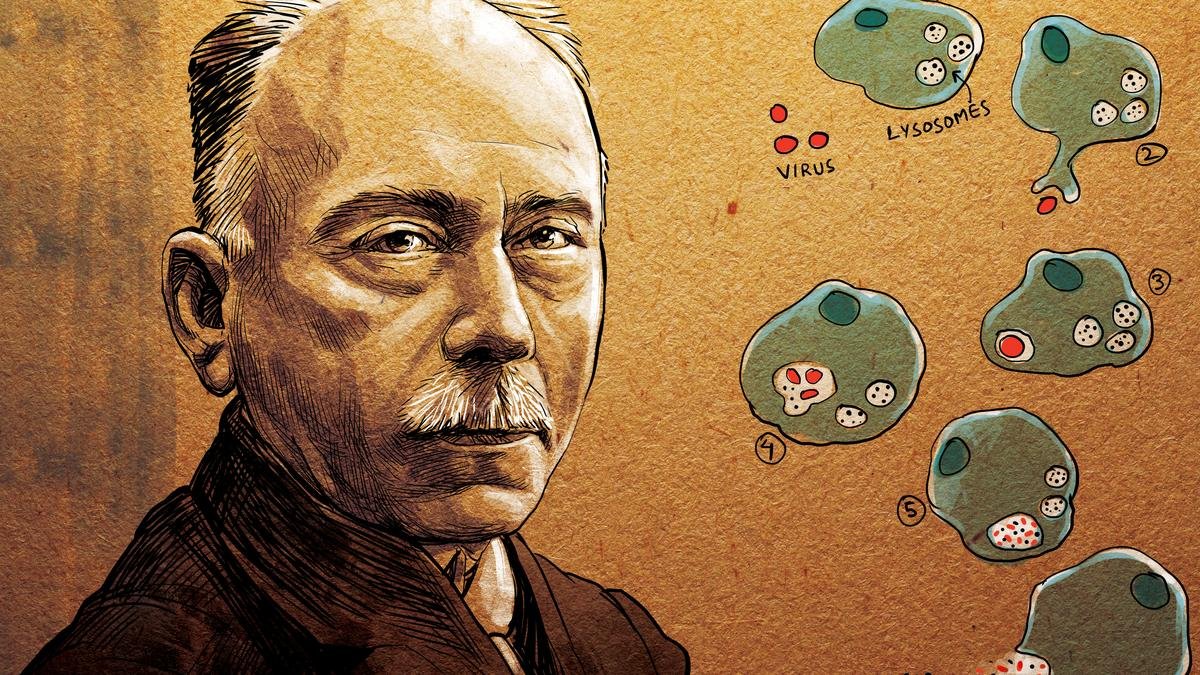
The Nobel Prize in Physiology or Medicine was not awarded from 1915 to 1918. Although the Nobel Foundation continued its work during the First World War, the conflict severely disrupted scientific communication, international collaboration and the evaluation of nominations. Under the Nobel Foundation’s statutes, the prize could be reserved or withheld if no discovery fulfilled the required criteria or if extraordinary circumstances prevented a proper assessment.
When the prize returned in 1919, it honoured Belgian bacteriologist and immunologist Jules Bordet “for his discoveries relating to immunity.” His research revealed how the body’s defence system identifies and destroys disease-causing microbes, providing the first clear explanation of one of the immune system’s most important mechanisms. His discoveries became the foundation of modern immunology and continue to influence vaccine development, infectious disease diagnosis and treatments for immune disorders today.
At the turn of the twentieth century, infectious diseases such as tuberculosis, diphtheria, cholera, typhoid fever and plague remained among the world’s leading causes of death. Although scientists had established that bacteria caused many diseases, the body’s own defence mechanisms remained largely mysterious. Physicians could observe that some people became immune after recovering from an infection or receiving a vaccine, but they did not understand how this protection worked or why blood could destroy certain bacteria.

Early life
Jules Jean Baptiste Vincent Bordet was born on June 13, 1870, in Soignies, Belgium. He studied medicine at the Free University of Brussels, graduating in 1892 before receiving a research fellowship that took him to the Pasteur Institute in Paris in 1894.
There, Bordet worked under microbiologist Élie Metchnikoff, who would later receive the Nobel Prize for his work on phagocytosis– the ability of certain white blood cells to engulf microbes. At the time, immunology was one of medicine’s newest disciplines, and scientists were divided over how the body fought infection. Some believed specialised immune cells were responsible for protection, while others argued that substances circulating in blood played the central role.
Bordet carefully designed experiments to understand the contribution of blood itself. Remarkably, while still in his twenties, he made discoveries that would help reconcile these competing theories and reshape the understanding of immunity.
In 1901, Bordet returned to Belgium to establish and direct the Pasteur Institute in Brussels, where he continued his research for the rest of his career.

Bordet’s major contribution
While studying blood serum, Bordet discovered that bacteria could only be effectively destroyed through the combined action of two separate components. The first consisted of specific antibodies, proteins produced after the body encounters a particular pathogen. These antibodies recognised and attached themselves to bacteria with remarkable precision. The second was a naturally occurring, heat-sensitive substance present in normal blood serum. Bordet initially named it alexine, derived from the Greek word meaning “to ward off.” It was later renamed the complement system by German immunologist Paul Ehrlich because it complemented the action of antibodies.
Through more laboratory experiments, Bordet demonstrated that antibodies alone could recognise bacteria but could not efficiently destroy them. Likewise, complement alone lacked specificity. Only when the two worked together could invading microbes be eliminated.
He also showed that heating blood serum destroyed complement while leaving antibodies intact. When fresh serum containing active complement was added back, the bacteria-killing ability returned. These experiments provided the first convincing evidence that immunity depended on coordinated biological mechanisms rather than a single defensive substance.
The discovery fundamentally changed scientists’ understanding of the immune system and helped settle one of the major scientific debates of the era by demonstrating that both cellular and humoral components contributed to immunity.
Building on these findings, Bordet developed the complement fixation test, one of the earliest laboratory techniques capable of detecting antibodies in blood. The method soon became a cornerstone of diagnostic microbiology and later formed the basis of the famous Wassermann test for syphilis, as well as numerous serological tests used throughout the twentieth century.

Research contributions
Beyond his Nobel Prize-winning work, Bordet made several landmark contributions to bacteriology.
In 1906, together with Belgian microbiologist Octave Gengou, he isolated the bacterium responsible for whooping cough, now known as Bordetella pertussis. The organism was later named in his honour, and the pair also developed Bordet-Gengou agar, a specialised culture medium that enabled laboratories to grow and study the bacterium.
These discoveries greatly improved the diagnosis of pertussis, a disease that was then a major cause of childhood illness and death .Bordet’s investigations also established many of the principles of serology—the study of antibodies and immune reactions in blood. His work demonstrated that immune responses could be measured objectively in the laboratory, transforming microbiology from a largely observational science into one supported by reproducible diagnostic testing.
Bordet recognised that immunity was far more complex than a single mechanism. He argued that multiple interacting processes protected the body against infection, an idea that anticipated the modern understanding of the immune system as an intricate network of cells, proteins and signalling molecules.
Throughout his career, he continued to investigate bacterial toxins, immune responses and infectious diseases, remaining scientifically active long after receiving the Nobel Prize.

Impact on medicine
Today, Bordet’s discoveries remain central to medicine.
The complement system is now known to comprise more than 30 proteins that form a crucial part of the body’s innate immune system. These proteins help destroy bacteria, viruses and infected cells while coordinating inflammation and activating other immune defences.
Modern serological tests, which detect antibodies in blood — owe much of their scientific foundation to Bordet’s work. Such tests are routinely used to diagnose infectious diseases, assess immunity following vaccination and identify autoimmune disorders.
His discoveries also strengthened the scientific understanding of vaccination by explaining how antibodies recognise pathogens and provide long-term protection against future infections.
More than a century later, complement biology remains one of the fastest-growing fields in immunology. Abnormal activation of the complement system has been linked to diseases including age-related macular degeneration, atypical haemolytic uraemic syndrome, lupus, certain kidney disorders and severe inflammatory conditions. Several modern medicines now specifically target complement proteins, while researchers continue exploring complement-based therapies for neurodegenerative diseases, autoimmune disorders and severe infections.
Jules Bordet remained director of the Pasteur Institute in Brussels for decades and continued his scientific investigations until late in life. He died on April 6, 1961, leaving behind discoveries that transformed medicine’s understanding of immunity.
By revealing how antibodies and the complement system work together to defend the body against infection, he transformed immunity into a measurable biological process, laying foundations that continue to guide medicine more than a century after his Nobel Prize.
Published – July 12, 2026 07:16 pm IST