

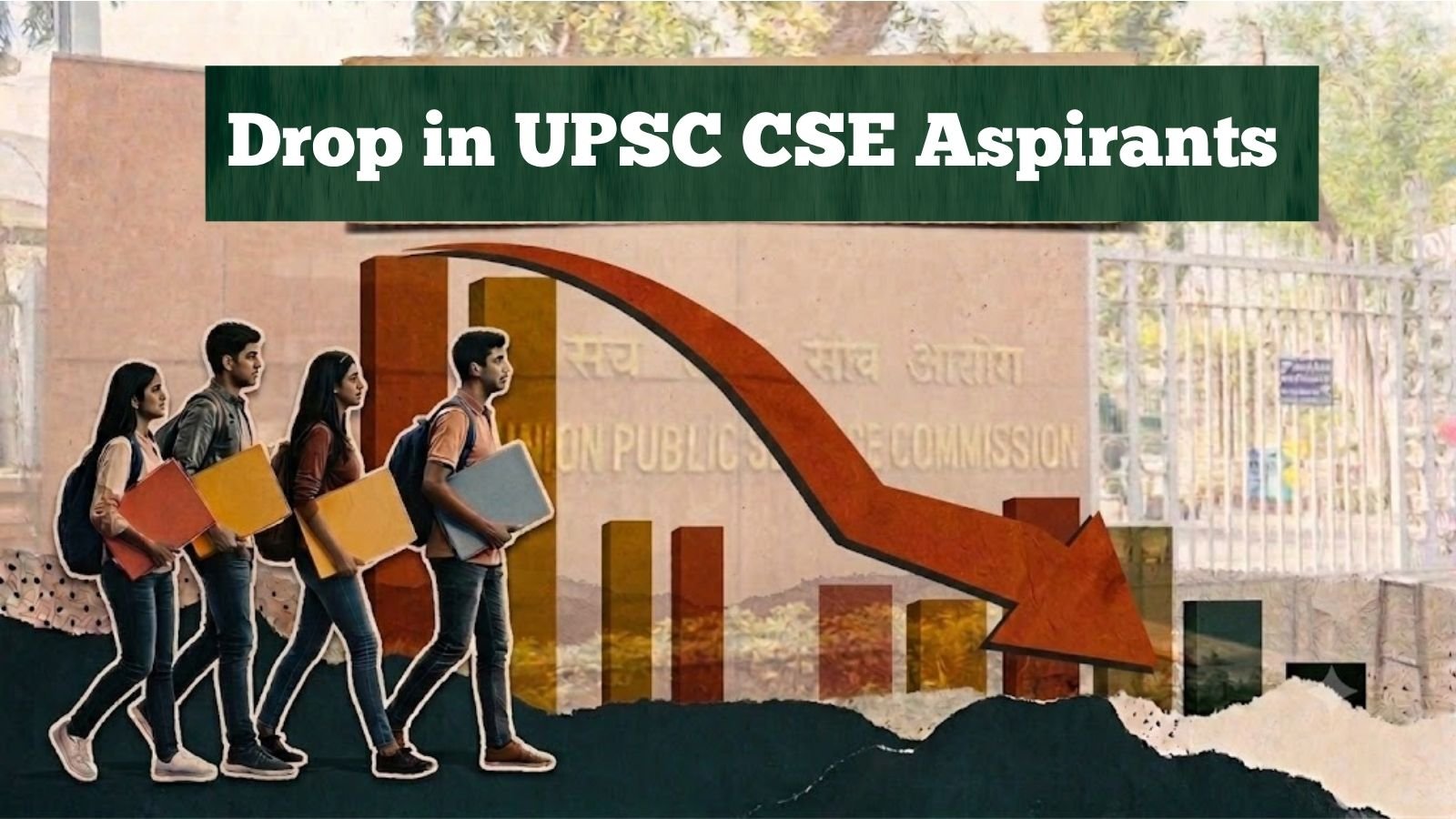
For every 70-odd candidates who sat for the UPSC Civil Services (Preliminary) Examination in 2023-24, only one went on to appear for the Mains — a ratio that has held roughly steady even as the overall size of the applicant pool has begun to shrink. The Union Public Service Commission’s (UPSC) 74th annual report (2023-24) shows a shift in candidate behaviour in the Civil Services Examination (CSE) — even as fewer aspirants sat for the Preliminary exam, a larger number of them went on to appear for the Mains.
According to the report, the number of candidates who appeared for the CSE (Preliminary), including the Indian Forest Service (Preliminary) exam, fell to 10,27,514 in 2023-24, down from 11,52,566 in 2022-23 and 11,12,318 in 2021-22. This marks a decline of nearly 1.25 lakh candidates compared to the previous year — the lowest turnout for the Prelims among the three years covered in the report.

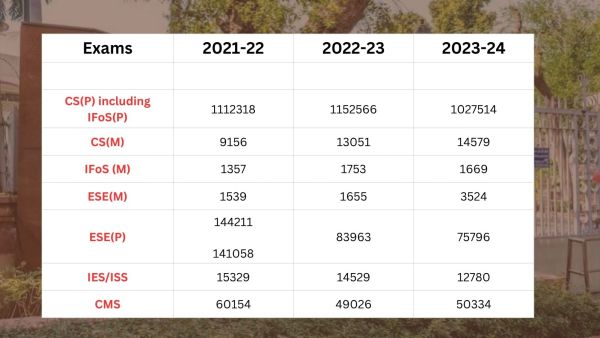 The data is taken from the UPSC 74th annual report and shows the three-year window period for civil exams.
In contrast, the number of candidates appearing for the Civil Services (Main) Examination has climbed steadily over the same period — from 9,156 in 2021-22 to 13,051 in 2022-23, and further up to 14,579 in 2023-24. This is the highest Mains turnout in the three-year window tracked by the Commission, even as the Prelims pool shrank.
Aspirants diversifying beyond CSE
The divergence between a shrinking Prelims cohort and a growing Mains cohort suggests that candidates may increasingly be rationalising their attempts — appearing only when adequately prepared — while also spreading their efforts across the wider basket of state civil services, rather than treating the UPSC exam as their sole shot at a government career.
Aditya Bhargava, a Bihar student preparing for civil services in New Delhi, said, “If the Civil Services do not work out, I would look towards opportunities in public policy, governance, and development sector organisations, where I can contribute to policy implementation and social impact. Think tanks, research institutions, and government advisory roles are also attractive options, as they allow one to apply the analytical and administrative skills gained during UPSC preparation.”
Being a humanities student, Aditya is not eligible to apply for CMS or ESE posts. Other options that he ponders are cracking the UGC NET and being an assistant professor.
The report’s broader data lend weight to this trend. Alongside CSE, examinations such as the Combined Geo-Scientist (CGS), Combined Medical Services (CMS), Engineering Services Examination (ESE), and Central Armed Police Forces (CAPF) exam continue to draw substantial numbers of applicants each year, indicating that aspirants are exploring parallel avenues within the civil and technical services ecosystem instead of concentrating solely on the CSE route.
Read | Not even 40% of UPSC CSE candidates are women
Story continues below this ad
Sriram Srirangam, director of Sriram’s IAS, said, “There is diversification among the aspirants. They are serious about finding a place in the government at a higher level, and they are not particular about UPSC recruitment. The number taken by the Commission combined for both civil services, armed police forces, statistical service, economic service, and engineering service, all of them put together, has dwindled, so students have to look for other channels.”
A decade of shrinking vacancies in UPSC
Part of this shift is also linked to how the number of vacancies on offer has moved over the past decade. UPSC vacancies peaked at over 1,300 posts around 2014, before falling sharply through the latter half of the decade — down to 1056 in 2017, 812 in 2018, and a low of 748 in 2021.
| Year | Number of Vacancies |
| 2012 | 1091 |
| 2013 | 1228 |
| 2014 | 1363 |
| 2015 | 1164 |
| 2016 | 1209 |
| 2017 | 1056 |
| 2018 | 812 |
| 2019 | 922 |
| 2020 | 836 |
| 2021 | 748 |
| 2022 | 1022 |
| 2023 | 1105 |
| 2024 | 1056 |
| 2025 | 1087 |
| 2026 | 933 |
The UPSC vacancies remained consistently above 1,100, reaching an all-time high of 1,363 in 2014. On the other hand, between 2018 and 2021, there was a significant dip during this period, with numbers falling below 1,000 for four consecutive years. The year 2021 saw the lowest vacancy at 749. Since 2022, there has been a steady return to normal, with vacancies stabilising around the 1,000–1,100 range.
When asked about the declining vacancies in the UPSC CSE, Aditya said that it is indeed discouraging for many aspirants; however, preparing for the Civil Services Examination is not just about securing a prestigious position but also about developing a deep understanding of governance, public policy, and society. “Ultimately, while UPSC is a dream, the larger goal is to contribute meaningfully to society, and there are multiple avenues to achieve that objective,” he said.
Story continues below this ad
State PSCs gaining ground
Alongside this, state-level public service commissions have emerged as an attractive and reliable alternative. Commissions such as the Bihar Public Service Commission (BPSC) and the Uttar Pradesh Public Service Commission (UPPSC) have, in recent years, become far more consistent in adhering to their examination calendars.
Srirangam claimed that State Public Service Commissions like Telangana, UP, Bihar, and Madhya Pradesh are “working wonderfully.” They are recruiting on an annual basis, there is an enormous amount of honesty and predictability, and therefore, students are finding that the better option. He added, “Candidates who are looking for vacancies at SEBI, NABARD, etc, are quite satisfied because these government jobs are also at a high level. So, it is quite a satisfactory destination for students.”
Read | Engineers dominate UPSC CSE final lists, even as candidates from Humanities stream see 65% jump
BPSC’s 71st Combined Competitive Examination alone notified over 2,000 vacancies, while UPPSC’s PCS exam for 2024 saw its vacancy count revised sharply upward from 220 to 947 posts. In several recent cycles, state PSCs have collectively notified vacancy numbers that rival or exceed the total seats on offer through the UPSC CSE, making them an increasingly serious parallel track — with a similar Prelims-Mains-Interview format — for aspirants weighing where to direct their preparation.
Story continues below this ad
| State PSC | 2026 | 2025 | 2024 | 2023 | 2022 |
| UPPSC | 500 | 930 | 947 | 173 | 383 |
| BPSC | 1,186 | 1,264 | 1,957 | 475 | 107 |
| MPPSC | 155 | 158 | 60 | 277 | 283 |
| MPSC | 79 | 601 | 524 | 673 | 161 |
| CGPSC | 238 | 246 | – | 242 | 189 |
Akash Mishra from Rewa, Madhya Pradesh, who has been preparing for both the MPPSC and UPSC examinations for the past four years, believes the MPPSC is relatively easier than the UPSC. “In MPPSC, there is a greater emphasis on factual knowledge and data, whereas UPSC focuses more on analytical ability and conceptual clarity. The UPSC also adheres to its examination calendar and completes the recruitment cycle on time, unlike the MPPSC. For instance, the MPPSC Mains examination for last year’s recruitment cycle and this year’s cycle are both scheduled to be held in 2026, with only a one-month gap between them,” Mishra said.
He also said that English-medium candidates have a slight advantage in the UPSC examination, while Hindi-medium candidates tend to have an edge in the MPPSC.
A tougher, more unpredictable exam
Aspirants and coaching experts also highlighted a changing character in the CSE itself. Over the past several exam cycles, the Commission has steadily moved away from direct, fact-based questions toward more analytical and application-based ones that test a candidate’s ability to reason through a concept rather than simply recall it.
“The UPSC examination is becoming not just more complex but also increasingly unpredictable. Take this year’s Preliminary examination, for instance — the General Studies Paper I question booklet ran to 55 pages. We also don’t know what to expect from the Main examination. With AI and other emerging developments, the UPSC appears to be reworking its examination pattern. It will become clearer how that is taking shape when the Main examination begins on August 26,” Srirangam said.
Story continues below this ad
When asked about his perspective on Prelims 2026, Aditya said, “UPSC has definitely made its examination more challenging over the years. Earlier, covering the syllabus and revising standard books gave candidates a reasonable sense of confidence. Today, with the internet making quality study material, coaching lectures, and current affairs available to everyone, access to content is no longer the real challenge. As a result, UPSC has shifted its focus from testing what you know to testing how you think.”
He added that the 2026 CSE Prelims is a good example, as many questions were so unconventional that aspirants felt it was almost impossible to predict what could be asked.
“The exam now rewards conceptual clarity, analytical thinking, and the ability to connect different subjects rather than simply memorising facts. On the other hand, while State PSC exams are also improving, they are still comparatively more syllabus-based and predictable, making preparation relatively more structured for aspirants,” he opined.
Speaking about the difficulty level of the CSAT and whether it prompted him to consider state civil services, Akash said, “The difficulty is there, and it may continue in the future. The exam is designed to test candidates comprehensively. However, switching to the state PCS just to avoid the CSAT is not a reason for me. Since the CSAT is only a qualifying paper and its marks are not counted towards the final merit list, aspirants should focus on clearing it by any legitimate means.”
Story continues below this ad
Other than the above, Raju Kumar, a Delhi-based UPSC aspirant, pointed out that current affairs are now woven into static subjects like Polity, Economy, Environment, and Science and Technology rather than appearing as standalone questions. Kumar pointed out that formats such as assertion-reason pairs and multi-statement, Roman-numeral options have become more common, which requires sharper time management even for well-prepared candidates.
He also pointed out that UPSC CSE prelims cut-offs have swung considerably from a high of 116 marks in 2016 to under 75.41 marks in 2023, which shows that the exam has grown less predictable even as it has grown more conceptually demanding.