

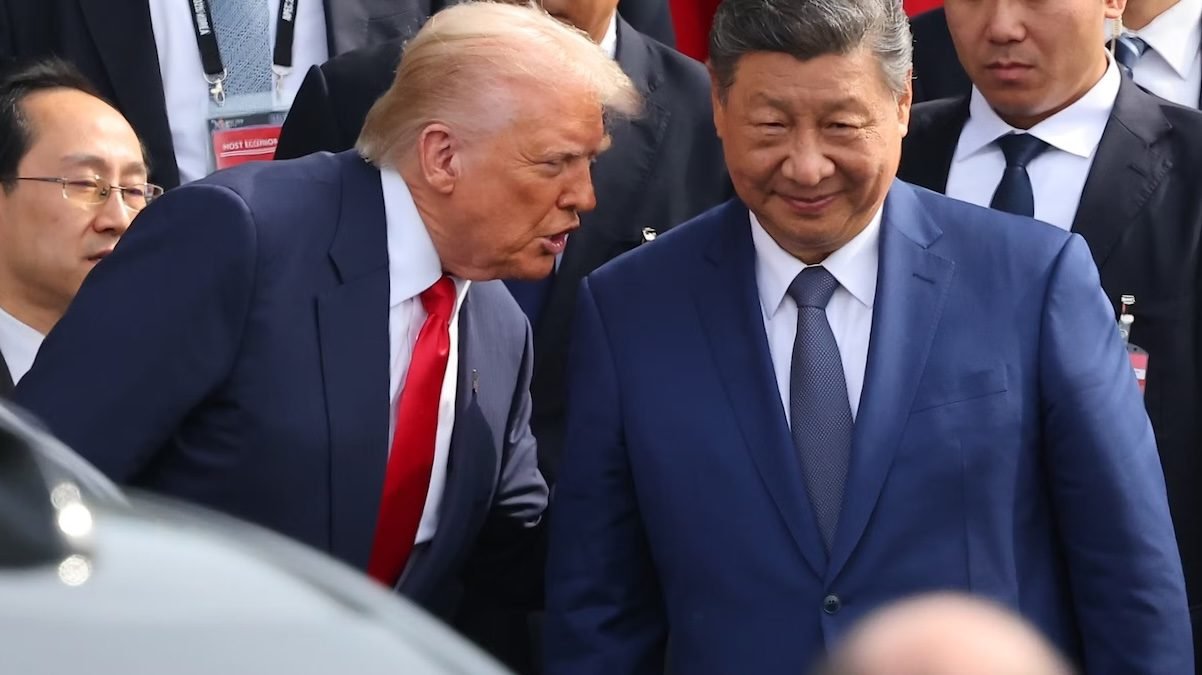
When President Donald Trump arrives in Beijing this week for talks with Chinese President Xi Jinping, the choreography will almost certainly be familiar: firm handshakes, oversized rhetoric, carefully calibrated symbolism and declarations about “historic” economic opportunities.
But beneath the spectacle will lie a much more consequential reality for Asia. Trump’s return to office has not produced a coherent new Indo-Pacific doctrine so much as a louder, more transactional version of America’s existing strategic anxieties.
Washington continues to frame China as its principal competitor, but increasingly through the language of tariffs, industrial rivalry and economic punishment rather than sustained alliance-building or regional institution-making.
For much of the past decade, successive US administrations described the Indo-Pacific as the center of geopolitical gravity. Barack Obama’s “pivot to Asia” sought to reassure allies that Washington recognized the region’s growing strategic importance.
Joe Biden expanded that framework through mini-lateral security partnerships, technology alliances and diplomatic engagement designed to counterbalance China’s rise without triggering outright confrontation.
Trump’s second term represents a notable departure. The administration has preserved much of Washington’s hard-line rhetoric toward Beijing, but without the broader diplomatic and economic framework that once reinforced US credibility across the Indo-Pacific.
Instead, Trump 2.0 has leaned heavily on economic nationalism, tariff threats and demands for greater burden-sharing from allies already grappling with rising geopolitical and financial uncertainty.
Despite claims of strategic renewal, the approach largely repackages longstanding anxieties about China into a more confrontational doctrine driven by trade escalation, economic coercion and increasingly incendiary rhetoric over global competition.
Regional governments increasingly view Washington through a transactional lens. Allies and partners hear repeated demands to decouple from Chinese supply chains while simultaneously confronting new tariffs, industrial policy disputes and uncertainty about long-term American commitments.
This matters because Asia’s middle powers do not want to choose between Washington and Beijing. Most seek strategic flexibility, diversified trade and stable security relationships that avoid forcing the region into rigid blocs.
Vietnam illustrates the dilemma clearly. Over the past decade, Hanoi emerged as one of the primary beneficiaries of global supply-chain diversification as manufacturers shifted production away from China amid escalating US-China tensions.
American companies themselves played a major role in that transition. Yet Washington now increasingly frames Vietnam’s export growth through the language of “overcapacity” and industrial imbalance, despite the fact that much of Vietnam’s manufacturing platform is driven by multinational investment rather than state-directed industrial dumping.
The contradiction has not gone unnoticed in the region. Nor has the growing gap between Washington’s military posture and its diplomatic messaging.
The US continues to conduct freedom of navigation operations in the South China Sea, deepen defense cooperation with allies and strengthen deterrence frameworks around Taiwan.
But military signaling alone does not constitute a regional strategy. Diplomacy, economic integration and institutional trust remain equally important currencies in Asia.
That is where Beijing sees an opening. China’s leadership understands that regional influence today is shaped not only by naval power, but by infrastructure financing, trade relationships, development assistance and increasingly by environmental diplomacy and ocean governance.
Beijing’s push to host the secretariat for the new High Seas Treaty reflects that broader strategy. China has sought to portray itself as a responsible steward of the global maritime commons, pledging financial support for marine conservation initiatives while simultaneously expanding its diplomatic presence across developing coastal states.
To be sure, many regional governments remain deeply wary of China’s intentions, particularly in the South China Sea, where maritime coercion, gray-zone tactics and territorial disputes continue to generate distrust.
But Beijing does not necessarily need to be entirely consistent in its own policies in order to replace American influence outright. It only needs to exploit perceptions of inconsistency in US policy.
Trump’s return has amplified those perceptions. The administration’s emphasis on tariffs and economic confrontation risks undermining the very partnerships Washington needs to sustain long-term strategic competition.
Regional leaders hear demands for alignment while watching America itself retreat from many of the trade frameworks and multilateral arrangements that once reinforced its economic leadership in Asia.
At the same time, Xi enters the upcoming summit with advantages that extend beyond diplomacy. China’s economy may be slowing, but Beijing retains enormous leverage across regional supply chains, manufacturing networks and infrastructure financing.
It can choke off supplies of critical minerals like rare earth elements that are essential for defense equipment, electric vehicles, and other essential products of everyday modern life. It continues to invest heavily in advanced technologies, maritime capabilities and strategic industries central to future competition.
Xi projects continuity in Asia through consistency, long-term planning and institutional discipline — qualities many regional governments value even if they remain wary of Beijing’s ambitions.
For example, China’s Belt and Road Initiative, regardless of criticism, signals permanence and continuity through ports, railways, energy projects and financing commitments that unfold over decades.
Chinese diplomacy also emphasizes patience and gradualism. Even when Beijing acts assertively in the South China Sea or Taiwan Strait, it typically embeds those actions within a broader narrative of historical continuity and national rejuvenation.
That continuity matters in Asia, where political stability and predictability are often valued as much as ideological alignment. Regional governments may not trust Beijing fully, but many increasingly question whether Washington’s policies will remain durable beyond electoral cycles and political personalities.
Trump’s Beijing visit, therefore, carries significance far beyond bilateral symbolism. The meeting will serve as a test of whether Washington can still articulate a broader Indo-Pacific vision that extends beyond tariffs, confrontation and episodic displays of strength.
It will also reveal whether the US still understands that influence in Asia depends not merely on containing China, but on offering a credible, stable and economically attractive alternative.
The danger for Washington is not that Asia suddenly becomes pro-China. It is that the region gradually adapts to a world in which American policy appears unpredictable, overly transactional and increasingly disconnected from the long-term realities shaping the Indo-Pacific economy.
That strategic drift would benefit Beijing far more than any summit communique or carefully staged diplomatic theater.
Trump may arrive in Beijing hoping to project strength. But many Asian observers will be watching for something else entirely: whether the US still possesses the political patience and strategic coherence necessary to lead in the Indo-Pacific.
Right now, that answer remains uncertain.
James Borton is the editor-in-chief of the South China Sea NewsWire and the co-author of a recently released SCSNW Indo-Pacific Report along with managing editor David Hessen.