

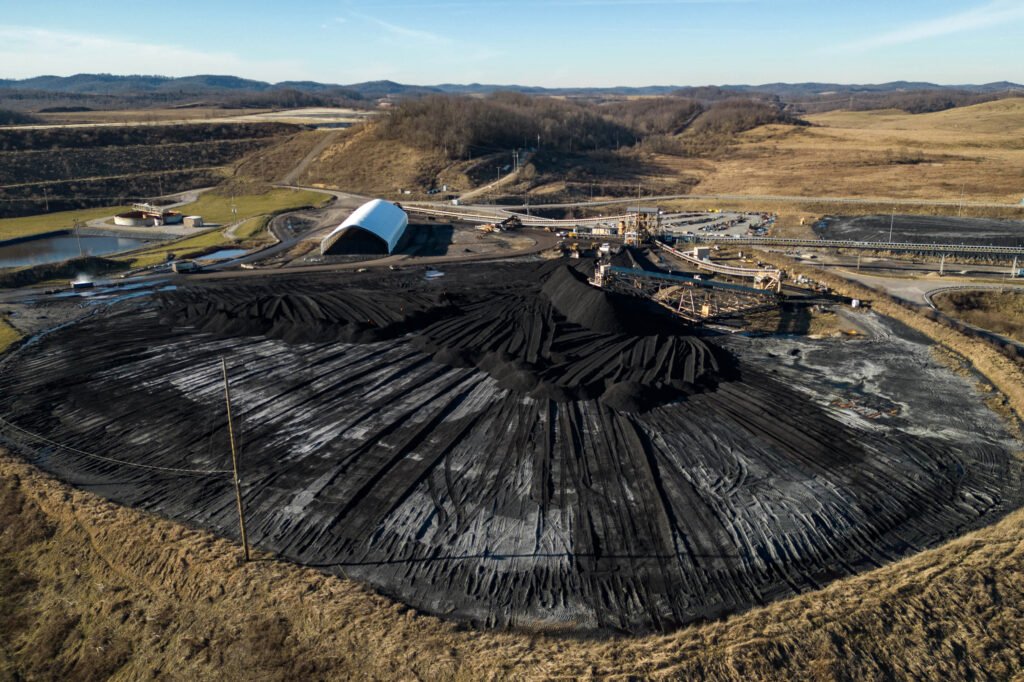
Thursday’s flurry of coal news from energy officials included $425 million to extend the life of 12 coal plants in several states, such as $50 million from the U.S. Department of Energy (DOE) for the Wheeling Power Company’s plans to “modernize” the Mitchell Plant in Moundsville, West Virginia.
“This was not necessarily a surprise. But also the rhetoric is frustrating, because coal is not dead in West Virginia,” said an exasperated Quenton King, government affairs specialist for the advocacy group Appalachian Voices, upon hearing the news. “We’re not building giant new solar panels in West Virginia, we’re just maintaining the coal systems.”
The latest coal projects are located in a different part of West Virginia to where legacy health issues have long been linked to coal, King noted. Still, he said the significant reinvestment in coal is all part of the same statewide trend in which energy alternatives are not receiving funding, more-expensive-to-build coal plants are, and people’s health and strapped pockets are bound to suffer.
Outside of West Virginia, Thursday’s announcement of $425 million from the DOE included funding to extend the life of coal plants in Arkansas, Arizona, Kentucky, North Carolina, North Dakota, Oklahoma, Tennessee and Wisconsin.
Another $350 million would be invested in new coal power plants in Anchorage, Alaska, and Mount Storm, West Virginia, federal officials said, and for upgrading a coal-fired plant in Guayama, Puerto Rico, and restarting a facility that closed in 2024 in Cumberland, Maryland.
The announcements came against the backdrop of Environmental Protection Agency rollbacks of regulations meant to protect people from toxic coal ash, and as the federal government continues to divest from renewable energy options such as solar and offshore wind.
While detailing the 13 projects to get federal money on Thursday, Energy Secretary Chris Wright highlighted the $75 million slated to go toward a new coal export terminal in Oakland, California, which the city has opposed in the past.
“By investing in both coal generation and critical export infrastructure, including the West Gateway Terminal Project, the Energy Department is strengthening U.S. energy security, reinforcing strategic supply chains, and advancing American energy dominance,” Wright said in a statement.
Michael Lenoff, a senior attorney with the nonprofit Earthjustice, on Friday bristled that the bulk of the funds were coming through the Defense Production Act.
“It is (unreasonable) for the administration to claim that the national defense needs an unreliable, old, expensive … way of producing electricity at the same time as taking efforts in many ways to try to thwart the modern technologies—like storage, solar and wind—from getting off the ground,” Lenoff said.
“Coal Should Be at the Bottom of Your List”
Earlier this year, the Trump administration ordered generators at five coal plants that were on their way to retirement to remain open. The president also previously suggested coal could help meet power demands from the burgeoning data center industry.
“Coal plants provide around-the-clock baseload power with on-site fuel storage, giving military installations and critical industries a level of resilience that is difficult to replicate,” Michelle Bloodworth, a spokesperson for coal industry group America’s Power, said in an emailed statement Friday.
This story is funded by readers like you.
Our nonprofit newsroom provides award-winning climate coverage free of charge and advertising. We rely on donations from readers like you to keep going. Please donate now to support our work.
Coal has been on the decline as an energy resource nationwide for decades. It is considered by experts the most polluting fossil fuel for power generation.
In 1990, coal generated more than half of the nation’s electricity. That plummeted to about 17 percent by 2025.
Throughout its lifecycle, experts say, coal has been shown to pollute the air, water and soil of nearby communities, contributing to cardiovascular disease, asthma, lung cancer, preterm birth, mental illness and premature deaths.
Children and older adults are most at risk, said Mary Willis, a professor in the Department of Epidemiology at the Boston University School of Public Health.
“If you’re going to pick between living next to any sort of power plant, coal should be at the bottom of your list,” Willis said Friday.
In additional studies on coal, Willis said researchers found that before 2009, 25 percent of all deaths of Medicare patients from PM2.5 particulate pollution were attributable to coal.
“After 2012, it was only 7 percent, which is a massive reduction,” Willis said, pointing to analysis that showed the drop resulted from declining coal-use and air pollution control devices.
A spokesperson for American Electric Power Company (AEP), owner of the Wheeling Power in West Virginia, said the Mitchell Plant “operates under strict local, federal and state environmental requirements.”
Officials at the company said the latest federal funds will improve the coal plant’s performance.
“Because we live and work in these communities, too, protecting our neighbors is important to us,” the company wrote in an email.
Two coal-fired units at Antelope Valley Station in Mercer County, North Dakota, are also set to receive upgrades with help from the DOE. Those improvements will help mitigate unplanned outages, energy officials said.
“The way I look at the coal industry, we do not have reliable replacements for coal energy at this time and for our local community,” said Casey Voigt, a Mercer County commissioner. “It creates a lot of very good jobs.”
Voigt said the proliferation of data center proposals are “a lot bigger issue” in the county than the coal industry.
In a separate announcement Thursday, the Trump administration said it was using emergency authority to stave off closure of a coal plant in Orlando, Florida, that was set to retire this month.
“Forcing this coal plant to remain open past retirement will needlessly jack up electricity bills for Central Florida families and businesses, right as they’re struggling with high energy costs,” said Ted Kelly, director and lead counsel for U.S. Clean Energy at Environmental Defense Fund.
The day before Friday’s coal plant announcement, the EPA advanced a plan by Louisiana to give the state more authority over coal ash in the state. If fully approved, the plan would make Louisiana the sixth state to follow Virginia in taking such a step.
Environmental groups continue to worry that air and groundwater monitoring at active and inactive coal plants will only keep becoming less-stringent.
“Ultimately, these coal plants are scheduled to retire for a reason,” said Kelly. “They are uneconomic and cheaper, cleaner and more reliable energy options exist.”
About This Story
Perhaps you noticed: This story, like all the news we publish, is free to read. That’s because Inside Climate News is a 501c3 nonprofit organization. We do not charge a subscription fee, lock our news behind a paywall, or clutter our website with ads. We make our news on climate and the environment freely available to you and anyone who wants it.
That’s not all. We also share our news for free with scores of other media organizations around the country. Many of them can’t afford to do environmental journalism of their own. We’ve built bureaus from coast to coast to report local stories, collaborate with local newsrooms and co-publish articles so that this vital work is shared as widely as possible.
Two of us launched ICN in 2007. Six years later we earned a Pulitzer Prize for National Reporting, and now we run the oldest and largest dedicated climate newsroom in the nation. We tell the story in all its complexity. We hold polluters accountable. We expose environmental injustice. We debunk misinformation. We scrutinize solutions and inspire action.
Donations from readers like you fund every aspect of what we do. If you don’t already, will you support our ongoing work, our reporting on the biggest crisis facing our planet, and help us reach even more readers in more places?
Please take a moment to make a tax-deductible donation. Every one of them makes a difference.
Thank you,

Reporter, California
Steven Rodas is an environmental and climate reporter for Inside Climate News based in Southern California. He previously reported on the environment in New Jersey, covering energy, pollution, wildlife and development. Steven’s work has appeared in several publications including NJ.com/The Star Ledger, hMAG, The Jersey Journal and The Hudson Reporter. He worked as a copywriter at Google. Steven has a master’s degree from Syracuse University’s S.I. Newhouse School Of Public Communications. He is fluent in English and Spanish (and welcomes your tips).