

World Humanoid Games feature robots competing in athletic events
Kurt Knutsson, ‘The CyberGuy’, joins ‘Fox & Friends’ to showcase the World Humanoid Games in Beijing, China. Over 2,000 robots and 600 teams from 16 countries compete in athletic competitions including sprinting, boxing, and soccer. Knutsson discusses how the U.S.-China tech race is expanding into humanoid robotics as developers push the boundaries of artificial intelligence.
NEWYou can now listen to Fox News articles!
If your mental image of a humanoid robot still involves stiff knees and awkward demos, you may want to update it. A Chinese humanoid robot has now covered 100 meters faster than Usain Bolt’s 9.58-second human world record. At the opening of Beijing’s World Humanoid Robot Games, an X-Humanoid robot completed the 100-meter sprint in 9.39 seconds. Then the number dropped again.
X-Humanoid announced on Aug. 25 that TianGong Ultra ultimately posted a 9.32-second time during the competition. The company says its robots reset the mark several times during roughly two hours of racing. Before anybody starts rewriting the Olympic record books, keep some perspective. Bolt still holds the official men’s 100-meter world record recognized by World Athletics. These robots compete under their own rules in a separate event.
CHINESE ROBOT BREAKS HUMAN WORLD RECORD IN BEIJING HALF-MARATHON
Still, look at how quickly this technology is moving. For me, the bigger story goes far beyond a robot beating Bolt’s time. We are watching humanoid machines go from clumsy demonstrations to increasingly capable physical systems at remarkable speed.
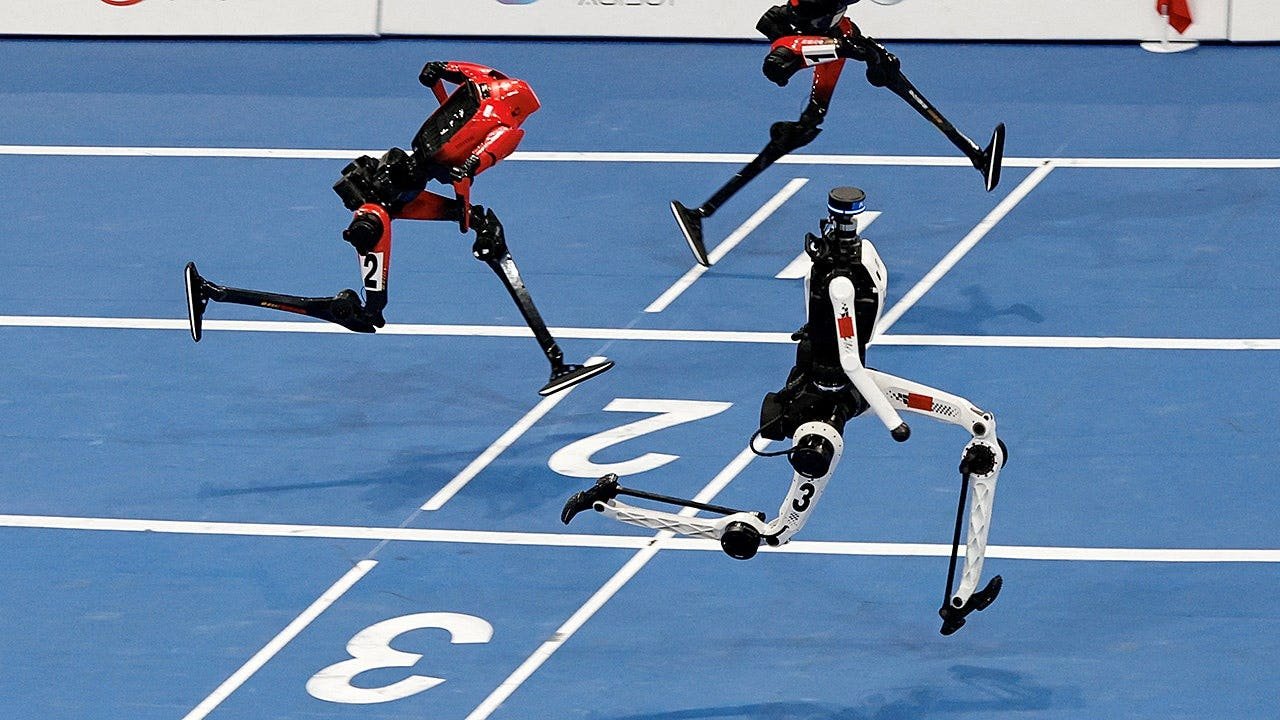
Robots from Team Tiangong Ultra compete in the 4×100-meter relay final on day 4 of the 2nd World Humanoid Robot Games at National Speed Skating Oval in Beijing, China, on Aug. 25, 2026. (VCG via Getty Images)
THIS SATURDAY! Free live CyberGuy class: Protect Your Money From Today’s Biggest Threats
Join us Saturday, Aug. 29, at 10 a.m. ET for a free CyberGuy LIVE class covering five simple steps to help defend yourself against AI scams, fraud, identity theft and financial hacks. Kurt “CyberGuy” Knutsson will explain how to set up bank alerts, strengthen your account logins, protect your phone number, freeze your credit and help secure your retirement savings against unauthorized transfers. No technical experience is needed. You’ll also receive our financial protection checklist, and every registrant will get a link to the class recording afterward.
Reserve your free spot today at CyberGuyLive.com.
Humanoid robots are suddenly getting very fast
The second World Humanoid Robot Games opened Aug. 22 at Beijing’s National Speed Skating Oval, known as the Ice Ribbon, and ran through Aug. 26. Organizers registered 666 teams and 2,056 robots for this year’s event. The competition included 51 events and 1,301 competition sessions.
The robots compete in track and field events along with challenges designed around real-world jobs. Organizers have also added tests involving physical skills such as weightlifting and tug of war.
That mix tells you something about what China wants these machines to become. The Games give developers a place to push speed and strength. They also expose weaknesses that can be harder to see in a carefully edited demonstration video.
TianGong Ultra ran 100 meters in 9.39 seconds, then 9.32
The first number that grabbed worldwide attention was 9.39 seconds. That was already quicker than Bolt’s 9.58-second human record from 2009. The comparison spread fast because almost everyone understands what a 100-meter sprint represents. Then X-Humanoid released its updated results.
The company says TianGong Ultra eventually reached 9.32 seconds, while other X-Humanoid teams recorded times of 9.34, 9.38 and 9.39 seconds. The exact comparison with Bolt needs context. These robots do not start, run or stop under the same conditions as human Olympic athletes.
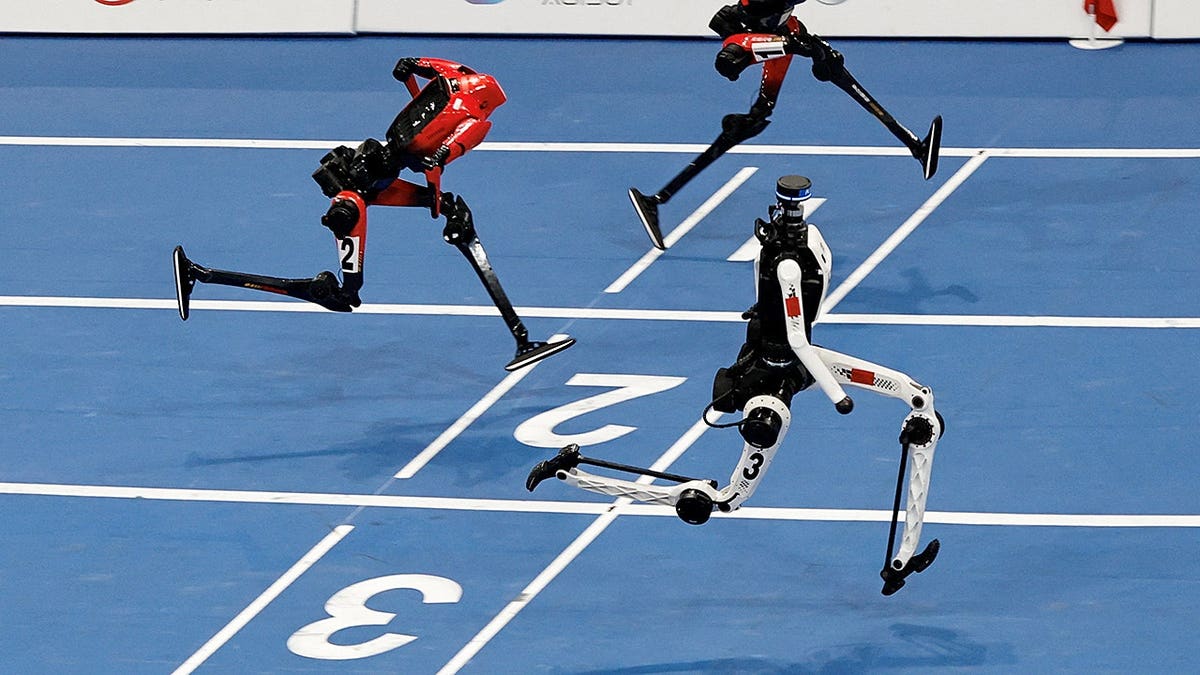
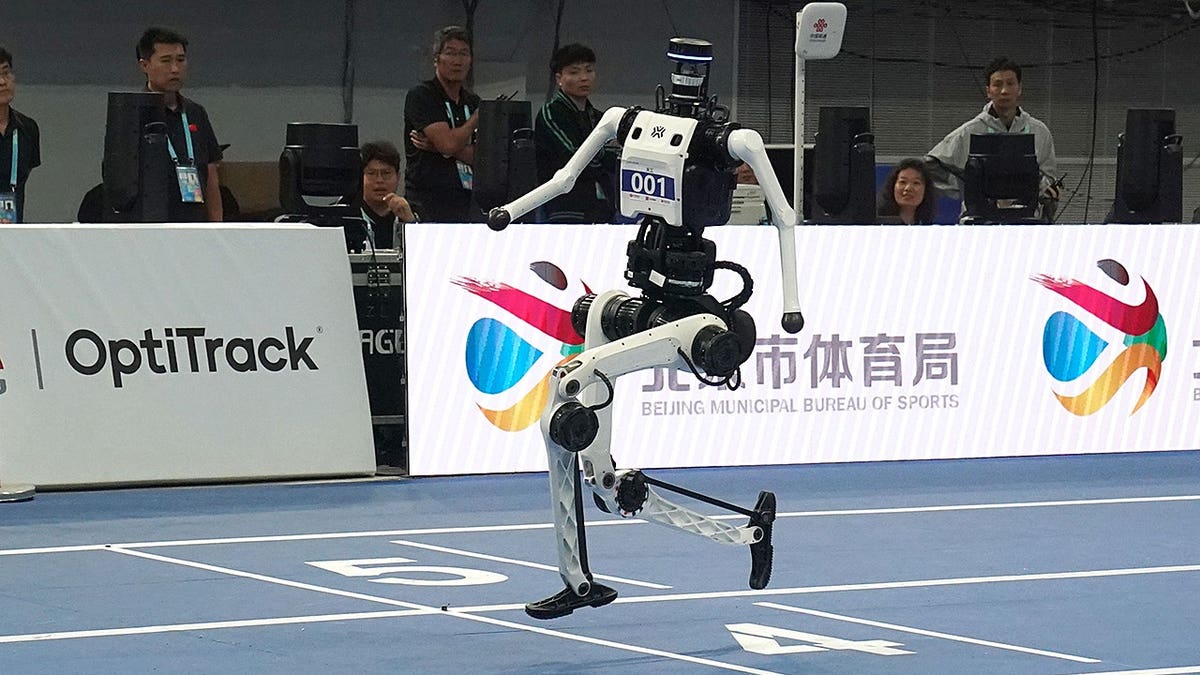
A Tiangong Ultra humanoid robot crosses the finish line in 8.86 seconds next to Honor humanoid robots during a 100-meter large-size group semifinal race at the 2026 World Humanoid Robot Games at the National Speed Skating Oval in Beijing, China, on Aug. 25, 2026. (REUTERS)
However, that does not make the improvement meaningless. A humanoid staying upright at that speed requires serious coordination between its motors, balance system, sensors and software. All of those pieces have to work together while the machine continuously adjusts its body. That is what catches my attention.
Last year’s winner took more than twice as long
The rate of improvement becomes even clearer when you look back only one year. At the inaugural World Humanoid Robot Games in 2025, the winning 100-meter robot finished in 21.50 seconds.
Now robots from the same development ecosystem are running the distance in less than 10 seconds. That is an enormous leap in a short period. We have already been following this acceleration at CyberGuy. Earlier this year, we showed you a Chinese humanoid called Bolt that reached 22 mph during testing. Running fast looks impressive on video. Yet the technology underneath that speed could become useful in places far removed from a racetrack.
A robot also jumped about 9 feet 5 inches
Running was only part of the show. An X-Humanoid robot reached 2.88 meters, or about 9 feet 5 inches, in a standing high jump. That height exceeds the recognized men’s high jump world record of 2.45 meters, or about 8 feet, set by Cuba’s Javier Sotomayor in 1993. Again, we need context.
Sotomayor’s world record came from a conventional high jump with a running approach. The robot competed in a standing high jump. Those events use very different mechanics. So the robot did not erase Sotomayor from the record books. What it did demonstrate was impressive explosive power and body control from a humanoid machine. Those capabilities could eventually translate into something far more useful than clearing a bar.
ROBOT LEARNS TO DISMANTLE BROKEN MACHINES
Once robots can move like this, you start asking where they can go
A fast humanoid robot does not need to become a track star to become valuable. Better mobility could help a robot move through a disaster area where sending a person could be dangerous. A machine that stays balanced while carrying equipment could eventually handle physically demanding jobs. Then you start thinking about environments where people would rather avoid going altogether.
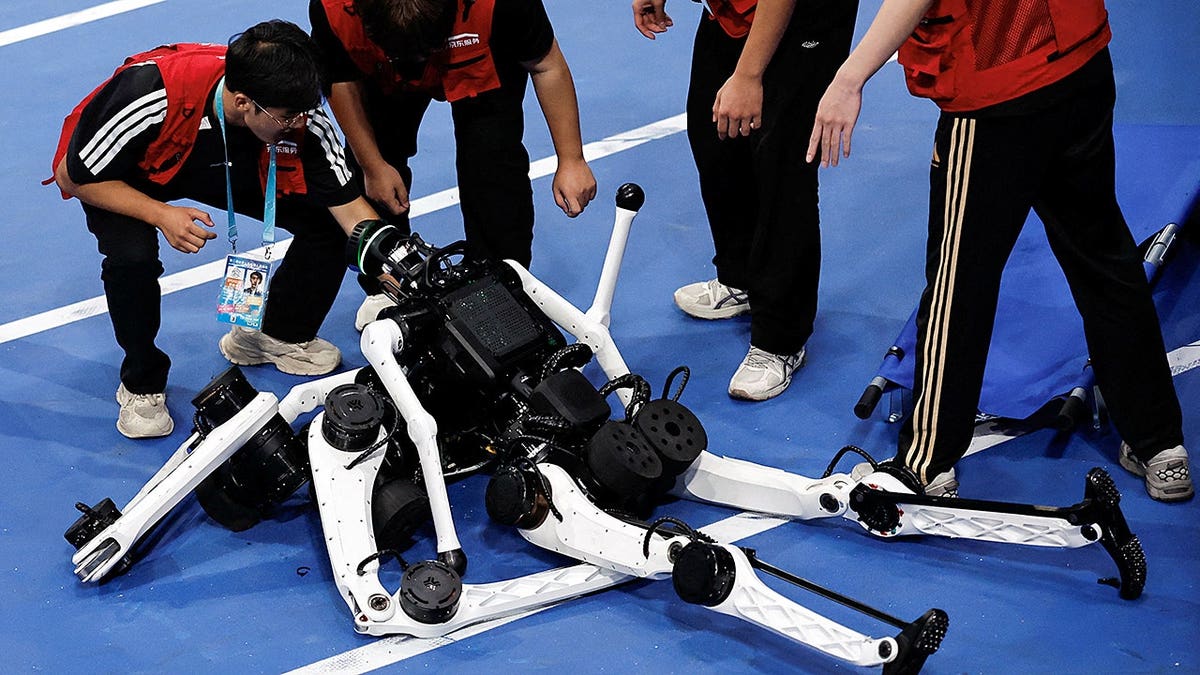
Maintenance team members check on Tiangong Ultra humanoid robots after they fall following the 100m large-size group final race at the 2026 World Humanoid Robot Games at the National Speed Skating Oval in Beijing, China, on Aug. 26, 2026. (REUTERS)
That brings us to the part of this story that deserves much more attention. One developer at the Games believes humanoid robot soldiers could arrive within the next decade.
One developer predicts robot soldiers within 5 to 10 years
Robotics engineer Yang Kun, who works for Shanghai-based humanoid robotics company AG BOT, says that he believes Chinese companies could be only five to 10 years away from robot soldiers. His company’s A3 humanoid competed in kickboxing at the Games. Yang described military and combat use as part of where he believes humanoid robotics could eventually go. That prediction deserves context. This comes from one developer. It does not represent an announced Chinese government timetable for deploying humanoid soldiers. I would not take five to 10 years as gospel.
Technology forecasts can move quickly in either direction. A machine can perform beautifully in a controlled environment and then struggle once the surroundings become unpredictable. What I would pay attention to is where developers believe this technology is headed. When people building these machines start discussing military applications, that tells us the conversation has already moved far beyond robots entertaining crowds at sporting events.
A battlefield would expose everything robots still struggle with
Running fast in a straight line is one challenge. Navigating a damaged building while carrying equipment presents an entirely different problem. A robot may encounter unstable ground, blocked paths and people moving unpredictably around it. Then comes the far harder issue of decision-making. A sprint gives a robot a clear destination. Real life rarely does. Military environments make that problem even tougher because communication can disappear without warning. Sensors can misread a situation. Software may face circumstances developers never anticipated.
That is why I would keep some perspective when watching these record-setting performances. The robots are getting impressive. They also still fall down. At the Games, some fast-running robots had trouble stopping after crossing the finish line and crashed into padded barriers. That creates a pretty good visual reminder of the gap between raw speed and reliable control.
China is testing robots for real-world jobs too
The organizers appear very aware of that gap. This year, Beijing upgraded the 100-meter event so robots must compete fully autonomously. Scenario-based events also encourage autonomous positioning, recognition and operation. The robots also face tasks inside settings modeled after factories, hotels and homes. Emergency-response challenges push them into situations where they must interact with their surroundings for longer periods.
That part interests me even more than a sprint record. A robot that runs 100 meters in nine seconds creates a great headline. A robot that can reliably work for hours without somebody constantly guiding it could change entire industries. China appears focused on both. CyberGuy has also reported on efforts to scale humanoid manufacturing in China, with factories preparing to build thousands of machines. That brings us to the larger technology race.
UNITREE G1 HUMANOID ROBOT ICE SKATES AND ROLLERBLADES
The U.S.-China tech race now has arms and legs
We hear constantly about competition between the United States and China over artificial intelligence. Humanoid robotics adds a physical layer to that race. The country that develops powerful artificial intelligence gains one advantage. The country that can put that intelligence inside a reliable robot body and manufacture those machines at scale could gain something much larger. Suddenly, the software can move through the physical world. It can enter an industrial facility. It can cross dangerous terrain or potentially operate where sending people would carry significant risk. U.S. regulators are already treating advanced foreign robotics as a national-security concern.
On July 28, the Federal Communications Commission added foreign-produced advanced robotic devices to its Covered List. The category includes qualifying humanoid robots and other advanced mobile robotic systems. The change means covered new devices generally cannot receive the FCC equipment authorization required for import or sale in the United States unless they receive an applicable conditional approval. That tells you Washington sees connected robots as more than another gadget category.
The AI brain could become the bigger story
For years, humanoid developers faced a frustrating mechanical challenge. How do you make a two-legged machine move efficiently without constantly falling over? Engineers still have plenty of work ahead. Yet today’s machines move very differently from the awkward humanoids we watched only a few years ago. That changes what developers can focus on next.
As robot bodies become faster and stronger, artificial intelligence continues improving at the same time. A more capable body could perform difficult physical work. Better AI could help that machine understand what it sees and determine what to do next. Put those advances together and humanoids become much more interesting. We recently showed you another humanoid demonstrating impressive running and movement skills. The biggest hurdle now may become less about making a robot move and more about making sure it makes good decisions once it gets there.
What this means to you
You probably will not see a humanoid robot soldier walking down your street anytime soon. You may encounter the technology behind these machines much sooner. The balance system that keeps a robot upright during a sprint could help one move through rubble after an earthquake. More capable sensors could allow robots to operate around human workers more safely. Factories will likely remain one of the first major targets.
Most buildings and workplaces were designed around the human body. That makes humanoids appealing because companies could potentially deploy them without rebuilding every workspace around a specialized machine. As reliability improves and costs come down, those capabilities could expand into other areas. The military discussion raises much harder questions.
How much decision-making authority should an autonomous machine have? Who carries responsibility if an AI-controlled robot makes a dangerous mistake? Those conversations should happen before the machines become capable enough to force them. Because the technology is moving quickly.
Kurt’s key takeaways
The Bolt comparison grabs your attention, but the bigger story for me is how quickly humanoid robots are becoming more capable. A 9.39-second 100-meter run shows how fast the motors, balance systems and software are improving. The military angle deserves attention too. One Chinese robotics engineer predicts robot soldiers could arrive within five to 10 years. I would not treat that timeline as gospel, but it shows where some developers believe this technology is headed. For America, this is another front in the technology race with China. A country that can combine advanced AI with reliable robot bodies and produce large numbers of them could gain a major advantage. We also need perspective. Running fast on a controlled track is far easier than navigating an unpredictable environment and making safe decisions. What I am watching now is how quickly these stronger robot bodies advance alongside increasingly capable AI.
If humanoid robots can outrun us, carry heavy equipment and make more decisions on their own, where would you draw the line on how much power we should give them? Let us know by writing to us at CyberGuy.com.
Sign up for my FREE CyberGuy Report
- Get my best tech tips, urgent security alerts and exclusive deals delivered straight to your inbox.
- For simple, real-world ways to spot scams early and stay protected, visit CyberGuy.com – trusted by millions who watch CyberGuy on TV daily.
- Plus, you’ll get instant access to my Ultimate Scam Survival Guide free when you join.
CLICK HERE TO DOWNLOAD THE FOX NEWS APP
Copyright 2026 CyberGuy.com. All rights reserved.