

Close Menu

    Subscribe to Updates

    Get the latest news information from worldwide businesses.

    What's Hot

    What ClickUp’s mass layoff tells us about the future of work

    May 25, 2026

    RBI unlikely to hike rates soon despite inflation risk, rate action only in Dec if needed: Icra’s Aditi Nayar

    May 25, 2026

    AU Real Estate acquires 5.6 acre land in Siddharth Vihar, for Rs 336 crore

    May 25, 2026
    Facebook Instagram YouTube LinkedIn X (Twitter)
    Trending
    • What ClickUp’s mass layoff tells us about the future of work
    • RBI unlikely to hike rates soon despite inflation risk, rate action only in Dec if needed: Icra’s Aditi Nayar
    • AU Real Estate acquires 5.6 acre land in Siddharth Vihar, for Rs 336 crore
    • Government forwent Rs 1 lakh crore via excise duty cuts to shield consumers from fuel inflation: FM
    • Far-right Elam party inspired by Golden Dawn makes gains in Cyprus election | Cyprus
    • Iran Us Relations: ‘If he knew history …’: Iran mocks Marco Rubio’s Taj Mahal visit | India News
    • University of Mumbai extends deadline for PG admissions till 30 May
    • ‘The Mandalorian and Grogu’ wastes a potentially brilliant era of ‘Star Wars’
    Newspublicly
    • About Us
    • Advertise & Partner with us
    • Pitch Your Story
    • Contact Us
    Facebook Instagram LinkedIn X (Twitter)
    Subscribe
    • Home
    • World News
      • Asia
      • India
      • USA
      • UK & Europe
      • Middle East
    • Economy & Business
      • Global Economy
      • Corporate & Industry
      • Finance & Markets
      • Policy & Trade
    • Technology
      • Gadgets & Devices
      • Software & Apps
      • AI & Machine Learning
      • Robotics & Automation
    • Health & Medicine
      • Fitness & Nutrition
      • Research & Innovation
      • Disease & Treatment
      • Doctors, Clinics & Patient Care
    • Travel & Tourism
    • Automobile
      • Electric & Hybrid Vehicles
      • Auto Industry Insights
    • Sports
    • More
      • Education
      • Real Estate
      • Environment & Climate
      • Space & Astronomy
      • War & Conflicts
    Newspublicly
    Home»Health & Medicine»Research & Innovation»This prehistoric fish may explain how animals first walked on Earth
    Research & Innovation

    This prehistoric fish may explain how animals first walked on Earth

    AdminBy AdminMay 25, 2026No Comments4 Mins Read0 Views
    Share
    Facebook Twitter LinkedIn Copy Link WhatsApp


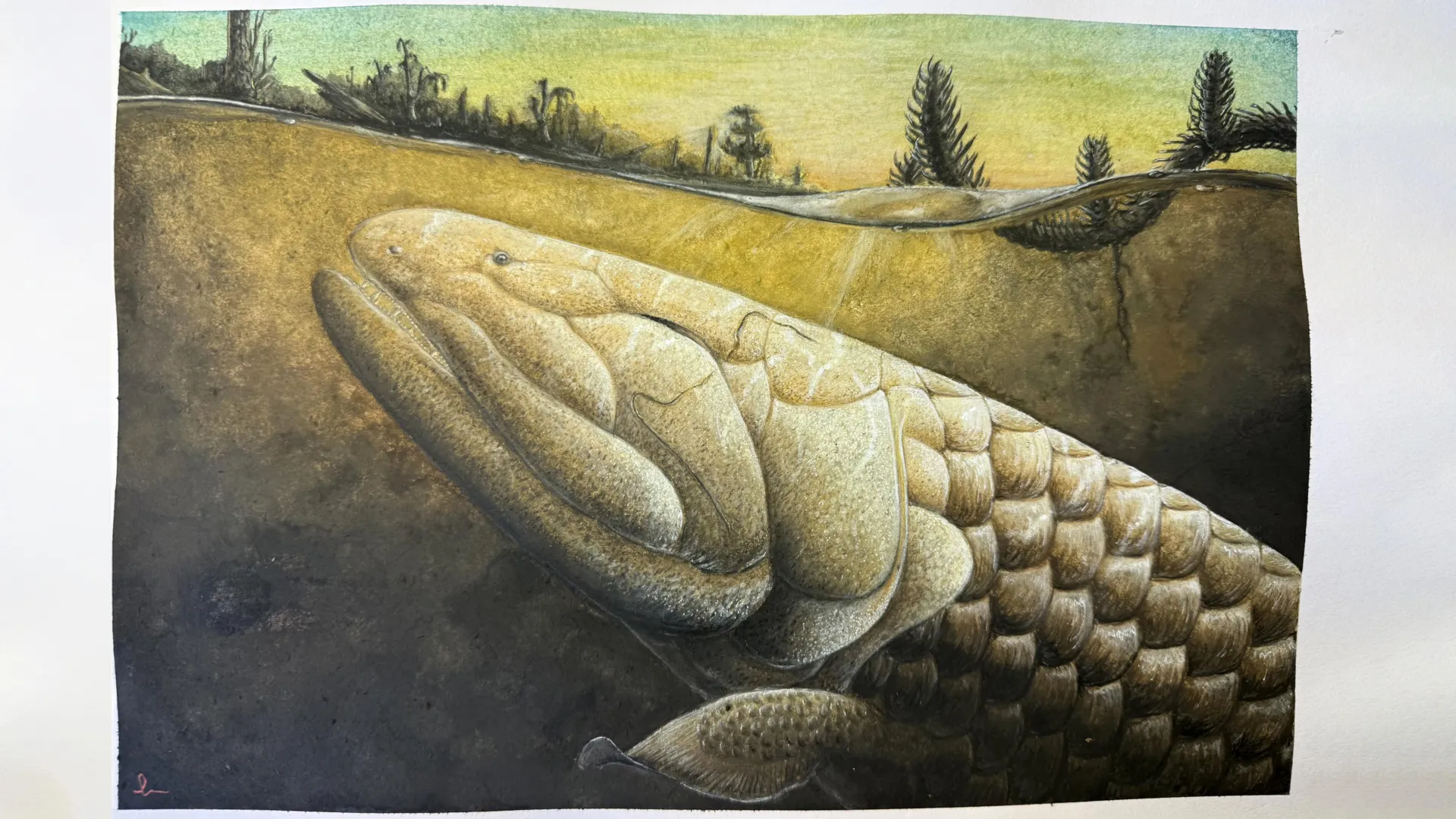
    Researchers at Flinders University have uncovered new details about one of the ancient fish species closely related to the first animals that eventually made the transition from water to land more than 380 million years ago.

    Using advanced neutron imaging technology, scientists examined the skull and braincase of Koharalepis jarviki, a large predatory fish that lived during the Devonian Period, often called the “Age of Fishes.” The fossil was discovered in Antarctica’s Lashly Mountains region and represents the only known specimen of its kind.

    High-Tech Imaging Unlocks Ancient Anatomy

    The research team used non-destructive scanning methods to peer inside the fossil and study structures that had remained hidden for hundreds of millions of years.

    “This precious fossil belongs to a group called the Canowindridae which highlights the ancient links between Australia and Antarctica,” says Flinders University Research Fellow Dr. Alice Clement, coauthor of a new article in Frontiers in Ecology and Evolution.

    “It is important to study such specimens from the Devonian Age of Fishes when the waters teemed with predatory lobe-finned fish like this that are closely related to land animals (tetrapods),” says Dr. Clement, from the College of Science and Engineering.

    Koharalepis belonged to the Canowindrid family, a group of fish that once lived across East Gondwana, with fossils now found in both Antarctica and Australia. Scientists consider these fish to be close relatives of the earliest four-limbed vertebrates that later evolved into land animals.

    Clues to the Water-to-Land Transition

    Lead author Corinne Mensforth, a PhD candidate from the Flinders Palaeontology Lab, says the fossil is especially valuable because it preserves the internal bones of the skull.

    “We chose to focus on Koharalepis as it is the only fossil in the entire family to preserve the internal bones of the skull, which gives us valuable insights into its braincase and neuroanatomy.”

    The scans revealed that the fish’s brain shared similarities with species associated with the evolutionary transition from aquatic to terrestrial life.

    “We found evidence that the brain of Koharalepis was similar to those of the fishes that straddle the vertebrate water-to-land transition.

    “We also found adaptations to life near the surface of the water, including openings in the top of the skull for additional air intake and an organ within the brain that detects light and circadian rhythms.”

    The researchers believe these features may have helped the animal survive in shallow environments where access to oxygen near the water’s surface was important.

    Ancient Predator Relied on More Than Vision

    The study also sheds light on how Koharalepis may have behaved in its environment. Growing to around 1 meter in length, the fish was likely an ambush predator that hunted smaller animals in freshwater systems.

    “Koharalepis which grew to about 1 meter was an ambush predator that preyed on other smaller animals in their environment, and with relatively small eyes it must have relied heavily on its other senses to capture its prey.”

    Flinders University Emeritus Professor John Long, who participated in earlier research that first described Koharalepis in 1992, says modern imaging technology made it possible to study internal structures without damaging the fossil.

    “This has enabled us to understand some of the behavior, adaptations and relationships of Koharalepis to its environment and to the other tetrapod-like fishes — and how fish first left the water to live on land approximately 385 million years ago,” he says.

    The new findings provide another important piece in the story of how vertebrates evolved from aquatic creatures into animals capable of living on land.

    The study, “New data on the sarcopterygian Koharalepis jarviki (Tetrapodomorpha; Canowindridae) from the Late Devonian of Antarctica, revealed via synchrotron and neutron tomography” (2026), by Corinne L Mensforth, John A Long, Joseph J Bevitt (Australian Centre for Neutron Scattering, ANSTO) and Alice M Clement, was published in Frontiers in Ecology and Evolution.

    The research was supported by the Australian Research Council (DP 200103398), with additional assistance from Dr. Matthew McCurry (Australian Museum) and Anton Maksimenko from the Australian Nuclear Science and Technology Organisation.


    Source link

    Author

    • Admin

      NewsPublicly.com is News & Articles Platform that creating SEO-focused articles on travel, lifestyle, and digital trends.

    Admin
    • Website

    NewsPublicly.com is News & Articles Platform that creating SEO-focused articles on travel, lifestyle, and digital trends.

    Related Posts

    Scientists discover why Ozempic and Wegovy weight loss eventually plateaus

    May 25, 2026

    Scientists discover hidden liver switch that cuts harmful cholesterol

    May 25, 2026

    Adorable tiny blue octopus found nearly 6,000 feet beneath the Galápagos

    May 25, 2026
    Leave A Reply Cancel Reply

    Demo
    Top Posts

    “Inside Gemini Robotics 1.5: How Robots Learn to Reason & Act

    November 22, 202525 Views

    How US Tariffs Are Reshaping the Global Growth Landscape?

    November 21, 202518 Views

    Pakistani Journalist Laughing at Tejas Fighter Jet Crash at Dubai Airshow Sparks Massive Outrage Worldwide

    November 23, 202517 Views

    Vibe-Coding Boom: How Non-Coders Build Apps With AI Agents

    November 22, 202515 Views
    Don't Miss

    What ClickUp’s mass layoff tells us about the future of work

    May 25, 20263 Mins Read0 Views

    AI’s biggest champions have argued for some time that the technology will usher in an…

    RBI unlikely to hike rates soon despite inflation risk, rate action only in Dec if needed: Icra’s Aditi Nayar

    May 25, 2026

    AU Real Estate acquires 5.6 acre land in Siddharth Vihar, for Rs 336 crore

    May 25, 2026

    Government forwent Rs 1 lakh crore via excise duty cuts to shield consumers from fuel inflation: FM

    May 25, 2026
    Stay In Touch
    • Facebook
    • Twitter
    • Instagram
    • YouTube
    • LinkedIn
    • WhatsApp

    Subscribe to Updates

    Get the latest creative news from SmartMag about art & design.

    Demo
    NEWSPUBLICLY
    Facebook X (Twitter) Instagram LinkedIn

    Home

    • About Us
    • Leadership
    • Advertise & Partner With Us
    • Pitch Your Story
    • Media Kit & Pricing
    • Career
    • FAQs

    Guidelines

    • Editorial & Submission
    • Partnership
    • Advertising & Sponsor
    • Intellectual Property Policy
    • Community & Comment
    • Security & Data Protection
    • Send Your Opinion

    Quick Links

    • Cookie Policy
    • Payment & Billing Terms
    • Refund & Cancellation
    • Copyright Policy
    • Complaint & Support
    • Sitemap
    • Contact Us

    Subscribe Us

    Get the latest news and updates!

    Copyright © 2026 Newspublicly (DIGITALIX COMMUNICATION). All Rights Reserved.
    • Privacy Policy
    • Terms of Use
    • Disclaimer