

Close Menu

    Subscribe to Updates

    Get the latest news information from worldwide businesses.

    What's Hot

    A tiny diamond defect could reveal a mysterious new kind of magnetism

    June 23, 2026

    Reconnect public health with people’s needs

    June 23, 2026

    AbbVie Acquires Apogee Therapeutics for USD 10.9 Billion to Boost Immunology Pipeline

    June 23, 2026
    Facebook Instagram YouTube LinkedIn X (Twitter)
    Trending
    • A tiny diamond defect could reveal a mysterious new kind of magnetism
    • Reconnect public health with people’s needs
    • AbbVie Acquires Apogee Therapeutics for USD 10.9 Billion to Boost Immunology Pipeline
    • Xteink’s tiny e-readers are 20 percent off for Prime Day
    • After betting the firm on Anthropic, Menlo Ventures raises victorious $3B fund
    • India-US trade talks gather pace as tariff clock ticks
    • India plans to operationalise up to 60 mines in FY27
    • SpaceX stock’s wild price swings since its IPO show how risky leveraged ETFs can be
    Newspublicly
    • About Us
    • Advertise & Partner with us
    • Pitch Your Story
    • Contact Us
    Facebook Instagram LinkedIn X (Twitter)
    Subscribe
    • Home
    • World News
      • Asia
      • India
      • USA
      • UK & Europe
      • Middle East
    • Economy & Business
      • Global Economy
      • Corporate & Industry
      • Finance & Markets
      • Policy & Trade
    • Technology
      • Gadgets & Devices
      • Software & Apps
      • AI & Machine Learning
      • Robotics & Automation
    • Health & Medicine
      • Fitness & Nutrition
      • Research & Innovation
      • Disease & Treatment
      • Doctors, Clinics & Patient Care
    • Travel & Tourism
    • Automobile
      • Electric & Hybrid Vehicles
      • Auto Industry Insights
    • Sports
    • More
      • Education
      • Real Estate
      • Environment & Climate
      • Space & Astronomy
      • War & Conflicts
    Newspublicly
    Home»Health & Medicine»Research & Innovation»This four-winged dinosaur may have terrorized Earth’s earliest birds
    Research & Innovation

    This four-winged dinosaur may have terrorized Earth’s earliest birds

    AdminBy AdminJune 23, 2026No Comments4 Mins Read0 Views
    Share
    Facebook Twitter LinkedIn Copy Link WhatsApp


    A remarkable fossil site in northwestern China has yielded hundreds of prehistoric bird remains, including clusters of shattered bones compressed into pellet-like masses resembling those produced by modern owls. For years, paleontologists suspected that a larger predator was responsible for hunting these birds, but no direct evidence of such an animal had ever been found.

    Now, a newly described dinosaur may provide the answer.

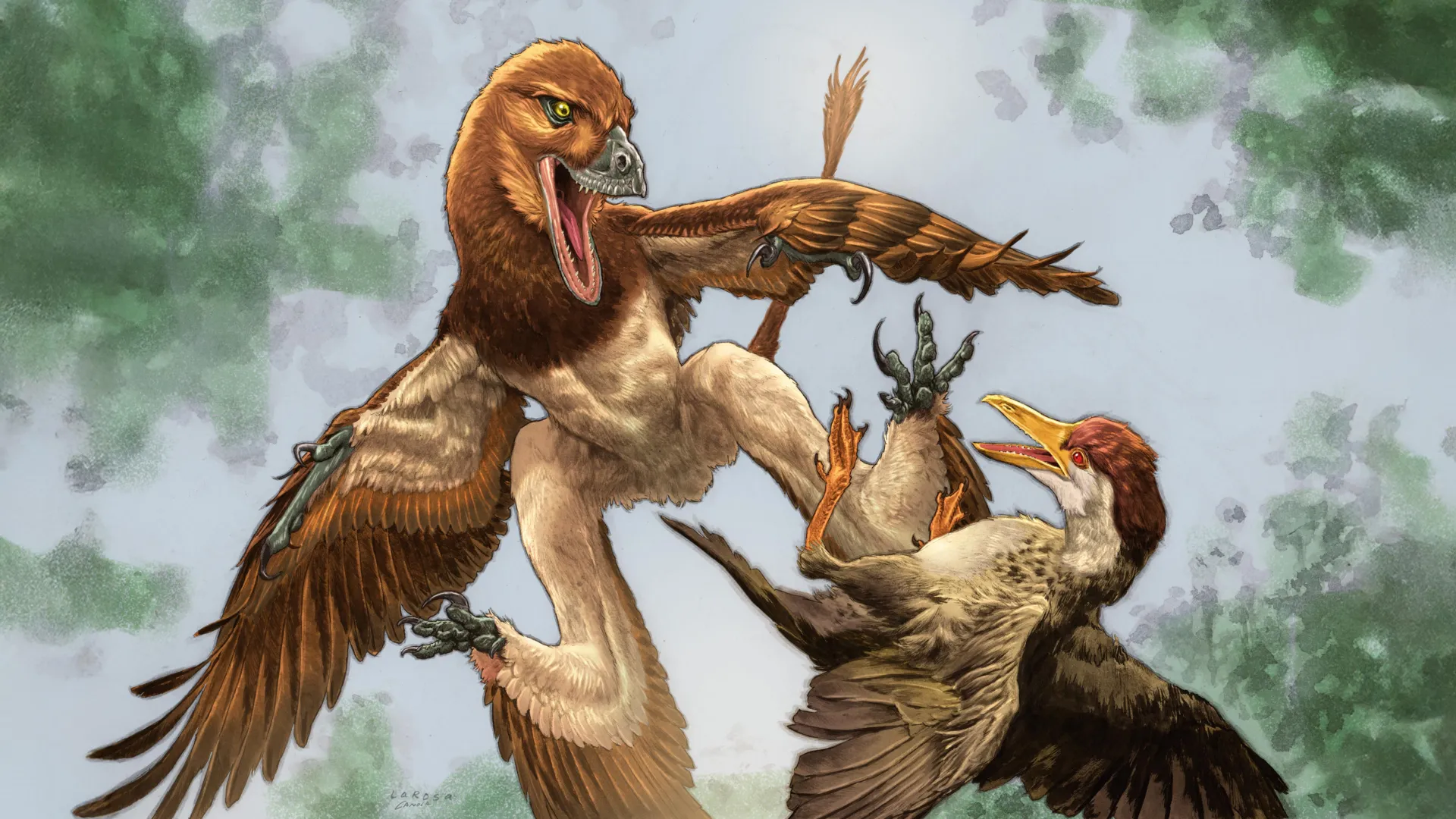
    In a study published in the Annals of Carnegie Museum, researchers report the discovery of a previously unknown dinosaur species from the same fossil bed. The animal was a feathered relative of Velociraptor with long feathers on both its forelimbs and hind limbs. Based on distinctive features of its arm and shoulder bones, scientists believe this dinosaur may have been the predator responsible for the mysterious bird bone accumulations.

    “Scientists have found these weird, broken-up clusters of bird bones at this site, and we didn’t know what made them. This new microraptor dinosaur, Jian changmaensis, is our best guess,” says Jingmai O’Connor, the associate curator of fossil reptiles at the Field Museum in Chicago and senior author of the paper describing the new species. “It’s the only dinosaur found at this site that wasn’t a bird, it was a carnivore, and it was much bigger than everything else that we’ve found there.”

    A Feathered Relative of Velociraptor

    Today’s birds are the only surviving dinosaurs, having endured the aftermath of the asteroid impact that struck Earth 66 million years ago. But long before that event, birds lived alongside many other dinosaur groups during the Jurassic and Cretaceous periods.

    Among their closest relatives were the dromaeosaurs, a group of feathered dinosaurs known for being relatively small, agile predators. Velociraptor, made famous by the Jurassic Park films, is one of the best-known members of this group (but they would have been smaller and more feathery than they’re depicted in the movies).

    The newly identified species, Jian changmaensis, belongs to a subgroup of dromaeosaurs called microraptors. Most microraptors were quite small, with some species reaching only about the size of a crow.

    “Jian is one of the biggest microraptor specimens that has ever been found,” says O’Connor. “The piece of its upper arm bone that we have is about 4 inches long, so the entire dinosaur probably had something like a four-foot wingspan, around the size of a barn owl.”

    A Four-Winged Gliding Dinosaur

    Although scientists have recovered only part of the animal’s arm, they suspect Jian shared a key feature with other microraptors. Long feathers likely covered both its arms and legs, creating the appearance of four wings.

    Rather than flying like modern birds, these dinosaurs were probably adapted for gliding.

    “Jian and the other microraptors probably weren’t capable of true, powered flight, but they could probably glide like a flying squirrel,” says O’Connor.

    The dinosaur’s name reflects both its appearance and its discovery location. In Chinese mythology, Jian is a winged creature, while changmaensis refers to the Changma Basin in China’s Gansu province, where the fossil was uncovered.

    New Insights Into Early Bird Ecosystems

    According to the researchers, the discovery fills an important gap in the ancient ecosystem represented by the Changma fossil site.

    “Jian changmaensis reveals that non-avian dinosaurs lived in what is now the Changma Basin, an area famous for its fossil birds,” says Matt Lamanna, corresponding author of the study and Carnegie Museum of Natural History’s Mary R. Dawson Curator of Vertebrate Paleontology and senior dinosaur researcher. “Our team has recovered more than a hundred bird fossils at Changma, but only this single non-avian dinosaur specimen. Jian provides critical new insight into the biological history of the Changma region and the ecological context of the ancestors of today’s birds.”

    The find also helps scientists better understand how birds evolved and what set their lineage apart from their close dinosaur relatives.

    “You cannot understand life on the planet today without looking at its origins,” says O’Connor. “Birds are arguably the most successful group of land-dwelling vertebrate animals on Earth today. Learning about early birds and their close non-bird dinosaur relatives gives us a better understanding of what made the group of birds that survived so special.”

    The study was contributed to by Ling-Qi Zhou (Gansu Geological Museum), Matthew Lamanna (Carnegie Museum of Natural History), Ashley Poust (University of Nebraska State Museum and University of California Museum of Paleontology), Da-Qing Li (Gansu Agricultural University), Hai-Lu You (Institute of Vertebrate Paleontology and Paleoanthropology, Chinese Academy of Sciences), and Jingmai O’Connor (Field Museum).


    Source link

    Author

    • Admin

      NewsPublicly.com is News & Articles Platform that creating SEO-focused articles on travel, lifestyle, and digital trends.

    Admin
    • Website

    NewsPublicly.com is News & Articles Platform that creating SEO-focused articles on travel, lifestyle, and digital trends.

    Related Posts

    A tiny diamond defect could reveal a mysterious new kind of magnetism

    June 23, 2026

    Hidden bird species discovered in Japan after DNA reveals a stunning secret

    June 23, 2026

    Scientists finally solved how H5N1 bird flu hid in dairy cows

    June 23, 2026
    Leave A Reply Cancel Reply

    Demo
    Top Posts

    The Blue Moon rises on May 30— Where and when to see the second full moon of the month

    May 30, 202640 Views

    New SOCOM rifle allows barrel swapping and cartridge changes

    June 1, 202633 Views

    “Inside Gemini Robotics 1.5: How Robots Learn to Reason & Act

    November 22, 202525 Views

    525 pounds of cocaine seized after Nebraska K9 alerts troopers on I-80

    May 28, 202624 Views
    Don't Miss

    A tiny diamond defect could reveal a mysterious new kind of magnetism

    June 23, 20265 Mins Read0 Views

    For decades, scientists recognized only two major types of magnets. One is the familiar ferromagnet,…

    Reconnect public health with people’s needs

    June 23, 2026

    AbbVie Acquires Apogee Therapeutics for USD 10.9 Billion to Boost Immunology Pipeline

    June 23, 2026

    Xteink’s tiny e-readers are 20 percent off for Prime Day

    June 23, 2026
    Stay In Touch
    • Facebook
    • Twitter
    • Instagram
    • YouTube
    • LinkedIn
    • WhatsApp

    Subscribe to Updates

    Get the latest creative news from SmartMag about art & design.

    Demo
    NEWSPUBLICLY
    Facebook X (Twitter) Instagram LinkedIn

    Home

    • About Us
    • Leadership
    • Advertise & Partner With Us
    • Pitch Your Story
    • Media Kit & Pricing
    • Career
    • FAQs

    Guidelines

    • Editorial & Submission
    • Partnership
    • Advertising & Sponsor
    • Intellectual Property Policy
    • Community & Comment
    • Security & Data Protection
    • Send Your Opinion

    Quick Links

    • Cookie Policy
    • Payment & Billing Terms
    • Refund & Cancellation
    • Copyright Policy
    • Complaint & Support
    • Sitemap
    • Contact Us

    Subscribe Us

    Get the latest news and updates!

    Copyright © 2026 Newspublicly (DIGITALIX COMMUNICATION). All Rights Reserved.
    • Privacy Policy
    • Terms of Use
    • Disclaimer