

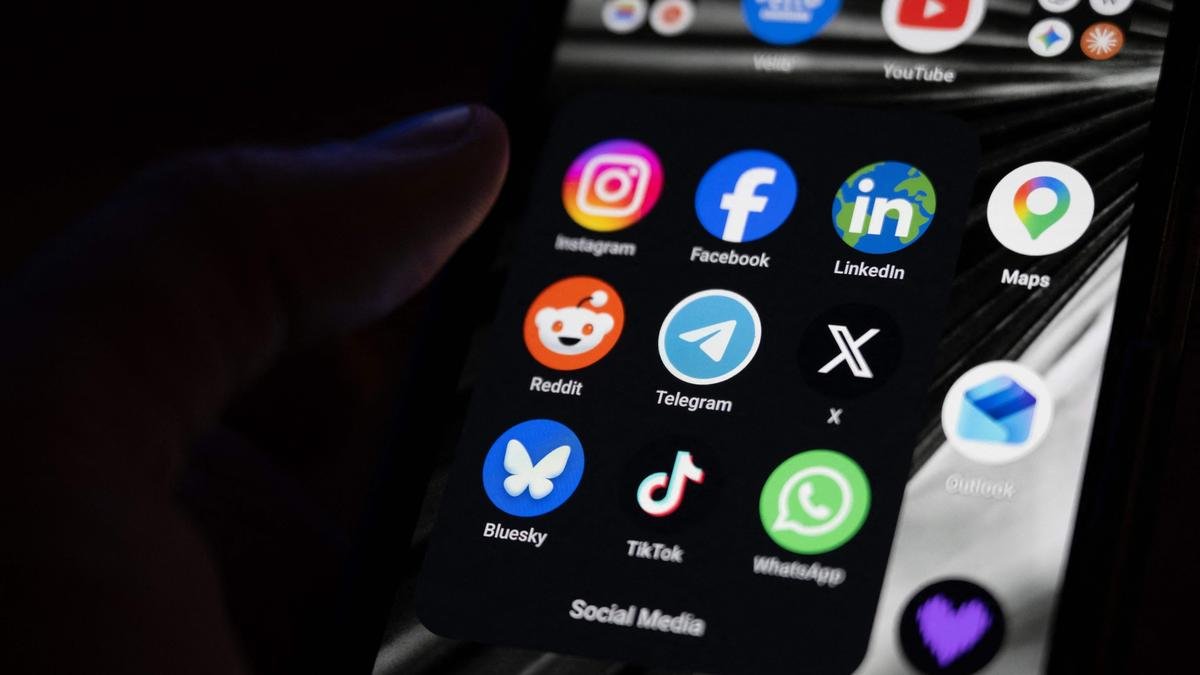

A ban restricts access, but it does not fix the environment around the child. For teenagers building their sense of autonomy, that restriction in itself can cause harm |Image used for representational purpose only
| Photo Credit: AFP
Ask a sixteen-year-old about a social media ban, and you get an answer sharper than most adults arguing about bans. She says, “It doesn’t prepare us for the real world when we will have to deal with these distractions in our life”. The teenager’s response strikes at the core of the ban vs. no ban debate: the necessity to teach and develop self-regulation.
The argument for and against bans
Lawmakers banning social media are working from the angle that if we remove the option altogether, the posting, compulsive scrolling, and ensuing anxiety will go away with it. The opposing argument is that bans prevent self-regulation, built through practice with social media access readily available.
Behavioral science has a fairly precise answer for which of these arguments holds up.
The bans themselves are moving fast and in earnest around the world. Australia was the first country to impose a sweeping ban on social media outright for children under-16 in 2025. Multiple countries in the EU are attempting to follow suit. These decisions to ban social media rest on neuroscientific insights showing that the human brain’s reward circuitry matures years before the prefrontal cortex that reins it in, leaving adolescents genuinely more vulnerable to engineered design working actively to grab their attention. Lawmakers are right to take this seriously.
But are social media bans for teenagers the panacea that they are made out to be?

How social media functions
Social media platforms function like a Skinner box for the modern human: our engagement on them runs on the same reinforcement-based learning as B. F. Skinner’s animal experiments. People on social media post faster exactly when their recent rate of reward, meaning engagement, has been higher. A pattern known as the law of effect, more ‘likes’ leads to more posting. Engagement on every platform runs on an unpredictable schedule; we never know which posts are going to land. Rewards are also hyper-personalised: an unending carousel of perfectly-matched content delivered based on every prior click and scroll.
What makes matters worse is that social media’s unpredictable and personalised rewards are exactly the training that will make children persist on these platforms through the interruption that comes from a ban. When there are multiple ways to get on social media, our behavior distributes itself across those options in proportion to the corresponding rewards. Think of a building with many entrances: remove one entrance without touching the others and people will continue to be able to get in. Underlying behavior does not vanish; It simply reallocates to a different mode. If a regular account stops working, we create a bustling market for fake accounts and new platforms not covered by the bans, effectively pushing teenagers to unregulated corners of the internet.
Perhaps predictably so, Australia’s ban, sweeping on paper, is showing that an estimated 85% of children under-16 are still finding their way onto restricted platforms, through borrowed logins and fake accounts, in a recent study. Bans are leaky. Short of closing every door at once, children will simply find the ones still open. But setting up strict age verification measures can be seen as an infringement upon teenagers’ rights to a private life, one of the reasons France’s newly-enacted social media ban was recently struck down by their Constitution Council.
In any case, let’s assume we manage to pull off the most stringent enforcement of a ban. Children with support systems in place will now have time to learn skills, build hobbies, and form real relationships. What happens to the vulnerable teenagers without a supportive home environment? A ban restricts access, but it does not fix the environment around the child. For teenagers building their sense of autonomy, that restriction in itself can cause harm.
In April, a commentary drawing on a year-long international working group on digital safety noted that bans are “unlikely to be effective” because they overlook how social platforms can be redesigned to build resilience, and instead place all the onus on teenagers. A nuanced solution is one that addresses the problem from both sides.

What, then, can work?
Nobel Prize winner Richard Thaler coined the term ‘nudge’ to describe choices that reshape the environment. When workers avoided retirement plans, a nudge that automatically enrolled them in superannuation funds profoundly impacted their savings. On social media, forcing platforms to batch-deliver notifications into fixed windows instead of letting them arrive at all times, and adding friction to sharing sensitive content, and disabling autoplay and infinite-scroll by default are nudges. We mandate structural corrections on the platform side. A boost, on the other hand, gives young people the skills to manage their own actions instead of complete restriction. The option to use social media stays available. Decision rules around time on social media, and encouraging goal-setting for healthier digital habits are examples of boosts.
Which brings us back to that 16-year-old. She was right: a ban will not teach her self-regulation. But unfettered access to social media where she is left to fend for herself will not work either. What she actually needs is a nuanced alternative, one that is, unfortunately, not on offer in her school’s policy.
(Maithri Sivaraman is an assistant professor at Teachers College, Columbia University. maithri.sivaraman@tc.columbia.edu)
Published – August 23, 2026 05:00 pm IST