

Close Menu

    Subscribe to Updates

    Get the latest news information from worldwide businesses.

    What's Hot

    AP EAMCET Results today Direct Link to Check Scorecard, Marks, Rank Card & Cut Off at cets.apsche.ap.gov.in

    June 29, 2026

    How NASA’s ‘America 250’ celebrations are reaching from the sky to the moon

    June 29, 2026

    ONE Championship: “Far from my best”

    June 29, 2026
    Facebook Instagram YouTube LinkedIn X (Twitter)
    Trending
    • AP EAMCET Results today Direct Link to Check Scorecard, Marks, Rank Card & Cut Off at cets.apsche.ap.gov.in
    • How NASA’s ‘America 250’ celebrations are reaching from the sky to the moon
    • ONE Championship: “Far from my best”
    • What exactly happens inside the body when LDL levels stay high for long periods?
    • U.S. starts vaccine effort for Ebola Bundibugyo as outbreak spreads
    • 1,420 TN govt doctors face disciplinary action for failing to rejoin service after PG
    • How to end a TV show
    • HP accelerates enterprise workflows with OpenAI Frontier
    Newspublicly
    • About Us
    • Advertise & Partner with us
    • Pitch Your Story
    • Contact Us
    Facebook Instagram LinkedIn X (Twitter)
    Subscribe
    • Home
    • World News
      • Asia
      • India
      • USA
      • UK & Europe
      • Middle East
    • Economy & Business
      • Global Economy
      • Corporate & Industry
      • Finance & Markets
      • Policy & Trade
    • Technology
      • Gadgets & Devices
      • Software & Apps
      • AI & Machine Learning
      • Robotics & Automation
    • Health & Medicine
      • Fitness & Nutrition
      • Research & Innovation
      • Disease & Treatment
      • Doctors, Clinics & Patient Care
    • Travel & Tourism
    • Automobile
      • Electric & Hybrid Vehicles
      • Auto Industry Insights
    • Sports
    • More
      • Education
      • Real Estate
      • Environment & Climate
      • Space & Astronomy
      • War & Conflicts
    Newspublicly
    Home»More»Space & Astronomy»The James Webb Space Telescope peered into one of the universe’s oldest galaxy clusters, and scientists can’t explain what they saw
    Space & Astronomy

    The James Webb Space Telescope peered into one of the universe’s oldest galaxy clusters, and scientists can’t explain what they saw

    AdminBy AdminJune 29, 2026No Comments4 Mins Read0 Views
    Share
    Facebook Twitter LinkedIn Copy Link WhatsApp


    Using the James Webb Space Telescope, astronomers have spotted a massive and densely packed galaxy cluster at “cosmic noon.” The fact that this cluster is so highly evolved could change theories of cosmic evolution, as it seems to exist before such structures were thought to be possible.

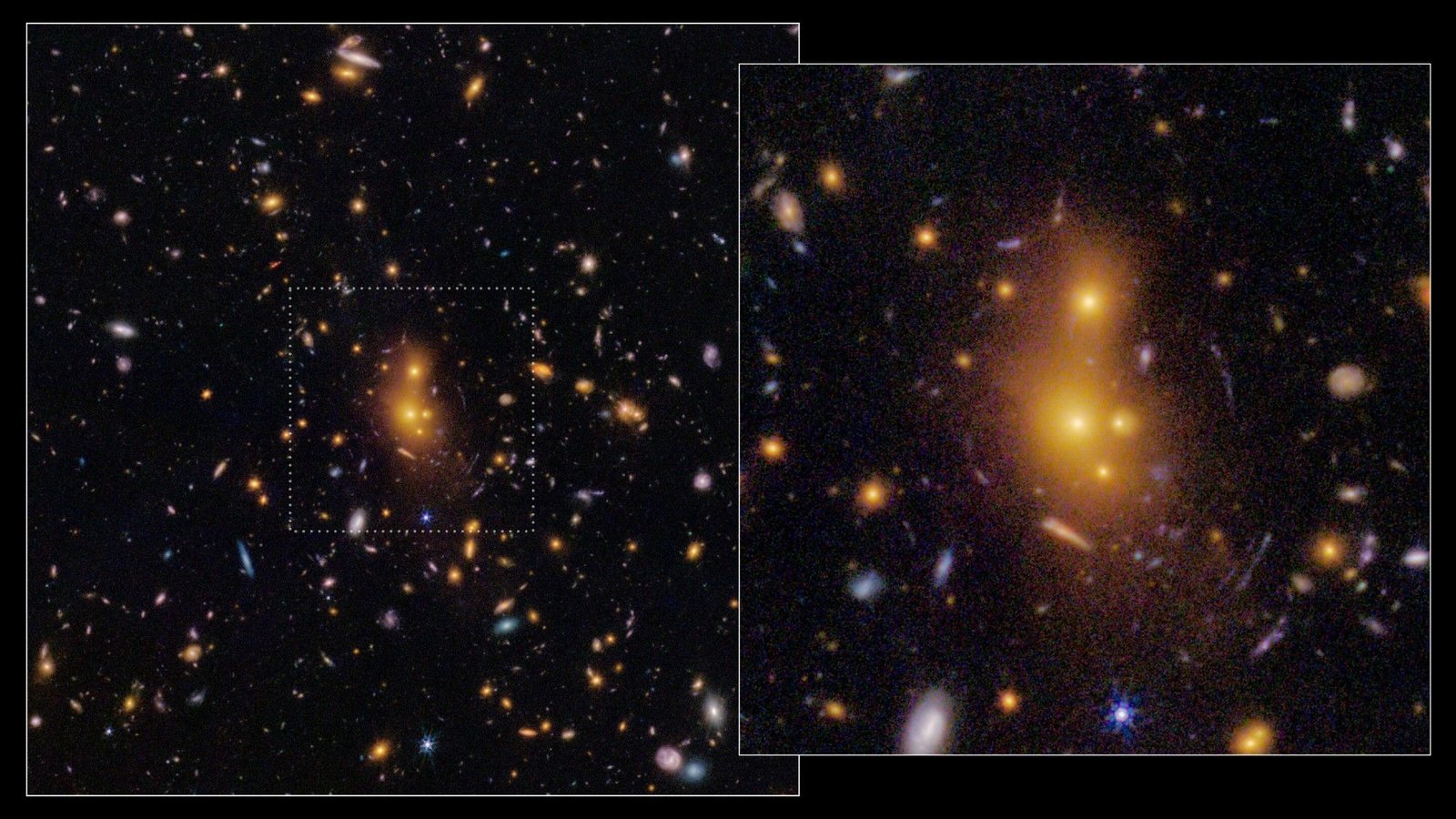
    Designated XLSSC 122 and first seen in 2014, the cluster immediately stood out to the team in James Webb Space Telescope (JWST) data because, being so large and concentrated, it resembled the galactic clusters found much closer to our own galaxy. However, this cluster is seen as it was around 10.4 billion years, just around 3.4 billion years after the Big Bang, a time when such structures were theorized to have only just begun to assemble.

    Even more excitingly, XLSSC 122 is acting as a gravitational lens and is aligned with even more distant galaxies, amplifying their light and making them easier to study.

    “When we got those first images back from JWST, we said, ‘wow, look at this, there’s strong lensing coming from this cluster!’ XLSSC 122 has now set the record for the most distant galaxy cluster displaying strong lensing, which is a valuable tool for astronomers,” team leader Kyle Finner of the California Institute of Technology said in a statement.

    What is gravitational lensing and why is it so useful?

    Gravitational lensing was first predicted by Albert Einstein in his 1915 theory of gravity, known as general relativity. General relativity says that objects with mass cause the fabric of space and time to warp. Think of this as being akin to placing a bowling ball on a stretched rubber sheet. Gravity arises from this curvature.

    The greater the mass of the object, the more extreme the curvature and thus the greater the gravitational influence of that object.


    You may like

    But there is another consequence. Light normally travels in a straight line, but spacetime is the track that it follows. If spacetime is curved, then the path of light is also curved. The closer that light travels to an object of great mass, the more its path swerves.

    That means when an object of great mass, in this case XLSSC 122, comes between Earth and a more distant light source, light from that background source arrives at our telescopes at different times based on the path it took around the intermediate object. This amplifies light from the background source and has been used by the JWST team to great effect in the study of ancient galaxies.

    When the Hubble Space Telescope previously studied XLSSC 122, it wasn’t able to capture images that showed it was a strong gravitational lens; it took the tremendous observing power of the JWST to determine this.

    Space

    A two-panel image shows a distant galaxy cluster as observed by NASA's Hubble Space Telescope and JWST.

    Two-panel image shows a distant galaxy cluster as it has been observed by NASA’s Hubble Space Telescope and JWST. (Image credit: NASA, ESA, CSA; Kyle Finner (Caltech/IPAC) Image processing: Robert Hurt (Caltech/IPAC-SELab))

    The strong lensing of this early galaxy cluster could also help unravel the mystery of dark matter. Effectively invisible because it doesn’t interact with light, dark matter does interact with gravity. Plus, because it outweighs the “ordinary matter” that makes up stars, planets, moons, and gas clouds in galaxies by a ratio of five to one, dark matter makes the largest contribution to the lensing effect of galaxies and galactic clusters like XLSSC 122.

    This means that gravitational lensing can be used to study the distribution of otherwise invisible dark matter in galaxy clusters, which is a vital element of galactic evolution, as it is thought that galaxies and galaxy clusters gather along vast filaments of dark matter. The hunt is now on for more lensing clusters like XLSSC 122, and if they are found so early in the universe’s history, a major revision of cosmology may be on the cards.

    “Strong lensing is a way to measure the dark matter without actually seeing the dark matter. It gives us a sensitive probe of our cosmological models,” said Finner. “It’s still early in the JWST era, and if we can start to get data on tens or hundreds of these types of objects at this stage in the universe, then we can really start putting our cosmological models to the test.”

    The team’s results were presented on June 17, 2026, at the 248th meeting of the American Astronomical Society. The research is available as a paper published in The Astrophysical Journal Letters.


    Source link

    Author

    • Admin

      NewsPublicly.com is News & Articles Platform that creating SEO-focused articles on travel, lifestyle, and digital trends.

    Admin
    • Website

    NewsPublicly.com is News & Articles Platform that creating SEO-focused articles on travel, lifestyle, and digital trends.

    Related Posts

    How NASA’s ‘America 250’ celebrations are reaching from the sky to the moon

    June 29, 2026

    The Strawberry Moon rises June 29. Here’s what to expect from June’s full moon

    June 29, 2026

    SpaceX sends 24 Starlink satellites into Earth orbit on Falcon 9 launch from California

    June 28, 2026
    Leave A Reply Cancel Reply

    Demo
    Top Posts

    The Blue Moon rises on May 30— Where and when to see the second full moon of the month

    May 30, 202640 Views

    New SOCOM rifle allows barrel swapping and cartridge changes

    June 1, 202633 Views

    “Inside Gemini Robotics 1.5: How Robots Learn to Reason & Act

    November 22, 202525 Views

    525 pounds of cocaine seized after Nebraska K9 alerts troopers on I-80

    May 28, 202624 Views
    Don't Miss

    AP EAMCET Results today Direct Link to Check Scorecard, Marks, Rank Card & Cut Off at cets.apsche.ap.gov.in

    June 29, 20262 Mins Read0 Views

    The exam was conducted between May 12 and May 20, 2026, by the council.(screengrab from…

    How NASA’s ‘America 250’ celebrations are reaching from the sky to the moon

    June 29, 2026

    ONE Championship: “Far from my best”

    June 29, 2026

    What exactly happens inside the body when LDL levels stay high for long periods?

    June 29, 2026
    Stay In Touch
    • Facebook
    • Twitter
    • Instagram
    • YouTube
    • LinkedIn
    • WhatsApp

    Subscribe to Updates

    Get the latest creative news from SmartMag about art & design.

    Demo
    NEWSPUBLICLY
    Facebook X (Twitter) Instagram LinkedIn

    Home

    • About Us
    • Leadership
    • Advertise & Partner With Us
    • Pitch Your Story
    • Media Kit & Pricing
    • Career
    • FAQs

    Guidelines

    • Editorial & Submission
    • Partnership
    • Advertising & Sponsor
    • Intellectual Property Policy
    • Community & Comment
    • Security & Data Protection
    • Send Your Opinion

    Quick Links

    • Cookie Policy
    • Payment & Billing Terms
    • Refund & Cancellation
    • Copyright Policy
    • Complaint & Support
    • Sitemap
    • Contact Us

    Subscribe Us

    Get the latest news and updates!

    Copyright © 2026 Newspublicly (DIGITALIX COMMUNICATION). All Rights Reserved.
    • Privacy Policy
    • Terms of Use
    • Disclaimer