

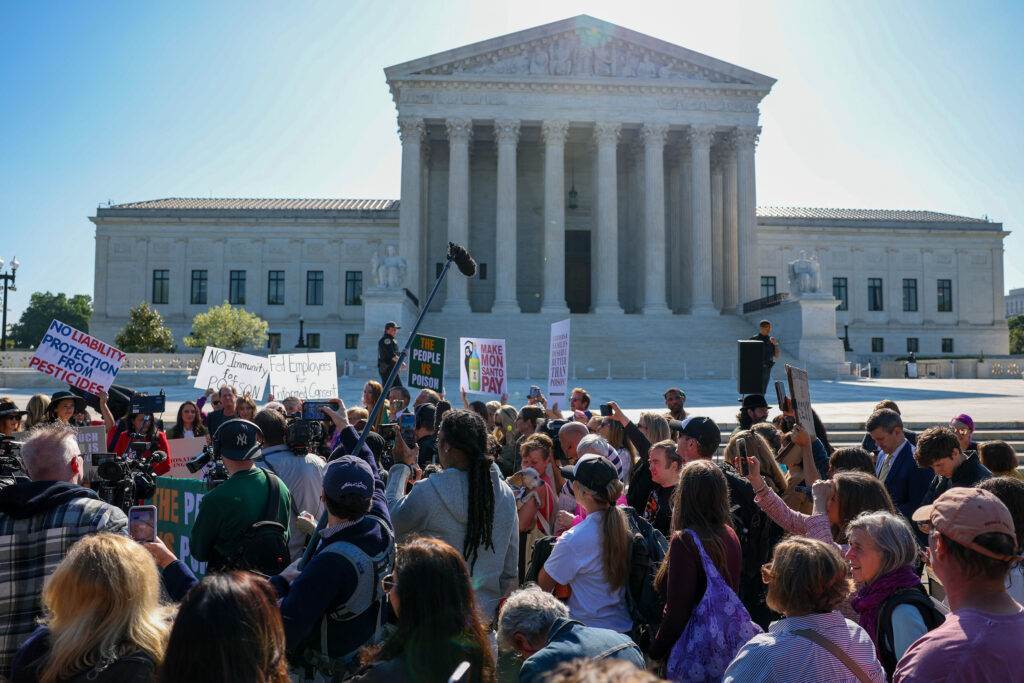
A Supreme Court ruling issued Thursday limits Americans’ ability to sue pesticide makers over alleged health harms from their products.
The 7-2 decision overturned a 2023 Missouri circuit court ruling that required agrochemical company Monsanto to pay John Durnell of St. Louis $1.25 million in compensatory damages for failing to warn customers of the cancer-causing potential of its popular weedkiller, Roundup.
Durnell said he used the glyphosate-based herbicide for twenty years before developing non-Hodgkin’s lymphoma.
Glyphosate-based weedkillers make up the bulk of all agricultural pesticide use in the U.S., with farmers and ranchers spraying over 250 million pounds of the chemical across farmland each year. An extensive body of research suggests improper glyphosate use could be linked to endocrine disruption, metabolic disorders, neurological effects and several cancers. Even after application, the chemical may leach into waterways or drift over residential areas.
And it’s not just glyphosate. Nearly all conventional weedkillers, derived from fossil fuels and petroleum byproducts, are believed to present multiple health hazards.
The highly anticipated ruling not only overturns the lower court’s decision, it also sets a legal precedent that all but seals the fate of hundreds of similar lawsuits being fought in courtrooms across the country.
The decision also represents a huge victory and financial windfall for Monsanto and its parent chemical company, Bayer, which has spent billions of dollars fighting legal claims linking Roundup to cancer since acquiring Monsanto in 2018.
In a majority opinion delivered by Justice Brett Kavanaugh, the court wrote that the Federal Insecticide, Fungicide, and Rodenticide Act (FIFRA) prohibits states from imposing labeling requirements “in addition to or different from” the labels required by the Environmental Protection Agency.
Therefore, manufacturers cannot be held liable for failing to warn consumers of possible health harms that are not formally recognized by the EPA, the court ruled.
The decision turns the tide in a largely unsuccessful campaign by Bayer and its lobbying group, Modern Ag Alliance, to pass state laws limiting the liability of pesticide producers in failure-to-warn suits.
“Cancer gag acts,” as opponents dubbed the bills, have struggled to gain ground, failing in 11 of the states that debated similar legislation this year. Language shielding pesticide companies from failure-to-warn lawsuits was also cut from the U.S. House Farm Bill and excluded from the current Senate draft.
The SCOTUS ruling effectively erases those failures, granting Bayer and other pesticide manufacturers long-sought immunity.
Modern Ag Alliance celebrated the decision in a statement issued today. “Today’s opinion provides important clarity for farmers and the entire agricultural industry, who rely on a predictable, science-based regulatory system to deliver the tools needed to feed, fuel, and clothe the country,” said Elizabeth Burns-Thompson, executive director of the organization, which Bayer launched in 2004.
Since its founding, Modern Ag Alliance has distributed ads warning that costly failure-to-warn suits threaten the sustained manufacturing of critical crop protection products.
Yet global glyphosate demand has grown steadily, even as Bayer spends billions each year settling cases claiming exposure to the chemical has caused non-Hodgkin’s lymphoma. In 2020 alone, the company paid more than $10 billion to settle 180,000 such claims.
Bayer has consistently maintained that the product is safe, citing repeated EPA evaluations of the carcinogenic potential of glyphosate. In both 2015 and 2017, the EPA classified glyphosate as “not likely to be carcinogenic to humans.”
This story is funded by readers like you.
Our nonprofit newsroom provides award-winning climate coverage free of charge and advertising. We rely on donations from readers like you to keep going. Please donate now to support our work.
However, the International Agency for Research on Cancer of the World Health Organization has classified glyphosate as a Group 2A substance, “probably carcinogenic to humans,” since 2015.
A 2022 ruling by the U.S. Court of Appeals for the Ninth Circuit required the EPA to revisit and update its evaluation of glyphosate’s impact on human and ecological health. The EPA says this review is ongoing.
Critics argue that the Supreme Court decision favors industry interests and places too much power in the hands of an EPA pesticide registration process that the nonprofit advocacy group Food & Water Watch described as “fatally-flawed” in a statement today.
“The disturbing reality is that glyphosate is just the tip of the pesticide iceberg. The EPA has approved hundreds of poisons the agency itself has linked to cancer, and our parents, kids and loved ones are paying for it with their health, sometimes their lives,” said Nathan Donley, the environmental health science director of the nonprofit Center for Biological Diversity. “The need to profoundly reform our industry-captured system of pesticide regulation could not be clearer.”
Legal pathways that allow consumers to hold chemical manufacturers accountable for hazard warnings are especially critical to public health in “an age of deregulation,” said Jay Feldman, executive director of Beyond Pesticides, in a statement issued by the national health and environmental group.
And Tarah Heinzen, legal director of Food & Water Watch, noted that the decision seems at odds with the Trump administration’s stated mission to “Make America Healthy Again.”
“If one needed any further proof that the president’s feigned mission to ‘Make America Healthy Again’ was a farce, today’s decision is all the evidence needed,” said Heinzen.
The MAHA movement has been clear in its anti-corporate immunity stance, forming unlikely alliances with left-leaning environmental advocacy groups and leading “People vs. Poison” protests on the steps of the Supreme Court last month as justices heard arguments in the Monsanto vs. Durnell case.
Conservative Justice Neil Gorsuch and liberal Justice Ketanji Brown Jackson joined in dissent from the majority opinion today.
Jackson authored the dissent, writing that the majority opinion “misunderstands” FIFRA’s requirements, “misinterprets” FIFRA’s ability to preempt failure-to-warn claims, and “ultimately leaves Durnell without a remedy for the significant harms he has suffered.”
About This Story
Perhaps you noticed: This story, like all the news we publish, is free to read. That’s because Inside Climate News is a 501c3 nonprofit organization. We do not charge a subscription fee, lock our news behind a paywall, or clutter our website with ads. We make our news on climate and the environment freely available to you and anyone who wants it.
That’s not all. We also share our news for free with scores of other media organizations around the country. Many of them can’t afford to do environmental journalism of their own. We’ve built bureaus from coast to coast to report local stories, collaborate with local newsrooms and co-publish articles so that this vital work is shared as widely as possible.
Two of us launched ICN in 2007. Six years later we earned a Pulitzer Prize for National Reporting, and now we run the oldest and largest dedicated climate newsroom in the nation. We tell the story in all its complexity. We hold polluters accountable. We expose environmental injustice. We debunk misinformation. We scrutinize solutions and inspire action.
Donations from readers like you fund every aspect of what we do. If you don’t already, will you support our ongoing work, our reporting on the biggest crisis facing our planet, and help us reach even more readers in more places?
Please take a moment to make a tax-deductible donation. Every one of them makes a difference.
Thank you,

Reporter, Iowa
Anika Jane Beamer covers the environment and climate change in Iowa, with a particular focus on water, soil and CAFOs. A lifelong Midwesterner, she writes about changing ecosystems from one of the most transformed landscapes on the continent. She holds a master’s degree in science writing from the Massachusetts Institute of Technology as well as a bachelor’s degree in biology and Spanish from Grinnell College. She is a former Outrider Fellow at Inside Climate News and was named a Taylor-Blakeslee Graduate Fellow by the Council for the Advancement of Science Writing.