

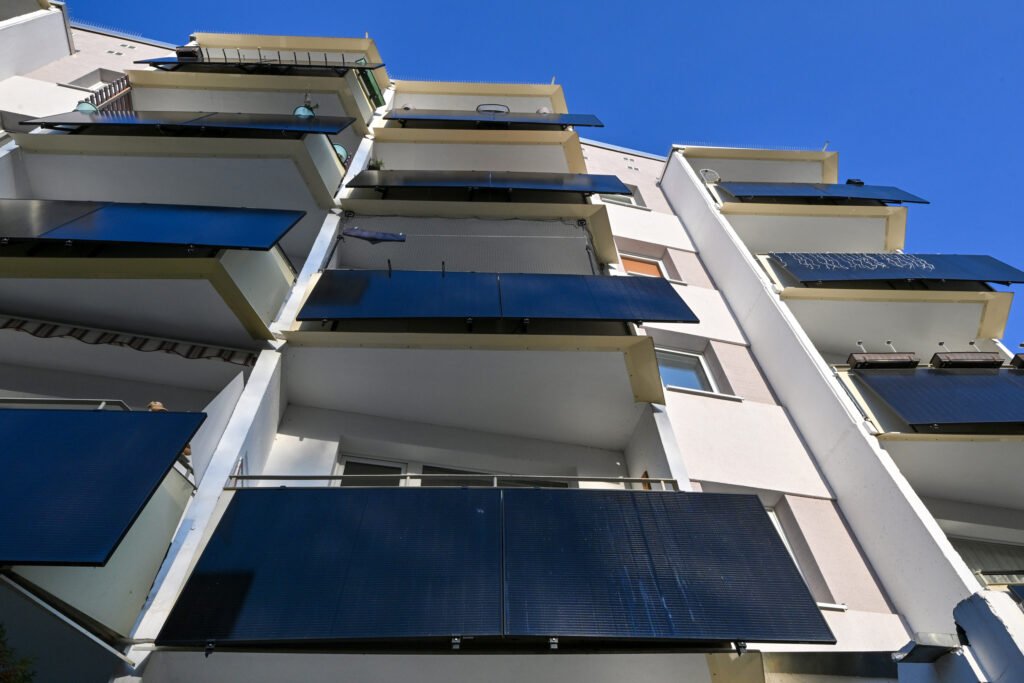
After Russia invaded Ukraine in 2022, electricity prices shot up across Europe and consumers looked for ways to save. One popular option was plug-in solar—inexpensive and easy-to-install renewable energy systems that began to appear in store aisles.
Now, Germany is the global leader in plug-in solar with about 1 million systems in official counts and probably many more that utilities and local governments haven’t counted.
I looked to Germany this week because I’ve been unsure whether plug-in solar makes sense for U.S. consumers, and I think Germany’s experience provides some clues about what may work here.
The benefits are clear. An entry-level plug-in system costs about $500 to $1,000 and can be installed in a backyard, on a balcony or on a roof. The electricity enters your home through a standard wall outlet, where it helps offset the electricity you draw from the grid. The low cost makes solar accessible for people who can’t afford to spend $10,000 or more on an electrician-installed rooftop array.
Here’s the main downside, as I see it: The financial benefits are small, starting at about $15 per month in the United States. It may make more sense financially to spend the cost of plug-in solar on insulation, air sealing or other basic measures to reduce energy use.
To help weigh the benefits against the concerns, I spoke with Craig Morris, the CEO of Bundesverband Steckersolar, Germany’s plug-in solar trade association. Readers may recognize that name. He is a U.S. native who has spent his adult life working as a clean energy advocate and researcher in Germany, and he was a key interview subject in my 2020 series about Germany’s energy transition, and another story since then.
“The distinctive thing about this technology is it’s so small that you don’t need an electrician to plug it in,” he said in a video interview from Berlin.

The do-it-yourself nature of the product is one reason it’s sometimes called “guerrilla solar,” with people installing it even in buildings and jurisdictions where it’s not allowed.
Morris previously worked for a nonprofit that advised the plug-in solar association. As plug-in solar grew in popularity, the association needed its first full-time manager and hired Morris last year.
He and his members are now working to convince the European Union to adopt rules that would allow plug-in solar across the bloc, rather than the patchwork now in place. Germany and Belgium passed plug-in solar laws in 2024 and other nations have followed suit. Hungary and Sweden are among the countries with restrictions.
I asked him if savings from plug-in solar may be too small to be worthwhile.
He responded by referring to an analysis his organization published this week that serves as a useful primer. It has a page comparing costs and payback periods in six international cities for a system that costs about $570.
The fastest payoff is 4.26 years in Berlin, largely because the region has high electricity prices, which create more opportunity for savings by generating your own power.
The slowest payoff is 9.56 years in Ho Chi Minh City, Vietnam, where electricity prices are unusually low.
Kansas City, Missouri, the only U.S. city listed, has the fourth-fastest payoff with 4.99 years. The city has high household electricity consumption, which means electricity generated by the panels is almost entirely consumed onsite, accelerating the payback period. This factor is offset by the region’s electricity rates, which are lower than those in all but Ho Chi Minh City.
This story is funded by readers like you.
Our nonprofit newsroom provides award-winning climate coverage free of charge and advertising. We rely on donations from readers like you to keep going. Please donate now to support our work.
The payoff periods are estimates that don’t account for consumers’ ability to optimize their power consumption to maximize the value of plug-in solar. For example, someone could choose to do laundry or other power-intensive tasks when the sun is brightest. Also, some markets offer net metering for plug-in solar, which compensates for excess electricity that goes back to the grid.
Customers can buy batteries to store electricity they don’t use right away. This increases the upfront cost but yields greater savings in the long run.
But my focus on the payoff periods may be missing the point.
Morris explained that the main benefit he sees with plug-in solar is that consumers are taking greater control of their energy costs and becoming participants in the transition to clean energy. He views this as part of creating and maintaining a political consensus that supports the transition, which is good for everyone.
He also sees land-use benefits, with plug-in solar occupying otherwise unused spaces in yards and on roofs and balconies. His organization has calculated that widespread adoption of plug-in solar would meet about 2 percent of Germany’s electricity demand, which would reduce the need to build new power plants on undeveloped land.
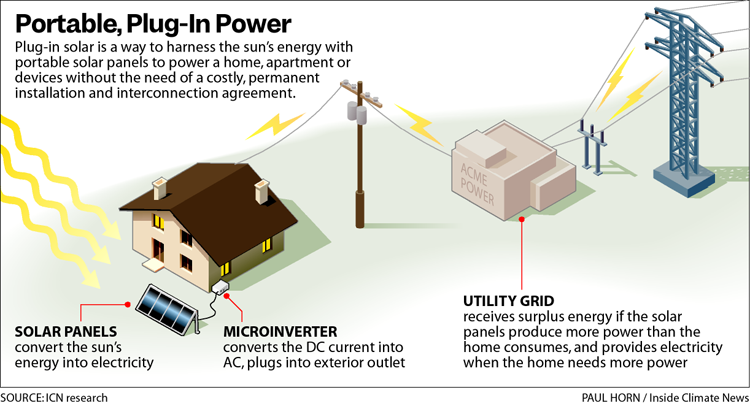
Utilities tend to be the primary opponents of plug-in solar, citing safety concerns. I’m not going to go point by point through the objections, other than to say that consumers shouldn’t plug a solar panel into a broken outlet or one that’s on a circuit that’s already prone to overloading.
To get a view from closer to home, I contacted Steven Hegedus, an engineering professor at the University of Delaware who has spent most of his career researching solar power.
Like Morris, Hegedus is someone I’ve known for a while, a longtime friend of my wife’s family. He’s also an expert in plug-in solar who appeared last year on the radio program Living on Earth.
Hegedus’ main concern is that the often-touted plug-in solar savings numbers may be overstated. He has kept an informal tally of costs and savings for systems in his region and has found that some would take 10 to 15 years to pay off.
He thinks payoff estimates are usually based on systems in markets with expensive electricity, such as California, which doesn’t apply to most of the country.
And he believes the savings estimates are based on systems that have been installed in positions that maximize sunlight exposure. But with the product’s do-it-yourself process, he argues that not all customers install it in the most effective location.
He thinks the benefits of plug-in solar probably exceed any concerns. The main benefit is that plug-in solar is widely accessible, creating an opportunity for many more people to generate clean energy, assume greater responsibility for their energy use and feel connected to the energy transition.
“You’re doing this for reasons other than just to save money,” he said.
The legal status of plug-in solar is unclear in much of the country. Bright Saver, a plug-in solar advocacy group, counts nine states that have passed laws or rules allowing the systems: Colorado, Connecticut, Maine, Maryland, New Hampshire, New York, Utah, Vermont and Virginia. Four states have bills that have passed one legislative chamber: California, Massachusetts, Minnesota and New Jersey.
California is almost certainly the leader in plug-in solar purchases, according to industry professionals, but I haven’t found any reliable data. The estimates I’ve heard are thousands of systems, so we’re talking about an industry that’s just getting started.
For more information, Solar United Neighbors, EnergySage and Bright Saver offer resources to help consumers answer basic questions about costs, savings and technical issues.
A few years ago, it would have been easy to dismiss a comparison of Germany and the United States as plug-in solar markets since electricity is much more expensive in Germany. But U.S. power bills have soared in recent years and are likely to continue doing so.
As this happens, plug-in solar will become a better deal, and, I think, much more popular.
Other stories about the energy transition to take note of this week:
Tesla, Sunrun and Renew Home Are Teaming Up for a Giant Virtual Power Plant: Tesla, Sunrun and Renew Home have announced plans for a 16-gigawatt virtual power plant that uses solar panels, batteries and smart thermostats to bolster the grid, as Jeff St. John reports for Canary Media. This is an unusually large example of energy companies seeking decentralized solutions to meet high electricity demand from data centers and other large users. Many of the solar panels, batteries and smart thermostats are already installed across the country; the new initiative is tying them together so they can work in tandem to help the grid.
A Clean Energy Tax Credit Deadline Is Looming; Here’s What That Means for Philadelphia: Clean energy developers are facing a July 4 deadline to begin construction to qualify for the federal investment tax credit under the phaseout specified in last year’s One Big Beautiful Bill Act. My colleague Daniel Perrin reports on how this is playing out in Philadelphia, where slow-moving bureaucracy for publicly funded projects is running up against the need to move quickly.
The Trump Administration Provides Money for Nuclear Reactors: The Trump Administration said this week that it would spend $17.5 billion to help cover the costs of 10 nuclear reactors for new power plants, part of an attempt to revitalize nuclear power in the United States and meet demand from data centers, as Jennifer McDermott and Matthew Daly report for The Associated Press. These are large nuclear reactors, a type that developers are wary of because of decades of cost overruns, as opposed to small modular reactors, which many analysts view as the future of nuclear power.
Inside Clean Energy is ICN’s weekly bulletin of news and analysis about the energy transition. Send news tips and questions to [email protected].
About This Story
Perhaps you noticed: This story, like all the news we publish, is free to read. That’s because Inside Climate News is a 501c3 nonprofit organization. We do not charge a subscription fee, lock our news behind a paywall, or clutter our website with ads. We make our news on climate and the environment freely available to you and anyone who wants it.
That’s not all. We also share our news for free with scores of other media organizations around the country. Many of them can’t afford to do environmental journalism of their own. We’ve built bureaus from coast to coast to report local stories, collaborate with local newsrooms and co-publish articles so that this vital work is shared as widely as possible.
Two of us launched ICN in 2007. Six years later we earned a Pulitzer Prize for National Reporting, and now we run the oldest and largest dedicated climate newsroom in the nation. We tell the story in all its complexity. We hold polluters accountable. We expose environmental injustice. We debunk misinformation. We scrutinize solutions and inspire action.
Donations from readers like you fund every aspect of what we do. If you don’t already, will you support our ongoing work, our reporting on the biggest crisis facing our planet, and help us reach even more readers in more places?
Please take a moment to make a tax-deductible donation. Every one of them makes a difference.
Thank you,

Reporter, Clean Energy
Dan Gearino covers the business and policy of renewable energy and utilities, often with an emphasis on the midwestern United States. He is the main author of ICN’s Inside Clean Energy newsletter. He came to ICN in 2018 after a nine-year tenure at The Columbus Dispatch, where he covered the business of energy. Before that, he covered politics and business in Iowa and in New Hampshire. He grew up in Warren County, Iowa, just south of Des Moines, and lives in Columbus, Ohio.