

Close Menu

    Subscribe to Updates

    Get the latest news information from worldwide businesses.

    What's Hot

    This Used Audi E-Tron Lost A Fortune. Its Battery Held Up Much Better

    June 8, 2026

    The real reason why e-bike throttles have gotten worse

    June 8, 2026

    Rs 74 lakh forged certificate scam busted in Rajasthan, 3 FMGs arrested

    June 8, 2026
    Facebook Instagram YouTube LinkedIn X (Twitter)
    Trending
    • This Used Audi E-Tron Lost A Fortune. Its Battery Held Up Much Better
    • The real reason why e-bike throttles have gotten worse
    • Rs 74 lakh forged certificate scam busted in Rajasthan, 3 FMGs arrested
    • Uber tells London to get ready for robotaxis
    • Uber, Wayve and Waymo are headed towards a robotaxi showdown in London
    • Bharat ​Petroleum to shut crude unit at Mumbai refinery in November
    • Gold just had its worst selloff since March. A floor may be $4,000, says one veteran strategist
    • India, China should stick to ‘right strategic perception’ of being cooperative partners, not rivals: Beijing
    Newspublicly
    • About Us
    • Advertise & Partner with us
    • Pitch Your Story
    • Contact Us
    Facebook Instagram LinkedIn X (Twitter)
    Subscribe
    • Home
    • World News
      • Asia
      • India
      • USA
      • UK & Europe
      • Middle East
    • Economy & Business
      • Global Economy
      • Corporate & Industry
      • Finance & Markets
      • Policy & Trade
    • Technology
      • Gadgets & Devices
      • Software & Apps
      • AI & Machine Learning
      • Robotics & Automation
    • Health & Medicine
      • Fitness & Nutrition
      • Research & Innovation
      • Disease & Treatment
      • Doctors, Clinics & Patient Care
    • Travel & Tourism
    • Automobile
      • Electric & Hybrid Vehicles
      • Auto Industry Insights
    • Sports
    • More
      • Education
      • Real Estate
      • Environment & Climate
      • Space & Astronomy
      • War & Conflicts
    Newspublicly
    Home»More»Space & Astronomy»Shockwaves from dying stars may sculpt ‘cosmic wagon wheel’ stellar nurseries, simulations reveal
    Space & Astronomy

    Shockwaves from dying stars may sculpt ‘cosmic wagon wheel’ stellar nurseries, simulations reveal

    AdminBy AdminJune 1, 2026No Comments3 Mins Read0 Views
    Share
    Facebook Twitter LinkedIn Copy Link WhatsApp


    Some of the galaxy’s most spectacular stellar nurseries resemble giant cosmic wagon wheels, with spoke-like structures that scientists say were sculpted by shockwaves from stellar explosions and powerful stellar winds.

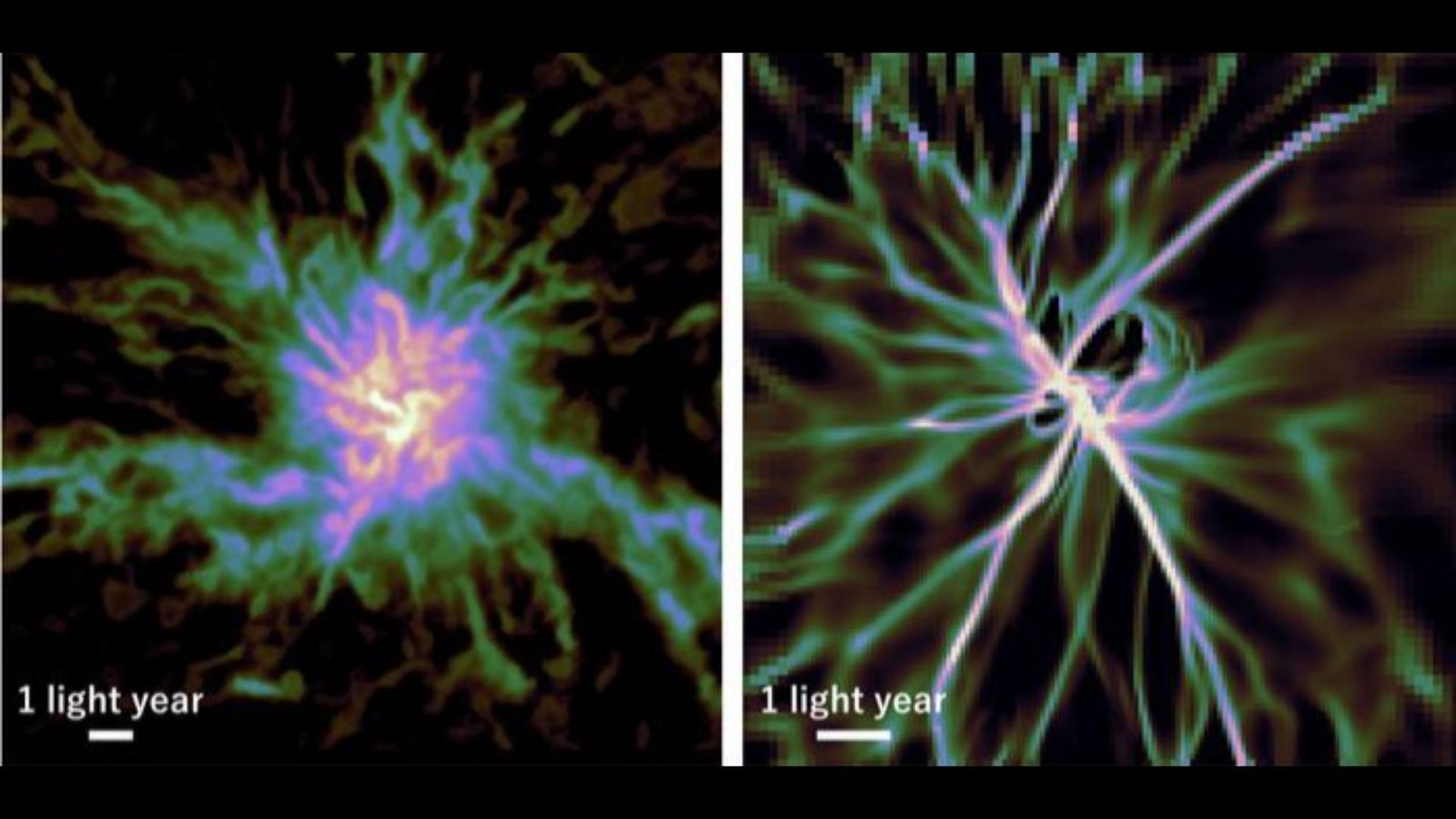
    Using powerful 3D simulations, researchers from Kyushu University and Nagoya University in Japan found that shockwaves racing through giant clouds of gas can carve out the spoke-like filaments often seen surrounding newborn stars. The findings could help explain the origin of so-called hub-filament systems — sprawling star-forming regions where long streams of gas radiate toward a dense central hub, creating a pattern that resembles the spokes of a wheel, according to a statement from Kyushu University.

    “Stars are born inside molecular clouds — vast, cold clouds of gas that drift through space,” Shingo Nozaki, lead author of the study, said in the statement. “But they only form in the coldest and densest parts of those stellar nurseries, where gas can collapse under its own gravity. In some of these star-forming regions, gas is organized into characteristic hub-and-spoke patterns known as Hub-Filament Systems (HFS).”


    You may like

    Astronomers have observed these structures throughout the Milky Way, but exactly how they form has remained an open question. The team used advanced 3D magnetohydrodynamic simulations to recreate the process, revealing that shockwaves propagating through giant molecular clouds can naturally generate the striking wheel-like architecture seen in some of the galaxy’s most active stellar nurseries, according to the study.

    Many stellar nurseries contain narrow filaments that funnel material inward toward crowded central regions where stars are actively forming. Understanding how those filaments emerge is key to understanding how gas accumulates and ultimately collapses into new stars.

    For the study, the researchers built a virtual molecular cloud threaded with magnetic fields and ran the simulations on ATERUI III, a supercomputer dedicated to astronomical research. Gravity first was seen pulling the magnetic fields inward, creating an hourglass-shaped configuration. The team then blasted the cloud with a simulated interstellar shockwave similar to those generated by expanding supernova remnants or powerful winds from massive stars. The result was a remarkably realistic hub-filament system.

    As the shockwave swept through the cloud, it encountered different parts of the curved magnetic field at varying angles, creating oblique shocks that amplified sections of the field and established preferred pathways for gas to flow. Over time, these channels funneled material into elongated filaments stretching toward a central hub, producing the spoke-like structure seen in telescope observations.

    Space

    The simulations also tracked how matter moves through stellar cradles. Dense gas tends to flow along the filaments, accelerating as it approaches the hub, while lower-density material between the spokes remains comparatively still. The researchers say this behavior may help explain why only a small fraction of gas in molecular clouds ultimately forms stars, according to the statement.

    Modeling the interplay between gravity, magnetic fields and shockwaves over millions of years, allows researchers to study processes that are otherwise difficult to observe directly. Future work will test a broader range of cloud structures and shockwave conditions, which could clarify why hub-filament systems vary across the Milky Way and offer new insight into the formation of massive stars and stellar clusters. The results also point to a broader cosmic cycle of destruction and creation, in which shockwaves from dying stars help shape the environments where new stars are born.

    Their findings were published March 18 in The Astrophysical Journal Letters.


    Source link

    Author

    • Admin

      NewsPublicly.com is News & Articles Platform that creating SEO-focused articles on travel, lifestyle, and digital trends.

    Admin
    • Website

    NewsPublicly.com is News & Articles Platform that creating SEO-focused articles on travel, lifestyle, and digital trends.

    Related Posts

    Rare daytime meteor shower peak this week — here’s how to see (and even hear) them

    June 8, 2026

    Trouble near the Milky Way: The Large Magellanic Cloud is ripping its smaller neighbor galaxy apart

    June 7, 2026

    10 best Spanish beaches to see the total solar eclipse 2026

    June 7, 2026
    Leave A Reply Cancel Reply

    Demo
    Top Posts

    The Blue Moon rises on May 30— Where and when to see the second full moon of the month

    May 30, 202640 Views

    New SOCOM rifle allows barrel swapping and cartridge changes

    June 1, 202632 Views

    “Inside Gemini Robotics 1.5: How Robots Learn to Reason & Act

    November 22, 202525 Views

    525 pounds of cocaine seized after Nebraska K9 alerts troopers on I-80

    May 28, 202624 Views
    Don't Miss

    This Used Audi E-Tron Lost A Fortune. Its Battery Held Up Much Better

    June 8, 20264 Mins Read0 Views

    The used e-tron still has about 76 kWh of usable capacity left. Its battery looks…

    The real reason why e-bike throttles have gotten worse

    June 8, 2026

    Rs 74 lakh forged certificate scam busted in Rajasthan, 3 FMGs arrested

    June 8, 2026

    Uber tells London to get ready for robotaxis

    June 8, 2026
    Stay In Touch
    • Facebook
    • Twitter
    • Instagram
    • YouTube
    • LinkedIn
    • WhatsApp

    Subscribe to Updates

    Get the latest creative news from SmartMag about art & design.

    Demo
    NEWSPUBLICLY
    Facebook X (Twitter) Instagram LinkedIn

    Home

    • About Us
    • Leadership
    • Advertise & Partner With Us
    • Pitch Your Story
    • Media Kit & Pricing
    • Career
    • FAQs

    Guidelines

    • Editorial & Submission
    • Partnership
    • Advertising & Sponsor
    • Intellectual Property Policy
    • Community & Comment
    • Security & Data Protection
    • Send Your Opinion

    Quick Links

    • Cookie Policy
    • Payment & Billing Terms
    • Refund & Cancellation
    • Copyright Policy
    • Complaint & Support
    • Sitemap
    • Contact Us

    Subscribe Us

    Get the latest news and updates!

    Copyright © 2026 Newspublicly (DIGITALIX COMMUNICATION). All Rights Reserved.
    • Privacy Policy
    • Terms of Use
    • Disclaimer