

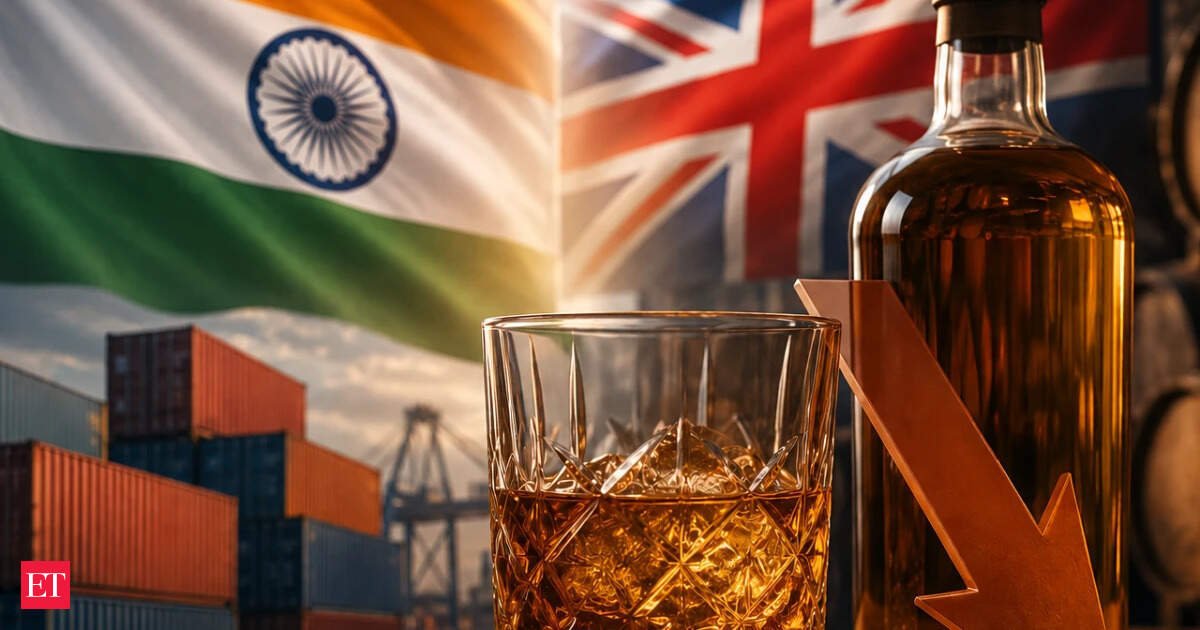
The agreement, which came into force earlier this month, immediately reduces customs duty on Scotch whisky and gin to 75% from 150%, with tariffs set to decline further to 40% over the next decade. While the move is expected to make imported Scotch cheaper, industry executives say consumers should not expect dramatic price cuts immediately, as state excise duties, VAT, logistics costs and distributor margins continue to account for a significant portion of retail prices.
Also Read: India-UK FTA comes into effect today, unlocking duty-free access for Indian exports
Instead, the FTA is expected to accelerate the country’s ongoing premiumisation trend while raising the quality benchmark for domestic producers.
India, the world’s largest whisky market by volume, sold about 259 million nine-litre cases of whisky in 2024, according to industry estimates cited by the Confederation of Indian Alcoholic Beverage Companies (CIABC). Whisky accounts for roughly two-thirds of India’s spirits market, making even modest changes in pricing and consumer preferences significant for the industry.

India was already the world’s largest market for Scotch whisky by volume before the India-UK free trade agreement came into force. According to the Scotch Whisky Association (SWA), exports of Scotch to India reached a record £248 million in 2024, equivalent to about 192 million 70cl bottles, making the country the biggest overseas market by volume but only the fifth largest by value.
The gap reflects India’s long-standing demand for lower-priced Scotch, much of it used for blending by domestic distillers, even as premium bottled Scotch remained constrained by the country’s 150% import duty before the FTA.Also Read: India-UK FTA draws mixed response from liquor industry over Scotch duty cuts
Premium Scotch to get cheaper
Rakshit Jagdale, Managing Director of Amrut Distilleries, expects retail prices of imported premium Scotch to fall meaningfully.
“What I strongly feel is that premium and luxury Scotch whisky prices will drop, MRP will drop. My personal opinion is that anything between 15 to 20% will be the drop,” Jagdale told ET Online.
“It will benefit Indian distillers who are importing blended malt Scotch to add to their mix in blended whisky. So, that will be a benefit to Indian distillers.”
Industry body International Spirits and Wines Association of India (ISWAI), however, estimates somewhat lower retail savings.
Using Maharashtra as an example, ISWAI projects that a 750 ml three-year-old blended Scotch priced at Rs 2,500 could become around 12% cheaper, while a 12-year-old blended Scotch retailing at Rs 4,250 may see a 13% reduction, provided companies pass on the entire benefit of lower import duties to consumers.
“The India–UK Free Trade Agreement is a strategic opportunity—not merely a tariff milestone—and policy decisions must stay focused on the broader economic dividends for all stakeholders, especially consumers,” said Sanjit Padhi, CEO, ISWAI.
Also Read: ‘We did it’: Modi, Starmer caught on mic hinting at breakthrough in UK-India trade deal
“This agreement delivers three distinct benefits: Greater consumer choice, unlocking access to a wider range of premium global brands, improved access to bulk Scotch for domestic producers and modest price relief for consumers.”
Indian single malts unfazed
Despite concerns that cheaper Scotch could threaten India’s fast-growing single malt category, domestic producers appear confident.
The tariff cuts also come at a time when India’s homegrown single malt industry has emerged as a formidable challenger to imported Scotch.
Industry estimates from the Confederation of Indian Alcoholic Beverage Companies (CIABC) show the country’s single malt market stood at about 675,000 nine-litre cases in 2023, with Indian brands accounting for roughly 345,000 cases, over 50%, overtaking imported Scotch and other international single malts, which sold about 330,000 cases.
Jagdale believes Indian single malts have already established themselves on quality.
“Indian single malt whisky has already carved out a niche for itself within the spirits category in India. Yes, there is some sort of apprehension that cheaper Scotch, cheaper single malt Scotch will be available, but if you look at quality perspective and parameters, they are equal or better than the standard 12-year-old Scotch single malt,” he said.
Piccadily Distilleries, maker of award-winning Indri, echoed the sentiment.
“The India–UK FTA is likely to be a defining moment for India’s premium whisky market, but not in the way many initially expect,” the company said in its response to ET Online.
“While the reduction in import duties on Scotch will certainly make premium Scotch more accessible over time, we believe the bigger impact will be on consumer behaviour rather than market disruption.”
The company argued that the agreement would accelerate premiumisation rather than trigger aggressive price competition.
“Consumers will have greater access to globally renowned Scotch brands, leading to a more educated and discerning whisky drinker. This, in turn, raises the benchmark for everyone in the category.”
It added that Indian single malts have earned global credibility after repeatedly winning international awards.
“The Indian whisky market is large enough for multiple premium categories to thrive. Scotch will continue to represent heritage and tradition, while Indian single malts will increasingly stand for innovation, provenance, and world-class quality,” the company said.
No price war expected
Industry executives appear aligned that the tariff cut alone will not result in an industry-wide price war.
“We do not see a price disruption. But as I was mentioning, I see prices of BIO (bottled in origin) single malts and BIO blended Scotch prices to drop by about 15 to 20%.”
Piccadily also expects only gradual price corrections.
“We don’t see a significant price disruption in the premium whisky market.”
The company noted that final retail prices will continue to depend on state taxes, logistics, exchange rates and distribution costs.
“The India–UK FTA will raise the level of competition, but it will be a competition driven by quality and innovation, not pricing.”
Bulk Scotch may be the bigger winner
One of the less discussed beneficiaries could be Indian-made foreign liquor (IMFL) manufacturers that rely on imported Scotch for blending.
ISWAI noted that nearly 79% of India’s Scotch imports arrive in bulk, rather than bottled form, and are used by Indian producers to manufacture premium blended whiskies.
Lower import duties on bulk Scotch could therefore reduce input costs while enabling producers to improve quality.
“The India–UK FTA creates a unique opportunity for Indian manufacturers to improve product quality, rationalise input costs, and enhance their competitiveness in both domestic and export markets,” Padhi said.
“It is therefore surprising that sections of the domestic industry continue to present an incomplete picture, despite the fact that Indian IMFL manufacturers stand to be among its biggest beneficiaries.”
State taxes remain the biggest variable
Executives also cautioned that customs duty is only one component of the final bottle price.
“The biggest misconception is that lower import duties will automatically translate into significantly lower retail prices,” Piccadily said.
“In reality, import duty is only one component of the final price. State excise duties, taxes, logistics, distribution costs and currency fluctuations all have a significant impact on what consumers ultimately pay.”
ISWAI similarly urged state governments not to offset the customs duty cuts by raising state taxes, arguing that doing so would dilute the intended benefits of the FTA.
A premium market gets more competitive
The timing of the agreement coincides with rapid premiumisation in India’s spirits market. According to alcohol market researcher IWSR, value growth in India’s beverage alcohol market continues to outpace volume growth as consumers increasingly trade up to higher-quality brands.
IWSR forecasts premium-and-above blended Scotch volumes to grow at a compound annual rate of 13% between 2022 and 2027, while premium-plus malt Scotch is expected to expand at an even faster 19% CAGR over the same period
The country has also emerged as a major producer of internationally recognised single malts, with Indian labels winning top honours at global competitions over the past few years.
For producers, the FTA appears less about cheaper Scotch replacing Indian brands than about creating a more competitive premium market where consumers have wider choice and quality becomes the primary differentiator.
As Jagdale summed it up, the industry’s growth outlook remains unchanged.
“No, our growth and forecast remain the same and robust.”
With tariffs continuing to decline over the next decade, India’s premium whisky market is likely to see gradual rather than abrupt change—but few in the industry doubt that the FTA has set in motion a long-term transformation of the country’s Scotch and premium whisky landscape.