

5 min readUpdated: Jul 24, 2026 01:36 PM IST
Eighteen days after beginning an indefinite hunger strike against alleged irregularities in the rehabilitation of families affected by the Ken-Betwa Link Project in Madhya Pradesh, Jai Kisan Sangathan leader Amit Bhatnagar on Wednesday suspended his fast, saying the agitation had achieved its “first success” after the state agreed to conduct fresh village-level surveys to identify families left out of compensation and rehabilitation.
Bhatnagar, who has been leading the Ken-Betwa Chita Andolan, said he was ending only the indefinite fast and not the movement itself.

“After achieving the first success of this 18-day indefinite fast, I am suspending my hunger strike today. But this struggle has not ended. From today, I am taking a pledge of ‘Nyay Satyagraha’. Until the last eligible person receives justice under the project, I will not rest. I will go from village to village, lead this movement, cooperate with every positive step taken by the administration and monitor every promise. If required, the next phase of the agitation will also begin,” he said.
The rehabilitation process concerns villages falling within the Daudhan Dam submergence zone. Bhatnagar had alleged that hundreds of eligible families were excluded from rehabilitation lists, that compensation assessments were flawed, and that Gram Sabha proceedings contained irregularities.
His health had deteriorated over the course of the fast, leading to appeals from civil society groups, activists and political leaders for him to end the protest.
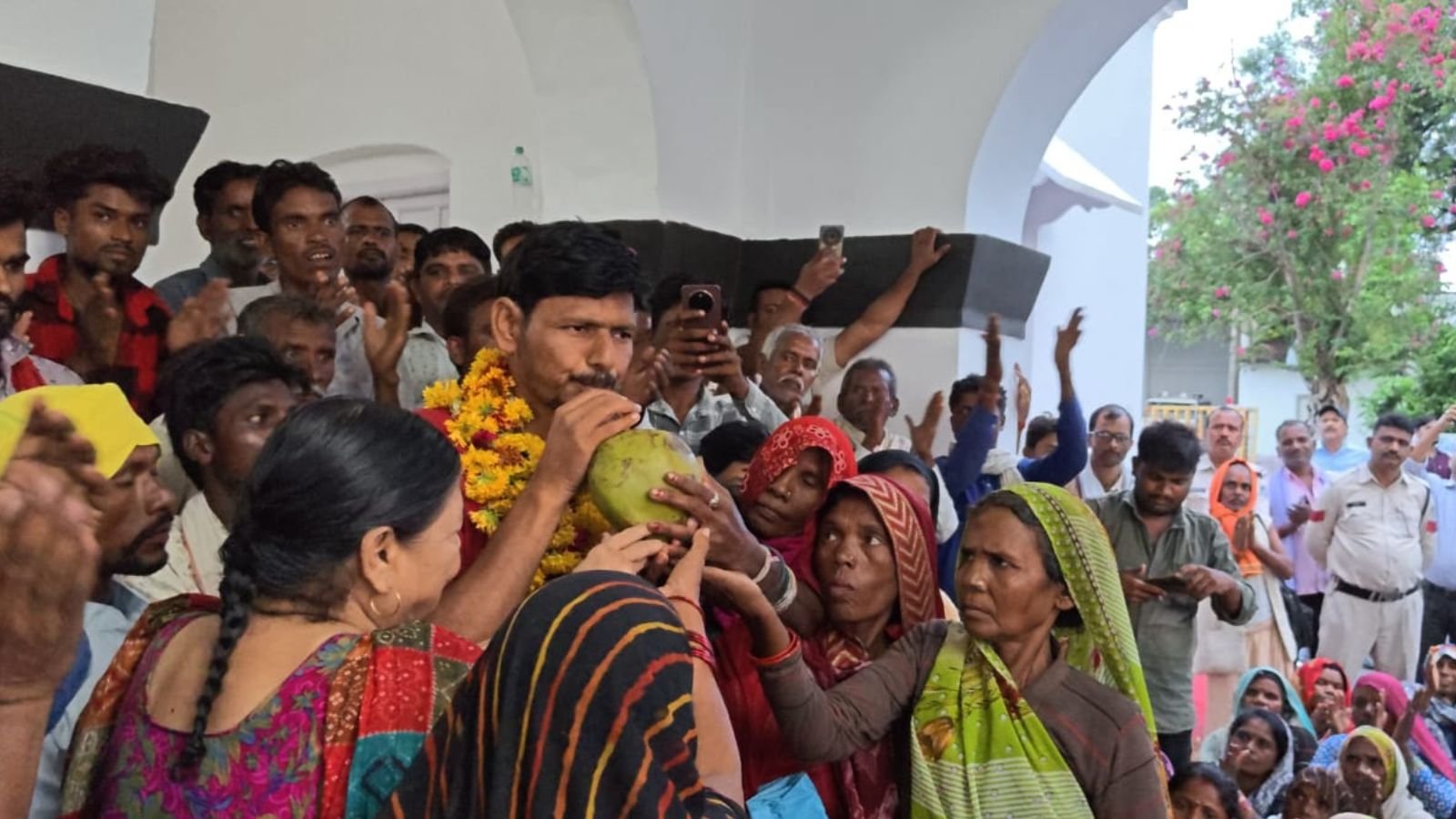
Announcing his decision from hospital, Bhatnagar said he had taken coconut water offered by his mother and tribal women who had participated in the agitation after the administration showed what he described as a “positive approach.”
According to him, district authorities have agreed to form joint teams comprising officials and representatives of the Jai Kisan Sangathan to conduct fresh village-by-village surveys in Chhatarpur district and include every eligible family that had been left out.
Story continues below this ad
He said the agitation was being transformed into what he called a “Nyay Upvaas” (Justice Fast), under which he would continue abstaining from food grains until all eligible families receive justice.
“I have not abandoned the fast. I have changed its form. Until the last eligible person receives justice, I will not eat food or roti,” he said.
Bhatnagar cited three reasons for suspending the fast. He said the women in affected villages across Chhatarpur and Panna had launched a “chulha bandi” protest, refusing to cook meals in solidarity. He said many elderly people and even children had also begun fasting.
“Seeing innocent children and entire families going hungry created a moral pressure on me,” he said. “Now the struggle will move from the hospital to the villages.”
Story continues below this ad
Pressure in Assembly
The decision came after a stormy debate in the Madhya Pradesh Assembly, where Leader of Opposition Umang Singhar accused the government of irregularities in rehabilitation and compensation under the Rs 44,605-crore river-linking project. During the debate, Chief Minister Mohan Yadav assured the House that any complaints would be investigated and promised that the exercise would be completed within a month.
In its written reply, the government said that 1,321 families in seven villages of Panna district had been displaced and 3,718 families across 14 villages in Chhatarpur district were affected by land acquisition or submergence.
The government maintained that all affected families had been sanctioned compensation and rehabilitation benefits. However, it also acknowledged that complaints from Chhatarpur had led to a fresh survey. According to the Revenue Department, 638 additional eligible families were identified after village-wise surveys, increasing the number of sanctioned beneficiaries from 3,080 to 3,718.
During the debate, Singhar demanded that the government table the survey reports and Gram Sabha proceedings before the Assembly and alleged that compensation had been wrongly distributed in some villages while other eligible families remained excluded. He also questioned how dam construction had progressed when the rehabilitation, according to him, remained incomplete.
Story continues below this ad
Revenue Minister Karan Singh Verma rejected allegations of any scam and said compensation had been disbursed to nearly all eligible families, with only a handful of cases pending due to documentation or banking issues.
Chief Minister Yadav then intervened, assuring the House that any specific complaints would be investigated.
“If there is any discrepancy or complaint, we will certainly investigate it and do justice,” Yadav said, adding that the exercise would be completed within a month.
The Ken-Betwa Link Project, India’s first river interlinking project, involves construction of the Daudhan Dam across the Ken River, a 221-km link canal and associated irrigation infrastructure to transfer water from the Ken basin in Madhya Pradesh to the Betwa basin in Uttar Pradesh.
Story continues below this ad
The project is expected to provide irrigation to drought-prone Bundelkhand, supply drinking water and generate hydropower, but it also requires the displacement of thousands of families and the diversion of forest land, making rehabilitation one of its most contentious aspects.