

Close Menu

    Subscribe to Updates

    Get the latest news information from worldwide businesses.

    What's Hot

    Approximately three thousand gas cylinders were swept into the Patalganga river from an HPCL plant in Raigad

    July 9, 2026

    Taco Bell is reportedly pulling produce from some stores. Here’s what to know.

    July 9, 2026

    US-Iran strikes: Strait of Hormuz ship traffic falls steeply

    July 9, 2026
    Facebook Instagram YouTube LinkedIn X (Twitter)
    Trending
    • Approximately three thousand gas cylinders were swept into the Patalganga river from an HPCL plant in Raigad
    • Taco Bell is reportedly pulling produce from some stores. Here’s what to know.
    • US-Iran strikes: Strait of Hormuz ship traffic falls steeply
    • Illegals root cause of demographic shifts in border dists: Shah | India News
    • NASA chief Jared Isaacman says agency has filmed unexplained UFOs
    • Wally Funk, trailblazing pilot and astronaut, passes away at 87
    • Pennsylvania’s Legislature Is Likely to Punt on Mass Transit Funding—Again
    • Paul Wight (fka Big Show) provides a personal update following his return to action
    Newspublicly
    • About Us
    • Advertise & Partner with us
    • Pitch Your Story
    • Contact Us
    Facebook Instagram LinkedIn X (Twitter)
    Subscribe
    • Home
    • World News
      • Asia
      • India
      • USA
      • UK & Europe
      • Middle East
    • Economy & Business
      • Global Economy
      • Corporate & Industry
      • Finance & Markets
      • Policy & Trade
    • Technology
      • Gadgets & Devices
      • Software & Apps
      • AI & Machine Learning
      • Robotics & Automation
    • Health & Medicine
      • Fitness & Nutrition
      • Research & Innovation
      • Disease & Treatment
      • Doctors, Clinics & Patient Care
    • Travel & Tourism
    • Automobile
      • Electric & Hybrid Vehicles
      • Auto Industry Insights
    • Sports
    • More
      • Education
      • Real Estate
      • Environment & Climate
      • Space & Astronomy
      • War & Conflicts
    Newspublicly
    Home»More»Space & Astronomy»Scientists have discovered the oldest quasar ever seen, and it shines with the light of a trillion suns
    Space & Astronomy

    Scientists have discovered the oldest quasar ever seen, and it shines with the light of a trillion suns

    AdminBy AdminJuly 9, 2026No Comments4 Mins Read0 Views
    Share
    Facebook Twitter LinkedIn Copy Link WhatsApp


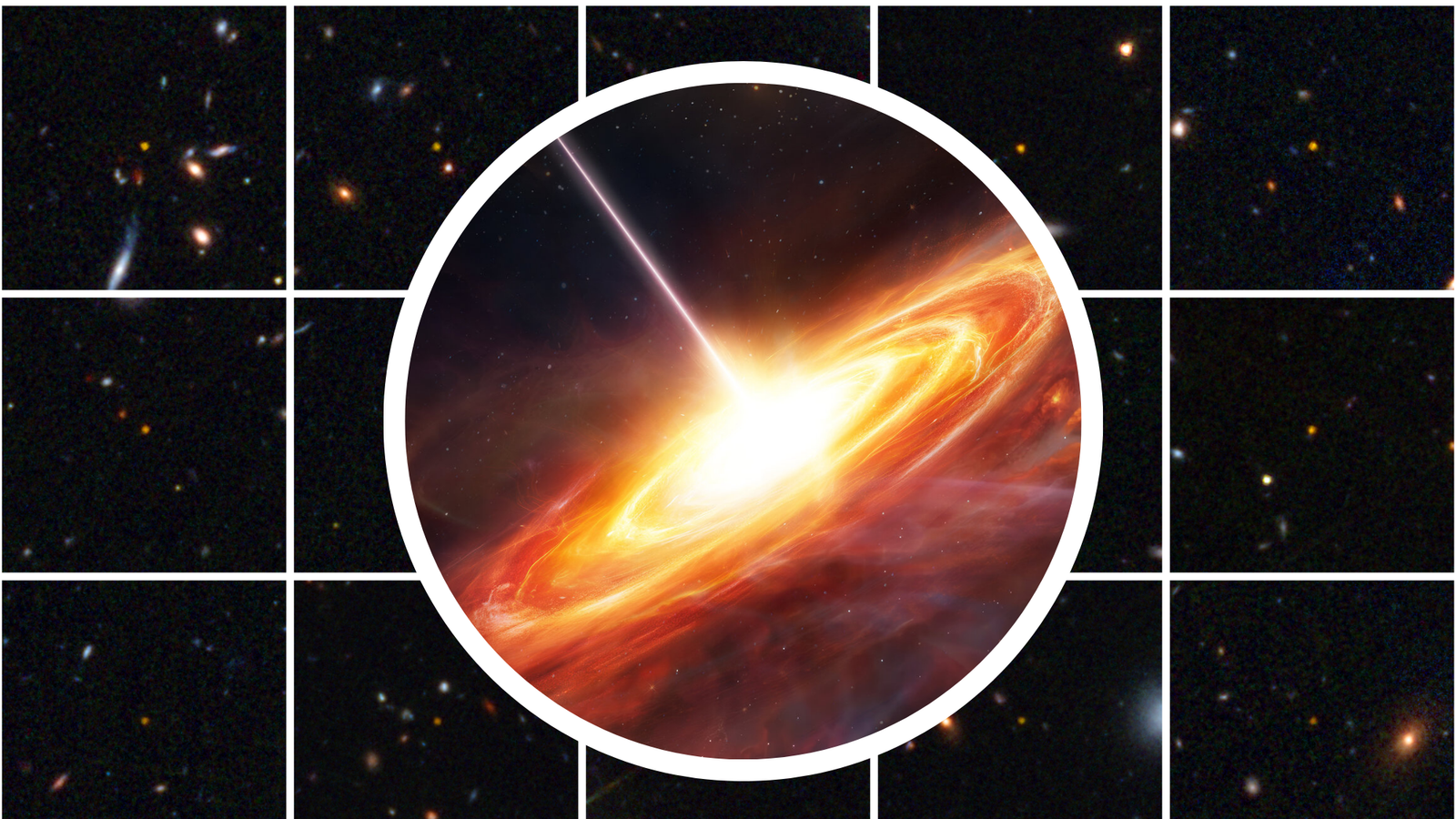
    Using the European Space Agency’s Euclid space telescope, astronomers have discovered a treasure trove of 31 black-hole-powered quasars in the early universe. The most impressive of these new discoveries is the most ancient and distant quasar ever seen, shining with the light of a trillion suns just 670 million years after the Big Bang.

    Quasars occur when supermassive black holes with masses millions or even billions of times that of the sun are surrounded by swirling disks of matter called accretion disks. As accretion disks gradually feed these central cosmic titans, the immense gravity of the black holes generates intense friction, causing this matter to glow so brightly that their luminosity can exceed the combined light of every star in their host galaxies.

    Despite this, quasars can still be difficult to spot at vast cosmic distances, with their light difficult to distinguish from the light of much more proximate stars. Thus, the hunt for the earliest quasars has been on for decades, with scientists hoping that the discovery of these bodies could help explain how supermassive black holes grew so rapidly so shortly after the Big Bang. Launched in 2023, Euclid has fulfilled its promise in its mission to discover early quasars, with this hitherto unprecedented haul of 31 of these black hole engines.

    “These early quasars date back to the Universe’s infancy,” team leader Daming Yang of Leiden University in the Netherlands said in a statement. “By finding and studying them, we can better understand how these enormous systems formed and grew so quickly — one of the greatest mysteries in astrophysics.”

    Previously, astronomers took around a decade to discover the first ten or so quasars at distances like this, which makes it incredibly impressive that Euclid has managed to detect more than three times that many ancient black hole engines in just a single year of observations.


    You may like

    The tip of the iceberg

    Thanks to this new treasure trove of quasars discovered when the 13.8 billion-year-old universe was merely 5% of its current age includes not just the brightest examples of these objects, but also some fainter quasars. That now means scientists can finally study these objects as a population.

    “Euclid is a true game-changer,” Yang continued. “Before, we could only find a handful of the very brightest ancient quasars, but Euclid lets us search far more efficiently across huge areas of sky to capture much fainter light. It’s a unique tool for quasar hunting.”

    Space

    Of the 31 new quasars, 12 existed when the universe was around 770 million years old, but the two that really stand out are the quasars designated EUCL J172902.75+641018.1 and EUCL J125308.55+705432.3, which are around 13 billion light-years away and existed just 670 million years after the Big Bang. That makes them the most ancient quasars ever documented.

    Lots of glowing dots of different sizes across a dark screen. There is a white grid on top of the screen with 15 squares.

    18 of the quasars discovered by the ESA mission Euclid. (Image credit: ESA)

    “This finding more than doubles the number of quasars we know of that are so ancient,” Antonio La Marca , a European Space Agency (ESA) Research Fellow on the Euclid team, said in the statement. “The Euclid team has taken a true ‘census’ of quasars at the dawn of the Universe for the first time. It’s a big step towards understanding these fascinating objects on a more fundamental level.”

    The quasars date back to a period of the cosmos known as the epoch of reionization, which lasted from around 680 million years after the Big Bang to 1.1 billion years after the Big Bang. During this period, the universe’s “dark ages” drew to a close with photons, particles of light, suddenly free to traverse the cosmos. Thus, these 31 quasars offer a unique opportunity to study this vital period in cosmic history.

    “Ancient quasars are rare discoveries,” ESA Euclid Project Scientist Valeria Pettorino said in the statement. “They’re interesting in themselves, but also time machines that enable us to explore the early universe and understand how the first generation of galaxies came to be.”

    The locations in the sky of the 31 newly discovered quasars

    The locations in the sky of the 31 newly discovered quasars (Image credit: ESA)

    The 31 quasars were discovered as part of the Euclid Wide Survey, which will eventually cover around one-third of the total sky over Earth.

    Scientists hope that this survey will shed light on the so-called “dark universe” comprised of two of the most pressing cosmic mysteries: dark energy, the puzzling force driving the acceleration of the expansion of the universe, and the nature of dark matter, the most abundant “stuff” in the cosmos which remains effectively invisible.

    “Euclid’s capabilities are unrivalled,” Pettorino concluded. “The telescope combines a large area, depth, sharp imaging, and unique space-based infrared vision in a way that lets us pick out rare, extremely distant objects far more efficiently than before.”

    The team’s research was published on Monday (July 6) in the journal Astronomy & Astrophysics.


    Source link

    Author

    • Admin

      NewsPublicly.com is News & Articles Platform that creating SEO-focused articles on travel, lifestyle, and digital trends.

    Admin
    • Website

    NewsPublicly.com is News & Articles Platform that creating SEO-focused articles on travel, lifestyle, and digital trends.

    Related Posts

    Wally Funk, trailblazing pilot and astronaut, passes away at 87

    July 9, 2026

    SpaceX wants to launch 100,000 Starlink satellites to orbit

    July 9, 2026

    ‘Reckless’ space-based data centers lack environmental review, drawing criticism

    July 9, 2026
    Leave A Reply Cancel Reply

    Demo
    Top Posts

    The Blue Moon rises on May 30— Where and when to see the second full moon of the month

    May 30, 202640 Views

    New SOCOM rifle allows barrel swapping and cartridge changes

    June 1, 202633 Views

    “Inside Gemini Robotics 1.5: How Robots Learn to Reason & Act

    November 22, 202525 Views

    525 pounds of cocaine seized after Nebraska K9 alerts troopers on I-80

    May 28, 202624 Views
    Don't Miss

    Approximately three thousand gas cylinders were swept into the Patalganga river from an HPCL plant in Raigad

    July 9, 20261 Min Read0 Views

    Raigad: Torrential rainfall and severe flooding in the Khalapur area of Raigad district have triggered…

    Taco Bell is reportedly pulling produce from some stores. Here’s what to know.

    July 9, 2026

    US-Iran strikes: Strait of Hormuz ship traffic falls steeply

    July 9, 2026

    Illegals root cause of demographic shifts in border dists: Shah | India News

    July 9, 2026
    Stay In Touch
    • Facebook
    • Twitter
    • Instagram
    • YouTube
    • LinkedIn
    • WhatsApp

    Subscribe to Updates

    Get the latest creative news from SmartMag about art & design.

    Demo
    NEWSPUBLICLY
    Facebook X (Twitter) Instagram LinkedIn

    Home

    • About Us
    • Leadership
    • Advertise & Partner With Us
    • Pitch Your Story
    • Media Kit & Pricing
    • Career
    • FAQs

    Guidelines

    • Editorial & Submission
    • Partnership
    • Advertising & Sponsor
    • Intellectual Property Policy
    • Community & Comment
    • Security & Data Protection
    • Send Your Opinion

    Quick Links

    • Cookie Policy
    • Payment & Billing Terms
    • Refund & Cancellation
    • Copyright Policy
    • Complaint & Support
    • Sitemap
    • Contact Us

    Subscribe Us

    Get the latest news and updates!

    Copyright © 2026 Newspublicly (DIGITALIX COMMUNICATION). All Rights Reserved.
    • Privacy Policy
    • Terms of Use
    • Disclaimer