

Lung cancer is one of the more common cancers affecting people worldwide. This is mainly thanks to smoking and, to a lesser extent, air pollution and occupational exposure. According to the latest World Health Organization estimates, there are about 2.5 million new cases and 1.8 million deaths every year. Prevention offers the ideal solution to this public health problem.
Scientists are currently on the threshold of finding a new way to identify people who may be predisposed to developing lung cancer and protect them proactively. A multinational team, from almost a dozen countries, led by Charles Swanton of the Francis Crick Institute, London, published its findings on an exciting discovery in Cell on May 4. The team has zeroed in on a set of 14 blood plasma proteins, which they call the “14-protein signature”, as a strong predictor of being diagnosed with lung cancer years in advance.
The team also identified an existing drug that could potentially be used to reduce the risk of developing lung cancer.
Looking in the blood
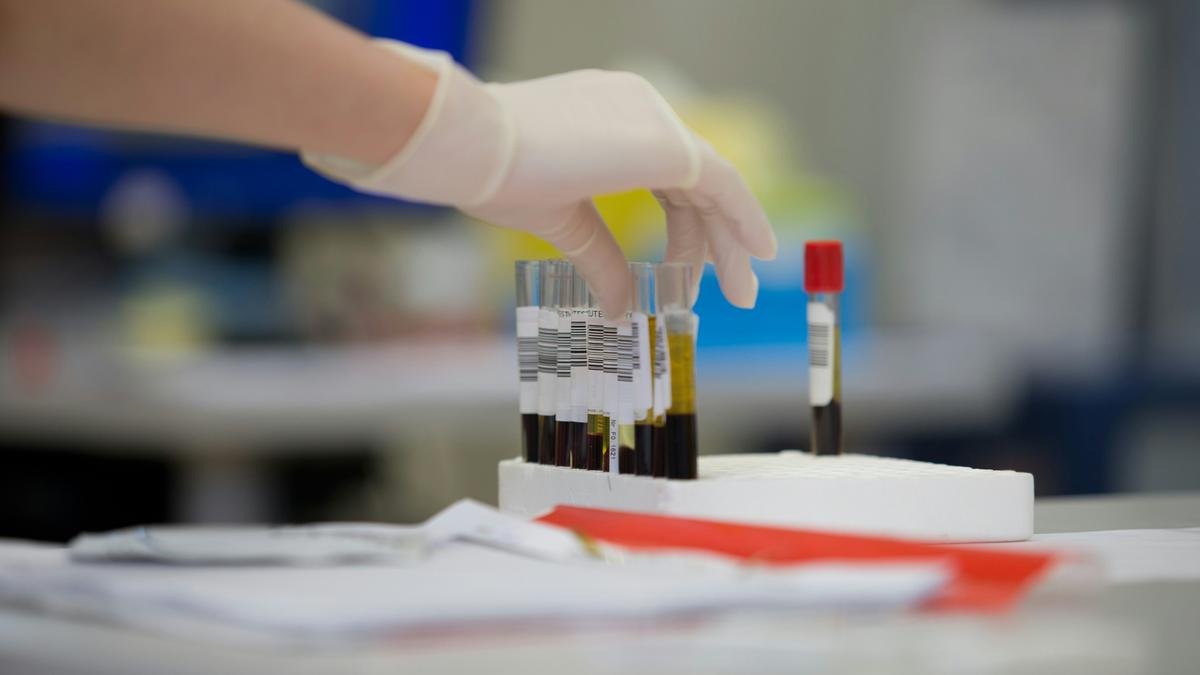
Blood plasma is the liquid portion of the blood that flows in our body. It contains thousands of proteins that come from every organ and tissue. This entire set of proteins is called the plasma proteome. The large-scale systematic study of the proteome is called proteomics.
Sampling blood plasma is akin to a liquid biopsy. The plasma proteomics profile provides a real-time snapshot of health and disease. If scientists could compare the profiles of people before and after the onset of a disease, they can glean important clues about changes in the plasma proteome as a person goes from well to unwell.
To get such data pertaining to lung cancer, Swanton et al. turned to the U.K. Biobank, an ongoing initiative that tracks the lives of approximately half a million volunteers to find out who falls ill and why. The Biobank is a repository of anonymised biological samples and corresponding health-related information of all these volunteers. It is accessible to scientists around the world to develop diagnostics and therapies for everyone, everywhere.
For a subset of the volunteers, around 10%, the plasma proteomics profiles became available in 2023.
The team used the profiles of about 48,000 volunteers to train a machine-learning model along with patient characteristics, such as age, gender, smoking status, lung cancer diagnosis, etc. This way, the team identified 14 plasma proteins linked to lung cancer.
How a cancer forms
Next, the researchers used the model to predict the incidence of lung cancer diagnoses using the proteomics data of about 12,000 patients whose data had been excluded from the model’s training. This set included 75 individuals of lung cancer with a median time to diagnosis of 5.1 years. The model predicted lung cancer diagnosis with a very high sensitivity, successfully identifying more than 75% cases.
The 14-protein signature was also found in eight additional datasets, including one from life-long non-smokers, essentially validating the signature’s usefulness.
The scientists also found that the signature was more pronounced when specific inflammatory pathways involving smoking and air pollution were activated. In a previous study, the same team had found that air pollution causes inflammation that awakens dormant mutant lung cells, which eventually become cancer cells.
This detail, together with the observations in the new study, led the team to hypothesise that smoking induces mutations, lung inflammation triggered by environmental cues follows, and this culminates in lung cancer.
The signature was also more distinct in people who developed chronic obstructive pulmonary disease and pulmonary fibrosis.
The CANTOS trial
If future research finds that this is indeed one way that lung cancer develops, scientists can think of treating the inflammation before the cancer takes root. Canakinumab is a drug made by Novartis and which currently has the U.S. Food and Drug Administration’s approval to treat inflammatory disorders. Swanton et al. were aware of a previous clinical trial called CANTOS that tested canakinumab’s ability to reduce the risk of recurrent cardiac events in patients who had experienced a prior heart attack and were suffering from persistent inflammation. Its effect was modest.
However, Swanton et al., who carried out a retrospective analysis of the trial data, found that 2,300 of the CANTOS participants who received canakinumab happened to display the 14-protein signature — and the risk of lung cancer was down by 50% in this group.
The data suggested that canakinumab could be a potential drug to prevent future lung cancer in those with the 14-protein signature.
Step by step
The 14-protein signature needs to be further validated. It has been derived from a population of limited diversity, representing the U.K., the U.S., and East Asia. If the signature is found to be relevant in many or even all populations, scientists will then have to develop a diagnostic test to detect all 14 proteins in blood plasma.
Assuming such a test also becomes available, canakinumab will have to be tested in clinical trials for its new purpose. Unfortunately, the CANTOS trial found that canakinumab could have serious side effects. The European Medicine Agency’s report concluded that the drug’s toxicity could outweigh its benefits.
Canakinumab is also prohibitively expensive. Treatments usually involve multiple doses over long periods of time. In the U.S., it costs $73,000 for a year. It is neither registered nor commercially available in India, and it would be imperative to explore inexpensive alternatives with similar function and with more acceptable safety profiles.
Ultimately, if we manage to tick all these boxes, the diagnostics and the drug would be of great benefit for individuals at risk of lung cancer worldwide. The work of Swanton et al. is a step in this direction.
S. Swaminathan is a retired professor of biology from BITS Pilani-Hyderabad and a former scientist, International Centre for Genetic Engineering and Biotechnology, New Delhi.
Published – June 10, 2026 08:15 am IST