

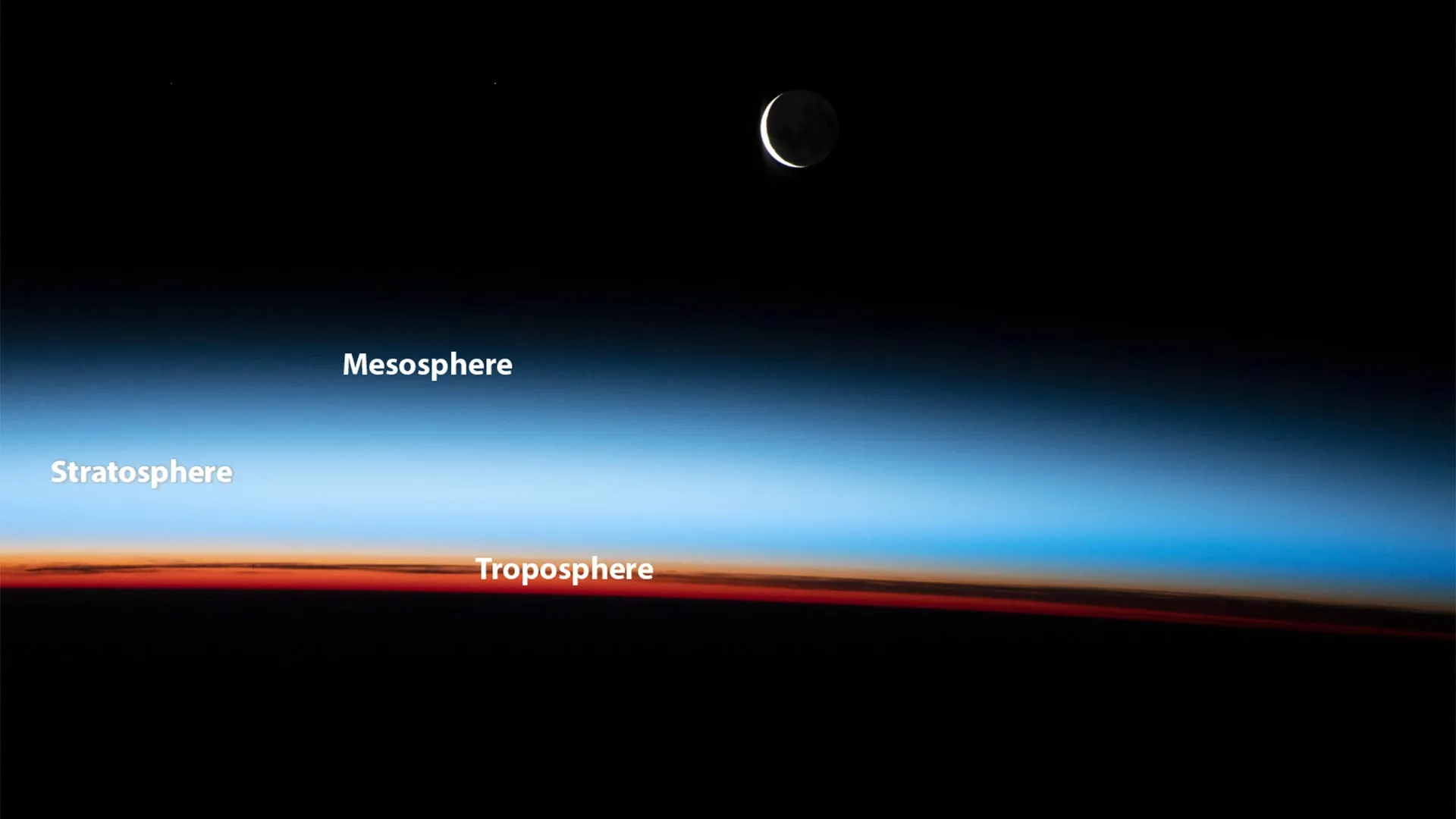
As the Earth’s surface and lower atmosphere continue to warm, another part of the planet’s atmosphere is doing the opposite. Far above the ground, the upper atmosphere has been cooling significantly for decades. Scientists have long recognized this unusual contrast as one of the clearest signals of human driven climate change, but the exact physics behind it remained uncertain.
Now, researchers at Columbia University say they have finally uncovered the mechanism responsible. Their new study explains how carbon dioxide (CO2) interacts with different wavelengths of light in ways that cool the upper atmosphere while warming the planet below.
“It explains a phenomenon that’s a fingerprint of climate change, has been known to occur for decades, and has not been understood,” says Robert Pincus, a research professor of ocean and climate physics at Lamont-Doherty Earth Observatory, which is part of the Columbia Climate School, and co-author of the study published in Nature Geoscience.
Why CO2 Cools the Stratosphere
Near Earth’s surface, CO2 traps heat that would otherwise escape into space, contributing to global warming. But conditions are very different higher up in the atmosphere.
In the stratosphere, the atmospheric layer stretching from about 11km to 50 km above Earth’s surface, CO2 behaves more like a cooling system. The molecules absorb infrared energy rising from below and then release part of that energy back into space. As atmospheric CO2 levels increase, the stratosphere becomes even more effective at shedding heat, causing temperatures there to drop.
Scientists first predicted this effect in the 1960s through climate models developed by climatologist Syukuro Manabe, whose work later earned a Nobel Prize. Since the mid-1980s, the stratosphere has cooled by about 2 degrees Celsius. Researchers estimate that this cooling is more than 10 times greater than it would have been without human generated CO2 emissions.
Although scientists understood the broad idea behind stratospheric cooling, many of the detailed processes remained unresolved.
“The existing theory was incredibly insightful, but at the moment we lack a quantitative theory for CO2-induced stratospheric cooling,” says Sean Cohen, a postdoctoral research scientist at Lamont-Doherty Earth Observatory, which is part of the Columbia Climate School, and the study’s lead author.
The “Goldilocks Zone” of Infrared Light
To solve the puzzle, Cohen worked with Pincus and Lorenzo Polvani, a geophysicist in Columbia Engineering’s Department of Applied Physics and Applied Mathematics. The team built mathematical models that identified the major processes driving stratospheric cooling. They repeatedly compared their calculations with climate simulations and observational data, refining the equations over several months until the models aligned with reality.
Their research pointed to a key factor: the way CO2 molecules interact with infrared light, also known as longwave radiation.
Not all infrared wavelengths behave the same way in the atmosphere. The researchers found that some wavelengths are especially effective at promoting cooling. They described this highly efficient range as a “Goldilocks zone.” As CO2 concentrations rise, this zone widens, increasing the atmosphere’s cooling efficiency.
“It’s those changes in efficiency that are going to ultimately be what’s driving stratospheric cooling,” says Cohen.
The researchers also examined the effects of ozone and water vapor. While both can influence heating and cooling processes in the atmosphere, their impact on stratospheric cooling turned out to be relatively small compared with CO2.
How Stratospheric Cooling Strengthens Warming Below
The team’s equations successfully reproduced several known features of the atmosphere. They matched observations showing that cooling becomes stronger with altitude, with the greatest cooling occurring near the top of the stratosphere. The calculations also confirmed that every doubling of CO2 leads to about 8 degrees Celsius of cooling at the stratopause, the upper boundary of the stratosphere.
The study also highlights an important climate feedback. Although increased CO2 helps the stratosphere radiate heat more effectively, the resulting cooler temperatures mean the Earth system ultimately releases less infrared energy into space overall. That strengthens heat retention closer to the surface, intensifying warming in the lower atmosphere.
“Here’s this process that we’ve known about for 50-plus years, and we had a pretty decent qualitative understanding of how it worked. However, we didn’t understand the details of what actually drove that process mechanistically,” says Cohen.
According to Cohen and Pincus, the research is less about proving climate change exists and more about improving scientific understanding of how the atmosphere works.
“This is really telling us what is essential,” says Pincus.
The findings could also have applications beyond Earth. Researchers say the same principles may help scientists better understand the atmospheres of other planets and distant exoplanets.
“Maybe we can better understand what’s going on in the stratospheres of other planets in our solar system or exoplanets,” says Cohen.