

It was never meant to be like this.

ADVERTISEMENT
ADVERTISEMENT
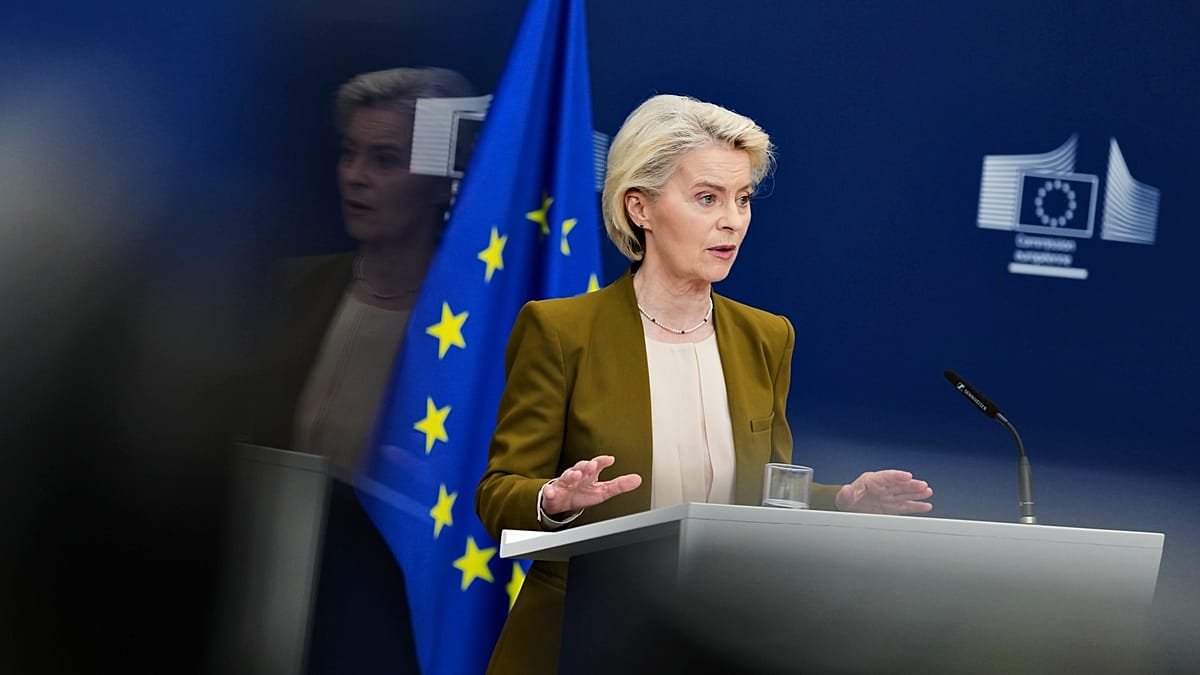
When European Commission President Ursula von der Leyen announced her blueprint for the 20th package of economic sanctions against Russia, she made maritime services the centrepiece.
“On energy, we introduce a full maritime services ban for Russian crude oil. It will slash further Russia’s energy revenues and make it more difficult to find buyers for its oil,” von der Leyen said in early February.
For Brussels, it was an overdue opportunity to complete unfinished business.
The EU first tried to ban the provision of maritime services for Russian tankers in 2022 as part of its import ban on Russian crude and refined products. If the bloc ceased to buy Russian oil, the thinking was that it should also stop helping Russia ship it.
But amid soaring inflation and energy prices, the administration of former US President Joe Biden feared fresh shockwaves and convinced Europeans to establish a price cap, instead of a full ban, so that services could continue under certain conditions.
The EU went along with it, and the price cap on Russian oil was set in December 2022 at $60 (about €52) per barrel. It was an unprecedented move by G7 allies.
Since then, the bloc has struggled to enforce the mechanism. Moscow has deployed its decrepit “shadow fleet” to bypass Western surveillance and sell its crude at higher prices. A weak attestation system, constant fluctuations in oil prices and the lack of Chinese and Indian participation have further muddied the waters.
Brussels concluded that it was time to move to the next stage and replace the price cap with a full ban on maritime services, fulfilling the original 2022 vision. The prohibition would be all-encompassing, from banking and insuring to shipping and flagging, and hit the heart of Moscow’s lucrative energy empire.
But an extraordinary convergence of factors, some internal and some external, some predictable and some unexpected, drastically flipped the script.
Today, the maritime services ban lies in limbo, forgotten and cast aside.
Here’s how the plan went awry.
The sanction that never was
It was von der Leyen herself who set the first trap on the road.
“As shipping is a global business, we propose to enact this full ban in coordination with like-minded partners after a decision of the G7,” she said in February.
By creating a link with the G7, as Brussels did for the price cap, von der Leyen raised the bar beyond her control. Biden’s successor, Donald Trump, radically shifted US policy on Russia, including on sanctions. The Trump administration never showed interest in the price cap, seen as a Biden-era idea, nor in any other joint course of action.
The blessing at G7 level was therefore unlikely, not to say implausible.
The Commission swiftly changed its tune. A few days after von der Leyen’s announcement, Economy Commissioner Valdis Dombrovskis clarified that a G7 deal was not an “absolute precondition” to impose the maritime services ban and promised the bloc would not “shy away” from moving forward on its own.
A majority of member states agreed and saw the G7 as a plus, not a must.
Still, securing the United Kingdom’s buy-in was considered an essential step because of the country’s world-leading position in the Protection and Indemnity (P&I) insurance that oil tankers need to cover for liabilities at sea.
But then, at the end of the month, the US and Israel launched strikes against Iran, the Strait of Hormuz closed down and oil prices skyrocketed. Suddenly, the idea of a maritime services ban lost a great deal of its appeal.
The market turmoil empowered Greece and Malta, the sceptical voices around the table, which host powerful maritime industries traditionally involved in the trade of Russian energy. (Cyprus shared their views but maintained a neutral stance because it held the EU Council’s rotating presidency at that time.)
The Mediterranean duo argued that the prohibition would lead to economic losses for the European economy and empower foreign competitors to take over their business. Russia, they said, would rely on China and India to continue its oil trade.
In closed-door discussions, they made it clear that without a G7 deal, they would veto.
Member states took the threat seriously. When the sanctions package was approved in April, the maritime services ban was adopted only in principle. Its activation was put on indefinite hold, pending “coordination and consideration” within the G7.
Commission officials insisted the legal wording was flexible and the ban could still become a reality. But reservations from Greece and Malta, disinterest from the US and silence from the UK, Canada and Japan left Brussels awkwardly alone.
When von der Leyen presentedthe 21st sanctions package in June, she did not propose activating the ban. In fact, she did not mention it at all. She instead turned her focus to the price cap, the very one that, just a few months earlier, she had tried to remove.
At the G7 summit in Évian, France, the subject was moot.
The long shadow of a veto
Today, the EU finds itself with a sanction in limbo, unsure of how or whether to proceed.
Sweden and Finland, the most vocal advocates, continue to call on the bloc to implement the ban. The Baltics, Poland, Denmark and the Netherlands also support the plan, as does Ukraine.
They all see energy revenues as the indispensable fuel of Russia’s war machine.
“Working towards a full maritime services ban is a crucial part of this effort, since it would substantially increase transportation costs and ensure that no EU entity is involved in supporting trade with Russian oil, coal or gas,” Swedish Foreign Minister Maria Malmer Stenergard told Euronews.
“A full ban would also be easier to enforce than the current oil price cap.”
By contrast, Greece, Malta and Cyprus are adamant about the need for a G7 agreement — a condition that some diplomats consider a tactic to ensure the ban never sees the light of day.
Athens, in particular, is ready to pull out all the stops to protect its industry.
During the chaotic negotiations on the 21st sanctions package, Greece wielded its veto power until it secured an exemption to continue shipping Russian LNG to non-EU clients after 1 January 2027, the original cut-off date.
The controversy over the Greek veto shone a light on Dynagas, an LNG carrier provider, and its founder, George Prokopiou. The billionaire tycoon also controls Dynacom, a firm that supplies tankers for Russia’s global oil trade.
The Financial Times estimates that Greek shipping companies like Dynacom have earned at least $3.8 billion (around €3.35 billion) shipping Russian oil over the past three years. The revenue stream is set to continue as long as Athens impedes the ban.
The European Commission is caught in the crossfire. The EU executive still stands by the sanction it once proposed, but is aware that the momentum has vanished and the complex circumstances, at home and abroad, make it politically toxic to promote.
The lingering uncertainty in the Middle East is also complicating the road ahead.
“A well-timed and well-enforced maritime services ban would squeeze Russia’s tanker capacity, raise transport costs and disrupt the Kremlin’s essential oil exports. But an abrupt ban could push up global oil prices, partly offsetting the hit to Russian revenues,” said Isaac Levi, a senior analyst at the Centre for Research on Energy and Clean Air.
“The EU should instead use this extraordinary leverage to crush Russia’s earnings without removing its oil from the market: rigorously enforce the price cap,” Levi added.
“Without serious enforcement, the price cap is a paper tiger — like setting a speed limit with no cameras, police or fines.”