

Close Menu

    Subscribe to Updates

    Get the latest news information from worldwide businesses.

    What's Hot

    Juliette’s descent beneath the silo leads to a major finding

    July 24, 2026

    Solar generated more electricity than coal and wind in May – EIA data

    July 24, 2026

    17 Best Pools in Las Vegas to Beat the Desert Heat

    July 24, 2026
    Facebook Instagram YouTube LinkedIn X (Twitter)
    Trending
    • Juliette’s descent beneath the silo leads to a major finding
    • Solar generated more electricity than coal and wind in May – EIA data
    • 17 Best Pools in Las Vegas to Beat the Desert Heat
    • A new antiviral could stop measles before an outbreak takes off
    • Long COVID Hits Women’s Brain Health Harder Than Men’s
    • Tesla’s car door defect could lead to tougher rules for everyone
    • As US weighs response to Chinese AI, industry urges against broad open-weight restrictions
    • OpenAI pushes ChatGPT into patient health records
    Newspublicly
    • About Us
    • Advertise & Partner with us
    • Pitch Your Story
    • Contact Us
    Facebook Instagram LinkedIn X (Twitter)
    Subscribe
    • Home
    • World News
      • Asia
      • India
      • USA
      • UK & Europe
      • Middle East
    • Economy & Business
      • Global Economy
      • Corporate & Industry
      • Finance & Markets
      • Policy & Trade
    • Technology
      • Gadgets & Devices
      • Software & Apps
      • AI & Machine Learning
      • Robotics & Automation
    • Health & Medicine
      • Fitness & Nutrition
      • Research & Innovation
      • Disease & Treatment
      • Doctors, Clinics & Patient Care
    • Travel & Tourism
    • Automobile
      • Electric & Hybrid Vehicles
      • Auto Industry Insights
    • Sports
    • More
      • Education
      • Real Estate
      • Environment & Climate
      • Space & Astronomy
      • War & Conflicts
    Newspublicly
    Home»More»Space & Astronomy»Rubin Observatory begins shooting the greatest cosmic movie ever, beginning a new era of astronomy
    Space & Astronomy

    Rubin Observatory begins shooting the greatest cosmic movie ever, beginning a new era of astronomy

    AdminBy AdminJune 30, 2026No Comments4 Mins Read0 Views
    Share
    Facebook Twitter LinkedIn Copy Link WhatsApp


    The universe is ready for its close-up! That’s because today marks the day that the Vera C. Rubin Observatory begins it’s 10-year mission to shoot the greatest cosmic move ever created.

    The decade-long project officially known as the Legacy Survey of Space and Time (LSST) is set to revolutionize our view of the universe. That means June 30, 2026 marks the beginning of a new era for astronomy.

    “Today, we begin filming the greatest cosmic movie ever made,” U.S. National Science Foundation (NSF) director Brian Stone said in a statement. “Every night, NSF–Department of Energy (DOE) Rubin Observatory will expand the frontiers of knowledge and strengthen America’s global leadership in science and innovation.”

    The LSST will see Rubin use its 3200-megapixel camera, the largest digital camera ever created, to repeatedly scan the entire sky over the southern hemisphere every few nights. Over the next decade, each point in the sky will be covered 800 times; this will result in an ultra-wide, ultra-high-definition time-lapse record of the cosmos, the scale of which will put any Sci-Fi epic to shame.

    And that includes the daring voyage of discovery present in any great Sci-Fi story. Astronomers teaming with Rubin will dive headfirst into the dark universe. That means the dual mysteries of dark energy — the force driving the accelerating expansion of the universe — and dark matter — which secretly seems to be holding galaxies together. Both are invisible to us, yet integral to the universe.


    You may like

    “With the launch of the ten-year Legacy Survey of Space and Time, NSF–DOE Rubin Observatory is opening a new window on the universe. It is embarking on a mission that will redefine modern cosmology and astrophysics,” Darío Gil, Under Secretary for Science at the DOE said in the statement. “With its world-class design and tools, Rubin Observatory will capture the dynamic nature of our cosmos and reveal unimagined insights into our universe’s biggest mysteries, from our own solar system to the very structure of the universe.

    “By seeking to understand the enigmatic phenomena of dark energy and dark matter, we are not just observing the stars; we are striving to grasp the fundamental laws that govern our existence.”

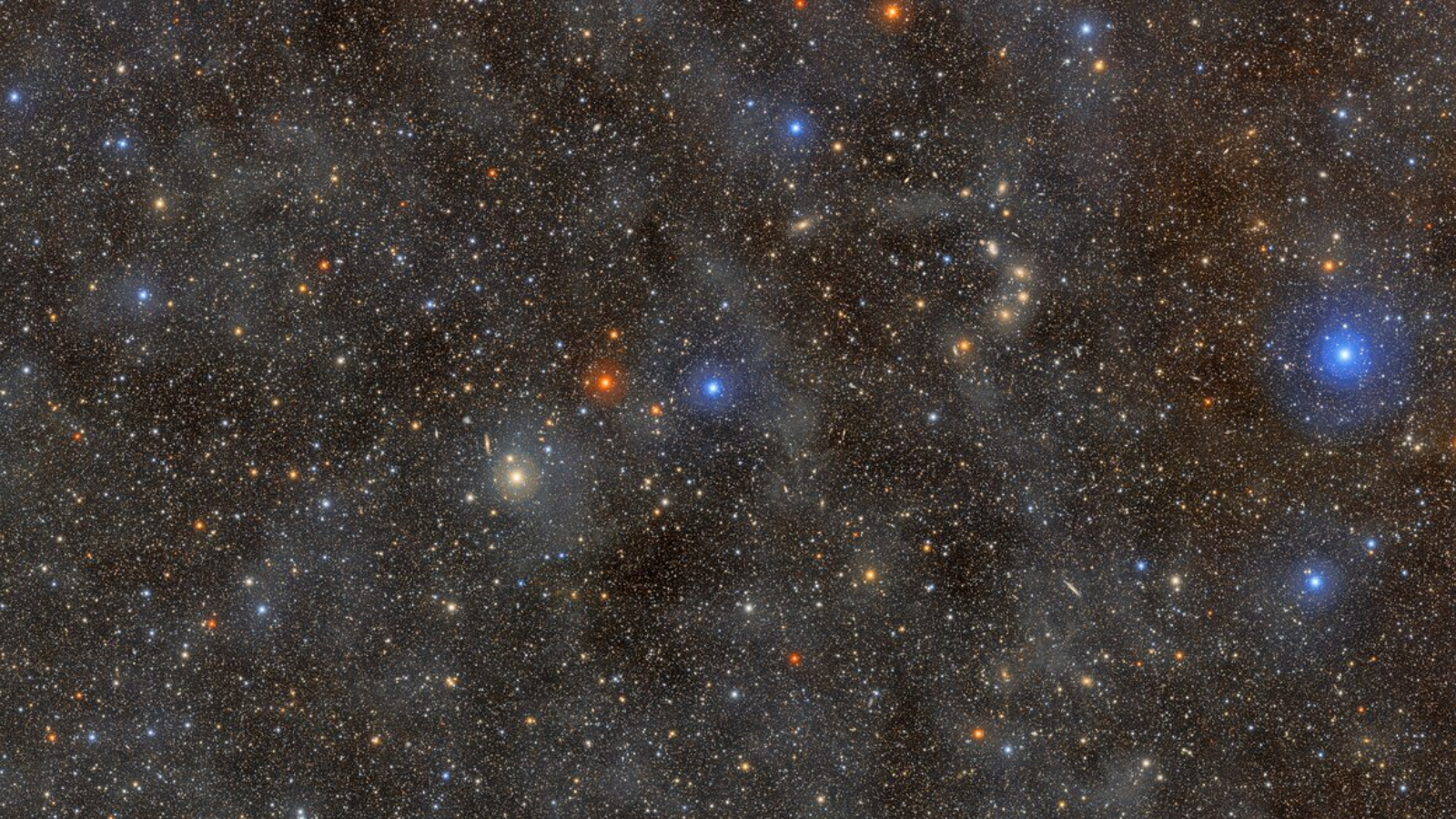
    Combining multiple exposures reveals far more detail than a single exposure. Adding together many Rubin images of the same field amplifies fainter objects

    Combining multiple exposures reveals far more detail than a single exposure. Adding together many Rubin images of the same field, amplifies fainter objects (Image credit: NSF–DOE Vera C. Rubin Observatory/NOIRLab/SLAC/AURA)

    The main actors in this LSST production will be a cast of pulsating stars, supernova explosions and fossil records of galaxies. This will not only provide clues as to the nature of dark matter and dark energy, but could also reveal hitherto undiscovered cosmic phenomena.

    Rubin will also make an impact on astronomy within the solar system, not just at the vast cosmic distances.

    For instance, Rubin is expected to discover millions of new asteroids and comets in our cosmic backyard, becoming the most powerful solar system discovery machine ever created. It is already living up to this potential.

    Space

    In its first few months of operations, Rubin, which sits atop a mountain in northern Chile, has already discovered 11,000 never-before-seen asteroids, including 33 near-Earth objects and 380 icy minor planets and dwarf planets out past the orbit of Neptune, referred to as trans-Neptunian objects.

    A map that shows what Rubin will observe during the LSST over the course of just one week

    A map that shows what Rubin will observe during the LSST over the course of just one week (Image credit: NSF–DOE Vera C. Rubin Observatory/NOIRLab/SLAC/AURA)

    It is estimated that the final LSST dataset will contain billions of objects, and its results will be available to all scientists and the general public — truly sparking a new age of cosmic discovery.

    “It’s taken 20 years of hard science, engineering, and more to get to the point where we can call ‘action’ as we start rolling on this blockbuster movie of the universe,” Phil Marshall, Deputy Director of Rubin Operations for SLAC, said. “Millions of alerts in just the last couple of months show that Rubin is up and running as a discovery machine. Now we’re putting it all together.”


    Source link

    Author

    • Admin

      NewsPublicly.com is News & Articles Platform that creating SEO-focused articles on travel, lifestyle, and digital trends.

    Admin
    • Website

    NewsPublicly.com is News & Articles Platform that creating SEO-focused articles on travel, lifestyle, and digital trends.

    Related Posts

    Epic photo captures lightning striking a Chinese rocket during liftoff

    July 24, 2026

    Planet hunter gets the silent treatment photo of the day for July 24, 2026

    July 24, 2026

    The easiest way to learn the summer night sky starts with these 3 stars

    July 24, 2026
    Leave A Reply Cancel Reply

    Demo
    Top Posts

    The Blue Moon rises on May 30— Where and when to see the second full moon of the month

    May 30, 202640 Views

    New SOCOM rifle allows barrel swapping and cartridge changes

    June 1, 202633 Views

    “Inside Gemini Robotics 1.5: How Robots Learn to Reason & Act

    November 22, 202527 Views

    525 pounds of cocaine seized after Nebraska K9 alerts troopers on I-80

    May 28, 202624 Views
    Don't Miss

    Juliette’s descent beneath the silo leads to a major finding

    July 24, 20264 Mins Read0 Views

    The search for answers grows even more dangerous in Silo Season 3 Episode 4 as…

    Solar generated more electricity than coal and wind in May – EIA data

    July 24, 2026

    17 Best Pools in Las Vegas to Beat the Desert Heat

    July 24, 2026

    A new antiviral could stop measles before an outbreak takes off

    July 24, 2026
    Stay In Touch
    • Facebook
    • Twitter
    • Instagram
    • YouTube
    • LinkedIn
    • WhatsApp

    Subscribe to Updates

    Get the latest creative news from SmartMag about art & design.

    Demo
    NEWSPUBLICLY
    Facebook X (Twitter) Instagram LinkedIn

    Home

    • About Us
    • Leadership
    • Advertise & Partner With Us
    • Pitch Your Story
    • Media Kit & Pricing
    • Career
    • FAQs

    Guidelines

    • Editorial & Submission
    • Partnership
    • Advertising & Sponsor
    • Intellectual Property Policy
    • Community & Comment
    • Security & Data Protection
    • Send Your Opinion

    Quick Links

    • Cookie Policy
    • Payment & Billing Terms
    • Refund & Cancellation
    • Copyright Policy
    • Complaint & Support
    • Sitemap
    • Contact Us

    Subscribe Us

    Get the latest news and updates!

    Copyright © 2026 Newspublicly (DIGITALIX COMMUNICATION). All Rights Reserved.
    • Privacy Policy
    • Terms of Use
    • Disclaimer