

One week ago, a 22-year-old young woman, girl undergoing surgery for Bartholin’s gland cyst (located next to the vaginal opening) in a State-run government college in Kaushumbi, Uttar Pradesh, had her pictures of face and private parts, taken during the surgery, circulated on WhatsApp groups.
Even as the authorities investigate these serious lapses in securities, several doctors say that photography in the operation theatre — mandated to claim insurance under the Ayushmann Bharat Pradhan Mantri Jan Arogya Yojana (AB PM-JAY) scheme, has several risks, both in terms of security and health.
What happens in the OT
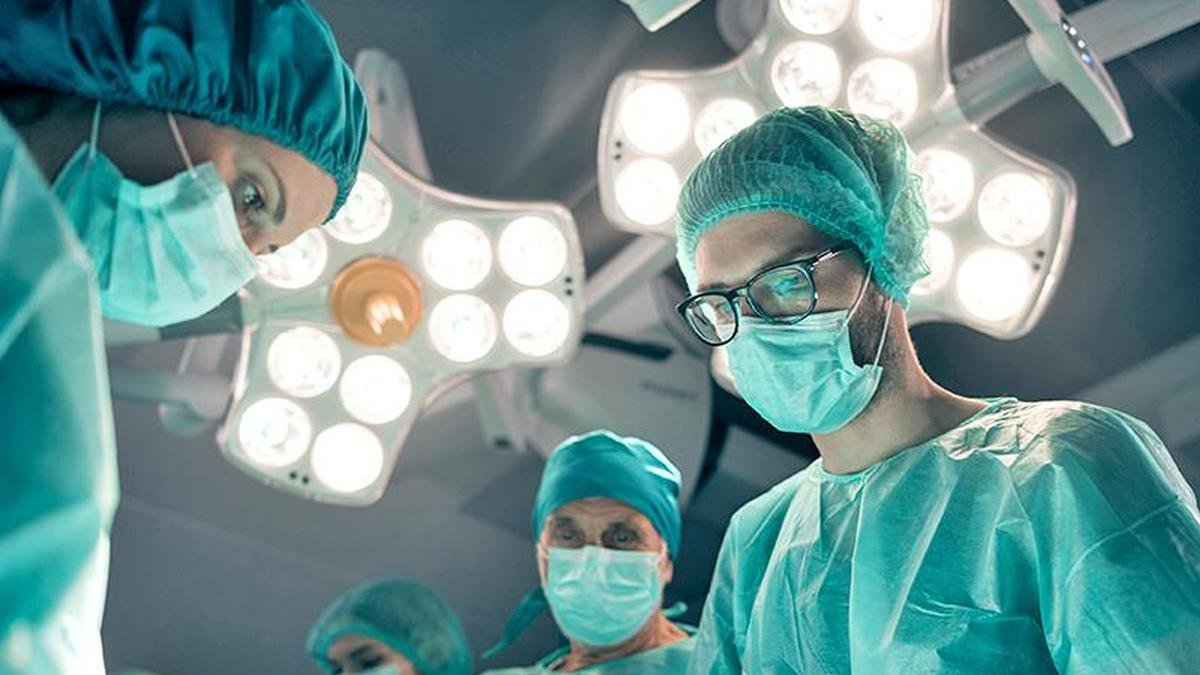
An operating theatre in any hospital follows a pre-set, choreographed rhythm. From the minute a patient is wheeled in, to the time they are wheeled out, a team of surgeons, anaesthetists, scrub nurses and OT technicians work together like a well-oiled machine, each movement calibrated to ensure the procedure proceeds safely.
Yet, in recent times, that rhythm has been disrupted.
Like in many hospitals empanelled under AB-PMJAY an orthopaedic surgeon in a privately-run hospital, has found a new and uneasy addition to his operating room. These days, once he has scrubbed in—after washing, donning a sterile gown, head cover, and mask, and stepping into a sterile field where the patient lies draped—he pauses before beginning the surgery. An OT technician steps forward. The patient’s face covering is lowered. The surgeon’s mask is briefly pulled down. A GPS-enabled camera phone is raised, and a photograph is taken.
Often, the patient is already deeply anaesthetised, unaware that this moment has occurred.
The procedure then continues, but not uninterrupted. Photographs are taken again—when the incision is made, when implants are inserted in, and when the wound is closed. The stitches, too, must be counted and a photograph taken. At times, the patient’s body is repositioned, not for surgical necessity, but to ensure that the required images are clear.
Once the surgery is complete, these photographs, along with bills and documentation, are uploaded to the AB-PMJAY portal as proof that the procedure was carried out on the patient for whom insurance approval was granted.
What was once a closed, carefully-controlled clinical space has, in effect, become a site of verification.
Why the photographs
The photograph mandates did not emerge in a vacuum. Over the years, private hospitals have been repeatedly flagged for exploiting publicly-funded insurance schemes such as AB-PMJAY—from billing for procedures never performed to substituting cheaper implants while claiming higher reimbursements. These issues have occurred even in reputed institutes.
The scale of the problem is massive. National Health Authority officials have said that in just two years, technology-driven checks flagged and prevented fraudulent claims worth over ₹630 crore. These ranged from duplicate procedures and fake admissions to manipulated diagnostics and fabricated documentation. At the same time, more than 1,000 hospitals have been de-empanelled or penalised for irregularities.
In response to this, States have tightened verification through visual “proof” built into the claims process. But in trying to discipline providers, the system has shifted the burden of suspicion onto patients themselves—who now find their bodies documented, exposed, and surveilled at their most vulnerable, paying the ethical price for a system misused by those in positions of power.

Medical consequences
The consequences are many. Nibedita Pramanik, director, Evangelical Hospital Society,, Odisha, notes that this photography interferes in optimal operation theatre functioning.
She gives the example of Caesarean sections. Many of these are performed as emergency surgeries. “In that high pressure environment, when a surgeon needs to concentrate on saving the lives of mother and baby, focusing on getting pictures clicked adds to the pressure,” she says.
Furthermore, there is always a worry that bringing the phone into the surgical environment might lead to contamination of the surgical field, she points out. Beyond these factors, Dr. Nibedita worries about consent.
At her hospital, patient consent for these photographs is obtained with the process explained to the patient in detail, in their own language and their consent is obtained. However, Dr. Nibedita and several other doctors point out that consent for OT photographs is not a mandatory requirement under AB-PMJAY: it is left up to the discretion of the individual hospitals, making it likely that many may not be obtaining patient consent at all. At several hospitals, only institutional consent forms existed — there were no forms provided by the government for photography consent.
There is also no clarity on standard practices: whether certain sensitive areas such as the genitals or the anal region can be photographed during surgery seems to vary from State to State. While Royson D’souza, a rural surgeon working in Gudalur with tribal populations says that they were not needed to upload images containing these parts of the patient, Dr. Nibedita says she has to upload them. “On the off chance that we do not upload, we are asked to do so,” she says

Security concerns
Apart from the intense discomfort that many doctors feel about their patients being photographed at their most vulnerable, the uppermost concern in their minds is leakages and security lapses.
“The photographs are taken on a common mobile phone of the institute which is geotagged, or from the mobile phone of one of the staff in the operation theatre. They are also stored and uploaded in institute computers. The patient’s face is there in the photographs along with their surgical images. This lends itself to misuse,” says a surgeon. And his worry isn’t unfounded. A recent media expose showed that photographs and videos from hospital CCTV cameras were being sold on Telegram.

Regulation needed
It is vital that the government formulate regulations in order to ensure these violations do not occur. But as it stands, this responsibility also falls on individual institutions.
Doctors note that patients from economically weak backgrounds consent, primarily because they do not have any other option. This is of course, if the institution has asked for consent, because the government has not taken measures to protect the patient’s interests in such a way.
What optimal informed consent would look like, Dr Nibedita, says, is: providing a patient with all of the information required, having the patient not only read the information in the consent form, but also getting the patient or their relatives to write down what they have understood in their own language before they sign.
This is far from the norm however. And this raises the important question of why individual acts of upholding patient dignity are required to fill in the massive vacuum created by State neglect.
(Dr. Christianez Ratna Kiruba is an internal medicine doctor, with a passion for patient rights advocacy. christianezdennis@gmail.com)